How Do You Go Global Against Clones And Competitors?

Picture_of_the_Globe

GoGlobal is Morten Lund’s new venture. Earlier this month, Lund pitched GoGlobal live on stage at The London Web Summit. Despite a few people thinking it was a ruse, GoGlobal aims to be a platform to grow globally for Software-as-a-Service (SaaS) companies. Lund says he wants to take three to four companies in to 40+ countries every quarter. Here is the problem I think he is looking to solve.

As soon as an Internet startup shows signs of success, somewhere in the universe its business model is replicated with razor-sharp execution tactics. If the startup is under the radar still, selling its products and services internationally is difficult without prior knowledge and business network.

Take online music streaming industry for example, its pioneer Spotify launched in Germany this month. Eagerly awaited by the German public, whose current suppliers of streaming music services include Deezer, Rhapsody, Rdio and Simfy, Spotify is now present in only 13 countries. Its French competitor Deezer has gone to as many as 45 countries and expects to conquer the world outside of the US by the end of 2012, according to its CEO Axel Dauchez. Will Spotify ever catch up?

First movers have good reasons to worry about competition. Deezer may not be a copycat, it was founded only 16 months after Spotify, but its plans to grow are much more aggressive.

So I spoke to a number of industry players to understand what it takes to grow an Internet business internationally.

Product Localization

Dauchez says that customizing the service was key to entering new markets. For Deezer it meant adding local artists, negotiating licenses with the labels for each individual country, and segmenting music into relevant genres (adding French Chanson for the Russian audience and Schlager for the German).

For some companies product localization may not need to be so extensive: for example Instagr.am did not do anything beyond translating its app into eight languages. For-website translation tools from EasyLing or SmartLing could work well.

In mobile apps industry, app store optimization, including localization of the screenshots in the appstore promotional materials, can increase download rates of a mobile app by 30 percent according to the mobile expert Stefan Bielau.

Marketing

Distributing mobile apps internationally goes beyond Google Play and iTunes. Distimo lists 60 app stores, but some local ones would not be included. Publishing apps in those stores is still largely a manual task, according to Bielau.

For an online business operating in the B2C space a desirable marketing channel would be a global partnership with Facebook. Having accomplished that, Deezer enjoys a Facebook-driven user base growth of 20 percent per week.

Using other social networks such as Nasza klasa in Poland, Orkut, owned by Google and popular in Brazil and India, or Russian Facebook equivalent Vkontakte for marketing purposes also makes sense, as they are admittedly cheaper for user acquisition, although Facebook’s audience is larger.

Earning money from some of the social networks may be tricky. According to Danil Kozyatnikov of Questli from Novosibirsk, Russia, his social games company partnered with Russian social networks, but in some cases the company did not get paid.

Thankfully, for those with a sizable budget, B2C user acquisition can be done through advertisement. According to Siegfried Müller, the co-founder of a hugely successful Munich-based Travian Games (120 million registered users), advertisement networks are well established globally, and buying ads in different countries is an easy task. Travian is present in more than 50 countries.

Payment

All the “likes”, clicks and registrations are useless without adequate payment methods. PayPal and credit cards may not always be a payment method of choice outside of the developed countries. Even in Germany bank account transfers are still preferred over other payment tools, and the country has one of the lowest numbers of credit cards in the EU.

XS Software, a Bulgarian online games company that sells its games in 80 countries, uses over 100 payment providers. According to the company’s project manager Dimitar Yanchev, SMS payments are the third most popular payment method after PayPal and credit cards. This is especially true for those customers who have not yet reached the legal age to have a bank account or a credit card. Such payment methods can be quite expensive, as telcos take a significant cut as a commission. InSyria, for example, it can be as much as 80 percent of the total revenue.

Many countries have so-called e-wallets for those who are unwilling to use their bank account or credit cards for online payment. In Russia and some Eastern European countries it is QIWI, in the Middle East and North Africa there is CashU, BoaCompra in Brazil, DotPay in Poland and ePay in Bulgaria. The way most of these e-wallets work is by allowing the customers to deposit money into the online account through a payment terminal or a kiosk. But even in Russia, e-commerce leaders such as Ozon still receive over 80 percent of payments as cash on delivery, as its CEO Maelle Gavet shared at TechCrunch Moscow.

In Serbia, Internet businesses cannot implement payment methods because it is necessary to register a legal entity there. In Eastern Europe the same requirement applies in Bulgaria and Croatia. A group of Serbia’s leading e-commerce sites, which includes Limundo (Serbian eBay) and Kupindo (Serbian Amazon) is currently developing their own escrow-based payment system called Platindo which will eventually become an e-wallet.

There are of course payment aggregators such as Moneybookers, recently rebranded as Skrill, which offer integration of 100 payment methods in 200 countries, but they do not come cheap and according to Müller of Travian Games have a small market share in many countries.

Deezer’s international roll-out did not go beyond credit card and PayPal payments for now, but the company intends to improve on this and other localization efforts gradually by establishing offices in 15 key countries, and participating in local scenes: marketing at festivals, and engaging local artists. Currently its international team is 20-strong, but the company expects to grow its total staff from 120 to 300 by the end of this year. As for payments, bundling its music streaming service with telcos’ annual mobile phone contract is likely to boost their user retention and allow them to collect revenue from their telecom partners.

Online Piracy

Deezer’s product is a digital good, and online piracy is its main competitor. Russian Vkontakte, for example, is blacklisted in the USbecause its users are enabled to freely upload music files and listen to them through Vkontakte free of charge. There is even a tool called Meridian that offers the creation of playlists using music on Vkontakte, all perfectly illegal and completely free. Dauchez believes that offering its users a premium music streaming experience. The rest is down to finding the right price point to get them to pay for it.

Logistics

For online retailers of physical goods, further challenges abound. I spoke to Jonathan Teklu, the managing partner of Berlin-based incubator SpringStar, which backed KupiVIP, the Russian version of Ventee Privee. He told me that when its founder, Oskar Hartmann, launched KupiVIP in Russia, he had to buy a fleet of trucks to deliver goods to its customers.

Indeed, logistics is another significant operational challenge in many of the world’s markets, where consumers are likely to cancel a purchase if no suitable delivery method exists. To address the challenge, Russian iTech Capital has set up QIWI Post, a joint venture with Polish Integer (owner of InPost), which leverages the brand of QIWI e-wallet and its network of terminals. QIWI Post is a terminal where a courier deposits a shipment, and buyers pay for the goods at the terminal and open the box using a provided code. Similar solutions exist elsewhere: for example in Germany, Estonia, and recently – thanks to InPost – also in Ireland under the name of Parcel Motel.

Other Issues

Companies looking to establish presence in the large developing markets such as Brazil or India will need a local partner to set up a legal entity, according to Teklu.

Educating online users is also essential. The online room and sublet reservation company AirBnB partnered with SpringStar in October 2011 to boost its international expansion. In Israel and the Middle East it is currently facing a problem of a cash economy, where the apartment owners prefer to be paid in cash, rather through an online transaction, an essential element of the Airbnb user experience. Changing such an attitude requires time.

Another example of having to educate consumers is India, where Internet users still have trust issues with buying online from unknown brands. A ticket-selling website MakeMyTrip engaged local travel agencies to let them use its website to book trips, and by so doing, educate their customers that it is safe to do so, according to Teklu.

These are few examples of challenges that come with need to grow internationally. Going back to Lund, he plans to target SaaS companies supporting them with legal, accounting, affiliate marketing and payment services amongst others, all offered as one platform.

Interested in what others thought of the idea, I asked Tom Cupr, from the Czech Republic, who has grown his daily deals business, Slevomat Group, into a 60 million Euro company with a presence in 7 Eastern European countries in just over a year. He said what’s really important is execution, but then again, he thinks that GoGlobal could make international expansion a lot easier.

This post is written by our regular contributor Natasha Starkell, the CEO of GoalEurope, the outsourcing advisory firm and a publication about outsourcing, innovation and startups in Central and Eastern Europe. Twitter @NatashaStarkell. Gplus.to/natashastarkell.


Information provided by CrunchBase


Dell Gives Up On Selling Smartphones In The U.S. (For Now, Anyway)

dellgrave

I’d wager that only a few of you will remember that Dell sold their own smartphones, and still fewer of you have ever actually owned one.

It should come as no surprise then that Dell, who entered the smartphone market less than two years ago, has announced that they have ceased sales of their last remaining smartphone lines: the Android-powered Venue and the Venue Pro Windows Phone. With those product lines getting the axe, Dell has (for now) put an end to their struggling smartphone business here in the States.

None of Dell’s smartphones managed to gain critical mass in the U.S. market, thanks in part to hardware and software issues that plagued the likes of the Streak 5 and the Venue Pro. They haven’t given up the smartphone ghost completely though, as they’ll continue to sell their devices outside of the United States. Their focus now, according to PC World, has shifted toward “emerging markets and higher-margin products.”

The smartphone game can be a very tough one to crack — consumers, fans, zealots, and certainly us tech writers, demand continuous improvement from the companies that make our hardware. Make them bigger, thinner, faster, better looking, and do it several times a year. Those are tall orders even for entrenched players like HTC and Motorola, so for a company like Dell whose primary focus remains in PC hardware and software solutions, the odds of building and maintaining a considerable stake in the smartphone market were against them from the beginning.

HP has learned that lesson all too well — after having spent an inordinate sum of money to throw their hat into the smartphone and tablet ring with webOS, they pulled the plug in what seems like record time. It takes more than cash and manpower to produce a hit, and in the end, neither HP nor Dell hit upon that crucial formula.

Right now though, Dell’s future in mobile remains hazy. A Dell spokesperson confirmed that the company has plans to push out new mobile products later this year, though he refused to comment on what exactly those devices are (my money is on a slew of Windows 8 tabs with some funky form factors). It’s very possible that Dell intends to dust themselves off and jump back into the ring, but they’ll need a brand new strategy if they want to start playing with the big boys any time soon.


Nielsen: As U.S. Nears Smartphone Majority, It’s A Two-Horse Race Between Android and Apple’s iOS

horses

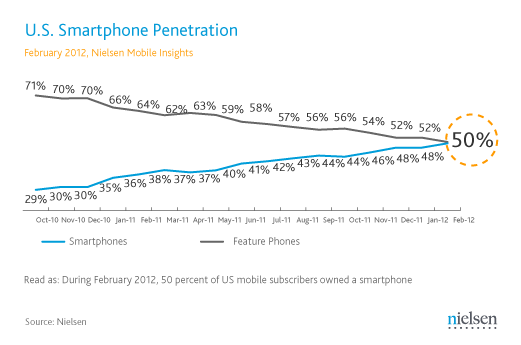
New numbers out from Nielsen today point to just how close the U.S. is to having more smartphone than feature phone users: analysts say 49.7 percent of cell phone users currently own a smartphone, a big leap on the 36 percent who owned smartphones only a year ago.

What’s increasingly clear in that growth is that, at least in the U.S., no other platform is proving to be a contender against Apple’s iOS and Google’s Android.

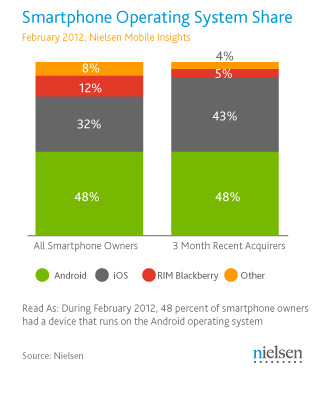
Currently, Android-based smartphones account for 48 percent of all smartphones owned in the U.S., while Apple’s different versions of the iPhone account for 32 percent. Both of those shares have grown: in September 2011, Nielsen said that Android’s share was 40 percent and Apple’s 28 percent.

When it comes to smartphones that are getting bought, the power of those two platforms is even stronger. In the last three months, Android accounted (again) for 48 percent of all handsets purchased, while Apple accounted for 43 percent.

This growth was at the expense of BlackBerry, now down to just five percent of handsets bought, with the rest of the other platforms — which includes Microsoft’s Windows Phone — accounting for 4 percent of purchased smartphones.

The big question for Microsoft/Nokia is whether Windows Phone will have what it takes to break out as a separate item in this list from the “others” pack. And the big question for RIM is whether it has what it takes to keep from becoming just another platform in the “other” category.

But while Android and Apple have cornered the market for purchases so far, there is still 50.3 percent of the market to play for, according to Nielsen’s figures. That’s still a lot of consumers, but most likely targeting a different kind of consumer from those who have bought handsets already.

Nielsen’s figures show a lot of momentum for smartphones in general: two-thirds of all handsets bought at the moment are smartphones, its analysts say.

[Photo: Paolo Camera, Flickr]


Millennial Media Shares Pop 100 Percent In Early Trading; Valued At Nearly $2 Billion

screen-shot-2012-01-05-at-5-41-34-pm-11-1

Mobile ad network Millennial Media just debuted on the New York Stock Exchange under the symbol “MM,” and saw shares pop 97 percent in the first trade of $25. The company initially priced its IPO at $13 per share last night, after increasing the range on Tuesday. At $25 per share, Millennial’s valuation jumps to nearly $2 billion. Trading reached as high as $27.90 in early trading.

Millennial which filed its original S-1 in early January, raised over $130 million in the offering, which is up from $75 million originally stated in earlier filings.

Millennial, which is one of the largest remaining independent mobile ad networks, currently serves ads to 200 million unique users worldwide, including approximately 100 million unique users in the United States alone. More than 30,000 apps are enabled by developers to receive ads delivered by Millennial.

From 2009 to 2010, Millennial’s revenue increased 195% from $16.2 million to $47.8 million, and the company took a net loss of $7.6 million, and $7.1 million, in those years, respectively. From 2010 to 2011, revenue increased 117% from $47.8 million to $103.7 million. In 2011, the company saw a net loss of just $287,000.

Founded by Paul Palmieri, the Baltimore-based company has raised $65 million in venture funding from Charles River Ventures, NEA, Bessemer Venture Partners, Columbia Capital and others. Palmieri issued this statement today: “Today is an exciting day for our company, and also a significant milestone in the maturation of the mobile advertising industry. We have spent the last six plus years helping create what’s now a multi-billion dollar mobile application advertising market and we look forward to continuing to drive growth and innovation in the space.”

In 2010, Palmieri jokingly called Millennial the quiet giant as competitors like Quattro (acquired by Apple) and AdMob (acquired by Google) stole the spotlight. Clearly that’s no longer the case.


Bleacher Report Doubles Down On Personalized Content, Brings Team Stream To The Web

Screen shot 2012-03-29 at 6.11.04 AM

It’s been fun to watch Bleacher Report grow from some random publishing site for amateur sports writers to a full-blown digital sports network backed by $40+ million in venture capital. Today, with 25 million unique visitors per month, Bleacher Report has become the fourth largest sports media property on the Web.

Over the last year or so, the popular sports network has been doubling down on its team-specific coverage, convinced that this has become the preeminent way that fans follow sports. Since January, the startup’s so-called Team Stream apps have lived on iPhone, Android, and the iPad, offering fans personalized dashboards with headlines, top stories, and tweets from their favorite teams. And today, Bleacher Report is bringing Team Stream to its home page.

Similar to its Team Stream apps, the new section of its homepage offers viewers realtime news on teams and topics from Bleacher Report’s bullpen of unpaid bloggers and professional sportswriters, as well as curated popular news from top sports destinations.

Team Stream allows fans to customize the homepage with content from as many of their favorite teams as they choose, and log in to Facebook to save their team settings so that the news appears every time a user visits the site — but login isn’t required to access team stream. And as an example of Bleacher Report’s somewhat unique approach to sports news, your personalized Team Stream is curated by the site’s editors, rather than by RSS aggregation. It’s all hand-picked.

It’s also interesting to see the site taking a mobile experience and applying it to the desktop in a kind of reverse-publishing initiative. If it works on mobile, why not bring it to the Web?

Bleacher Report’s new homepage will also include a social module that features trending topics on social media networks, enabling fans to quickly share content with their friends, along with beefing up its “Lineup” section, which will now feature national sports stories and video clips to be periodically updated over the course of the day.

The move today becomes yet another example of how publishers are increasingly looking to focus on bringing personalized content to their readers as a way to encourage clicks, repeat visits, and engagement. Bleacher Report may be in the minority when it comes to sports media offering customized content, but this is sure to be just the beginning — after all, the sports team from my area is without a doubt superior to the sports team from your area — and I want to be able to prove that, across platforms.


Amazon And The NIH Team Up To Put Human Genome In The Cloud

1000Genomes

Amazon and the U.S. National Institutes of Health (NIH) announced today that the complete 1000 Genomes Project is being made available on Amazon Web Services as a public data set. The announcement, made at the White House Big Data Summit, will make the largest collection of human genetics available to anyone free of charge.

In case you’re light on the details, the 1000 Genomes Project is an international research effort started in 2008 that involves 75 companies and organizations working together to create a detailed catalog of the human genome, and all its 3 billion DNA bases. To date, over 200 terabytes of data have been created since the project’s start.

There’s now DNA sequenced from over 2,661 individuals from 26 populations, and the NIH is planning to add more samples this year. The effort led to the techniques used to sequence the DNA of other species, going from the mouse to the gorilla.

The project started off with three pilot studies. Amazon began hosting the initial pilot data on Amazon S3 in 2010, so it’s not surprising to see the remainder of the data added today. The latest dataset is the most current, containing the DNA of 1,700 people.

The move to put the data up on Amazon, specifically, Amazon Web Services, aims to help speed up access to the research. Previously, researchers had to download data from government data centers or their own systems, or even snail mail it on discs.

The data will be stored on Amazon Simple Storage Service (Amazon S3) and Amazon Elastic Block Store (Amazon EBS) and can be accessed from AWS services such as Amazon Elastic Compute Cloud (Amazon EC2) and Amazon Elastic MapReduce (Amazon EMR).

The 1000 Genomes Project is only one of many of the publicly hosted datasets found on Amazon. Others include data from NASA’s Jet Propulsion LaboratoryLangone Medical Center at New York UniversityUnileverNumerateSage Bionetworks and Ion Flux.

More details on the data itself are here.


Wanna Access Your Windows Desktop Anywhere Before Windows 8? WorldDesk Says It Has The Answer

worlddesk

With Windows 8, Microsoft is introducing more portable, cloud compatibility in the form of Windows To Go, but what about those seeking a solution today that works on devices running Windows 7? WorldDesk claims to have an answer.

The Northern Irish-founded, now Menlo Park, Calif.-based company has launched a new virtualization platform that it says allows all Windows 7 users to carry their desktops around on any device, including some of the smallest portable devices of all, like a USB drive, a smartphone and an iPod. Written as a 64-bit platform, WorldDesk can also work via the cloud through a Dropbox integration it first announced in February at the release of a 32-bit version of the platform.

There are, of course, other online desktop vendors, like OnLive and CloudOn, offering similar solutions. The issue with these that WorldDesk is addressing, says its CEO Rao Cherukuri, is that competitors remain expensive and deliver poor user experience; they also do not offer mobile and offline storage.

The other main difference with similar virtualization services is that WorldDesk does all the processing on the end device: that means it can be used for processor-intensive programs like Photoshop, AutoCAD and HD Video. It delivers “the same flexibility and experience on par with local PC,” says Cherukuri.

The significance of extending the platform to 64-bit from 32-bit is that it gives WorldDesk a much wider target audience. Currently, Windows 7 accounts for one-third of the worldwide OS market share, with over half of PCs running it in 64-bit mode for higher memory and performance capabilities.

Given that the shift to Windows 8 will be gradual, WorldDesk is targeting legacy users of Windows 7, and Windows XP first. But it is also making a Windows 8 version, and has internal demos of Android also underway, so that when users do make the move to another platform, they will take their WorldDesk desktops with them.

The company has yet to release user numbers but says they are a “healthy mix” of end-user and enterprise customers throughout the Americas, EMEA and Asia-Pacific. Because WorldDesk runs natively on the end device the service does not have any issues with corporate firewalls, but also has an enterprise-specific solution should an issue arise.

There is also the issue of whether the move to cloud services may ultimately invalidate solutions like WorldDesk’s. Cherukuri notes that current cloud services still lack the processing power for intensive programs (like Photoshop or AutoCAD), and besides, “Desktops have proven to be very sticky.”


TechCrunch Beirut Meetup This Friday #TCBeirut

Screen Shot 2012-03-29 at 16.14.58

So ArabNet in Beirut is rocking, but we also wanted to make sure there was an opportunity for other startups in town to come say hi to TechCrunch while we’re here, so we are throwing together a TechCrunch Beirut Meetup!

The Meetup is organised in conjunction with entrepreneur platform Wamda, co-working space AltCity, and the Seeqnce tech incubator.

Here are the details:

Date: Friday, March 30

Time: From 7pm to 9pm (and onwards)

Location: Mezyan Pub, Estral Center (near Kabaji/Coffee Bean & Tea Leaf), Hamra, Beirut, Lebanon, WANA, Asia, World

Google Map: http://g.co/maps/h2fu3

Hashtag: #TCBeirut

Feel free to bring all your startup stuff like t-shirts, stickers and iPads to demo your startup/app etc (if you want).

I look forward to seeing you there!


Former Zong CEO And Founder And Mobile VP David Marcus Named President Of eBay’s PayPal

david-marcus-2

After former president Scott Thompson departed for the CEO role at Yahoo, PayPal has named David Marcus, the former CEO and founder of mobile payments startup Zong and PayPal Mobile VP, as President (PayPal acquired Zong last year for $240 million). Ebay CEO and acting PayPal president John Donahoe posted the news this morning in a blog post.

From PayPal’s blog post: [Marcus is] going to lead PayPal with that “founder’s perspective,” to bring start-up energy to PayPal’s unmatched global reach and digital payment capabilities. With David at the helm, we will have an even deeper commitment at PayPal, and across eBay Inc., to be a leading technology-driven and customer-focused product innovation company. We’ll continue to focus on accelerating product innovation, driving consumer engagement and creating a world where paying anytime, anywhere and any way is synonymous with PayPal.

Marcus started his first company, GTN telecom, back in 1996 in Geneva, Switzerland, which was acquired by World Access in 2000. That same year, he founded Echovox, a mobile media monetization company that helps large media companies connect with their mobile audiences. Zong, which was spun out of Echovox, offered a mobile payments platform, that let you pay for items online via direct billing to your mobile phone. When PayPal acquired Zong last year, Marcus became VP of mobile for the payments giant.

Considering Marcus’s extensive experience in mobile, it’s clear the direction PayPal is going when it comes to the payments experience. Last year, the company processed $4 billion in mobile payments transactions and expects $7 billion in mobile payment volume in 2012. Marcus has been focusing his efforts of late on the launch of PayPal Here, a Square-like mobile payments hardware and software platform for small businesses.

PayPal has also been hard at work on an in-store payments technology for big box retailers, which has been adopted nationally by Home Depot.

You can see Marcus introducing PayPal Here in the video below.


Glass Act

Photo by Jim Merithew/Wired

Apple probably didn’t realize what it was starting when it decided to build the iPhone 4 out of two panes of glass, forgoing the traditional metal or plastic backing and causing thousands of geek brains to simultaneously explode at the prospect.

But somehow this worked, and Apple ended up not with a bunch of people crying over broken phones but rather kudos for drafting such an avant garde design.

Now here comes everyone else.

With the Envy 14 Spectre, HP takes an already out-there idea to its barely sane terminus by making a little more than half of this 14-inch laptop out of glass. The palm rest is made of glass, as is the front of the LCD (of course) and the exterior/backside of the lid.

There are reasons this makes sense. Glass is a better transmitter of wireless signals than metal, so (theoretically) the Spectre should have better Wi-Fi range and performance than its metal-clad counterparts. The Spectre is also outfit with an NFC reader, so you can (also theoretically) sync up wirelessly with your NFC-capable smartphone by just dropping it on top.

The Spectre feels fast and was rock-solid stable during our testing.

At its heart, the Spectre is a plus-size ultrabook, jumping from 3 to exactly 4 pounds and offering a similar experience by way of specs to other ultras. The 14-inch screen offers 1600×900 pixel resolution. Under the hood, a 1.6GHz Core i5, 4GB RAM, and 128GB of SSD storage round out the package. As with most ultrabooks, there’s no optical drive and only integrated graphics are included.

Surprisingly, despite some middling components, the Spectre performed admirably on benchmarks and other real-world tests, generally performing in line with higher-end ultrabooks and even holding its own on graphics-based assessments. The Spectre feels fast and was rock-solid stable during our testing.

Of additional interest is HP’s approach to software bundling: Full versions of Adobe Photoshop Elements and Premiere Elements are preinstalled, as is a full, two-year version of Norton Internet Security. Unlike those frustrating, 30-day trialware apps, this bundle actually adds real value to the not-inexpensive machine.

Of course, all of this would be meaningless if the Spectre was hard to use, and I’m happy to report that it’s been built with the end-user firmly in mind. The island keyboard offers very good feedback, and each key is individually backlit, so no light leaks out from the gaps. Ports include one USB 2.0, one USB 3.0, full-size Ethernet, HDMI, and mini DisplayPort, plus an SD card slot. Battery life, at 4½ hours, is on par with most ultrabooks.

As with other Envys, the Spectre is outfitted with Beats audio, and sure enough the audio performance from this laptop is exceptional. It’s one of the loudest notebooks I’ve encountered, and overall audio quality is very good, too.

The only real drawback to the Spectre is its weight: The extra screen size is negligible, but that extra pound is meaningful if you’re considering this machine against a true ultrabook. Also, it remains to be seen how durable a glass laptop would be in daily use. (One thing you will notice off the bat, though, is how quickly it picks up fingerprints.) But one thing’s for sure: That glass lid ensures the Spectre will be a real conversation piece — even more so if you manage to shatter it.

WIRED Soft-touch magnesium alloy base gives grip to the underside. Stable, with solid performance. Outstanding audio quality. Love the approach to bundling. Slim power brick includes a USB charging port.

TIRED Weak on the specs: Slow CPU and no graphics card. Design is difficult to open and even pick up single-handedly. Feels awfully heavy in the MacBook Air era.

Hyundai’s Feedback Loop Yields a Better Coupe

Hyundai has aggressively collected customer feedback about its cars over the last decade. By listening to what Hyundai drivers want and then delivering on those desires, the company is stronger, the public perception of the brand has improved remarkably, and sales are through the roof. The Korean automaker now has over 5 percent of the U.S. market and industry-beating sales increases through early 2012.

It just shows the power of the Feedback Loop principle — action, information, reaction. By embracing the cycle of constant feedback and improvement, Hyundai has been able to produce successively better generations of cars over the years.

The two-door coupe, which shares its architecture (and relatively long wheelbase) with the four-door Genesis sedan, arrives in 2012 as a 2013 model.

Evidence: the 2013 Genesis Coupe, which has stepped forward in refinement since it debuted four years ago. The two-door coupe, which shares its architecture (and relatively long wheelbase) with the four-door Genesis sedan, arrives in 2012 as a 2013 model. It builds on the previous version with revised front- and rear-end styling, more power, a revamped interior, as well as drivetrain and suspension tweaks. There are no less than six trim levels available, from the base, manual transmission turbo four-cylinder 2.0T starting at $24,250 all the way up to the V6 3.8 Track with a new eight-speed automatic transmission, at $34,250.

Hyundai is serious about marketing the Genesis Coupe as a car with “sporting cred,” but it’s important to remember that it is essentially a GT or “personal luxury coupe,” as cars of this type are often called. That implies four-seater functionality, and the Genesis has enough rear legroom for extra passengers, but insufficient headroom for anyone over 5′ 7″. As such, it’s really a longish two-seater with extra storage space.

Thus, it aligns with some competitors better than others. The most obvious is the similarly-profiled Infiniti G37, over which the Hyundai enjoys a $10,000 price advantage. Other Hyundai targets include the Ford Mustang, Chevrolet Camaro, and Scion FR-S, which all play in the same rear-wheel drive coupe price range, though they all differ in personality. Volkswagen’s Golf GTI and Golf R, Nissan’s 370Z, BMW’s 3 Series coupe and Honda’s Accord V6 Coupe arguably also compete with the Genesis for a similar audience. Basically, there’s competition aplenty in an auto segment where style counts.

To that end, Hyundai refreshed the Coupe’s exterior, aiming, as the company says, for a “bolder and more aggressive statement.”

A new, larger front grill and headlight design replaces the previous assembly. The look is more like that of Hyundai’s Veloster — not bad, but let down by a solid black bumper section running through the grille opening under the Hyundai badge. The piece is visually disruptive, particularly against lighter colors. Rear changes are largely to the tail lamps which are more stretched LED units. Profile details remain the same.

The interior, however, is far better than the one it replaces. Instruments are more legible, and an attractive center stack and shifter quadrant are set off by a trio of analog gauges showing fuel mileage, torque and oil temperature. Seat comfort is also much improved, with added supportive bolstering to hold you in place. A revised shifter is attractive, but the shape is a bit awkward. On the early-production car I tested, the shifter loosened up and swiveled — dangerous if you’re hot-lapping the Genesis on the track or whipping it on the street. A seven inch touchscreen with navigation (and, optionally, Hyundai’s Blue Link telematics) betters the previous display.

A Peek Inside Dropbox’s Company-Wide Hack Week At Its Big New SF Offices

From the outside, Dropbox looks occupied with launches these days. It came out with a big redesign this month, then followed up quickly with a new way to share files with Facebook friends. But the company is busy with a lot of internal growth, too. It recently moved into big new offices down the street from us in the tech-heavy SOMA district of San Francisco, and has been busy hiring elite engineers (or buying them, like it did with the recent acquisition of Cove).

It also has the added challenge of bonding the team together in the middle of the action, trying to maintain its startup culture. So it took the idea of a hackathon — usually a 24-hour event where developers compete to build small projects — and turned it into a full week in early March. The exhausting contest and associated recreational activities (“Dropbox Jeopardy” and such) are captured in detail by Eric Chang in the classy video above.

Most of it is focused on the efforts of two engineers who work on a Harry Potter-inspired “Marauder’s Map” of the new office, using Wifi signals to figure out the locations of people and their laptops. It’s a clever way to show new employees around — and the video is the first look the world is getting at the new location.

But you’ll also see some of the other hacks show up. There was a password strength meter that warns users about tricks that might leave them hacked, a tool that warns developers where bugs are likely to show up as they’re writing code… and funner ones like a cartoon mural of employees, and a rap song.

The music, by the way, is “We Will Learn” by Beat Culture, “Adrift (Shigeto’s Adrift A Dream Remix)” by Tycho.


What’s The Best iPad Streaming Music App? MOG’s New iPad App vs Rdio vs Spotify

Mog Rdio Spotify iPad

Don’t stop the music. It seems obvious, but MOG is the first of the big music streaming services to get this right on a tablet. Today MOG officially releases its iPad app, and it includes MOG Radio which when enabled will continue to play songs after your currently queued tracks finish. No more hours of accidental silence. It’s also retina-ready to crisply display artwork, bios, editor’s picks, and reviews.

Compared to Rdio’s iPad app and Spotify for iPhone (no iPad app available), MOG has the best experience for simply playing music, it streams in higher fidelity on wi-fi, and provides the most accurate recommendations. Here’s a full breakdown of how the three compare on music playback, discovery, price, and sound quality.

MOG was hoping to do a big launch today but Apple pushed its new iPad app live Saturday night. Its release and the booming early sales of the New iPad should wake up Spotify and other music companies to the fact that it’s crucial to offer apps for Apple’s tablet. Beyond portability, they make a great dedicated music playing second screen for use beside a laptop.

So if you’ve got an iPad, which on-demand music streaming app and service should you choose? MOG is my pick. Here’s why:

Music Playback

The biggest advantage of tablet streaming apps over their smartphone sisters is the space to to always show both play controls and what’s you’re currently hearing. MOG nails music playback on iPad. A persistent play bar up top can always be expanded to show album art near-fullscreen (4/5s), bigger than Rdio (3/5s). MOG CEO David Hyman tells me “With the new Retina resolution, you feel like you’re holding the album in your hand.

The play bar also hosts the MOG Radio button. Instead of going quiet when your current selection ends, if enabled MOG Radio automatically starts playing an infinite loop of songs related to what you were listening to. A slider lets you select to hear more by the exact artist you were hearing or give MOG the freedom to play similar artists too.

That means you can cue up a single song, and then let MOG Radio take over, similar to a certain music genome project you’ve probably heard of. Hyman tells me “The goal was to build a Pandora-style radio experience where you don’t have to use thumbs up and down, we just automatically improve over time” by tracking your plays and skips.

MOG Radio alone will make me choose it over Rdio whose Play Station doesn’t kick in automatically and merely shuffles your current selection, or Spotify which only offers standard loop and shuffle.

Discovery

This has traditionally been Rdio’s domain but MOG has done a good job of usurping the throne. Both offer pages of new releases and charts, and Rdio’s feel a little cleaner to browse. MOG’s also includes editor’s picks, though, to clue you into cool stuff that might not be popular or brand new.

Rdio shines with its Heavy Rotation page, which offers quick access to what you, friends, and the whole user base are playing most. I often get addicted to songs and not having to search for them each time I return is very helpful. MOG’s recommendations trump Rdio’s, though. Rdio only uses your play history, so when I listened to a throwback Blink 182 album first all my recommendations were of emo rock I hardly listen to anymore. MOG pre-populates its algorithm with your Facebook Likes, and then improves it with your listening habits which makes its recommendations much more accurate for new users.

When you find someone good on MOG, not only can you add it to your queue like on Rdio, you can choose to play it next, at the end of your queue, or ditch your queue and play it now. Spotify only lets you add songs to playlists, which both its competitors do too.

Pricing, Offline Play, and Sound Quality

In what I wouldn’t be surprised to learn is price fixing, MOG, Spotify, and Rdio all charge $9.99 per month for unlimited ad-free mobile listening. Rdio scores points by letting you use your free minutes on mobile, while the others make you to pay to even try their mobile apps.

All three companies let you beam music to your home stereo over Airplay, and  sync / download music to your device for offline playlists. Spotify only lets you download playlists, Rdio does that plus albums, while MOG lets you sync playlists, albums, and songs. In both streaming and downloading, MOG offers the highest bitrate if enabled:

So with the best music playback, strong discovery, and the highest streaming rates for wi-fi, my testing shows MOG now has the top on-demand music streaming iPad app. You’ll have to pay, and its competitors may offer higher fidelity if you’re without wi-fi, but MOG’s the best choice for most people. Now, go rock out.


Flutter: The YC Startup That Wants To Put The World’s Webcams To Good Use

Screen shot 2012-03-26 at 3.40.53 PM

Say you’re sitting at your laptop, listening to music while responding to emails, writing code, or reading blogs. Then your phone rings, and the typical scramble ensues: You minimize your browser, maximize your music app, and search frantically for the pause button or volume control — all, hopefully, before you miss the call. Sound familiar? That’s a problem that Flutter, a startup in Y Combinator’s latest batch of companies, has solved.

Flutter is an app for Mac that lets you control the play function on Spotify or iTunes by simply waving at your computer. You can watch it in action in the video embedded above. That in itself is pretty nifty — as evidenced by the 11,000 people who downloaded Flutter in the first 11 days it was available, and the 400,000 gestures the app logged from those users. In the near-term, Flutter expects to expand its functionality to control other media apps such as Pandora and YouTube, as well as to other operating systems and devices beyond the Mac.

But the really interesting thing is the company’s long-term vision, which goes well beyond the ability to start and stop a Rihanna song with a wave of your hand. Ultimately, Flutter co-founders Navneet Dalal and Mehul Nariyawala tell me, Flutter wants to power the eyes of our devices — in the same way that Siri functions as the iPhone’s ears.

It’s a big ambition, but it makes a lot of sense. Webcam hardware has become so inexpensive — about 50 cents a pop — one is included in practically any new laptop, tablet or phone that enters the market today. But we really only use them for two purposes: Shooting photos or videos, or video-chatting with others. The guys at Flutter envision a future where we use gestures along with our voices to tell our machines what to do, rather than pressing buttons or clicking a mouse. It’s all about interacting with our devices in a more natural, human way. As an expert in computer vision, Dalal especially is well-positioned to lead this push.

For now, though, Flutter is keeping it simple, trying to make the best tool for easily controlling the music playing on your computer. Maintaining a narrow focus is smart for a tiny six-person startup that’s just starting out. But it’s the long-term potential of the technology and the team that really makes Flutter one to watch.


99dresses Wants To Give Women An Infinite Closet

Screen Shot 2012-03-26 at 2.31.58 PM

The model for how women purchase clothing is essentially broken. Because it is an ever-changing status symbol and subject to trends, fashion is not exactly like any other goods.

For example, with furniture you buy a new couch or a bed and then you have one, you don’t need another one or a different one two weeks later. Not so with dresses or shoes. In fact if many women, myself included, had their way, we’d never wear the same thing twice.

But spending $$$ on something you’ll only wear once isn’t really economically feasible, for even the 1%ers among us.

“I feel like I have a closet full of clothes and nothing to wear,” says 99dresses founder Nikki Durkin, ” I’m a twenty-year-old girl, I don’t have a lot of money but I like to look nice. And if I have this problem and all my friends have this problem, then let’s just create this Infinite Closet.”

Durkin realized that the technology existed to solve her dilemma and built clothing swap community 99dresses in her native Australia. The Infinite Closet idea caught on through word of mouth and the site saw over 4k dresses uploaded over four months. Durkin decided to shut down the Australian site and give the US market a go — So she applied to Y Combinator, and got accepted.

To participate on 99dresses, users upload a dress that they may be tired of, but that somebody else might appreciate. Unlike other clothing swap services Poshmark and Threadflip, 99dresses is aiming for the Forever 21 and Zara set, not necessarily the well-heeled worshippers of Lanvin, Balenciaga and Prada.

Also unlike its competitors, 99dresses doesn’t use any actual currency, so women who upload dresses must sell them for “buttons.” In turn they can use these buttons to buy other dresses (sortable by size), and can also buy extra buttons for a dollar each if they’re short of a needed amount. The company currently monetizes by selling these buttons.

An item never actually leaves the Infinite Closet, and simply is taken out of circulation when you “buy” it. Ostensibly you could buy a dress, wear it once to a party, and re-upload it for someone else to enjoy (The seller pays for shipping and handling). “It’s guilt-free shopping,” says Durkin, “prolonging that rush of never having to wear the same thing twice.”

While the service is limited to dresses at the moment, Durkin tells me that she plans on rolling out other categories of clothing in the next one to two months. Durkin also is currently talking with colleges around the US, and hopes that individual campuses will adopt the 99dresses platform for themselves. No plans to include men are in the works, because men “consume fashion differently than women.”

The site currently has an inventory of over 500 dresses and Durkin is focused on building up that inventory. She says the site was so beloved in Australia that women still email her asking when it will be back up, “I’ve proven the model in Oz.”