Daily Crunch: Facebook acquires Kustomer for $1B

Facebook makes a billion-dollar acquisition, we learn more about Twitter’s Clubhouse-style feature and Moderna applies for emergency authorization for its COVID-19 vaccine. This is your Daily Crunch for November 30, 2020.

The big story: Facebook acquires Kustomer for $1B

Kustomer says it can give customer service teams better data and a more unified view of the people they’re interacting with. So with this acquisition, Facebook can improve its offerings for businesses that have a presence (in some cases, their primary digital presence) on the social network.

The terms of the deal were not disclosed, but TechCrunch has confirmed that the deal price was around $1 billion.

Facebook isn’t the only social media company making acquisitions to improve its customer service features. Earlier this month, Snap bought Voca.ai, a startup creating AI-based voice agents for call centers.

The tech giants

Alphabet’s DeepMind achieves historic new milestone in AI-based protein structure prediction — The advance in DeepMind’s AlphaFold capabilities could lead to a significant leap forward in areas like our understanding of disease, as well as future drug discovery and development.

Twitter’s Audio Spaces test includes transcriptions, speaker controls and reporting features — Earlier this month, Twitter announced it would soon begin testing its own Clubhouse rival, called Audio Spaces.

With an eye for what’s next, longtime operator and VC Josh Elman gets pulled into Apple — Elman said he will be focused on the company’s App Store and helping “customers discover the best apps for them.”

Startups, funding and venture capital

HungryPanda raises $70M for a food delivery app aimed at overseas Chinese consumers — HungryPanda makes a Mandarin-language app specifically targeting Chinese consumers outside of China.

Materialize scores $40M investment for SQL streaming database — CEO Arjun Narayan told us that every company needs to be a real-time company, and it will take a streaming database to make that happen.

Curio Wellness launches $30M fund to help women and minorities own a cannabis dispensary — The new fund, started by the Maryland-based medical cannabis company Curio Wellness, aims to help underserved entrepreneurs entering the cannabis market.

Advice and analysis from Extra Crunch

DoorDash aims to add $11B to its valuation during public offering — The delivery platform gave a range of $75 to $85 per share.

Strike first, strike hard, no mercy: How emerging managers can win — Investors at Fika Ventures argue that “Cobra Kai” offers valuable lessons for VC.

The road to smart city infrastructure starts with research — The right technology can upgrade any city, but we need to understand its impacts.

(Extra Crunch is our membership program, which aims to democratize information about startups. And until November 30 — that’s today! — you can get 25% off an annual membership.)

Everything else

Moderna claims 94% efficacy for COVID-19 vaccine, will ask FDA for emergency use authorization today — If granted the authorization, Moderna will be able to provide it to high-risk individuals such as front-line healthcare workers.

FCC Chairman Ajit Pai will step down to make way for the Biden administration — Pai’s tenure has been a controversial one.

Original Content podcast: Just don’t watch Netflix’s ‘Holidate’ with your parents — But if you avoid parental awkwardness, it’s a perfectly adequate holiday-themed romantic comedy.

The Daily Crunch is TechCrunch’s roundup of our biggest and most important stories. If you’d like to get this delivered to your inbox every day at around 3pm Pacific, you can subscribe here.

A tween tries Apple’s new ‘Family Setup’ system for Apple Watch

With the release of watchOS 7, Apple at last turned the Apple Watch into the GPS-based kid tracker parents have wanted, albeit at a price point that requires careful consideration. As someone in the target demographic for such a device — a parent of a “tween” who’s allowed to freely roam the neighborhood (but not without some sort of communication device) — I put the new Family Setup system for the Apple Watch through its paces over the past couple of months.

The result? To be frank, I’m conflicted as to whether I’d recommend the Apple Watch to a fellow parent, as opposed to just suggesting that it’s time to get the child a phone.

This has to do, in part, with the advantages offered by a dedicated family-tracking solution — like Life360, for example — as well as how a child may respond to the Apple Watch itself, and the quirks of using a solution that wasn’t initially designed with the needs of family tracking in mind.

As a parent of a busy and active tween (nearly 11), I can see the initial appeal of an Apple Watch as a family tracker. It has everything you need for that purpose: GPS tracking, the ability to call and text, alerts and access to emergency assistance. It’s easy to keep up with, theoretically, and it’s not as pricey as a new iPhone. (The new Apple Watch SE cellular models start at $329. The feature also works on older Apple Watch Series 4 or later models with cellular. Adding the Apple Watch to your phone plan is usually around $10 per month more.)

I think the Apple Watch as a kid tracker mainly appeals to a specific type of parent: one who’s worried about the dangers of giving a younger child a phone and thereby giving them access to the world of addictive apps and the wider internet. I understand that concern, but I personally disagree with the idea that you should wait until a child is “older,” then hand them a phone and say “ok, good luck with that!” They need a transition period and the “tween” age range is an ideal time frame to get started.

The reality is that smartphones and technology are unavoidable. As a parent, I believe it’s my job to introduce these things in small measures — with parental controls and screen time limits, for example. And then I need to monitor their usage. I may make mistakes, and so will my daughter, but we both need these extra years to figure out how to balance parenting and the use of digital tools. With a phone, I know I will have to have the hard conversations about the problems we run into. I understand, too, why parents want to put that off, and just buy a watch instead.
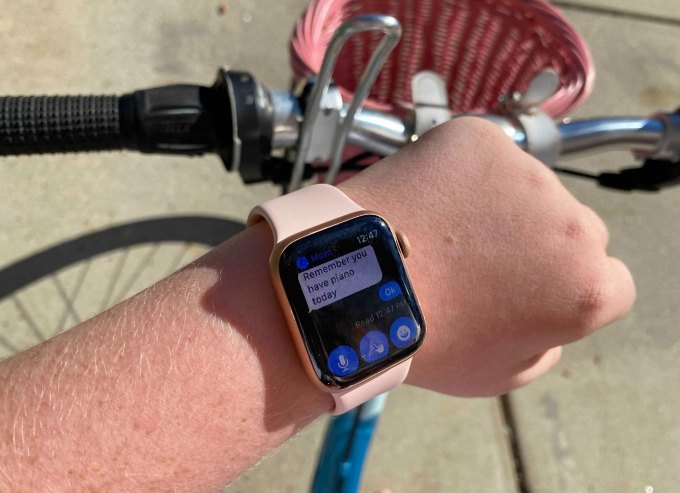
Image Credits: TechCrunch

After my experience, I feel the only cases where I’d fully endorse the Apple Watch would be for those tech-free or tech-light families where kids will not be given phones at any point, households where kids’ phone usage is highly restricted (like those with Wi-Fi-only phones) or those where kids don’t get phones until their later teenage years. I am not here to convince them of my alternative, perhaps more progressive view on when to give a kid a phone. The Apple Watch may make sense for these families, and that’s their prerogative.

However, a number of people may be wondering if the Apple Watch can be a temporary solution for perhaps a year or two before they buy the child a smartphone. To them, I have to say this feels like an expensive way to delay the inevitable, unavoidable task of having to parent your child through the digital age.

Given my position on the matter, my one big caveat to this review is that my daughter does, in fact, have a smartphone. Also, let’s be clear: this is not meant to be a thorough review of the Apple Watch itself, or a detailed report of its various “tech specs.” It’s a subjective report as to how things went for us, from which, hopefully, you can learn.
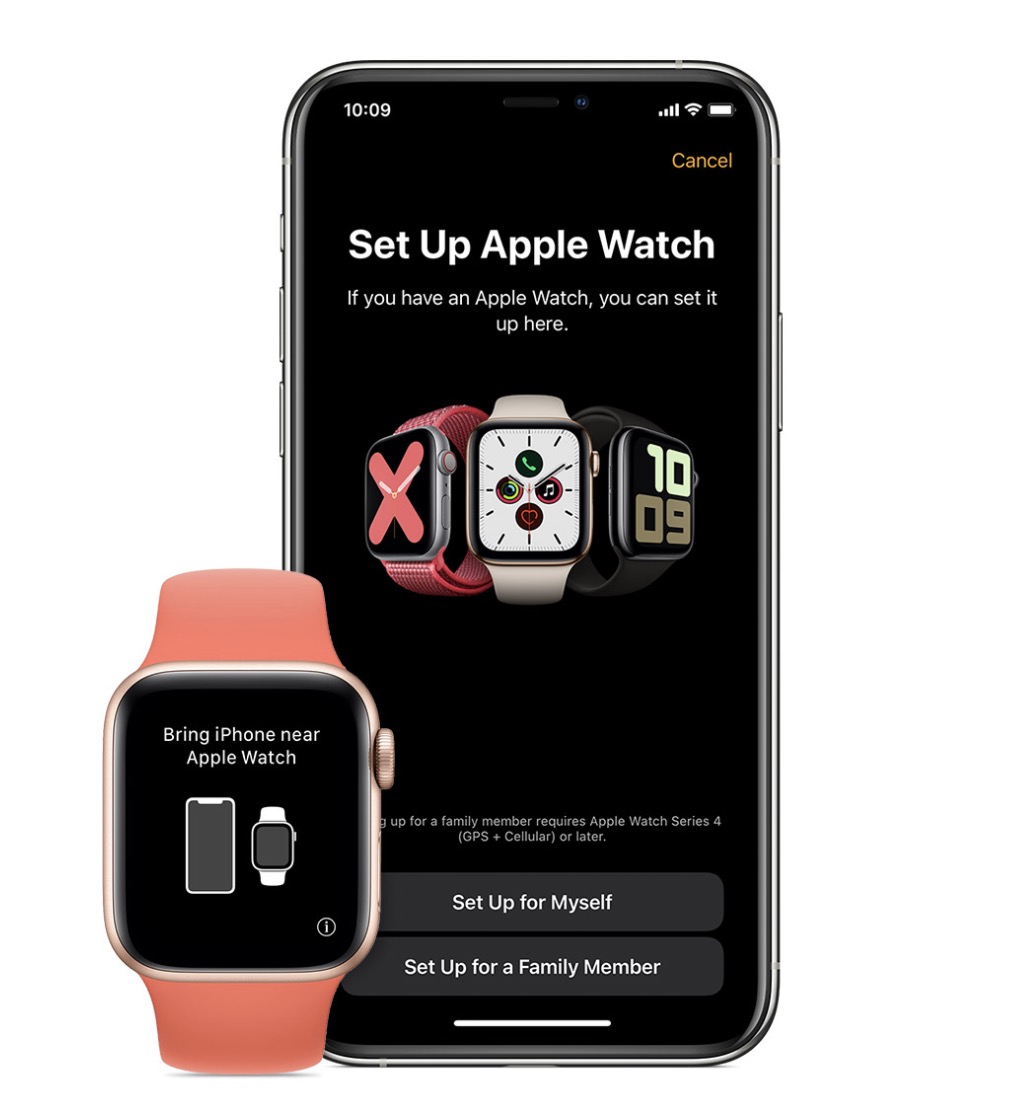
Image Credits: Apple

To begin, the process of configuring the new Apple Watch with Family Setup was easy. “Set Up for a Family Member” is one of two setup options to tap on as you get started. Apple offers a simple user interface that walks you through pairing the Watch with your phone and all the choices that have to be made, like enabling cellular, turning on “Ask to Buy” for app purchases, enabling Schooltime and Activity features and more.

What was harder was actually using the Apple Watch as intended after it was configured. I found it far easier to launch an iPhone app (like Life360, which we use) where everything you need is in one place. That turned out not to be true for the Apple Watch Family Setup system.

For the purpose of testing the Apple Watch with Family Setup, my daughter would leave her iPhone behind when she went out biking or when meeting up with friends for outdoor activities.

As a child who worked her way up to an iPhone over a couple of years, I have to admit I was surprised at how irresponsible she was with the watch in the early weeks.

She didn’t at all respect the multi-hundred-dollar device it was, at first, but rather treated it like her junk jewelry or her wrist-worn scrunchies. The Apple Watch was tossed on a dresser, a bathroom counter, a kitchen table, on a beanbag chair and so on.

Thankfully, the “Find My” app can locate the Apple Watch, if it has battery and a signal. But I’m not going to lie — there were some scary moments where a dead watch was later found on the back of a toilet (!!), on the top of the piano and, once, abandoned at a friend’s house.

And this, from a child who always knows where her iPhone is!

The problem is that her iPhone is something she learned to be responsible for after years of practice. This fooled me into thinking she actually was responsible for expensive devices. For two years, we painfully went through a few low-end Android phones while she got the hang of keeping up with and caring for such a device. Despite wrapping those starter phones in protective cases, we still lost one to a screen-destroying crash on a tile floor and another to being run over by a car. (How it flew out of a pocket and into the middle of the road, I’ll never understand!)

But, eventually, she did earn access to a hand-me-down iPhone. And after initially only being allowed to use it in the house on Wi-Fi, that phone now goes outdoors and has its own phone number. And she has been careful with it in the months since. (Ahem, knocks on wood.)

The Apple Watch, however, held no such elevated status for her. It was not an earned privilege. It was not fun. It was not filled with favorite apps and games. It was, instead, thrust upon her.

While the iPhone is used often for enjoyable and addictive activities like Roblox, TikTok, Disney+ and Netflix, the Apple Watch was boring by comparison. Sure, there are a few things you can do on the device — it has an App Store! You can make a Memoji! You can customize different watch faces! But unless this is your child’s first-ever access to technology, these features may have limited appeal.

“Do you want to download this game? This looks fun,” I suggested, pointing to a coloring game, as we looked at her Watch together one night.

“No thanks,” she replied.

“Why not?”

“I just don’t think it would be good on the little screen.”

“Maybe a different game?”

“Nah.”

And that was that. I could not convince her to give a single Apple Watch app a try in the days that followed.

She didn’t even want to stream music on the Apple Watch — she has Alexa for that, she pointed out. She didn’t want to play a game on the watch — she has Roblox on the bigger screen of her hand-me-down laptop. She also has a handheld Nintendo Switch.

Image Credits: TechCrunch

Initially, she picked an Apple Watch face that matched her current “aesthetic” — simple and neutral — and that was the extent of her interest in personalizing the device in the first several weeks.

Having already burned herself out on Memoji by borrowing my phone to play with the feature when it launched, there wasn’t as much interest in doing more with the customized avatar creation process, despite my suggestions to try it. (She had already made a Memoji her Profile photo for her contact card on iPhone.)

However, I later showed her the Memoji Watch Face option after I set it up, and asked her if she liked it. She responded “YESSSS. I love it,” and snatched the watch from my hand to play some more.

Demo’ing features is important, it seems.

But largely, the Apple Watch was strapped on only at my request as she walked out the door.

Soon, this became a routine.

“Can I go outside and play?”

“Yes. Wear the watch!” I’d reply.

“I knowwww.”

It took over a month to get to the point that she would remember the watch on her own.

I have to admit that I didn’t fully demo the Apple Watch to her or explain how to use it in detail, beyond a few basics in those beginning weeks. While I could have made her an expert, I suppose, I think it’s important to realize that many parents are less tech-savvy than their kids. The children are often left to fend for themselves when it comes to devices, and this particular kid has had several devices. For that reason, I was curious how a fairly tech-literate child who has moved from iPad to Android to now iPhone, and who hops from Windows to Mac to Chromebook, would now adapt to an Apple Watch.

As it turned out, she found it a little confusing.

“What do you think about the Watch?” I asked one evening, feeling her out for an opinion.

“It’s fun…but sometimes I don’t really understand it,” she replied.

“What don’t you understand?”

“I don’t know. Just…almost everything,” she said, dramatically, as tweens tend to do. “Like, sometimes I don’t know how to turn up and down the volume.”

Upon prodding, I realize she meant this: she was confused about how to adjust the alert volume for messages and notifications, as well as how to change the Watch from phone calls to a vibration or to silence calls altogether with Do Not Disturb. (It was her only real complaint, but annoying enough to be “almost everything,” I guess!)

I’ll translate now from kid language what I learned here.

First, given that the “Do Not Disturb” option is accessible from a swipe gesture, it’s clear my daughter hadn’t fully explored the watch’s user interface. It didn’t occur to her that the swipe gestures of the iPhone would have their own Apple Watch counterparts. (And also, why would you swipe up from the bottom of the screen for the Control Center when that doesn’t work on the iPhone anymore? On iPhone, you now swipe down from the top-right to get to Control Center functions.)

And she definitely hadn’t discovered the tiny “Settings” app (the gear icon) on the Apple Watch’s Home Screen to make further changes.

Instead, her expectation was that you should be able to use either a button on the side for managing volume — you know, like on a phone — or maybe the digital crown, since that’s available here. But these physical features of the device — confusingly — took her to that “unimportant stuff” like the Home Screen and an app switcher, when in actuality, it was calls, notifications and alerts that were the app’s main function, in her opinion.

And why do you need to zoom into the Home Screen with a turn of the digital crown? She wasn’t even using the apps at this point. There weren’t that many on the screen.

Curious, since she didn’t care for the current lineup of apps, I asked for feedback.

“What kind of apps do you want?,” I asked.

“Roblox and TikTok.”

“Roblox?!,” I said, laughing. “How would that even work?”

As it turned out, she didn’t want to play Roblox on her watch. She wanted to respond to her incoming messages and participate in her group chats from her watch.

Oh. That’s actually a reasonable idea. The Apple Watch is, after all, a messaging device.

And since many kids her age don’t have a phone or the ability to use a messaging app like Snapchat or Instagram, they trade Roblox usernames and friend each other in the game as a way to work around this restriction. They then message each other to arrange virtual playdates or even real-life ones if they live nearby.

But the iOS version of the Roblox mobile app doesn’t have an Apple Watch counterpart.

“And TikTok?” I also found this hilarious.

But the fact that Apple Watch is not exactly an ideal video player is lost on her. It’s a device with a screen, connected to the internet. So why isn’t that enough, she wondered?

“You could look through popular TikToks,” she suggested. “You wouldn’t need to make an account or anything,” she clarified, as if these details would fix the only problems she saw with her suggestion.

Even if the technology was there, a TikTok experience on the small screen would never be a great one. But this goes to show how much interest in technology is directly tied to what apps and games are available, compared with the technology platform itself.

Other built-in features had even less appeal than the app lineup.
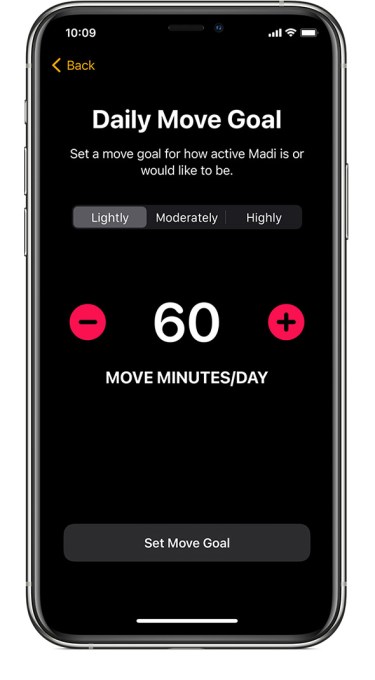
Image Credits: Apple

Though I had set up some basic Activity features during the setup process, like a “Move Goal,” she had no idea what any of that was. So I showed her the “rings” and how they worked, and she thought it was kind of neat that the Apple Watch could track her standing. However, there was no genuine interest or excitement in being able to quantify her daily movement — at least, not until one day many weeks later when were hiking and she heard my watch ding as my rings closed and wanted to do the same on hers. She became interested in recording her steps for that hike, but the interest wasn’t sustained afterwards.

Apple said it built in the Activity features so kids could track their move goal and exercise progress. But I would guess many kids won’t care about this, even if they’re active. After all, kids play — they don’t think “how much did I play? Did I move enough today?” And nor should they, really.

As a parent, I can see her data in the Health app on my iPhone, which is the device I use to manage her Apple Watch. It’s interesting, perhaps, to see things like her steps walked or flights climbed. But it’s not entirely useful, as her Apple Watch is not continually worn throughout the day. (She finds the bands uncomfortable — we tried Sport Band and Sport Loop and she still fiddles with them constantly, trying to readjust them for comfort.)

In addition, if I did want to change her Activity goals later on for some reason, I’d have to do so from her Watch directly.

Of course, a parent doesn’t buy a child an Apple Watch to track their exercise. It’s for the location-tracking features. That is the only real reason a parent would consider this device for a younger child.

On that front, I did like that the watch was a GPS tracker that was looped into our household Apple ecosystem as its own device with its own phone number. I liked that I could ping the Watch with “Find My” when it’s lost — and it was lost a lot, as I noted. I liked that I could manage the Watch from my iPhone, since it’s very difficult to reacquire a device to make changes once it’s handed over to someone else.

I also liked that the Apple Watch was always available for use. This may have been one of its biggest perks, in fact. Unlike my daughter’s iPhone, which is almost constantly at 10-20% battery (or much less), the watch was consistently charged and ready when it was time for outdoor play.

I liked that it was easier for her to answer a call on the Apple Watch compared with digging her phone out of her bike basket or bag. I liked that she didn’t have to worry about constantly holding onto her phone while out and about.

I also appreciated that I could create geofenced alerts — like when she reached the park or a friend’s house, for example, or when she left. But I didn’t like that the ability to do so is buried in the “Find My” app. (You tap on the child’s name in the “People” tab. Tap “Add” under “Notifications.” Tap “Notify Me.” Tap “New Location.” Do a search for an address or venue. Tap “Done.”)
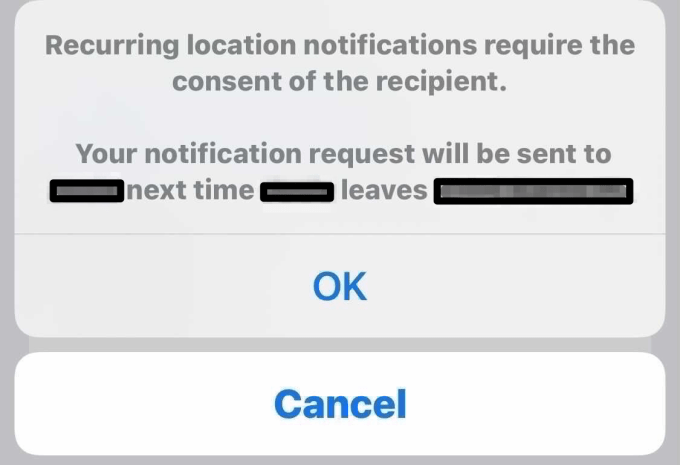
Image Credits: TechCrunch

I also didn’t like that when I created a recurring geofence, my daughter would be notified. Yes, privacy. I know! But who’s in charge here? My daughter is a child, not a teen. She knows the Apple Watch is a GPS tracker — we had that conversation. She knows it allows me to see where she is. She’s young, and, for now, doesn’t feel like this a privacy violation. We’ll have that discussion later, I’m sure. But at the present, she likes the feel of this electronic tether to home as she experiments with expanding the boundaries of her world.

When I tweak and update recurring alerts for geofenced locations, such alerts can be confusing or even concerning. I appreciate that Apple is being transparent and trying to give kids the ability to understand they’re being tracked — but I’d also argue that most parents who suddenly gift an expensive watch to their child will explain why they’re doing so. This is a tool, not a toy.

Also, the interface for configuring geofences is cumbersome. By comparison, the family-tracking app Life360 which we normally use has a screen where you simply tap add, search to find the location and you’re done. One tap on a bell icon next to the location turns on or off its alerts. (You can get all granular about it: recurring, one time, arrives, leaves, etc. — but you don’t have to. Just tap and be alerted. It’s more straightforward.)

Image Credits: Apple

One feature I did like on the Apple Watch, but sadly couldn’t really use, was its Schooltime mode — a sort of remotely-enabled, scheduled version of Do Not Disturb. This feature blocks apps and complications and turns on the Do Not Disturb setting for the kids, while letting emergency calls and notifications break through. (Make sure to set up Shared Contacts, so you can manage that aspect.)

Currently, we have no use for Schooltime, thanks to this pandemic. My daughter is attending school remotely this year. I could imagine how this may be helpful one day when she returns to class.

But I also worry that if I sent her to class with the Apple Watch, other kids will judge her for her expensive device. I worry that teachers (who don’t know about Schooltime) will judge me for having her wear it. I worry kids will covet it and ask to try it on. I worry a kid running off with it, causing additional disciplinary headaches for teachers. I worry it will get smashed on the playground or during PE, or somehow fall off because she meddled with the band for the umpteenth time. I worry she’ll take it off because “the strap is so annoying” (as I was told), then leave it in her desk.

I don’t worry as much about the iPhone at school, because it stays in her backpack the whole time due to school policy. It doesn’t sit on her arm as a constant temptation, “Schooltime” mode or otherwise.

The Apple Watch Family Setup is also not a solution that adapts as the child ages to the expanding needs of teen monitoring, compared with other family-tracking solutions.

To continue the Life360 comparison, the app today offers features for teen drivers, and its new privacy-sensitive location “bubbles” for teens now give them more autonomy. Apple’s family-tracking solution, meanwhile, becomes more limited as the child ages up.

For instance, Schooltime doesn’t work on an iPhone. Once the child upgrades to an iPhone, you are meant to use parental controls and Screen Time features to manage which apps are allowed and when she can use her device. It seems a good transitional step to the phone would be a way to maintain Schooltime mode on the child’s next device, too.

Instead, by buying into Apple Watch for its Family Setup features, what you’ll soon end up with is a child who now owns both an Apple Watch and a smartphone. (Sure, you could regift it or take it back, I suppose…I certainly do wish you luck if you try that!)

Beyond the overboard embrace of consumerism that is buying an Apple Watch for a child, the biggest complaint I had was that there were three different apps for me to use to manage and view data associated with my daughter’s Apple Watch. I could view her tracked activity was tracked in my Health app. Location-tracking and geofence configuration was in the Find My app. And remotely configuring the Apple Watch itself, including Schooltime, was found in my Watch mobile app.

I understand that Apple built the Watch to be a personal device designed for use with one person and it had to stretch to turn it into a family-tracking system. But what Apple is doing here is really just pairing the child’s watch with the parent’s iPhone and then tacking on extra features, like Schooltime. It hasn’t approached this as a whole new system designed from the ground-up for families or for their expanding needs as the child grows.

As a result, the whole system feels underdeveloped compared with existing family-tracking solutions. And given the numerous features to configure, adjust and monitor, Family Setup deserves its own app, or at the very least, its own tab in a parent’s Watch app to simplify its use.

At the end of the day, if you are letting your child out in the world — beyond school and supervised playdates — the Apple Watch is a solution, but it may not be the best solution for your needs. If you have specific reasons why your child will not get their own phone now or anytime soon, the Apple Watch may certainly work. But if you don’t have those reasons, it may be time to try a smartphone.

Both Apple and Google now offer robust parental control solutions for their smartphone platforms that can mitigate many parents’ concerns over content and app addiction. And considering the cost of a new Apple Watch, the savings just aren’t there — especially when considering entry-level Android phones or other hand-me-down phones as the alternative.

[Apple provided a loaner device for the purposes of this review. My daughter was cited and quoted with permission but asked for her name to not be used.]




With an eye for what’s next, longtime operator and VC Josh Elman gets pulled into Apple

Josh Elman is moving over to Apple, he announced on Twitter today, saying he will be focused on the company’s App Store and helping “customers discover the best apps for them.”

Asked for more details about his new role, Elman referred us to Apple, which confirmed his employment but declined to offer more, including about his new title. (This is typical operating procedure for the tech giant.)

Certainly, Elman has plenty of experience with fast-growing technologies and popular apps in particular. One of his first jobs out of Stanford was with RealNetworks, a bubble-era internet streaming company that went public in 1997, three years after it was founded. (It remains publicly traded, though its market cap is just $60 million these days.)

After RealNetworks, it was on to LinkedIn, which Elman joined in 2004 as a senior product manager when the company was just two years old. From there, Elman worked in product management at the custom apparel and accessories company Zazzle, then at Facebook, then Twitter.

Perhaps unsurprisingly, the venture firm Greylock brought Elman into the fold in 2011 as a principal, and by 2013, he was a general partner, investing in social networking deals throughout, like Musical.ly (ByteDance acquired the company and turned it into TikTok); Nextdoor (which is reportedly eyeing ways to go public); Houseparty (acquired last year by Epic Games, which is now suing Apple); and Discord (which is sewing up a private funding deal at a valuation of roughly $7 billion).

Somewhat unexpectedly, in 2018, Elman left his full-time role with Greylock to join a company notably not in the firm’s portfolio — the stock-trading platform Robinhood. As interesting, though he took on the role of VP of product at the popular and fast-growing startup, he didn’t cut ties with Greylock entirely, taking on the title of venture partner and remaining on as a board member to his companies.

Asked about the move, Elman told TC at the time that he had “started talking with a few of my partners about how I want to spend the next decade of my professional life. What gets me the most energized is when I can dig in on product with a hyper-growth company.”

Ultimately, the Robinhood role didn’t last long, with Elman leaving last November after less than two years on the job. Now Elman — who said he’s stepping away from some of his Greylock-related board seats — has a new chance to do what he loves most, from one of the most powerful perches in the world, the App Store.

Now, to see what he does there. “I’m really excited to get to build ways to help over a billion customers and millions of developers connect,” he tweeted earlier, apparently sharing as much as he can publicly for now. Added Elman in the same thread: “I recently found my college resume. My career objective was ‘To create great technology that changes people’s lives’. Still at it :)”

Vista acquires Gainsight for $1.1B, adding to its growing enterprise arsenal

Vista Equity Partners hasn’t been shy about scooping up enterprise companies over the years, and today it added to a growing portfolio with its purchase of Gainsight. The company’s software helps clients with customer success, meaning it helps create a positive customer experience when they interact with your brand, making them more likely to come back and recommend you to others. Sources pegged the price tag at $1.1 billion.

As you might expect, both parties are putting a happy face on the deal, talking about how they can work together to grow Gainsight further. Certainly, other companies like Ping Identity seem to have benefited from joining forces with Vista. Being part of a well-capitalized firm allowed them to make some strategic investments along the way to eventually going public last year.

Gainsight and Vista are certainly hoping for a similar outcome in this case. Monti Saroya, co-head of the Vista Flagship Fund and senior managing director at the firm, sees a company with a lot of potential that could expand and grow with help from Vista’s consulting arm, which helps portfolio companies with different aspects of their business like sales, marketing and operations.

“We are excited to partner with the Gainsight team in its next phase of growth, helping the company to expand the category it has created and deliver even more solutions that drive retention and growth to businesses across the globe,” Saroya said in a statement.

Gainsight CEO Nick Mehta likes the idea of being part of Vista’s portfolio of enterprise companies, many of whom are using his company’s products.

“We’ve known Vista for years, since 24 of their portfolio companies use Gainsight. We’ve seen Gainsight clients like JAMF and Ping Identity partner with Vista and then go public. We believe we are just getting started with customer success, so we wanted the right partner for the long term and we’re excited to work with Vista on the next phase of our journey,” Mehta told TechCrunch.

Brent Leary, principle analyst at CRM Essentials, who covers the sales and marketing space, says that it appears that Vista is piecing together a sales and marketing platform that it could flip or go public in a few years.

“It’s not only the power that’s in the platform, it’s also the money. And Vista seems to be piecing together an engagement platform based on the acquisitions of Gainsight, Pipedrive and even last year’s Acquia purchase. Vista isn’t afraid to spend big money, if they can make even bigger money in a couple years if they can make these pieces fit together,” Leary told TechCrunch.

While Gainsight exits as a unicorn, the deal might not have been the outcome it was looking for. The company raised more than $187 million, according to PitchBook data, though its fundraising had slowed in recent years. Gainsight raised $50 million in April of 2017 at a post-money valuation of $515 million, again per PitchBook. In July of 2018 it added $25 million to its coffers, and the final entry was a small debt investment raised in 2019.

It could be that the startup saw its growth slow down, leaving it somewhere between ready for new venture investment and profitability. That’s a gap that PE shops like Vista look for, write a check, shake up a company and hopefully exit at an elevated price.

Gainsight hired a new chief revenue officer last month, notably. Per Forbes, the company was on track to reach “about” $100 million ARR by the end of 2020, giving it a revenue multiple of around 11x in the deal. That’s under current market norms, which could imply that Gainsight had either lower gross margins than comparable companies, or as previously noted, that its growth had slowed.

A $1.1 billion exit is never something to bemoan — and every startup wants to become a unicorn — but Gainsight and Mehta are well known, and we were hoping for the details only an S-1 could deliver. Perhaps one day with Vista’s help that could happen.

Infogrid raises $15.5M from Northzone to retrofit buildings with ‘smart’ IoT

Infogrid, an IoT startup which can retrofit an existing building to make it “smart”, has raised $15.5 million. The Series A funding round was led by Northzone, with participation from JLL Spark, Concrete VC, The Venture Collective, Jigsaw VC, an unnamed real estate investment group and an unnamed large international asset owner, although one report speculated that it is Starwood Capital, the property-focused investor.

Infogrid’s platform combines IoT sensors with proprietary AI analysis and has had some success re-vamping facilities management (FM) for some of the world’s largest FM providers, such as global banks, supermarkets, restaurant chains and the NHS. Infogrid also has an “impact-style” mission to enable businesses to reduce the environmental and social cost of their buildings while simultaneously benefitting their bottom line and asset values.

Infogrid’s system can detect when refrigerated products are being kept outside the required temperature range, measure air quality and check for virus risk indicators such as Legionnaires’ disease in water pipes.

William Cowell de Gruchy, founder/CEO and a former British Army officer, said in a statement: “Until now, the lack of viable and scalable technology has meant that facilities management is one of the last industries to be enhanced by digitization, despite covering the world’s largest asset class. Infogrid’s end-to-end smart building system finally arms organizations with insight to take control and take action. This new era of insight and automation will bring about a positive impact on the efficiencies of businesses, the wellbeing of employees, and the environmental footprint of buildings.”

Jeppe Zink, partner at Northzone added: “With the world undergoing the largest wave of urban growth in history, the built environment already generates 39% of annual global carbon emissions. We were instantly drawn to Infogrid for its ability to future-proof buildings in the long-term.”

Union Labs believes uniting VC and corporate expertise can help startups solve ‘hard tech’ problems

Chris Kim and Nate Williams formed Union Labs with the conviction that investors and companies aren’t collaborating closely enough to ensure the success of the startups they back.

Kim is the former co-founder and chief technology officer at the automatic lock company August. He first met Williams when the company was attempting to create a consortium of stakeholders for the Internet of Things market.

Nate loved the go-to-market side when he came on board. He led the charge for us getting into retail,” Kim said. 

Later, when August was acquired in 2017, the two men continued to work together after Williams took a role as an entrepreneur in residence at Kleiner Perkins. Kim would assist in due diligence as the two continued to refine the thesis that they’d worked on at August — that uniting stakeholders was a critical component of success for new technology companies.

That thesis became the organizing principle for their Union Labs fund, which has raised $29 million of a targeted $50 million fund. 

“We’re starting to see this bifurcation between really, really hard deep tech firms versus other firms that might [have] one out of five of their deals being deep tech. Chris and I saw a lane for ‘applied’ deeptech,” said Williams.

This lane runs through the early-stage technology firms that need guidance from operators at hardware companies rather than the software-as-a-service experts that Williams and Kim said populate most venture capital firms. “Educating a SaaS partnership about ‘hard tech’ is super hard,” said Williams.

In addition to Williams and Kim, Union Labs has two directors: Thomas Lee, who spent years working at Enphase Energy, and Annie Le, a former chief operating officer at Pryze.

One example of the kinds of startups that the new Union Labs fund is hoping to back is Strella Biotechnology, a company that has developed sensors to monitor the ethylene gas emitted by produce to determine the freshness of fruits and vegetables.

Union Labs is targeting 20 investments with the first fund, including 15 direct investments and another three-to-five companies that it intends to incubate.

The other public investments in the company’s portfolio include the car rental optimization service Carnect and a toolkit for home safety called Encircle Labs (that’s not revealing too much about its business).

A fourth portfolio company, that has yet to publicly reveal its services, is working on solving problems in field service management related to training.

While these issues have presented challenges for industry, with the exception of the sensor business, none of them could be considered “hard tech” from a hardware perspective… and indeed, many of them resemble the software-as-a-service businesses that many firms are writing checks to support.

For its part, Union Labs is writing pre-seed and seed-stage checks with an average size of $890,000 for an 11% ownership stake. Williams says the firm will invest anywhere from $500,000 to $1.5 million.

For startups, one selling point for the firm is the connection it still maintains with the Internet of Things consortium Williams helped to establish for August Homes. Through the consortium Williams has been able to pull together corporate backers in telecommunications, utilities, consumer electronics and insurance, along with Kleiner Perkins and GV (which Williams said are investors).

“One of the things we’ve seen is the rise of corporate venture capital firms,” said Williams. And both Kim and Williams want their firm to act as a hybrid, between corporate venture capital and a traditional venture firm. 

Time will tell if they can turn their mission into something more than a marketing message.

Strike first, strike hard, no mercy: How emerging managers can win

TX Zhuo
Contributor

TX Zhuo is the managing partner of Fika Ventures, focusing on fintech, enterprise software and marketplace opportunities.

Huston Collins
Contributor

Huston Collins is an investor at Fika Ventures. He was previously an associate at Greenspring Associates where he started the firm’s machine learning platform.

Like many of us during COVID-19, I’ve found myself watching a bit more TV than I’m typically accustomed to. My latest binge? “The Karate Kid” series continuation “Cobra Kai” on Netflix.

A long-time fan of “The Karate Kid,” I find my style’s a bit more Miyagi-Do, but, in reflecting upon my last few years as a founding GP at a young VC firm, I see some parallels between what it takes to win as an emerging manager and the mantras by which the Cobra Kai school abides.

Before diving into that, let me quickly set the stage for what the competitive landscape looks like for emerging managers these days. I’ll focus primarily on the seed landscape here, but the Cobra Kai framework applies just as readily to later stage funds as well.

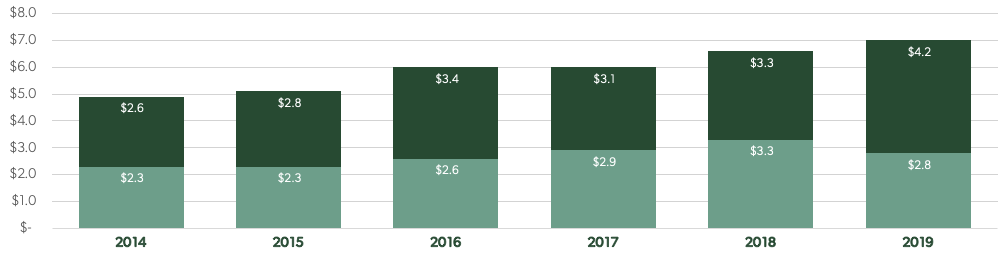
Leading up to the coronavirus pandemic, the venture industry saw a record number of dollars raised by seed funds less than $100 million in size. As is the case across stages however, there has been a notable decline in seed volume in the wake of COVID-19.

US fundraising activity for sub $100M seed rounds

U.S. fundraising activity for sub-$100M seed rounds. Data source: PitchBook-NVCA Venture Monitor. Image Credits: Fika Ventures

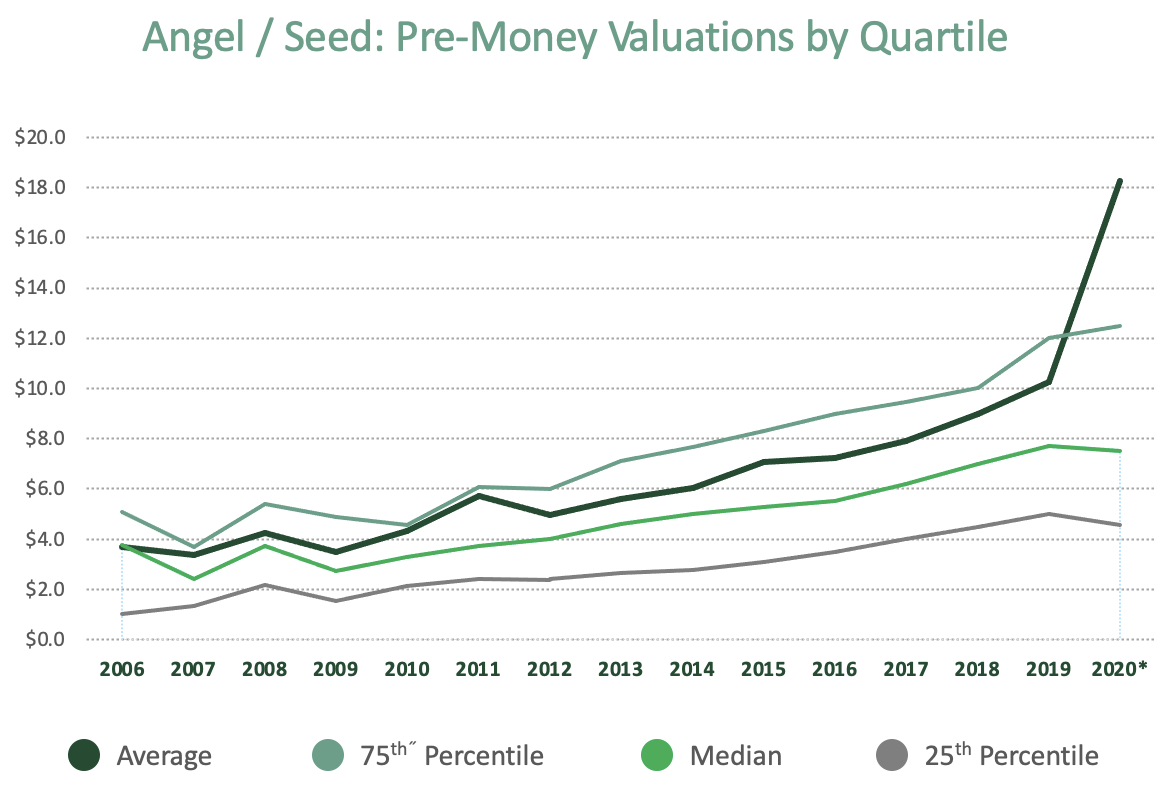
The opposing dynamics of a contraction in deal volume and an unprecedented amount of readily available investable capital has led to a tremendous amount of competition for the highest-quality deals. This flight to quality can be clearly seen in the rise of seed valuations in the upper quartile compared to the decline in other cohorts. Amid a backdrop of COVID chaos, upper quartile valuations have hit an all-time high.

angel/seed pre-money valuations by quartile

Angel/seed pre-money valuations by quartile. Data source: PitchBook-NVCA Venture Monitor. Image Credits: Fika Ventures

Due to their smaller fund size and prescriptive portfolio construction mandates, emerging managers have little leeway in terms of the valuations at which they can invest — their ownership requirements and check size limits impose a hard ceiling to which their investors hold them strictly accountable.

If budging on valuation is not a viable tactic to compete against established firms — which, in addition to their ability to be less price sensitive also boast more recognizable brand names, larger teams and higher AUM that affords them higher budgets for platform resources — how can emerging managers win? Enter Cobra Kai.

Strike first

Let’s face it. As an emerging manager, the chances of you winning a deal once the established players start to circle drops precipitously. In order to win, you need to have a first-mover advantage.

On a practical level, there are two windows of opportunity to achieve this:

EveryAction acquires Mobilize, the Democratic volunteering platform

Nonprofit donor management platform EveryAction is buying Mobilize, a company that connects Democratic campaigns to volunteers and helps marshal activists toward progressive causes. Mobilize, formerly known as MobilizeAmerica, grew out of Higher Ground Labs, an incubator focused on leveraging tech for left-leaning political causes and campaigns.

With the acquisition, EveryAction can now extend Mobilize’s organizing tools to its existing base of more than 15,000 clients, which includes the Sierra Club and the Human Rights Campaign. EveryAction is a nonprofit-focused wing of NGP VAN, a company that provides much of the digital infrastructure for the Democratic Party. The terms of the Mobilize deal were not disclosed.

Mobilize, founded in early 2017, rode the wave of Trump-era activism on the left to become a ubiquitous tool helping progressive campaigns translate online interest and energy into action. The platform powered outreach for many candidates in 2020’s Democratic primary, including now President-elect Joe Biden’s campaign, who continued to use Mobilize into the general election.

After Trump’s surprise win in 2016 — and the surprising strategies that got the campaign there — Democrats turned to the startup scene to hone new tools. If the last four years served as a testing ground for Democratic political startups, 2020 sees them on the cusp of a new era altogether.

Earlier this year, Mobilize raised a $3.75 million Series A round led by progressive tech incubator Higher Ground Labs. Chris Sacca’s Lowercase Capital and LinkedIn co-founder Reid Hoffman, a prominent Democratic donor, also participated in the Series A. Mobilize’s acquisition follows another recent exit connected to Higher Ground Labs: In August, Social Capital, founded by billionaire ex-Facebooker Chamath Palihapitiya, picked up text banking platform Hustle.

Within EveryAction, Mobilize will become its own unit led by Mobilize CEO and co-founder Alfred Johnson. The company’s existing team will move over into the new division under EveryAction’s umbrella. Mobilize co-founder and president Allen Kramer will also move over to EveryAction as deputy general manager of organizing.

“EveryAction is the leading software provider to nonprofits with clients like the National Audubon Society, Planned Parenthood Federation of America, and the United Nations Foundation,” Johnson told TechCrunch. “They are uniquely poised to bring our best-in-class offering for events and volunteer management to these very deserving organizations.”

Prior to the acquisition, EveryAction was already connected to Mobilize as an integration on its platform, and Johnson called the news a “natural evolution” of that relationship. “Our two companies are extremely aligned in mission: to help cause-driven organizations build bigger movements by driving and deepening supporter engagement,” Johnson said. “Together, we can help more people do more good.”

5 reasons you don’t want to miss out on TC Sessions: Space 2020

We’re just about two weeks away from launching TC Sessions: Space 2020, our first focused foray into early-stage space startups and the essential satellite industries that support them. Buy your pass and join us on December 16-17 for two days packed with all the right stuff, including untapped opportunity.

Still looking for a reason to initiate your launch sequence? We’ll go you four better. Here are five stellar reasons to attend TC Sessions: Space 2020.

1. Top innovators in the space scene

You’ll hear from and engage with the top minds, makers and investors in the space community. We’re talking the leaders of public, private and government agencies; the people making it happen and looking to share their expertise and insight with you — the up-and-coming minds and makers.

A quick for instance includes General Jay Raymond (U.S. Space Force), Lisa Callahan (Lockheed Martin), Jim Bridenstine (NASA), Peter Beck (Rocket Lab) and investors like Chris Boshuizen (Data Collective DCVC), Mike Collett (Promus Ventures) and Tess Hatch (Bessemer Venture Partners).

2. Out-of-this-world networking

Connect and build relationships and opportunities with the global space startup community. CrunchMatch, our free, AI-powered platform, simplifies finding and connecting with the people who align with your goals. Send invitations, schedule 1:1 video calls, meet VCs, founders, engineers, potential customers or employees — you never know who you’ll meet or where one connection can take your business.

3. Fast Money for your startup

An early-stage space startup burns through money like a rocket burns through, well, rocket fuel. Don’t miss Fast Money — a series of six breakout sessions. Presenters from leading space accelerators and funding programs will talk about government accelerators, partnering with the Air Force and how to access grant money. Afterward, you can schedule individual appointments with representatives from each program. Look for the Fast Money sessions in the event agenda.

4. Space expo

Explore more than 30 early-stage startups pushing the boundaries of space technology in the expo area. Check out the competition, start a conversation or kick off a collaboration. Hold up, are you a boundary-pushing founder, too? Then get yourself a Space Startup Exhibitor Package, showcase your talent and take advantage of two expo-only opportunities. See details in reason No. 5 below!

5. Pitch, pitch, pitch

  • Founders who exhibit in the expo area get five minutes to pitch live to attendees tuning in from around the globe. Increase your exposure, spotlight your technology and open the door to opportunities.
  • Looking for ways to improve your pitch? On December 16 from 2:30 – 3:30 p.m., Stephan Reckie, Executive Director of GEN Space, will moderate a pitch feedback session for startup founders exhibiting in the expo area.
  • Are you feeling lucky? Your promising early-stage space startup might be one of 10 selected for a pitch competition — a joint mission between TechCrunch and Starburst Aerospace — called Pitch Me to the Moon. Starburst will choose the competitors, who will each pitch live to a panel of high-profile judges from across the industry.

Spend two days learning, connecting and engaging with the space startup community. Buy your pass and tap into a galaxy of opportunity at TC Sessions: Space 2020.

Is your company interested in sponsoring TC Sessions: Space 2020? Click here to talk with us about available opportunities.

Reminder: Last chance to save 25% on Extra Crunch membership

Today is the final day of the Green Days Sale. Don’t miss out on an opportunity to save 25% on annual Extra Crunch membership.

You can claim the deal here.

Extra Crunch helps you spot technology trends and opportunities, build better startups, get ahead at your job and stay connected to a growing community of founders, investors and startup teams. It features thousands of articles, including weekly investor surveys, daily market analysis and expert interviews on fundraising, growth, monetization and other work topics.

Find answers to your burning questions about startups and investing through Extra Crunch Live, and stay informed with our members-only Extra Crunch newsletters. Other benefits include an improved TechCrunch.com experience, 20% off future TechCrunch  events and savings on software services from DocSend, Crunchbase and more.

Join our growing community at a discounted rate here.

The Green Days sale is our biggest discount of the year, so don’t snooze on the savings. The sale ends on November 30. If you have questions about the sale or Extra Crunch membership, please contact our customer support team at [email protected].

Virgin Orbit targets launch window on December 19 for second orbital test launch

Virgin Orbit has announced the target timing for its next orbital flight attempt, which follows a demonstration launch earlier this year that went mostly well — right up until its rocket separated from the carrier launch craft and fired up its own engines for the crucial rest of the trip to space. The company says that it’s undertaken a number of upgrades based on that first try, however, including updates to the engine systems, carrier aircraft and data systems to hopefully have a better demo flight the second time around.

The new launch window is December 19, between the hours of 10 a.m. to 2 p.m. PST. There’s also a backup window set for December 20 ranging across similar hours, the company says, and others in the following weeks, in case it needs to be rescheduled for any reason. This demonstration will involve a full launch cycle of the entire Virgin Orbit launch system, including its Cosmic Girl launch aircraft (a modified 747 passenger airliner) and LauncherOne, the rocket that detaches from Cosmic Girl at cruising altitude before firing up its own engines to make the rest of the trip to space with small satellite payloads on board.

Virgin Orbit’s system is unique because it takes off and lands from a traditional airport, eliminating the need for specialized launch sites and opening up the potential of relatively low-lift global launch flexibility. It also has the potential to offer cost and scheduling advantages to small satellite companies looking to launch just one or a few spacecraft, without having to wait for timing on a ride-share mission on a larger rocket like one from SpaceX, or pay a premium for something like Rocket Lab’s offering.

Last time around in May, Virgin Orbit’s flight went perfectly from takeoff through the separation of LauncherOne from the carrier aircraft. The rocket even fired up its engines on time as planned, but the engines cut off essentially right away due to a built-in safety system that also worked as planned when it detected some unusual readings.

With this second attempt, Virgin Orbit wants to show that it’s system works from that point on, as well, with a full first-stage powered flight and operation of the upper stage. Stakes are a bit higher this time around, as on board will be actual customer satellites, even though this is technically still a demonstration mission — the primary purpose of which is to collect data.

The 10 payloads on board are from NASA and represent a number of different scientific and educational programs created entirely by U.S.-based universities and academic institutions.

Dear Sophie: What I’m thankful for

Sophie Alcorn
Contributor

Sophie Alcorn is the founder of Alcorn Immigration Law in Silicon Valley and 2019 Global Law Experts Awards’ “Law Firm of the Year in California for Entrepreneur Immigration Services.” She connects people with the businesses and opportunities that expand their lives.

Here’s another edition of “Dear Sophie,” the advice column that answers immigration-related questions about working at technology companies.

“Your questions are vital to the spread of knowledge that allows people all over the world to rise above borders and pursue their dreams,” says Sophie Alcorn, a Silicon Valley immigration attorney. “Whether you’re in people ops, a founder or seeking a job in Silicon Valley, I would love to answer your questions in my next column.”

Extra Crunch members receive access to weekly “Dear Sophie” columns; use promo code ALCORN to purchase a one- or two-year subscription for 50% off.


Dear Reader,

Thank you so much for being a part of the genesis of “Dear Sophie” over the course of this year. As I reflect on the Thanksgiving holiday weekend, I’m appreciative of how much all of us around the world have come to know in 2020. We are all interconnected, regardless of where we were born or wherever we currently reside. This year has included major, transformative events. These changes serve us to better know what we want and what we don’t. As a result, I am positive that our future experiences will be enhanced.

Looking back over the last year, I’m appreciative of President Trump’s digitization effort to improve the H-1B lottery process.

Looking forward, it’s exhilarating that increasing access to immigration opportunities is a major priority for President-elect Biden. I’m confident the Biden-Harris administration will support the U.S. embracing our roots as a land of opportunity. Moving into 2021 we will recognize our immigrant heritage, welcome newcomers and recognize the important contributions of immigrants for a better world.

There’s so much to be thankful for:

I’m appreciative of you, my readers, and the messages and feedback I receive from you about this column, questions you have and topics you would like to see covered. I appreciate TechCrunch and Extra Crunch for this platform to share my thoughts, experiences and knowledge.

I’m appreciative of all of our clients from around the world who we’ve been able to successfully support. Many moments this year seemed bleak, but we were able to come through. I appreciate their many contributions to the U.S. and creating health solutions and jobs as they have gone on to launch and scale innovative startups in Silicon Valley and beyond.

I’m appreciative of my amazing team at Alcorn Immigration Law and for our successes in supporting folks to come to live and work in the U.S. and achieve their dreams. And I’m appreciative of our team to compile a “64 Questions to Ask Your Immigration Attorney,” a checklist of questions you should ask when interviewing immigration attorneys before starting the immigration process. I’m appreciative for having the opportunity to share my knowledge on my podcast, Immigration Law for Tech Startups — this week’s podcast is all about appreciation!

And finally, I’m appreciative of my amazing job. I have the privilege of supporting people from all around the world to create their dreams. It’s humbling and inspiring to listen to my clients’ stories, hopes and dreams. It’s the most magnificent chess game to identify and tailor immigration strategies that best fit their unique situation, priorities and timing.

Part of why being an immigration attorney inspires me is because our amazing clients entrust us to support them in navigating the U.S. immigration system to make their dream a reality. We had many major legal victories this year:

I appreciate the client who was on an E-2 Visa for Treaty Investors as an employee. He was desperate to join an early-stage startup and was in a difficult bind of needing to get expedited approval in the pandemic and be able to provide his contractual notice to his current employer. We all knew it was risky, so I’m proud of our team for successfully petitioning for the startup to sponsor him in O-1A Visa for Extraordinary Ability status.

I also appreciate the aspiring startup founder we helped to gain independence from a corporate employer by assisting him with self-petitioning his green card. We succeeded in getting him approved for an EB-2 NIW (National Interest Waiver) exceptional ability green card.

I am also appreciating that we successfully supported a prospective startup co-founder to remain in the U.S. while maintaining his position in line for a green card. A prominent VC required that he immediately leave his current employer and begin working full time for the very early-stage startup prior to investing $6 million. This founder had been bound at a prior company in L-1A Visa for Intracompany Transferee Managers and Executives, and he didn’t want to lose his midstream green card process. We successfully transitioned him to the new company quickly and secured him green card portability. He can now focus on the startup and spending time with his family.

While most U.S. consulates remained closed, I appreciate that we were able to support our client to get an E-3 Visa interview, have her visa approved and be able to move to the U.S., even in the middle of the pandemic.

Notably, we helped a client avoid having to return to her home country for two years after her J-1 Educational and Cultural Exchange Visa was set to expire, and her employer was about to do a round of layoffs. We guided her through the green card process, including helping her prepare for an interview at U.S. Citizenship and Immigration Services (USCIS), as well as accompanying her to the interview. Instead of being banished from the U.S., now she is celebrating that it is her permanent home.

And there are so many more stories like these.

I’m also appreciative that we launched our first online immigration course, Extraordinary Ability Bootcamp. Many of our client successes stem from options such as the O-1A nonimmigrant visa, as well as the EB-1A extraordinary ability green card and the EB-2 NIW green card. I’m grateful to have had the opportunity to record a series of classes that can help anybody meet the criteria for U.S. immigration.

This Thanksgiving, I hope you caught a glimpse of this feeling of appreciation for people and experiences in your life. I feel exhilarated and eager about the future and to see what’s ahead. 2020 has taught me that we are empowered at this moment because we have the freedom to choose how we feel. We can always choose to love and appreciate unconditionally. New opportunities are ahead that will support us all.

Thank you for being a part of “Dear Sophie.”

Joyfully,

Sophie


Have a question? Ask it here. We reserve the right to edit your submission for clarity and/or space. The information provided in “Dear Sophie” is general information and not legal advice. For more information on the limitations of “Dear Sophie,” please view our full disclaimer here. You can contact Sophie directly at Alcorn Immigration Law.

Sophie’s podcast, Immigration Law for Tech Startups, is available on all major podcast platforms. If you’d like to be a guest, she’s accepting applications!

C3.ai’s initial IPO pricing guidance spotlights the public market’s tech appetite

On the heels of news that DoorDash is targeting an initial IPO valuation up to $27 billion, C3.ai also dropped a new S-1 filing detailing a first-draft guess of what the richly valued company might be worth after its debut.

C3.ai posted an initial IPO price range of $31 to $34 per share, with the company anticipating a sale of 15.5 million shares at that price. The enterprise-focused artificial intelligence company is also selling $100 million of stock at its IPO price to Spring Creek Capital, and another $50 million to Microsoft at the same terms. And there are 2.325 million shares reserved for its underwriters as well.

The total tally of shares that C3.ai will have outstanding after its IPO bloc is sold, Spring Creek and Microsoft buy in, and its underwriters take up their option, is 99,216,958. At the extremes of its initial IPO price range, the company would be worth between $3.08 billion and $3.37 billion using that share count.

Those numbers decline by around $70 and $80 million, respectively, if the underwriters do not purchase their option.

So is the IPO a win for the company at those prices? And is it a win for all C3.ai investors? Amazingly enough, it feels like the answers are yes and no. Let’s explore why.

Slowing growth, rising valuation

If we just look at C3.ai’s revenue history in chunks, you can argue a growth story for the company; that it grew from $73.8 million in the the two quarters of 2019 ending July 31, to $81.8 million in revenue during the same portion of 2020. That’s growth of just under 11% on a year-over-year basis. Not great, but positive.

Twitter’s Audio Spaces test includes transcriptions, speaker controls and reporting features

Earlier this month, Twitter announced it would soon begin testing its own Clubhouse rival, called Audio Spaces. The new product will allow Twitter users to gather in dedicated spaces for live conversations with another person or with groups of people. While the company showed off a handful of screenshots of the product at the time of the announcement, there were few specifics about how Audio Spaces would work. Now, we know a bit more about Audio Spaces’ feature set, thanks to some digging by reverse engineer Jane Manchun Wong. 

Wong enabled the private beta in the Twitter app and took screenshots that show how Audio Spaces and its features would look in action. Of course, these features could change before the feature later rolls out to the public, but it gives an idea about how Twitter is currently thinking about the product.

Twitter is internally testing Audio Spaces Beta, here’s another look:

– Uses Periscope as backend

– Reactions: ?????

– “Who can speak” can be adjusted in the middle

– Transcriptions available

– Spaces can be reported

– “Share feedback” sends DM to @TwitterSpaces pic.twitter.com/hbyiJuEWw5

— Jane Manchun Wong (@wongmjane) November 28, 2020

The images show that users will be able to apply the same sort of conversation controls that are today available for tweets to Audio Spaces, as well. This will allow users to configure their Audio Space to be open to anyone who wants to join, only to people they follow or only to people they specifically invite to join.

Users can invite others to their space in a number of ways, too, including via DM (direct message), by posting a tweet or copying a link that can be shared elsewhere.

When joining a space, people will enter the space with their microphone disabled to limit noise. As the conversation progresses, they can react to what’s being said with a variety of emoji, like the “100,” raised hand, fist, peace sign and waving hand.

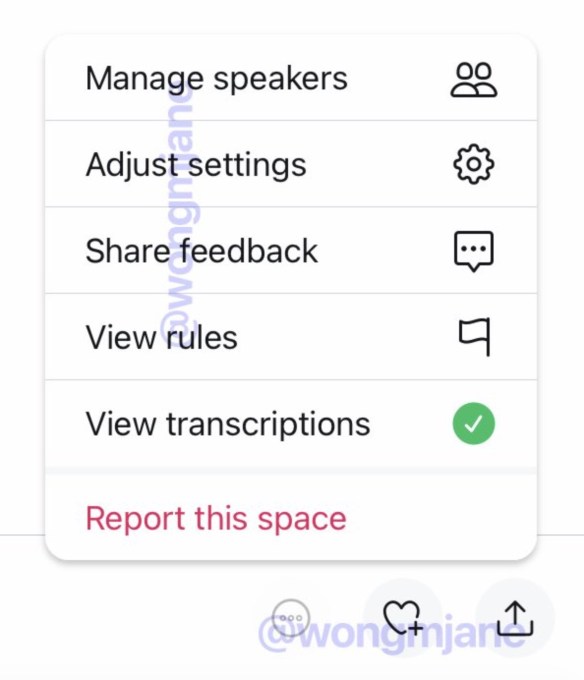
In addition, the Audio Space’s creator will be able to adjust who can speak at any time after the dedicated room has been created. From an in-app menu, they’ll be able to manage the speakers, adjust other settings, view the rules, as well as share feedback or report the space, among other things.

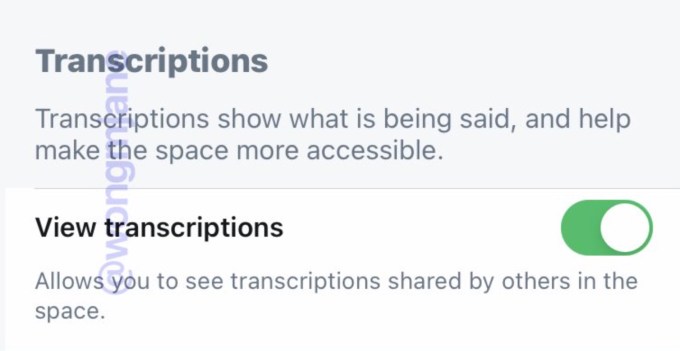
One interesting finding is that Audio Spaces will include transcriptions of the chat, according to this menu. That’s a differentiating feature, compared with some other audio chat room services. While ostensibly a feature designed for accessibility, it could also prove useful in keeping the conversations appropriate and respectful, since users would know their words were being written down.

This could help address one issue with the private chat room model, where live conversations have proven to be hard to moderate. Despite being in an invite-only beta, Clubhouse, for example, already experienced a handful of incidents of moderation failure, including the harassment of a New York Times reporter and another conversation that delved into anti-Semitism.

Twitter, which has struggled for years to combat abuse on its platform, was a questionable place to be testing this unproven new format for online socializing.

It wasn’t clear how Twitter will approach moderation for these audio chat rooms, but it appears the transcription feature could be a deterrent to toxic speech while the in-app reporting feature allows for a more direct solution to problems that crop up. When users choose the “Report this Space” option, they can then choose to report across a variety of categories, including self-harm, violence, sexual content, child safety, private information or abusive behavior.

Because Audio Spaces is in private beta, testers will also have access to a “Share Feedback” option that allows them to DM the account @TwitterSpaces.

Wong also noted Audio Spaces is using Periscope for its back-end, according to her digging in the app’s code.

Twitter earlier said Audio Spaces would be launching to a small group of users. During tests, those users would include a group of people who are “disproportionately impacted by abuse and harm on the platform: women and those from marginalized backgrounds,” Twitter Staff Product Designer Maya Gold Patterson had noted, when introducing the feature in a briefing for reporters this month.

Reached for comment, a Twitter spokesperson said: “We’ll have more to share on Spaces closer to the public beta experiment launch.”

FCC Chairman Ajit Pai will step down to make way for the Biden administration

The chairman of the FCC, Ajit Pai, has announced he will leave his position on January 20 as President-elect Biden is sworn in. Pai’s tenure has been a controversial one, and while he would almost certainly like to be remembered for his efforts to “bridge the digital divide,” as he was fond of saying, it is the dismantling of net neutrality that will be his legacy.

It is traditional at the FCC for the chairman to leave when the administration changes parties. Pai took over when Tom Wheeler, who chaired the commission at the end of the Obama years, resigned upon Trump’s election. The Biden administration has not announced its pick for the new leader of the communications agency.

In an official FCC memo, Pai thanked his colleagues and summarized the accomplishments of his four years at the helm (as, it must also be said, the first commissioner of Asian descent):

Together, we’ve delivered for the American people over the past four years: closing the digital divide; promoting innovation and competition, from 5G on the ground to broadband from space; protecting consumers; and advancing public safety.

I am proud of how productive this commission has been, from commencing five spectrum auctions and two rural broadband reverse auctions in four years, to opening 1,245 megahertz of midband spectrum for unlicensed use, to adopting more than 25 orders through our Modernization of Media Regulation Initiative, to aggressively protecting our communications networks from national security threats at home and abroad, to designating 988 as the three-digit number for the National Suicide Prevention Lifeline, and much, much more.

Notably absent from that list is Pai’s unfortunate magnum opus and arguably the effort that got him the job: The elimination of 2015’s net neutrality rules. The tremendously dishonest and partisan campaign to overturn these popular and important curbs on broadband companies put a stink on Pai’s tenure at the outset that no amount of good work could wash out.

For as always, the bulk of the FCC’s duties fly under the public’s radar, and a great deal of work was done under Pai, as under any other administration, invisibly and thanklessly. (Though in some cases less invisibly than before — Pai’s FCC did make improvements to transparency, in some ways anyhow.)

Surely Pai’s greatest priority was, as indeed he often stated, ameliorating the “digital divide” that prevents millions of Americans from enjoying affordable, fast internet. Numerous new programs and funds were created to improve this situation, but Pai was hampered by bad information — essentially provided on the honor system by ISPs themselves — and the seemingly endless rollout of 5G, which we’re all still waiting on.

His final effort, alas, will not much improve the opinion of him at large. As Trump raged impotently about Section 230, a law that shields internet companies from liability for the actions of their users, Pai took up that flag and announced his intention to revisit and perhaps change the interpretation of it — a month before the election. The simpering, plainly political nature of the effort, almost certain now to be aborted entirely, attracted considerable criticism, makes for a poor final chapter in an already troubling story.

The next step for the FCC is the nomination and confirmation of a new chairman and replacement commissioners, and though several names have been floated by political insiders, no one has emerged yet as the heir apparent.