Brand-To-Fan Platform Crowdtap Expands To Facebook & Mobile, Sees Revenue Soar

crowdtap-mobile-facebook

Crowdtap, a web-based network that allows brands to connect with their most engaged fans and customers through social media, has just expanded to two more platforms: Facebook and mobile. The mobile application comes in the form of an iPhone app which allows fans to participate in the brand’s “challenges” (games and contests) in order to earn rewards.

Meanwhile, the new Facebook tab sets up a special “VIP” section right on the brand’s own Facebook page, to allow for interactions with its top fans.

Since launching at SXSW in 2011, Crowdtap has raised $7 million in funding from the Foundry Group, and now counts among its customers over 60 well-known U.S. brands, including American Express, Old Navy, Sony Pictures, Dreamworks, Verizon Wireless, Microsoft, Pinkberry, and more.

In Q1 of this year, Crowdtap reports it has surpassed its entire revenue from all of 2011. Although the company declined to give hard numbers here, we do know that it had already surpassed $1 million in revenue as of July 2011. They tell us that’s it’s safe to assume that this number was “well surpassed” through the end of the year. And now they’ve made all that and more in just one quarter.

For those unfamiliar, Crowdtap allows a brand to reach out to its influencers from communities they’ve built up on Facebook, Twitter or in CRM databases, as well as reach out to Crowdtap’s member base of 250,000 consumers. In exchange for interactions with the brand, which may entail things like surveys, polls, online discussions or social sharing, the consumers are rewarded through exclusive access to new products and content, or whatever else it is the brand in question wants to offer – freebies, perhaps, or gift cards.

In addition, Crowdtap also supports fans’ favorite charities by allowing them to choose charitable donations instead of cash rewards, and it even goes so far as to require that a set number of a fan’s points are given to a charity.

There’s a “gamified” element to all this, too, as Crowdtap’s members earn points, badges and rewards for their participation.

For the brands and marketers, Crowdtap provides them with an online dashboard that gives them a real-time look into their social communities, helping them see how consumers are interacting and what insights they may have.

One of the first companies to roll out the Crowdtap Facebook tab is Woolite, and several clients are planning to roll out on the mobile app, but Crowdtap is unable to disclose the details at this time, due the the sensitive nature of its discussions with the brands.


Galaxy S III Reportedly Revealed In Vietnamese Hands-On Video

sgs31

With only a few weeks left to go until Samsung’s big London reveal, the leaks are just flying out of the woodwork now. If that recent Brazilian leak didn’t quite fill you with much confidence, this one just may — the team at Tinhte.vn recently posted an extensive hands-on with what claims to be the Samsung i9300, perhaps better known as the Galaxy S III.

I know, I know, we’ve seen scores of leaks up to this point, but it’s worth pointing out that Tinhte has an impressive track record. They went hands-on with the new iPad before just about anyone else, not to mention scoring early images of the iPhone 4 and Samsung’s 10-inch Galaxy Tab over the years.

Anyway. The i9300 — which BGR claims is the correct model number next big Galaxy phone — features a 4.6-inch 720p AMOLED display on the front, and an 8-megapixel camera pod around back. If the body looks a little strange (not to mention different from that other recent leak), The Verge reports that the device in question is wrapped in a dummy shell so as to keep the device’s true visage from showing through.

Inside that ersatz shell is a 1.4GHz quad-core chipset, and thanks to a quick look at the device’s System Information screen, it indeed appears to one of Samsung’s Exynos 4×12 series systems-on-a-chip. The device also sports 1GB of RAM, 16GB of internal storage, support for NFC, and the usual microSD card slot. The specs that Team Tinhte spell out are a bit more realistic rumor mill has circulated recently, and lends a bit of credence to the notion that the GSIII is more of an incremental update than a full-blown revolution.

At this point, there’s no way to be sure that this device is indeed the Galaxy S III (or whatever Samsung ends up calling it), but the fact that Tinhte has since yanked their post entirely fills me with a glimmer of hope. Fortunately, a copy of the video has made its way to YouTube with English subtitles, which I’ve included below.


AT&T’s AVP Of Technical Research Explains The New Watson Speech API

Screen shot 2012-04-20 at 9.59.43 AM

It was only yesterday that AT&T announced its Watson Speech API, meant to let developers of any kind provide products with real-time translation baked right in.

I got the chance to speak with Mazin Gilbert, AT&T’s AVP of Technical Research, about what this could mean over the next few months and years, and it sounds like useful, seamless translation might finally be in the pipeline.

We’ve seen real-time translation efforts again and again, but no one has ever really nailed it. By opening up an API to developers, AT&T has the numbers on its side, and it’s only a matter of time until someone breaks down the language barrier entirely.

Besides English, six languages are supported including Italian, French, German, Spanish, Japanese and Chinese. All the languages are in different stages of development.

The hope is that, eventually, I’ll be able to make a call to China and speak with someone as comfortably and clearly as I would if I was calling someone in the U.S.


Seeing Is Believing: This Nokia Ad Was Filmed Entirely With The 808 PureView Supercamera Phone

As this new ad clearly demonstrates the 41MP Nokia 808 Pureview is an amazing piece of mobile photography technology. It was filmed with just the 808 Pureview and it looks great. Nokia has a winner in the 808 PureView. Too bad it’s a Symbian device.

41MP in a handset? Yessir. As Devin previously explained, it should not be dismissed as a gimmick. This is a real advancement in sensor and processing technology. The only real downside are that it’s built around Nokia’s Symbian Belle OS and it’s not coming to the States anytime soon.

Nokia reportedly worked on the sensor technology for 5 years. Sure, the 808 is a tad bulky by today’s smartphone standard but the stellar camera should by enough compensation for its target niche.


HTC Is Done With QWERTY Keyboard Phones

htc-touch-pro

Touchscreens killed the keypad star. HTC is reportedly done with physical keypads and will instead focus on better on-screen keypad technology.

The word comes from HTC creative director Claude Zellweger speaking at a Seattle press event. “As a company the QWERTY keyboard we’re moving away from in general.” This likely doesn’t mean HTC won’t release another QWERTY phone in the near future but rather the company is shifting development focus away from physical keys.

This shouldn’t come as a surprise. The entire smartphone market started moving away physical keys as a response to the iPhone’s rise to the top. Even RIM followed this trend with its line of Storm smartphones. For better or worse, ditching physical buttons in favor for on-screen keyboards allow for thinner more stylish phones.

MobileBurn quotes Zellweger saying “putting too much effort into that [QWERTY phones] would take away from our devices.” This shows that HTC understands that the company needs a unified brand rather than a gaggle of phones. In previous years HTC seemingly released a new Android handset every three weeks. During Android’s roaring early days, this strategy helped grow the platform by enticing new buyers with fresh phones built on the latest technology. But now, as Samsung and Motorola have slowed their roll, HTC needs to do the same and it seems the QWERTY phones are getting the ax.


Applications About To Close For Wayra London Incubator

screen-shot-2012-03-07-at-14-27-18

Back in March giant telco Telefonica opened the latest addition to its growing global network of startup incubators dubbed “Wayra Academy”. Wayra is the latest incubator/accelerator in London, joining Springboard, Seedcamp and Innovation Warehouse.

Now this is fair warning that the deadline for Wayra applications is about to close. So you better hurry.

You can apply here.

If you’re wondering what the deal is with this latest in a long line of new European incubators, then here’s how it’s set up:

Telefonica takes around a 10% stake in a startup for up to €50,000 in funding, pocket change to a company their size. Wayra will put about 20 startups into its London building for six months, after which it will help them pitch for follow-on funding from other sources of venture capital. If after 6 months things are not working out I was told that Wayra will sell back their share of the company to the startup for €1. But check Ts & Cs I hazard. In exchange for all this Telefonica gets the right of first refusal on the companies. Clearly that provides some potential security in that you’ve basically got a potential buyer before you even start, but it’s not going to be very competitive if your startup gets a better offer from some other suitor. But if you’re a startup that needs to have a telecom partner at the off, this is a dream come true. Ultimately it plans to fund around 350 startups.

I think it would be good to get these all places singing and humming in London, which, at least according to the Startup Genome project recently, now ranks behind Silicon Valley and New York in terms of startup activity.


VCs Invested $5.8B In 758 Deals In Q1 2012, Total Dollars And Deals Both Down From Last Quarter

us

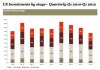
Venture capitalists invested $5.8 billion in 758 deals in the first quarter of 2012, according to a MoneyTree Report from PricewaterhouseCoopers LLP and the National Venture Capital Association (NVCA). The report shows that after a strong fourth quarter 2011, VC investment activity for the quarter fell 19 percent in terms of dollars and 15 percent in the number of deals compared to the fourth quarter of 2011 when $7.1 billion was invested in 889 deals.

While the Life Sciences (biotechnology and medical device industries combined) and Clean Technology sectors saw decreases in both dollars and number of deals in the first quarter, there were double-digit percentage increases in dollars invested in the Consumer Products and Services, and Telecommunications industries. Additionally, investments into companies in the Later stage of development experienced an increase, rising 11 percent and accounting for 40 percent of total dollars invested during the first quarter of 2012.

The Software industry received the highest level of funding for all industries with $1.6 billion invested during the first quarter of 2012, but still saw a 18 percent decrease in dollars, compared to $2 billion invested in the fourth quarter. The Software industry also had the most deals completed in Q1 with 231 rounds, a 12 percent decrease from the 262 rounds in the fourth quarter of 2011.

Dow Jones VentureSource reports in a separate study that U.S.-based companies raised $6.3 billion through 717 venture capital deals during the first quarter of 2012, an 18% decline in capital and 9% decline in deals from the same period last year. And the median amount invested in a financing round fell 13% to $4 million in the first quarter of 2012.

Internet-specific companies received more than one billion dollars for the eighth consecutive quarter with $1.4 billion going into 188 deals, which is 3 percent lower in dollars and 23 percent lower in deals than the fourth quarter of 2011 when $1.4 billion went into 244 deals.

Eleven of the 17 MoneyTree sectors experienced decreases in dollars invested in the first quarter, including Semiconductors (43 percent decrease), IT Services (26 percent decrease), and Industrial/Energy (14 percent decrease). The Consumer Products & Services sector experienced a 78 percent increase during the quarter due to the largest deal of the quarter ($238 million) occurring in that sector.

Even enterprise investments, which saw two years of growth, slowed, says Dow Jones. In the first quarter, 100 deals raised $947 million, a 29% decline in deals and 10% decline in capital raised from the same period a year ago.

Deals By Stage:

Seed stage investments fell 9 percent in dollars and 41 percent in deals with $141 million invested into 53 deals in the first quarter. Early stage investments fell 31 percent in dollars and 24 percent in deals with $1.6 billion going into 290 deals. Seed/Early stage deals accounted for 45 percent of total deal volume in Q1, compared to 53 percent in the fourth quarter of 2011. The average Seed deal in the first quarter was $2.7 million, up from $1.7 million in the fourth quarter. The average Early stage deal was $5.6 million in Q1, down from $6.1 million in the prior quarter.

First-time financing (companies receiving venture capital for the first time) dollars decreased 22 percent to $783 million in Q1, the third lowest level in survey history. And, the number of deals fell 28 percent to 195 deals in the first quarter, the lowest level since the third quarter of 2009. First-time financings accounted for 14 percent of all dollars and 26 percent of all deals in the first quarter, compared to 14 percent of all dollars and 30 percent of all deals in the fourth quarter of 2011.

Companies in the Software, Media & Entertainment, and IT services industries received the most first-time rounds in the first quarter. The average first-time deal in the first quarter was $4.0 million, up slightly from $3.7 million in the prior quarter. Seed/Early stage companies received the bulk of first-time investments, garnering 81 percent of the deals.

Dow Jones reported that in the U.S. specifically, seed- and first-rounds accounted for 44% of deals and 21% of capital invested during the first quarter, the same proportion of deals as the corresponding period last year but an increase from 16% of capital raised in that quarter.

Expansion stage dollars decreased 32 percent in the first quarter, according to the MoneyTree report, with $1.7 billion going into 207 deals. Overall, Expansion stage deals accounted for 27 percent of venture deals in the first quarter, a slight uptick from 26 percent in the fourth quarter of 2011. The average Expansion stage deal was $8.3 million, down from $10.9 million in the prior quarter.

Investments in later stage deals increased 11 percent in dollars and 13 percent in deals to $2.3 billion going into 208 rounds in the first quarter. Later stage deals accounted for 27 percent of total deal volume in Q1, compared to 21 percent in Q4 when $2.1 billion went into 184 deals. The average Later stage deal in the first quarter was $11.0 million, which decreased slightly from $11.2 million in the prior quarter.

The slump isn’t particularly surprising-other reports have shown a similar trend for the first quarter.

But global managing partner of PWC’s VC practice, Tracy Lefteroff says that the improvement in the public markets during the first quarter could lead to an increase in VC dollars spent in the second quarter.

“The overall decline in investment in the first quarter underlies several shifts occurring in the venture space,” said Mark Heesen, president of the NVCA. “The industry continues to contract and consolidate which is beginning to manifest itself in fewer dollars being invested in fewer deals. Yet, we feel that the overall impact will be positive for the asset class as only the best entrepreneurs and technologies will be funded at rational valuations.” He adds that with the exit market and M&A improving, VCs could be pouring more money into first time deals in the coming months.


An Uneven Number

The HTC One S will be available on T-Mobile’s 4G network on Apr. 25. Photo: Ariel Zambelich/Wired

HTC has been one of the more prolific players in the Android phone market of late. But so far, the Taiwanese manufacturer hasn’t quite solidified its desired reputation as a beloved premium handset maker, up with the likes of Apple, Samsung and Motorola.

Over the past couple of years, HTC’s strategy has been to make dozens of phones at dozens of price points — something for everyone, but nothing truly memorable. That “almost there” legacy continues with the HTC One S, the first model in the company’s newly rebooted smartphone lineup to reach the U.S.

The One S is a sleek, speedy and attractive handset that runs Ice Cream Sandwich, but HTC has made a few design stumbles here which keep the phone from being truly exceptional.

The One S is exclusive to T-Mobile’s 4G network in the U.S., and is available starting Apr. 25 at a price of $200 with a two-year contract.

It’s pegged as a mid-range flagship phone. If you’ve ever used the old HTC Sensation, then the One S will feel familiar, as it takes some of its design cues from the older handset.

Photo: Ariel Zambelich/Wired

The first thing I noticed was the quality of the materials used to make the One S. The anodized aluminum body feels strong and impressive. The feel is definitely metallic, and nothing like cheap plastic. The phone is super-thin (about a third of an inch thick) and at 4.21 ounces, very light.

I can’t think of a single phone on the market that looks quite like this.

The metallic back of the One S is beautiful, with a gradient paint job that starts as charcoal gray at the bottom and moves to a lighter blue-gray at the top. There is one simple microUSB port on the left side, with a headphone jack and power button up top and a volume rocker on the right side. There is no microSD card slot, so the included 16GB of storage will have to be enough. I should note that the phone comes with a total of 25GB of free storage from Dropbox, thanks to a special promotion. So if you’re comfortable living in the cloud, 16GB of onboard storage will be enough.

I can’t think of a single phone on the market that looks quite like this. That’s a good thing, as retail shelf appeal is a biggie. But while attractive, the aluminum back doesn’t feel particularly grippy. I often felt like the phone could slip out of my hand if I wasn’t careful in handling it.

The bezel that lines the edges of the 4.3-inch display dips slightly along the sides, allowing the aluminum edge of the case to meet the glass further down the sides of the device, rather than on the face. This means swipes and taps can be executed without ever encountering a hard edge on the face. Instead, you just feel smooth, responsive glass — a nice, thoughtful touch.

But the display itself isn’t all good. Colors were too bright and over-saturated. On websites, apps and photos, reds popped so much they seemed to be glowing. Blues were too warm, greens rendered and electric quality at times and over all everything felt too amped up. Comparing photos to their real-world counterparts and viewing the same image on other screens made these problems clear.

The 960×540 “qHD” resolution of the display was fine last year, but for a high-end phone in 2012, I’d expect at least a 720p resolution when watching video in landscape mode.

Another issue: the One S uses of a PenTile Super AMOLED display that’s inferior to what’s offered on Samsung and Apple phones — or even what’s seen on HTC’s One X (headed to AT&T). The PenTile pixel arrangement allows for a distracting pixelation of everything on the display. If you look closely, you’ll be able to see the jagged edges of app icons, text and images — particularly where black meets white. The subpar display takes away from the premium feel of the rest of the hardware.

Photo: Ariel Zambelich/Wired

Kick Out the Jams

Photo by Jon Snyder/Wired

For years, it was all about speaker docks — standalone, table-top systems that plug into the wall and hold your phone, charging it and playing your songs at the same time.

More recently, we’ve seen a flood of smaller, cord-free speaker systems that play streaming music from your mobile device. The king of this category is Jawbone’s Jambox, a six-inch-wide stereo speaker box with a USB-rechargeable battery, a rubberized case and a Bluetooth radio. It doesn’t charge your phone, but you can take it just about anywhere.

I love this category — I have a wireless speaker in every room in the house — so I was excited to test the Sound Kick, the newest speaker from Soundfreaq.

It’s a speaker box that hits a sweet spot between the compact Jambox and a larger, more traditional dock. It’s portable, uses Bluetooth to stream wirelessly, has a rechargeable battery, and it also charges your phone (any phone, not just an iPhone) via a USB port on the back. It sounds great, and it’s only $100 — half the price of a Jambox.

The manufacturer, Soundfreaq, is a small American company that makes a handful of mobile-centric products, including the Sound Stack, a traditional speaker dock with built-in Bluetooth that we rated very highly in 2011. The company also makes the Sound Step Recharge, another speaker system with a rechargeable battery.

But the Sound Kick is cheaper, more attractive and more portable than either of those. It’s not that small — about 10.5 inches long, 1.4 inches thick and about 4.5 inches tall, roughly twice the size of a Jambox and a bit heavier. A portion of the back panel pops out, letting it tilt back. The box-shaped section, which pulls out easily with two fingers, doubles as a speaker enclosure, so it improves the bass response from the pair of 2.3-inch drivers.

Photo by Jon Snyder/Wired

Along the top are standard controls: play/pause, forward/back, volume, power and a Bluetooth pairing button. There’s also a button marked “UQ3″ that adds some “spatial enhancement” to your audio. Most small speaker system have a similar feature, some DSP magic that pumps up the reverb and widens the stereo image. I don’t like it — the music sounds more delicate and distant — so I left it off most of the time.

Otherwise, the Sound Kick sounds amazing. It slaughters the Jambox when it comes to performance. It’s louder, more nuanced and much more clear in the highs and lows. There’s no distortion at full volume. It sounds markedly better than any other speaker box I’ve tried at the $100 price point, and it even rivals Logitech’s larger $150 wireless boombox, which has four active speakers.

Also, it stays put. This is a quibble, but some of these speaker boxes (the Jambox especially) are so small, the vibrations from the drivers make them dance around on the table and even fall off the edge to their potential deaths. The Sound Kick doesn’t move. It’s got a wide enough footprint and enough grip that it won’t budge, even when cranked.

Its ability to charge a smartphone or an iPod works even when it’s running solely on the battery.

To test the 2200mAh battery, I charged it all the way and ran it dry twice. I got almost exactly six hours of continuous play time out of it both times. That’s while streaming music over Bluetooth from an iPhone and an iPad. To recharge, the Sound Kick uses a standard wall wart — no USB charging here, unfortunately.

Its ability to charge a smartphone or an iPod works even when it’s running solely on the battery. Plug your phone’s charging cable into the USB port on the back, then start turning the volume down. Once you get to about 60 or 70 percent volume, you’ll see your phone switch into charging mode. Turn it up past that threshold and your phone stops charging. The lower volume level required to get it to charge your phone is a little too quiet, but it’s a fair tradeoff — you can sit in the park and keep your phone alive the extra hour it takes to polish off the twelver of PBRs as long as you’re willing to turn the Fleetwood Mac down a couple of notches. As you’d expect, the Sound Kick’s battery won’t last as long if you’re also using it to charge your phone, but it’s a convenient add.

Also, we should note that the Sound Kick is hitting shelves just as rumors about a bigger Jambox heat up. Jawbone has filed a design with the FCC for a 10-inch-wide, 2.8-pound Bluetooth speaker. It’s likely to be called the “Big Jambox” and sell for $300.

Seeing as how it’s only $100, the Sound Kick is an excellent buy. It’s available starting this week exclusively from Soundfreaq’s website and at Target stores, but a Soundfreaq spokesperson tells me the Sound Kick will make its way to other retail outlets in the coming months.

WIRED Bigger than a Jambox, but louder and clearer. Charges an iPhone (or any other smartphone) at half speed, or an iPod at full speed over USB. Battery lasts over six hours, which is respectable. Pairs easily to Bluetooth devices and maintains a connection without trouble. Audio in jack for non-toothy mobiles. Slim enough for a backpack.

TIRED Too big for a pocket or purse. Volume limit while charging your mobile is a bummer. Design isn’t that rugged, and it probably won’t withstand more than a couple of falls from the table to the floor. No USB charging, power supply required. DSP feature is a letdown.

Fore Eyes

Photo by Jim Merithew/Wired

I’ve been reviewing tech products for about 10 years now, and I can tell you that I’ve never been quite so sad to pack up and return a piece of gear as I was when I had to send back the Foresight Sports GC2. Because this deceptively simple-looking gadget could have changed my life. Or at least my golf game.

The GC2 is what’s known as a launch monitor. Using a high-speed stereoscopic camera system, it measures exactly what’s happening at the moment your club impacts the ball. The system can directly measure the ball’s speed, back and side spin, launch angle, and azimuth. From those parameters, it can then calculate the carry distance and total distance of the shot.

“So what,” you might ask. But for golfers, these numbers are the new Holy Grail. For most of the game’s history, it was impossible to know exactly what was happening at impact, and most teaching was informed by tradition, not physics. So, for instance, if I’m hitting slices with significant right-hand spin (not that I ever slice the ball), it means that the club face is open in relation to the path of the club at impact. With the numbers from the GC2, I can see exactly what is happening.

It’s also a huge boon for finding the right equipment. Grabbing four drivers, I could hit 10 balls with each, and quickly find that two of the drivers generated much more favorable launch conditions than the others. Further tweaking of the two good drivers allowed me to lower spin and increase my launch angle, which means more distance off the tee.

There are other launch monitor systems on the market, some of which use radar, and some which use cameras. What separates the GC2 is its size, and cost. It’s portable and can run on batteries, which means that, if you’re feeling very, very fancy, you can take the unit to the driving range. Just be prepared to have every single other guy hitting balls come by to see what you’re up to.

It’s also, relatively, a bargain. Which might sound insane when I tell you that the GC2 sells for $6,495, and you’ll pay another $2,195 for PC-based simulation software that let’s you play virtual courses and save and analyze your data. And sure, that’s a crazy, crazy amount of money.

But you have to remember two things. First, competitive systems run up to $20,000. And second, the CG2 is just really, really cool. Most avid golfers spend way too much money to try to improve their games; this is one piece of tech that just might actually help.

As I stood in front of the molded plastic case, having packed up the GC2 to return it, I wondered if I was doomed to mid-handicap purgatory forever. I’m hopeful that practice and lessons will help me continue to improve, but I’ll always look back longingly at my data-driven golden era.

WIRED Instant feedback on what, exactly, is happening with your swing. Portable, rugged, battery-operated. Bluetooth and USB connections.

TIRED Price is still too much for all but the most well-off duffers.

Photo by Jim Merithew/Wired

12 Pounds of Gaming Love

The Alienware X51 Andromeda. Photo by Jon Snyder/Wired

It’s been quite a while since I attended my last LAN party, but I was under the impression that most gamers have moved on to laptops like these folks, if for no other reason than to quit it with all the lugging, loading, and hauling of gear. A laptop makes things easy: Bring your power adapter and a laser mouse and you’re ready to frag.

But every gamer knows that laptops — even so-called “gaming laptops” — have limitations. Namely, they suck at gaming. And they are ridiculously expensive, and if there’s one thing the typical gamer doesn’t have, it’s lots of money.

And so “real gamers” continue to soldier on, lugging their home-built desktops, a keyboard, mouse, monitor, cables, and gumption to every LAN party.

To them, Alienware offers this proposition: Give us $1,000, and we’ll give you a gaming desktop in a pint-sized design that’s easier to lug around. At a bit over 12 pounds (not including the 3-pound power brick) and a bit larger than a gaming console, the Andromeda X51 is easily toted under one arm, leaving the other free to carry the Keystone Light.

Our tester was spec’d a little higher than the $700 base model. Here’s what $1,000 gets you: a 3GHz Core i5, 8GB of RAM, a terabyte of hard disk space (7200 rpm), an Nvidia GTX 555 graphics card (with dual outputs), and slot-loading DVD. Loads of ports are available, including two front-mounted USB 2.0 and audio jacks. In the rear, you get four more USB 2.0, two USB 3.0, HDMI, Ethernet, SPDIF TOSLINK and coaxial ports, and, on the graphics card, dual DVI and one mini-HDMI port. Certainly a workable configuration either as a gaming luggable or as a pint-sized computer for, say, a dorm room.

Of course, it’s the benchmarks that really matter on a gaming machine, and the Andromeda doesn’t disappoint. It didn’t stutter on any game we threw at it, delivering well into the 60fps-plus range on every gaming benchmark we use. Perfectly playable, and with a P3166 rating on 3DMark 11, vastly superior to any laptop you’re going to find at video operations. General performance was exceptional but not record-breaking. Most computers with Core i7 chips will do better with CPU-intensive operations if that’s on the menu.

Gaming on a laptop is no picnic, but hauling gear to an event is no fun either. There’s no denying the X51 will provide a far better gaming experience than any laptop — even a machine three to four times the price. But only you know your tolerance for attempting to strap a desktop into your car’s passenger seat with the seatbelt.

That’s probably why they invented online multiplayer.

WIRED Plenty of ports and power for most gaming needs. Super portable: 15 percent the size of a regular Alienware tower. Modular internal design makes replacing or upgrading parts easy. Sturdy build. Reasonably quiet.

TIRED Necessarily limited expansion options: 330-watt power supply and physical issues mean replacing the video card is tricky. Still more expensive than a DIY system. Power brick is the size of a man’s shoe.

TransferWise Raises $1.3M From Index, Others For The Next Disruption In Money Transfer: Crowdsourcing

money

If you’ve ever had to transfer money from one currency to another, you know that it can be a frustratingly pricey business. Now a new company, TransferWise, has raised seed funding totaling $1.3 million to tackle that problem.

TransferWise describes itself as the “Skype of money transfer” because it allows consumers to send money between UK and European accounts for a fraction of the price that banks charge, using a peer-to-peer, “crowdsourced” model to get the best rate on the exchange.

(And, also like Skype, it is banking on scaling up the business quickly in order to  make some money back on the margin that it loses in individual transactions. So far the service is only available in two currences, euros and dollars, but there may be more added soon.)

“Charging a small amount is clearly a scale business but we’ve now proven this model works between Pounds and Euros, so now the question is to expand, adding more users and more currencies and markets,” says Taavet Hinrikus, TransferWise’s founder and CEO. He says dollar expansion is “definitely” something the company is planning but equally is considering transfers to India and China, partly as a result of this funding. “There is so much to do,” he says.

Hinrikus is no stranger to growing along the Skype model: he was the Internet calling giant’s first employee.

And similarly, the company’s new investors also lend the startup strong e-commerce cred: In addition to lead investors IA Ventures and Index Ventures (which only weeks ago put $16 million into another crowdsourced money-exchanging startup, Funding Circle), other backers include PayPal co-founder Max Levchin, and an unnamed group of strategic angel investors that the company says have been behind a number of other disruptive e-payment plays like Wonga, Betfair and Paypal. Kima Ventures, Seedcamp and The Accelerator Group also participated.

The financials behind TransferWise make the service a very compelling option for individuals sending money from one currency to the other: A typical transfer of £1,000 into euros using Western Union can cost over £100 once you add in exchange rates and other fees. Hinrikus says the same transfer with a bank is slightly better but still expensive at £50. TranferWise’s cut on the same deal? £4.50, he says.

That kind of cost savings appeals exactly to the kind of people that TransferWise is seeing already using the service: expats, retirees, overseas workers and (increasingly) small businesses. These categories of users collectively transfer a significant amount of money ever year: TransferWise notes that expatriate retirees alone transfer £400 million annually transferring money through banks.

So how does it work, exactly? Hinrikus explains that TransferWise uses the same midmarket exchange rates that big banks get on the interbank market. However, banks will often play around with that exchange rate and factor in their own fees into the process. In contrast, TransferWise takes a fee of £1 on transfers up to £300.

The funding news also comes on the heels of TransferWise turning one year-old and reporting a milestone in its growth in February: €10 million ($13 million) in funds transferred, with €500,000 saved for users in the process. Those are small sums in the greater world money transfers, which sees upwards of $4 trillion in funds transferred every day. Still, that is also a sign that the service is seeing some activity, and that the market holds a lot of potential, too.

Roger Ehrenberg, managing partner at IA Ventures,will join TransferWise’s board of directors.


iKamasutra: A Tale Of Sex, Love, And Apple App Store Rejection

apple_after

I’ve seen plenty of apps get yanked from Apple’s App Store in my day, but the news of an app called iKamasutra getting that same treatment really has me scratching my head. I won’t rehash the entire story, but here’s the gist of what happened:

Apple pulled the iKamasutra from the App Store in February, and after a bit of sleuthing, creator Naim Cesur of NBITE managed to contact someone in Apple’s verification department. According to that Apple employee, the app was removed because of a suggestive app icon and a preponderance of detail in the images used (including the use of brown hair).

Cesur and his team dutifully updated the apps with a revamped icon and less detailed imagery, and resubmitted it. And then they waited.

It’s worth noting that iKamasutra is hardly a stranger to this sort of thing. Shortly after creator Naim Cesur first submitted it for inclusion in Apple’s App Store in 2008, reviewers shot it down for featuring “pornographic and obscene material,” an interesting claim for an app that seemed to have sexual positions acted out by Keith Haring characters. The app was rejected yet again around the time when Apple introduced age restriction controls for apps, but was finally admitted into the store around December 2009.

Meanwhile, Google too quickly yanked the iKamasutra app from the Google Play Store, and the end result was only slightly less unpleasant. After the app was pulled the team soon discovered the rationale behind the decision — according to an email from the Android Market Support team, the app violated the sexually explicit material provision of the content policy.

NBITE eventually made the decision to trick out the Android version with the same toned-down visuals, and re-release it as a separate app in the Google Play Store where it remains. Meanwhile, they’re still being shut out of Apple’s walled garden.

I had to see what all the fuss was about. With iKamaSutra unavailable from the iOS App Store, I turned to two of the three remaining versions of the app still in circulation — the original version in the Windows Phone Marketplace, and the similarly updated version found in the Google Play Store. I downloaded them, fired them up, and started digging.

And what did I happen to find? Putting some mildly annoying music aside, not too much. Looking at the “uncut” version, I can sort of understand where Apple is coming from with regard to the offending gray lines. They’re mainly there to add a bit of anatomical detail — think faces, the curves of someone’s back, a collarbone — but Apple’s original umbrage probably stems from the fact that they also delineate the occasional breast or buttock.

But the bowdlerized version available in the Google Play Store is said to feature the same set of images in the updated version of the iOS app, and there’s nothing explicit to be found here — just plenty of vague silhouettes enjoying each other’s company.

Would I show them to my mother? Probably not. Would she be unduly disgusted or disturbed by seeing them? Absolutely not.

From my vantage point, NBITE has complied with everything that Apple has asked of them (and more). Brown hair? Fixed. Potentially suggestive gray lines? Gone. So what exactly is Apple’s problem with the app now? Well, when Apple finally responded to the Cesur and the NBITE team, it was to say that there were too many Kama Sutra apps in the App Store.

The thing is iKamasutra has been in the App Store for years, and has racked up something like 8 million downloads in that time (Cesur tells me that it would’ve easily exceeded 9 million by now had it not been pulled). That there are plenty of Kama Sutra apps in the App Store isn’t really a question, and there are indeed plenty of lousy ones. There’s an argument to be made for good apps that happen to fall under that category though, and from my brief experience with it, iKamasutra certainly seems to be one of them.

I suspect the real issue here is one of subjectivity. Even with age controls in place, Apple will never, ever let explicit content into the App Store, but I have to wonder about the criteria that Apple’s reviewers are using to judge cases like this one. I don’t doubt that Apple’s review crew is doing what they’re doing for the sake of protecting their users, but I don’t think enacting a sort of blanket policy is the way to go. Alternatives are surely tough to come by considering the sheer number of apps that require their attention, but a case like this raises some valid concerns about the consistency of the review process.


CEO Scott Thompson To Cut 50 Properties: “Yahoo Has Been Doing Way Too Much”

scott-thompson

CEO Scott Thompson outlined his vision today for how Yahoo can start growing again. His big theme: Focus, focus, focus.

“Yahoo has been doing way too much for too long and was only doing a few things really well,” Thompson said.

He was speaking on the earnings conference call covering his first full quarter as CEO — revenue was flat while earnings went up. Thompson has already been making some big changes, with layoffs and a major reorganization, but he said he isn’t satisfied with the results so far.

Even the company’s lesser-known properties may be getting more engagement than most startups or mid-size companies, but Thompson said, “That doesn’t mean we should continue to do everything we currently do.” He said he will be shutting down or “transitioning” at least 50 Yahoo properties (he didn’t say which ones, but we’ve heard that a number of Yahoo entertainment-focused properties were hit hard by the layoffs), so that it can focus on core products like Mail, Finance, and Sports.

Other strategies include using all the data that Yahoo has collected to deliver a more personalized experience for users, doing more to show advertisers their return on investment, and accelerating the process of developing new features and products.

“Yahoo has built processes that were originally intended to help us scale but they’ve become way too complex and stifled innovation,” Thompson said.

Shutting down properties may lead to a “modest” decrease in revenue, but the company’s margins will improve, he added. (Earlier in the call, CFO Tim Morse said the company is aiming for margins of 20 percent, excluding traffic acquisition costs.) He also said that Yahoo won’t rule out developing new products in the future, but first it needs to “earn the right to pursue new growth opportunities” by improving core experiences.

“I’m convinced we don’t need to reinvent who we are,” Thompson — instead, Yahoo just needs to reinvent the user experience.


Liberate Your Pics: OpenPhoto Brings Its Killer Photo Sharing Platform To Your iPhone

Screen shot 2012-04-17 at 10.41.10 AM

If you’ve ever scoffed at Flickr, felt that photo sharing and storage websites hold your photos hostage, associated photos on the Web with platform lock-in, then you’ve already started to get a sense of why Jaisen Mathai left Yahoo last year to build OpenPhoto. Appalled by having to watch Yahoo let an awesome startup/service like Flickr go to seed, (“I was extremely frustrated by the lack of product vision,” Mathai said at the time), he took to Kickstarter and raised the $25K he needed to get it off the ground.

That was July of last year. Since then, Mathai joined WebFWD, Mozilla’s Open Innovation program, which gives select entrepreneurs 1:1 mentorship, access to the Mozilla global network, infrastructure support, etc. Today, OpenPhoto has a new, redesigned website, a brand, spanking new iPhone app, and Mathai has recruited an all-star team of designers and engineers, ex-Yahoo, ex-Apple, current Twilio and Mozilla engineers, a principal designer of OStatus protocol, and the organizer of the Scale Linux conference, to name a few, who are all donating their time to the project.

Again, as you might have guessed, the biggest value proposition for OpenPhoto, and something Mathai has become obsessed with, is that it is meant to be immune to a website, service or application dying, paradigm shifts and changings of the guard. The founder believes OpenPhoto is the only photo service where users have more control and access to their photos than the service itself, which means that everything is done on the user’s terms — and that right there is OpenPhoto’s main differentiator from the scores of other photosharing tools out there.

This means that, in terms of how the service works,u users get to select where they’d like to store their photos, whether that be on Dropbox, a personal Amazon S3 bucket, or on a hard drive. Users then have the option to let OpenPhoto scour all of your photos — those already uploaded to Flickr, Picasa, or Facebook. OpenPhoto stores them all in a central spot, which is always backed up and available on your laptop or on your phone.

As to the service’s new iPhone app, the same features apply. Connect OpenPhoto to your Dropbox account, upload photos from your camera roll or take a photo, view, organize and share from the app, post on social networks, crop, add filters, etc. But the biggest part, with the most potential implication is that it’s all completely open sourced on Github.

Mathai says that he hopes that designing OpenPhoto to be open source at its core helps bring longevity, as the history of photo sites is full of those falling out of style, shutting down, or drastic changes in focus. This leaves users in the difficult spot of having to retrieve content or deciding if they like the new service. Being open source, Mathai says, the community keeps the designers honest, and makes users a big part of how the service/UI/UX evolve, even if this means forking off in a new direction, which, when coupled with how the photos themselves are stored, means users can easily switch to a different variant or use both simultaneously.

In terms of storage, Mathai says that this is something that the team is trying to “abstract away” as much as possible, focusing more on Dropbox early on, since that’s what makes since for most consumers. But the service may eventually begin to remove the “select your service” option and assume smart defaults that work for most users, as long as it doesn’t sacrifice one of the top priorities: Portability.

Of course, as many are well-familiar, Dropbox isn’t optimized for sharing or managing photos. And, looking at the startup’s roadmap, its not likely that they will be making a lot of improvements there, as it really lies outside their core competency — storage and syncing at scale. OpenPhoto wants to make it easy to organize and share your Dropbox photos, adding value by way of an awesome set of UIs that lie on top of Dropbox. Check out the photo below for an example.

As to monetization? When I asked Mathai if this were a project developed purely in the name of democratization and open source — mission-driven rather than financially driven, the founder gave a great response: “It’s about the mission but without money it’s moot and will become just another open source project that a bunch of nerds use.” The team plans to build a business model that is, as they say, similar to what Automattic does with WordPress. The hope is that eventually there will be an ecosystem of designers and engineers making money from OpenPhoto.

Next, we raised the question of Instagram’s $1 billion sale to Facebook, to which Mathai said that he thought social (and, really, Facebook and Instagram) represented the only innovation in the photo space over the last five years, making photo sharing natural, effortless, and fun. However, on the flip side, photo management has (at least relatively) been ignored: “I think we’re actually worse off today than we were 30 years ago, in terms of managing and preserving our photos,” Mathai says.

Mathai thinks, and I tend to agree, that personal clouds will eventually win out, but this is a paradigm shift, and most companies and developers don’t think in terms of how and where that data is stored. Companies have a lot to lose by allowing users to take their content elsewhere, but it will happen, and those who stand in the way, leave a trail of unhappy ex-users as they go.

So, beyond being able to install OpenPhoto yourself, or sign up for a hosted account, the platform offers developers a set of APIs which they can use to make cool apps for the platform, and help steer it forward.

While the startup’s iPhone app is live, the team is still working out the kinks, and wants to get the app to a point where it really sings before it focuses full-time on releasing its Android version. But Mathai said he hopes to launch on Android within the next two months, with the help of his mobile lead, Patrick Santana, who joined OpenPhoto full-time at the beginning of this year.

All in all, OpenPhoto has come a long way since Mathai posted his project on Kickstarter last summer, and it’s been fun to watch its evolution. There’s still a long way to go, but in the wake of Instagram’s acquisition, a lot of people are looking around for the right photo sharing, photo management solution, and considering OpenPhoto gives you more control and more options than any of its kind, it stands to gain. The technology is there, and it’s improving, though it will be essential for OpenPhoto to balance its geek cred with killer consumer application. It’s definitely on the way.

And, hey, Instagram and OpenPhoto are both powered by Ubuntu, but OpenPhoto lets you manage photos with much more control, and make your Dropbox photos look sexy. And what’s better than that?

You can check out OpenPhoto on Github here, and tinker away. Or you can check out openphoto.me for the hosted version, the iPhone app here, and the project here.

Let us know what you think.