20M Users Strong, Lookout Partners With Deutsche Telekom To Bring Mobile Security Apps To Europe

deutsche-telekom

Lookout, a company that offers security services for a number of smartphone platforms, is continuing its international expansion to Europe with a strategic partnership with European telecommunications giant. Deutsche Telekom. Financial terms of the partnership were not disclosed.

For background, Lookout’s web-based, cloud-connected applications for Android, Windows Mobile, BlackBerry and iOS devices help users from losing their phones and identifies and block threats on a consumer’s phone. Users simply download the software to a device, and it will act as a tracking application, data backup and a virus protector much like security software downloaded to a computer. People can also manage multiple mobile devices and locate a phone or tablet on a Google map. Lookout, which now has 20 million users, says it identified more than 1,000 instances of mobile malware in 2011, which is a significant increase since 2010.

Last year, Lookout raised $40 million in new funding from Andreessen Horowitz, Khosla Ventures, Accel Partners and Index Ventures to help expand the company’s presence abroad.

The partnership focuses on distribution and joint innovation, aiming to bring mobile security and better device health to Telekom’s millions of customers throughout Europe. CEO John Hering tell us that this is the company’s first strategic carrier partnership in Europe. He explains that while product details of the deal are still being determined, Deutsche Telekom and Lookout are teaming up to drive innovation in new areas of product development for the security company. Deutsche Telekom has set up a facility for Lookout in Berlin, he says, to build new functionalities together. In some Deutsche Telekom phones, Lookout will be preloading its mobile security app, he adds.

“The mobile environment is increasingly led by downloadable mobile applications, often with people customizing their devices with mobile applications from different sources,” says Heikki Makijarvi, Senior Vice President Business Development at Deutsche Telekom. “This drives the importance of security and health on mobile. Lookout’s experience in developing leading-edge security applications for this new dynamic environment makes them the ideal partner for Telekom in this critical new category of device solution.”

This partnership adds to relationships Lookout has with a number of U.S. carriers, including Verizon, Sprint, and T-Mobile (a subsidiary of Deutsche Telekom). And the company’s mobile security app is already available in Australia, Canada and the United Kingdom via native apps.

Herring says that the expansion of Lookout to European customers will also help boost the security company’s Mobile Threat Network, a cloud-based network which constantly analyzes global threat data to identify and quickly block new threats with over-the-air app updates. The Mobile Threat Network scans billions of apps a month.


Vodafone Buys Cable & Wireless For $1.7B, Gives Mobile Carrier Bigger Window On Enterprise, Broadband

Image (1) logotipo_vodafone.thumbnail.jpg for post 363518

Big news from the UK this morning: Vodafone, one of Europe’s biggest mobile operators, has made a formal offer to buy up the assets of Cable & Wireless Worldwide  for £1 billion ($1.7 billion), a deal that catapults Vodafone into running its own fixed line network in the UK and specifically will give it a much bigger view to winning enterprise business — a big challenge to BT and a mark of further consolidation in the space.

Cable & Wireless, first founded in the nineteeth century and one of the biggest operators in Europe, has fallen on hard times more recently and has run through three chief executives since a restructuring in 2010.

The deal will make Vodafone the UK’s second-largest operator, with £7 billion ($10.5 billion) in annual revenue.

According to Vodafone’s statement to the market, Vodafone will offer C&W shareholders 38 pence in cash for each C&W share, a premium of 92 percent to C&W’s closing price on February 10 (when Vodafone had first made its offer). It says that both sides have reached agreement on that deal and that C&W directors will recommend the buy to shareholders.

The deal opens a new opportunity for Vodafone to offer networking services for enterprises, which form the core of C&W’s customer base at the moment, but as Vodafone CEO Vittorio Colao noted in the statement Vodafone could also use C&W’s extensive international network to offload its mobile network traffic in other markets and serve enterprises outside the UK, too:

“The acquisition of Cable & Wireless Worldwide creates a leading integrated player in the enterprise segment of the UK communications market and brings attractive cost savings to our UK and international operations. We look forward to working with the management and employees of Cable & Wireless Worldwide to combine our expertise for the benefit of our customers and shareholders.”

It will also give Vodafone its first crack at owning a broadband network: that could mean more consumer services from the carrier, too, to compete against incumbent operator BT.

It raises another question, though: currently Vodafone supplies BT with wireless network that it sells on to customers; and BT provides Vodafone with backhaul for its wireless network. For now it looks like business as usual: “I see no reason why our relationship with BT should not continue to be good,” Colao noted in the analyst call earlier today.

The deal is also a setback for another carrier, Tata in India, which had also been angling to buy C&W as part of its international expansion strategy; it withdrew its bid last week.

Cable & Wireless is one of the UK’s oldest carriers. The company was first established from a number of international telegraph assets and in the 1980s became the first carrier to offer a competitive service to BT in the UK. It’s not clear yet what will happen to C&W’s current chief executive, Gavin Darby, although this deal could mark a return of sorts: he had joined C&W in November 2011 having previously worked for Vodafone.

At the moment around one-third of C&W’s revenues come from its international operations, which extend across the UK, Asia Pacific, India, Middle East & Africa, Europe and North America.

In the UK, although C&W had offered retail services (eg broadband and other products like cable) to consumers in the past, more recently the company has been operating as a wholesale carrier, with other operators using its network to deliver broadband to businesses and consumers. It will be interesting to see whether Vodafone plans to continue this business model, or use the network to launch its own broadband operation.


Read Offline: News.me Automatically Downloads Your News Whenever You Leave Home

Screen shot 2012-04-22 at 10.28.47 PM

News.me, the newsreader app hatched in The New York Times’ R&D lab and incubated at betaworks, today added a nifty feature to its new iPhone app, which gives readers instant access to their news offline — whenever they leave the house. The new feature, called Paper Boy, allows users to set their home location using their iPhone’s GPS, and thereafter, every time they leave their digs with phone in tow, News.me automatically downloads their social news in the background so that it’s ready to read offline as they go about their day.

For anyone who uses public transit to get to work and is as as a result without WiFi, PaperBoy’s value proposition should be immediately apparent. While there are hundreds of ways to check news sources, many of them only offer their content when connected to the Web. News.me General Manager Jake Levine tells us that, since News.me is located in New York City, the team often uses the city’s subway system to get around, but found themselves without anything to read while in transit.

Paper Boy was designed to eliminate this pain point, and provide subway, bus, and train commuters instant access to their news while on-the-go. Outside of Newsstand apps, Levine says that News.me is the first app to offer this functionality — to support background downloading of news content whenever readers leave their home addresses.

In the beginning, News.me’s social newsreading experience was iPad-only, offering readers an aggregated list of news stories drawn from Facebook and Twitter, curated based on signals from Twitter and bit.ly, viewable in the context of the original tweet or Facebook comment. The startup also offers a Summify-like email digest of news culled from users’ Twitter streams, which picked up quite a few users in the wake of Summify’s acquisition.

News.me’s email digest turned out to be much more in demand than its iPad app, so, in March, News.me launched a new iPhone app that completely rebuilt the app’s mobile experience from the ground up. As Anthony pointed out at launch, the real goal of re-imagining the app was to bring News.me into the realm of a news-based social network.

Leading with a feature called “Reactions,” readers now have the ability to post responses to the stories they find in their streams, with the added benefit of being able to follow other users and comment on their friends’ shared stories. The app offers five pre-written responses — “Ha!”, “Wow”, “Awesome”, “Sad”, and “Really?” — that enable them to respond to news automatically, without having to spend time creating a paragraph-long response.

The startup’s iPhone app is designed to let users share and respond to shared news quickly, while giving them a smaller microcosmic social network in which they can share their thoughts without having to post to their Facebook walls or Twitter streams. It’s an approach to news sharing that puts News.me in competition with Flud, which made a similar play into social newsreading back in December.

Without a doubt, there’s way too much noise on the Web when it comes to news shared across our social networks, and News.me has developed a fairly useful tool for channeling that noise into a signal of top news from our most-used social networks, that is pre-filtered and easy to consume. And since so many of us love to consume news while on the go — when we’re not in the driver’s seat — Paper Boy is a smart, easy way to quench our thirst for news when we lose access to WiFi. (To find it, just head to “Settings”.)

You can find News.me available for download in the App Store here.


Adobe Officially Unveils CS6 And Its $49/Month All-Inclusive Creative Cloud Subscription Service

creative_view_changes

Today is a big day for Adobe. Not only is the company officially unveiling the next versions of virtually all of the applications in its Creative Suite, but Adobe is also launching its Creative Cloud online offerings. This marks a major change in how Adobe is selling and marketing its flagship product: while the company will continue to offer a shrink-wrapped version of CS6, it’s also introducing a subscription service with this update. For $49/month with an annual subscription or $79/month for month-to-month memberships, users can now get full access to any CS6 tool, including Photoshop, InDesign, Illustrator, Premiere Pro and AfterEffects. The suite will also include Adobe’s new HTML5 design and development tools Muse and Edge, and will be deeply integrated into the company’s tablet apps. Users will be able to download and install these apps on up to two machines.

Photoshop, the most popular application in the suite, will also be available through a stand-alone subscription for $19.99/month with an annual membership and $29.99 without.

Adobe will also offer a student and teacher edition of Creative Cloud for $29.99/month. Current CS3, CS4 and CS5.5 users will qualify for a special introductory offer of $29.99/month. In the coming months, Adobe will also launch a version of Creative Cloud for teams, though the price for this one hasn’t been determined yet.

Oddly enough, the company hasn’t announced an actual launch date for these updates and new services yet. According to today’s announcement, however, these products “are scheduled to be available within 30 days.”

The updated Creative Suite apps obviously include a number of major changes, but maybe the most interesting change – and likely also the controversial one – is Adobe’s move toward a subscription service for CS6. The company obviously knows that quite a few of its users still want to buy the standard shrink-wrapped versions of its apps and will continue to offers these as well.

As Scott Morris, Adobe’s senior marketing director for the Creative Pro product line, told me last week, though, the company expects that most of its users will slowly migrate to the subscription service over time. In Adobe’s view, this gives users more flexibility to use apps when they need them and put their subscription on hold when they don’t. Adobe also plans to release a steady stream of new tools and updates to subscribers that won’t be available to users of the standard version until the next major update. Lightroom 4, for example, won’t be finished in time for this launch, but Creative Cloud subscribers will get it, as well as the final version of Adobe’s HTML5 development program Edge, the moment it becomes available later this year.

Photoshop, of course, is among the most pirated applications and while Morris stressed that the subscription service shouldn’t be seen solely as a way to combat piracy, he did acknowledge that it has the potential to help Adobe with its piracy problem.

Creative Cloud isn’t just a subscription service to Adobe’s tools, though, it also includes an online storage and sharing component. Adobe itself calls it its “hub for making, sharing and delivering creative work.” Subscribers will, among other things, be able to sync their files to Adobe’s cloud and then edit them with the company’s mobile tools on the iPad, for example, or just upload their files Dropbox-style to the web and share them with their clients or colleagues. Initially, users will have access to 20GB of online storage, with additional storage purchase options coming soon.

Creative Cloud subscribers will also get access to Adobe’s publishing and web hosting services, which will allow them to easily publish their apps, magazines and catalogs to iOS, Android and the web. Members will also get access to Typekit, which offers web designers access to 700 fonts.

The forthcoming team version of Creative Cloud will give users access to more storage and administrators will be able to allocate disk space depending on individual users’ needs. In addition, Adobe will provide these subscribers access to something akin to Apple’s Genius Bar where users can get one-on-one advice and support.

Another aspect of Creative Cloud will be its community site that will include a deviantART-like component for publicly sharing work with others.

As for the individual apps that are getting updates today, there are too many changes to list them all. As Morris told us, the focus here, for the most part, was on making the apps more responsive and smarter. Here are some of the highlights from the individual apps:


Google Makes Its Big Video Push With AdWords For Video

adwords for video

A couple of weeks ago, early participants in the new AdWords for Video program gathered at the YouTube offices. The ostensible justification for the meeting was a fancy photo shoot, but YouTube executives also gave a little pep talk, laying out their vision to make video advertising available to small businesses. They even let themselves get a little dreamy, imagining a day when video might become as lucrative for Google as search.

So what is AdWords for Video? It integrates video campaigns into the AdWords dashboard, where Google’s search and display advertisers are already bidding for and managing their campaign. So small businesses can treat video ads as just another campaign that they’re running with Google, rather than something big and scary. It could be particularly useful for the ones that already have a big presence on YouTube that they’d like to promote. Specifically, AdWords for Video allows you to buy Google’s TrueView ad units, which can appear in YouTube videos, alongside search results, and in the company’s display network.

The program was first announced publicly in September and has been beta testing with select advertisers. Today, however, AdWords for Video is having its official launch, and the program is opening to everyone.

For Group Product Manager Baljeet Singh, the program began two years ago, when he was talking with business-owning friends. Singh suggested that they advertise on YouTube, but they said it had never even occurred to them as a possibility. Naturally, Singh decided that he had to build an ad service that his friends would use, and today is the culmination of those efforts. The product has evolved over those two years, but Singh says there has been “a common thread of trying to make it easy and democratize the flow for our advertisers.” In other words, he says the aim was to continue simplifying the ad-buying process as much as possible.

The program could also become a key way for Google to monetize YouTube. The video site’s finances are the subject of ongoing speculation, with one of the challenges being user-generated content that could scare away advertisers. Singh says that by enlisting advertisers through AdWords, Google should be able to fill more of YouTube’s ad inventory — but that doesn’t mean Google will be sticking ads in front of any random video.

“There’s a set of videos that are monetizable,” Singh says. “Clearly, with more demand, that’s going to imply that more of those videos … are going to be monetized. But it won’t change the set of videos that are monetizable.”

To help get the word out, Google has appointed nine Ambassadors — businesses who have already had success with AdWords for Video, who have chosen to each mentor a nonprofit on getting started on YouTube, and who will be hosting Google+ Hangouts to share their strategies. The Ambassadors cover a pretty broad range of businesses (albeit usually ones with a strong online presence and lots YouTube videos to promote) including Berkleemusic.com (the online arm of the Berklee College of Music), online clothing retailer ModCloth, and RevZilla, a site that sells motorcycle gear. I talked to representatives from each of those three companies, and they all talked about how the program had opened their eyes to what they can do with video ads at a relatively low cost. They also had suggestions for future improvements — mainly ways to track how each video led not just to views and clicks to a website, but actual purchases.

You can read more at the Get Started page.


Andreessen Horowitz Made $78M Off $250,000 Investment in Instagram

instagram logo

Andreessen Horowitz revealed that it made $78 million off its $250,000 seed investment in Instagram’s billion-dollar acquisition in a post that was meant to quell criticism that it “fumbled” its involvement with the company.

“Ordinarily, when someone criticizes me for only making 312 times my money, I let the logic of their statement speak for itself,” wrote general partner Ben Horowitz. “However, in this case, the narrative that some critics put forth has the nasty side effect of casting two outstanding entrepreneurs—Kevin and Dalton Caldwell—in an unfair light and glosses over an important ethical issue that we faced.”

While Andreessen Horowitz was one of Instagram’s very earlier investors, it said it didn’t follow-on because of a conflict of interest with another company it funded. The firm had supported Picplz, another photo-sharing concept that didn’t end up having as much momentum as Instagram. The company behind it eventually changed changed course and turned into App.net, which gives other mobile developers landing pages and other tools for acquiring users.

Dalton Caldwell, who was chief executive of the company behind Picplz, was already working on photo concepts in April 2010, a month after Kevin Systrom raised $500,000 in funding for Burbn, a location-sharing concept that would eventually morph into InstagramInstagram launched in early October 2010 and Caldwell’s company said it had closed funding in early NovemberInstagram later went on to take funding in a round led by a rival top-tier firm, Benchmark Capital.

Last week, The New York Times ran a story saying that Andreessen Horowitz had basically screwed up its investment in the company. The decision to fund Picplz “was a calculated bet against Instagram and it left Mr. Systrom livid,” the Times reported.

But Horowitz is framing the choice as an ethical issue:

After speaking with both entrepreneurs and much internal discussion, we concluded that funding Kevin to compete with Dalton would be a violation of the original implicit commitment we made to Dalton—to not fund competitors to PicPlz. On the other hand, funding Dalton did not violate our implicit agreement with Kevin because he changed his business—we’d funded Burbn not Instagram.

So our choices were: a) invest in Dalton b) invest in neither or c) invest in Kevin and violate our commitment to Dalton. As soon as we fully recognized those were the choices, we ruled out option c and elected option a.

However, we still had a problem: because we had invested in Kevin’s seed round, we had both information rights and pro rata rights to the series B. These are important and valuable rights, but it seemed completely unethical to us to exercise them since we funded a competitor. As a result, we unilaterally and without compensation or consideration gave Kevin back those rights and did not invest further in Instagram.

And note to future founders: Horowitz emphasized that what Instagram did in selling to Facebook for $1 billion is exceedingly rare. For every company like that, there are literally thousands of failures.

He added, “News to world: it generally takes longer than two years to create a billion dollars in value. What Kevin and team did was special and unique.”

This story is developing….


Web Video Sucks, But Here’s How It Can Be Great

Button-Play-icon

Editor’s Note: Jordan Kurzweil is Co-CEO of Independent Content, an agency that helps media companies launch new digital products and businesses. Prior to starting Independent Content, Jordan worked at AOL running original programming, and News Corp, where he helped bring its traditional brands to digital. You can follow him on Twitter @jordankurzweil.

I love movies. I love TV shows. I hate web videos.

They suck.

But let me qualify: An overwhelming number of professionally produced made-for-the-web videos are just not worth watching and barely hold a viewer’s attention for their miniscule run-time. Largely, they’re ill-conceived, poorly executed, poorly commercialized or downright boring.

Yes, there are a few individual standouts (maybe The Guild, some SNL Digital Shorts, La Blogotheque’s “Take Away Shows,” a few Funny or Die clips, and a never-ending line-up of “viral videos”), but you’d be hard-pressed to name a web program that has achieved irrefutable success — a sustained, engaged audience at scale, or more simply, a web series you watch religiously and recommend to others.

And the thing is, there’s no good reason this has to be the case. Web video programs DO NOT have to suck.

The industry has grown-up — the audiences are there, the ad dollars are waiting — and with advertisers and networks gathering for the Digital Content Upfronts Newfronts this week and next, we need to seriously define success in the world of made-for-the-web video, put into practice the mechanisms for creating those successes, and own up to our hits and misses.

Last week at the IAB’s Digital Video conference, a host of execs from media companies, ad agencies and technology companies tried to provide a definition of success and came up with two basic points of view:

1) Popularity – How many people have seen a video
2) Ad dollars – How much money is spent on ads in and around a video

Unremarkably, given industry-wide fear of failure, and consistently unproven ability, they missed a third, huge factor: Building real audience.

Since the advent of media, Audience with a capital “A” has been the core definition of success. Whether a newspaper, television show, film, band, book or blog, an engaged, active, repeat audience is what makes or breaks a media property. Audience — habitual, fervent, powered by word-of-mouth — builds value and drives all other successes: Ad dollars, box office sales, subscriptions, downloads, etc.

This is why Ted Sarandos at Netflix is investing so heavily in original programming (as is Hulu) with a focus on building “strung out” audiences, and why web businesses like Machinima are raising capital on valuations in the hundreds of millions of dollars. In the era of video everywhere, large audiences of hooked viewers for extended periods of time equates to success. Nothing new.

Taking an honest look at original web videos, most, if not all, have failed to build real audiences, and none have inspired the sense of awareness, fandom (or even bubbling fervor) that develops around an even mildly successful television show.

Not Battleground.
Not Lilyhammer.
Not ClevverStyle.
Not Failure Club.
Not The Gillmore Gang. (Sorry TechCrunch)

But the thing is — and I never would have said this a few years ago — web originals can build Audiences. Here’s how.

Step one, promotion.

The web has proven it can drive viewership at scale, i.e. we can direct large audiences to a single piece of content. The web portals, iTunes, and ad agencies do this everyday via homepage promotions, media buys, content discovery widgets, social media campaigns and so on. This type of initial burst of promotion drives sampling, or as TV folk call it, tune in. We can, and should refine the use of these tools and use them in a coordinated and even bigger way along with offline promotion to drive eyeballs to programming.

Step two, make it f*cking great.

Easy to say, and hardest to do, but when viewers arrive, we need to entertain and provide immediate value. We need to make great content. To date, as I said at the top, we have failed as an industry to do this (Note: I am partly to blame. As the GM of FOX.com and then the head of original programming at AOL I have been responsible for the production of terabytes of original web videos — some good, a great many mediocre, but none building repeat audience).

There are a host of factors that have contributed to the problem — low budgets, short lead times, infinitesimal audience attention span and over commercialization forced by the industry’s desperation for ad dollars and instantaneous results — a self-fulfilling generator of poor quality. I have been in the meetings, and seen it all first-hand, and the biggest structural problem has been an endemic lack of focus and commitment to creative product.

What makes great content?

People and focus. Talented people executing great ideas that connect with audiences. Read Warren Littlefield’s oral history of Friends in this month’s Vanity Fair. It is all about talented people – from the show creators and writers, to the actors, to studio executives pushing and machinating to execute an idea that had been pitched around Hollywood by a number of different producers ad infinitum. But NBC and Bright/Kauffman/Crane made it a hit. What’s the primary difference between Battle Ground on Hulu and Veep on HBO?

Details. The actual creative execution of the concept.

Starting at the beginning of the creative/pitch process, established producers need to cut the crap, and the cheap tricks, and bring their A-level ideas, talents and (perhaps most importantly) focus to the digital game. Some are starting, but for too long, the web has been treated as a creative dumping ground, a home for regurgitated pitches that didn’t get bought by studios, networks and cable nets (and guess what kids, there’s generally a reason!), and producers have considered digital an ancillary business that naturally doesn’t get as much of their time and focus compared to higher paying TV and film projects. But, there’s a wave of new digital native creators coming who don’t differentiate between viewing platforms, and they are going to eat your lunch if you don’t wake-up.

Digital distributors and networks (Netflix, Hulu, AOL, Yahoo!, Amazon) — anyone buying original programming — need to hire creative executives, people with the right instincts, taste and knowledge of their intended audiences to help shape, improve and market programming. There is a reason these jobs exist at television networks, production companies and studios — great creative executives, like book editors, make content better by both pushing and protecting creators, providing audience insight and enabling great work.

Look at the careers of David Nevins at Showtime (and Imagine), Sheila Nevins at HBO (no relation), Kevin Reilly at FOX and FX, and you will see the rise in popularity and hit-making capabilities of those networks – and to a person they and their staffs have provided one very important thing:

Runway. Whether driven by the breakneck pace engendered by the dotcom “ship and scale” mentality, or the immediate and fickle expectations of The Street or advertisers, the digital content industry has never understood or embraced the basic idea that creative endeavors need the time, space and money to develop. Coming up with the right concept, writing the great script, CASTING the right talent, hiring the most appropriate director — all take trial, error, revision, time and money. Oh, and keep the advertisers out of it until it’s done and ready for them. Consensus is no way to produce anything actually creative.

Step 3, product.

We need to make it easy for people to come back to content they like. This is our biggest challenge, given the byzantine and organic structure of the Internet and services and consumer expectations we have created on top of it. We need to look at ways of solving this as both distributors as well as producers, considering everything from navigation and usability, marketing tactics, technology and platform functionality, and even the form and format of the content. Once the fish bites, we need to set the hook.


The Billion Dollar Mind Trick

2961565820_3d59b7bdfb

Editor’s Note: This article is co-authored by Nir Eyal and Jason Hreha. Nir is the founder of two acquired startups and blogs at NirAndFar.com. Jason is the founder of Dopamine, a user-experience and behavior design firm. He blogs at persuasive.ly.

Yin asked not to be identified by her real name. A young addict in her mid-twenties, she lives in Palo Alto and, despite her addiction, attends Stanford University. She has all the composure and polish you’d expect of a student at a prestigious school, yet she succombs to her habit throughout the day. She can’t help it; she’s compulsively hooked.

Yin is an Instagram addict. The photo sharing social network, recently purchased by Facebook for $1 billion, captured the minds of Yin and 40 million others like her. The acquisition demonstrates the increasing importance — and immense value created by — habit-forming technologies. Of course, the Instagram purchase price was driven by a host of factors, including a rumored bidding war for the company. But at its core, Instagram is the latest example of an enterprising team, conversant in psychology as much as technology, that unleashed an addictive product on users who made it part of their daily routines.

Like all addicts, Yin doesn’t realize she’s hooked. “It’s just fun,” she says as she captures her latest in a collection of moody snapshots reminiscent of the late 1970s. “I don’t have a problem or anything. I just use it whenever I see something cool. I feel I need to grab it before it’s gone.”

THE TRIGGER IN YOUR HEAD

Instagram manufactured a predictable response inside Yin’s brain. Her behavior was reshaped by a reinforcement loop which, through repeated conditioning, created a connection between the things she sees in world around her and the app inside her pocket.

When a product is able to become tightly coupled with a thought, an emotion, or a pre-existing habit, it creates an “internal trigger.” Unlike external triggers, which are sensory stimuli, like a phone ringing or an ad online telling us to “click here now!,” you can’t see, touch, or hear an internal trigger. Internal triggers manifest automatically in the mind and creating them is the brass ring of consumer technology.

We check Twitter when we feel boredom. We pull up Facebook when we’re lonesome. The impulse to use these services is cued by emotions. But how does an app like Instagram create internal triggers in Yin and millions of other users? Turns out there is a stepwise approach to create internal triggers:

1 — EDUCATE AND ACQUIRE WITH EXTERNAL TRIGGERS

Instagram filled Twitter streams and Facebook feeds with whimsical sepia-toned images, each with multiple links back to the service. These external triggers not only helped attract new users, but also showed them how to use the product. Instagram effectively used external triggers to communicate what their service is for.

“Fast beautiful photo sharing,” as their slogan says, conveyed the purpose of the service. And by clearly communicating the use-case, Instagram was successful in acquiring millions of new users. But high growth is not enough. In a world full of digital distractions, Instagram needed users to employ the product daily.

2 — CREATE DESIRE

To get users using, Instagram followed a product design pattern familiar among habit-forming technologies, the desire engine. After clicking through from the external trigger, users are prompted to install the app and they begin using it for the first time. The minimalist interface all but removes the need to think. With a click, a photo is taken and all kinds of sensory and social rewards ensue. Each photo taken and shared further commits the user to the app. Subsequently, users change not only their behavior, but also their minds.

3 — AFFIX THE INTERNAL TRIGGER

Finally, a habit is formed. Users no longer require an external stimulus to use Instagram because the internal trigger happens on its own. As Yin said, “I just use it whenever I see something cool.” Having viewed the “popular” tab of the app thousands of times, she’s honed her understanding of what “cool” is. She’s also received feedback from friends who reward her with comments and likes. Now she finds herself constantly on the hunt for images that fit the Instagram style. Like a never-ending scavenger hunt, she feels compelled to capture these moments.

For millions of users like Yin, Instagram is a harbor for emotions and inspirations, a virtual memoir in pretty pixels. By thoughtfully moving users from external to internal triggers, Instagram designed a persistent routine in peoples’ lives. Once the users’ internal triggers began to fire, competing services didn’t stand a chance. Each snapshot further committed users to Instagram, making it indispensable to them, and apparently to Facebook as well.

Photo credit: Dierk Schaefer


As Pinterest’s Hype Peaks, Growth May Be Slowing

Screen shot 2012-04-22 at 23.47.44

Pinterest has been on a hot streak this year. Or should we say hype streak?

In February, comScore reported that the site had passed 10 million monthly unique users faster than any standalone site ever. Then we started to hear from sources on Sand Hill that the company has attracted interest at a $1 billion valuation. But numbers from third-party sources like Facebook app tracking service, AppData, are pinning a slightly different picture on the image and link-sharing site.

Pinterest’s monthly active users on Facebook — or the number that has connected to Facebook over the past thirty days — have dropped to 8.3 million, from around 12.2 million a month ago when the site did a major redesign. Daily Active Users are also down but not by as much: on April 21 they were 930,000, from 1.1 million on March 22.

The highest-ever number of DAUs on Pinterest was on March 18, when the site had 4.4 million unique visitors, according to AppData. That’s two days after Pinterest did a redesign that evidently irked many users.

A couple other sources including Google search trends, Compete and mobile app tracker App Annie are also showing a picture of decelerating growth. App Annie reports a dip in download rankings for Pinterest’s mobile app.

Figures from Compete note that Pinterest had over 18 million unique visitors in March but that growth appears to be slowing.

 
Google search trends also shows some cooling in queries for the word “pinterest.”

Now all of these data sources are flawed in their own way. They’re not perfect. AppData only shows users connected to Facebook and Pinterest accounts may only touch the Facebook platform when users sign-up or post something to the social network. So it’s more of a proxy for sign-ups than a good barometer of daily engagement. Then Compete is often inaccurate in terms of raw numbers. Then Google search trends just shows the number of people looking for Pinterest, not the number of Pinterest users.

But taken together, they do paint a portrait of a site that is cooling.

So what gives?

1) The redesign really did turn users off.

2) There was an iPhone app update that apparently gave some users trouble while logging in through Facebook. Another update apparently fixed it three days ago on April 18.

3) The drop in active users may simply be a correction for the some of the meteoric rise in attention that we’ve seen for the site: that is, people propelled by all the coverage Pinterest has gotten who have registered in the last couple of months, but who aren’t actually using it much, if at all.

4) People may be logging in and signing up less through Facebook: AppData measures MAUs and DAUs on Facebook log-ins, but you can also sign up and sign in using your email or Twitter account. Perhaps usage numbers from those two other channels have still been climbing, and Facebook is getting used less (that begs the question of why the turn away from Facebook).

There is also that issue of spam and copyright questions: two no-nos for the mostly-over-36, female audience that uses the site. We have reached out to Pinterest for a comment on these numbers and will update with its response.


Sins Of The Cloud

bad-cloud-computing

Editor’s Note: Alexander Haislip is a marketing executive with cloud-based server automation startup ScaleXtreme and the author of Essentials of Venture Capital. Follow him on Twitter @ahaislip.

In the beginning there was the cloud. And it was good. But over time it can also be surprisingly expensive. If you’ve ever said “Oh my god,” at the end of your billing cycle, you’re may be starting to think about putting boundaries on this virtual Eden. Yet you’ll quickly find that public cloud vice is hard to stamp out. It’s ingrained into human nature and finds its expression through self-service IaaS delivery and opaque billing processes. Here are some of the sins we’ve seen:

Instance Gluttony: Why get a quarter-pounder when you can get a double quarter-pounder and a Big Gulp soda? IT admins are people too and they fall into this common foible when provisioning cloud servers. A “medium” Linux EC2 instance in Virginia is eight-times more expensive than a micro-instance. Run that instance for an entire year and you’ll see a difference of $1,225 over the cost of the micro-instance.

Add-On Greed: It’s so easy to start racking up costs when you opt to add services on top of your machines. Consider the option to add patch management as it comes offered by a large cloud provider. The managed services package that includes patching costs $100 per month just to start using for a single server. After that, it’s $0.12 per server per hour, which doesn’t sound like a lot until you figure that it works out $87.60 per month and over $1,050 per year. It’s much less expensive to deploy cloud patches yourself.

Cluster Lust: It’s natural to want to instantiate machines. But it’s a desire that just needs to be kept in check. Seeding too many machines, all designed to do the same task, can be wasteful. Soft budget controls can help you know when someone is going overboard and can help you curb those enthusiasms. That’s nice, but hard limits that can prevent the launch of new instances when a user exceeds budget is much more powerful, if you’ve got the technology to do it.

Sins of Silent Omission: Does your team tell you about each machine they spin up? I didn’t think so. It’s easier to beg forgiveness than ask for permission, especially when your credit card is involved. Just seeing what’s running may be a big help when it comes to eliminating these rogue instances. Controlling access and ensuring only approved applications are running are important too when it comes to hunting down unapproved instances that nobody told you about.

Termination Sloth: It’s great to spin up machines, but it’s a sin to be lazy about shutting them down. Some experts estimate that between 15% and 40% of public cloud instances run idle at any point. That adds up. Suppose you spin up 10 large EC2 instances, do the work that needs doing and leave them running until the end of the month. That compute power sits there doing nothing but costs $2,304. Without a single, unified view of your machines, your best bet for finding the slothful is to look for the people who forget to turn out the lights or leave the toilet seat up.

Compute Envy: Thou shalt not covet thy neighbor’s compute cluster. Big companies see their bills rise as one operating group starts to envy the resources another gets and refuse to share. People start standing up instances just to keep up with other developers they know, instead of provisioning based on real need. It sounds silly, but it happens all the time in big corporations.

Cloud Pride: Think you’ve got it right? The chances are that by the time you’ve overcome the other sins of the public cloud and brought your spending under control, it may be time to move back inside the enterprise and launch a private cloud to save costs — just as Zynga did. Architecting for portability can help you make this transition should you need it.

Image credit: Soffront Blog


Enterprise Open Source Usage Is Up, But Challenges Remain

sonatype-oss-policy

I think we can all safely agree that open source software development is here to stay. Open, collaborative development has fundamentally changed not only how we code, but also the code we produce. It’s easier than ever to build complex solutions by reusing existing components. A new report from Sonatype examines the current state of open source in the enterprise. Although heavily slanted toward open source Java consumption, the trends are interesting. It’s also worth pointing out that Sonatype provides a solution for open source software management, so they have a stake in the game here. Their data is worth a look, though.

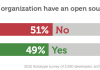
Nearly 80% of the enterprises surveyed consume open source software. Most interesting to me: two thirds of them are actively contributing code back to the upstream projects they consume. Also interesting to note is that just shy of half of all surveyed companies have a formal open source policy in place. And of those with formal policies, half of the respondents cite those policies as detrimental to the success of development.

The top complaints about formalized open source policies are:

  • it slows down development
  • we find out about problems too late in the process
  • it’s not clear what’s expected of us
  • there is no enforcement

Some organizations further restrict open source software usage by license, going so far as to verify the license of all components and their dependencies. At first blush that might sound like a big waste of time, but in reality that’s a good thing: open source license compliance is important, and fundamentally important to the longevity of open source in general. Of course, if these enterprises aren’t distributing their applications to others then license compliance with copyleft licenses like the GNU Public License isn’t as big of a deal.

Sonatype’s primary product, Nexus Professional is a repository manager that aims to solve many of the licensing, dependency, and procurement problems identified in the Sonatype survey (again, with a specific focus on Java). The survey highlights that 73% of enterprises stay informed on new releases of the open source components they use by manual web searches, or by directly visiting the projects’ websites. That’s clearly inefficient. Even established code sharing services like GitHub, Google Code, and SourceForge aren’t being as heavily utilized as they could be by the companies surveyed.

The primary motivation for this report is to demonstrate the need for Sonatype’s products, obviously. That focus, though, reveals useful general information. For example, the financial industry is the most likely to completely lock down open source developers to using specific approved resources. Another interesting revelation: the aspects of open source software most important to the companies surveyed are maturity, security, and overall code quality. License type is only of interest to a comparatively smaller portion of survey respondents.

Regardless of any challenges introduced by open source software, it’s clear that open source is gainin more popularity within traditional enterprises. Anything that can be done to simplify the consumption and compliance issues identified by Sonatype — for Java and every other language — is a good thing.


Finally A Redesign!? Ugly Craigslist Hiring UI Designer To Become “Faster, Friendlier And Easier”

Craigslist Under Construction

Recognizable, fast-loading, but outdated as hell website seeks Senior UI / Usability / Front End Engineer. Love it or hate it, Craigslist‘s design could provide a better experience, and apparently Craig thinks so too, as this weekend the site posted a job opening for someone to make it “faster, friendlier, and easier”. It’s hoping for a brave designer who can “develop new products and features that will have CL users swooning”, “optimize internal team tools”, and who has mobile app design and platform support skills.

There’s plenty of tweaks we’d appreciate like more consistent navigation controls and better use of whitespace. But don’t expect Craigslist to ditch its famously minimal facade that’s helped it climb to 50 million classified postings and 30 billion page views a month.

It’s been almost two years since Craigslist made any significant change to its interface, and even that was subtle. The site has looked largely the same for a decade now. While its massive community and network effect protect it from disruption, task marketplaces like Zaarly and lodging locators like Airbnb are starting to nip at its heels. Maybe it’s finally time give the site a little polish, even if the text-heavy look remains.

We’ve reached out to founder Craig Newmark for details about what the usability engineer would be working on. Here’s the full job posting, bolded for fun and usability:

craigslist needs hands-on Senior UI/Front-End/Usability Engineers to:

– improve the craigslist user experience — faster, friendlier and easier;
develop new products and features that will have CL users swooning;
optimize internal team tools for efficiency and effectiveness;
– integrate new front-end technologies wherever appropriate; and
– solve interesting tech issues at billion-page-view-per-day scale

Successful candidates will know more about front-end technologies than any of us do, based on been-there-done-that work experience, and will be able to communicate that knowledge and experience effectively. Experience with as many of the following as possible will be helpful:

– highly-optimized web interaction design;
– HTML, CSS, javascript, jquery, ajax;
– perl & other scripting languages;
– Apache, mod_perl;
– C, C++;
– cross-browser development and troubleshooting;
– current UI libraries and frameworks;
– large scale, big traffic, high performance websites;
– website security, cross-site scripting & other vulnerabilities;
– API design and maintenance;
mobile app design, supporting mobile platforms;
– integrated mapping technologies; and
– expert troubleshooting skills.

craigslist offers:

– an unusually philanthropic company mission and philosophy;
– opportunity to work on one of the most used websites in the world;
– love from users and staff for adding features and fixing bugs;
a laid-back, idealistic, non-corporate vibe;
– San Francisco office location
– competitive compensation and superior benefits

For consideration, please send a summary of your interest and experience and a plain text resume pasted into the body of an email (no attachments) to [email protected]. Thanks for your interest in craigslist!


Panels Are A Waste Of Time, But They Don’t Have To Be

trashtime

Editor’s Note: Guest contributor Joey Flores is a co-founder of Earbits, a Y Combinator-backed online radio ad platform for the music industry.

Two years ago, when I first co-founded Earbits, I started frequenting various startup events like so many other first-time founders. Some of them were mixers, others were pitch competitions, and many were topic-focused panels and discussions meant to provide sage advice to budding entrepreneurs. I had reasonable experience on the ground floor of various startups but raising capital was a mystery to me. Naturally, I went to more than a few panel discussions about fundraising in preparation for doing that at my new company.

Every panel I ever went to about fundraising was filled with prominent Angel investors and VC’s telling us about how to put together a good deck, how to get their attention through a warm intro, what kinds of things make a company invest-able, and other very common fundraising advice. After having read all of the same advice on Both Sides of the Table and Venture Hacks, I found that most fundraising panels were a complete waste of time.

Sure, many of the things they said were true, but I always felt like they scratched the surface of the fundraising process and catered to the people who knew the least and were the least likely to raise money. I always felt like they should be talking to the people who were actually in a position to raise venture money, and that those people needed much deeper knowledge. Instead, it’s always the basics. Nothing juicy.

Over the next two years, I would go to panels about marketing music, buying media, and a number of other topics. The panels about marketing music were always made up of owners of music marketing companies. The panels about buying media were always stocked with Vice Presidents of Sales for major media companies.

Last year, I was asked to sit on a panel at a conference for songwriters and musicians to talk about how to get their music on the radio and it couldn’t have been more ironic. To many I might be considered an industry expert but on Earbits, you simply submit your music for consideration and, if it’s radio-ready, you’re in rotation because that’s how we make money. That means that, despite owning an internet radio company, I still know absolutely nothing about how to get your music on FM radio.

The other people on the panel were radio promoters, programming directors and other industry experts telling the audience about all of the normal tactics for trying to get radio airplay, most of which they also admitted don’t work at all.

Every panel I go to is stocked with experts in the industry, and they’re almost always worthless. I leave every panel asking the same frustrated questions. Why do they always tell you so little about the real strategies needed to be good at the things these panels are supposed to teach you? Why is it always so Topic 101?

And I usually blame the moderator for asking rookie questions.

Last year, I was lucky enough to go through Y Combinator’s Winter 2011 session. In addition to having great speakers at the weekly YC dinners, Paul Graham and team put together panels on various topics like fundraising and customer acquisition. Every one of the YC panels is made up of YC alumni who have had particular success at the task at hand, and all of the discussions are off the record. Suddenly, every panel I was going to was mind blowing.

The fundraising panels at YC are chock full of advice that conflicts with nearly everything I had ever heard from Angels and VC’s on other panels. The media buying tips were things that no VP of Sales would ever admit they had done for a startup client with a $5k budget. I have never been a note taker in my entire life, and yet I find myself taking notes constantly at every YC panel. What I came to realize is that almost every panel I have ever seen before was populated with exactly the wrong people for the audience it was intended for.

If you want to put together a panel about fundraising for first-time founders, you don’t stock it with Angels and VC’s. You stock it with people who were recently very effective at raising money as first-time founders. You don’t pick the runaway successes who posted their data online and got a million offers even though those are the exciting names that draw a crowd. You pick founders who slugged it out in the trenches and took a million meetings – people with un-sexy businesses who really had to work for their funding. You pick people who are just like the people who are going to be sitting in the crowd.

A VC on a fundraising panel is going to tell founders how to make a deck that makes their life easier and that they prefer a warm intro because those things benefit them and serve their needs. They’re not going to tell people how to start a bidding war or raise a round without giving up a board seat, and that’s what founders really care about. Even if this reality isn’t a malicious and intentional effort to train people to do what they want, the reality is that most people in business are in denial about what strategies actually work on them. VC’s tell you they invest in great teams solving real problems but the headlines on TechCrunch often say otherwise.

If you want to teach people about media buying, don’t offer up panelists who sell media for a living. The VP of Ad Sales for MSN isn’t going to tell you how to buy remnant inventory or that you can get their inventory cheaper through an ad banner network. If you want to help people buy media, put together a panel of people who have gotten the best deals with the least resources and have built companies on cheap, effective media – people who are the best at the buying side of the negotiating table. And, if you want to teach musicians how to get on the radio, don’t bring in people who sell airtime to anybody with a good recording or throw away most of the press kits they receive, bring in the lucky few artists who, without a label or manager, got into heavy rotation on KROQ against all odds.

Basically, as an advice-seeking student of any kind, you can bet that the best panels aren’t going to be made up of top level players on the “opposing” side of the situation you’re currently in. Those people either have motivation to tell you what they want you to think is the reality, or they simply won’t know how or why they behaved in ways that got their negotiating counterparts a better deal. Further, most experts in the industry haven’t had to be in the shoes of someone slugging it out in a very long time. Simply put, their advice is probably not that relevant for people who really have their work cut out for them and need deep knowledge about the most effective best practices of today.

From now on, if you’re considering going to a panel about a topic you want to learn about, look for a panel of people who are where you want to be in about two or three years. If the panelists look like the people who are going to be sitting across from you in upcoming negotiations, and on most panels of industry experts they will, the odds are it’s going to be a big fat waste of your time.


Frustration, Disappointment And Apathy: My Years At Microsoft

microsoft-logo

Editor’s Note: This Guest post is written by Max Zachariades, who spent the last five years at Microsoft in various roles. He blogs under the name Max Zografos.

I first used Windows on a TULIP portable computer, some twenty years ago. Graphical user interface, icons, mouse, an amazing new world was ushered in before my wide eyes.

At university, I scored a summer internship with Microsoft. I sported a Microsoft collared shirt and showed off my “Microsoft Product Specialist” badge with infinite pride. When Windows 2000 launched, I distributed official evaluation copies to the School of Engineering. Lecturers didn’t hide their admiration, and wonder, about my infatuation with this company. They called me the “Microsoft man,” which I saw as a compliment.

In 2005, I was commissioned to lead two Microsoft Europe-wide projects. Microsoft seemed way ahead. Virtual meetings, digitized calendars all beeping in tandem, flexible work arrangements, massage chairs, free soda. What’s more, toilets were squeaky clean. Most multinationals I’d worked for had heinous facilities, which pretty much poisoned the well for me.

Like Alice in Wonderland, I pranced around the campus, drinking as much of the Microsoft Kool-Aid as I possibly could. In 2007, I obtained a “blue badge.” I was a full-time employee now. One of them.

Fallen Star

Within my first year, I was awarded the venerable “Gold Star.” It read:

Congratulations! In recognition of your important contribution to our success, you have been selected to receive a special Gold Star Spot bonus award. I am pleased to inform you that you will receive an award of $1,000 less all applicable taxes and withholding. Since joining you’ve hit the ground running — you’re a star in the making!

Microsoft also gave out corporate-branded gizmos, laser pointers, memory keys, plastic crystals and other toys. When I raised a suggestion that we divert some of those funds to charity, my communication style was flagged as inappropriate and antagonistic.

In time, my eyes opened. We were box tickers and pen pushers. Any original thinking was sacrificed at the altar of time-proven, common sense process. Efforts to break the mould were all but punished.

The Microsoft Meeting

Microsoft culture expects you to be in meetings. Calendars need to be decorated with sufficient colourful blocks, to signal over-activity.

Dig a bit deeper and you’ll realise that Microsoft meetings are a way to diffuse and evade responsibility for decisions. Yes – let’s spend weeks on weeks “reviewing with stakeholders.” It’s so much safer that taking swift decisions ourselves. The company places no trust on the individual to make the right decision on their own.

So what happens in those meetings? Are they brainstorming earth-shattering new ideas? Are they inventing new products? Why are they getting paid to join so many of them? How can Microsoft afford to have so many of its employees fluffing about?

Because they can. Microsoft sits on stockpiles of cash, with about $60 billion earning interest in the bank. With that mystery out of the way, let’s take a look at some of those meetings: Strategy reviews, deep dives, virtual coffee breaks, quarterly off-sites, monthly get-togethers, director summits, leadership meetings, etc.

Yikes, who is going to organise all that? Fear not. Every team has their very own “business manager.” And since business managers are too senior to be bogged down with logistics, enter the legions of “support managers” and “administrative assistants” reporting to business managers.

Large companies have overheads, a necessary evil, you say. Overheads need to be managed. And managed they are: Group Managers, Program managers, General managers, together with ‘Senior’ flavours of those and a whole new breed of directors, stakeholders, business owners, relationship leads coupled with their own countless derivatives.

All those meeting-goers are not making anything. Deciding upon and making something is hard. And if this onerous activity has to be done, then hire external consultants for it. It’s easier and less risky.

There is no creative tension, no vision these days. Left to Microsoft’s hands we’d still be toiling on overheating Vista desktops.

This company is becoming the McDonalds of computing. Cheap, mass products, available everywhere. No nutrients, no ideas, no culture. Windows 8 is a fine example. The new Metro interface displays nonstop, trivial updates from Facebook, Twitter, news sites and stock tickers. Streams of raw noise distract users from the moment they login.

In an already loud world, all Windows 8 does is increase the decibels.

Getting Fired

Mea Culpa: I should have left on my own volition, much earlier.

Truth is, I was comfortable. Too comfortable. Stupefied even. Why look for work elsewhere when I could coast from meeting to meeting, uttering and typing meaningless busywork. I could not relinquish that kind of comfort.

Year after year, I began to voice my concerns about the meaninglessness of it all. Why write up dozens of monthly scorecards when nobody ever reads them? Worse yet, why join follow up conference calls? Why schedule get-togethers when there is no agenda? Why spend a month chasing stakeholder-committees for trivial project decisions. Why spam people’s inboxes with monthly newsletters and weekly narratives about how great our team is?

They called it out in my performance reviews: I lacked “respect for authority.” “Microsoft people are well-tenured,” said my boss once. Many employees are with Microsoft for 15 years or more. Sidestep hierarchy and tenure at your own peril.

I became cynical about the whole process. I was seen as a “rebel” and the leadership team began to marginalise me. My planned and promised promotion was cancelled.

Month after month, what I saw as a dubious case was put together. Official HR warnings were sent. My time ran out. I was offered 12-weeks’ pay for an amicable departure. Instead I decided to escalate the thoughts above to the highest echelons of Microsoft.

Below is an excerpt of my email to a Corporate Vice President.

Naturally, large teams are expected to have overheads. However, I’ve never witnessed such a systematic waste of company’s time and resources.

including its execs—spend much of their time in informational meetings with no agenda or
purpose. Let me cite an example from today’s newsletter. A senior exec talks about what he will do in March:

‘March is going to be a busy month! I will be representing at the first ever and then will representing at in San Diego on . Then back in the U.S. again the week of for the LT Strategy Planning Workshop. In March, I have 1:1s lined up with and several of her LT: , , , and .”

I struggle to discern what will actually be achieved in March by this exec. All I can see is a series of expensive trips and endless hours spent in gatherings with no outcomes or deliverables.

Can Microsoft afford that? …

Entire days spent on meetings about meetings, drafting and re-drafting ‘team stories’ and participating in endless informational conference calls. I am confident that could achieve the same actual results with just 10 percent of its current funding. Given the opportunity, I can provide more clarity on this topic.

In a time of disruptive new technologies and competition, I believe Microsoft, and each organization within, should lead by example. We cannot afford not to.

Within hours of sending this email I was summarily fired and escorted to the door, days short of my 5-year anniversary with Microsoft.


HTC One S Review: Head-To-Head With The One X And iPhone 4S

Screen shot 2012-04-22 at 2.02.05 PM

I’ve been fiddling around with the HTC One S for a few days now, and I have to say it’s stolen a little piece of my heart. The hardware is just about perfect, with a 4.3-inch qHD display and a slender aluminum unibody shell, and software like HTC’s Sense 4 overlay and Android 4.0 Ice Cream Sandwich only sweeten the deal.

But, as per usual, there’s plenty to consider out there. The wide world of mobile only grows wider by the second, with hot new phones launching left and right. Just today, Sprint’s Galaxy Nexus and the LG Viper landed on store shelves, and lest we forget that the iPhone 4S is ready and waiting while the One X is mere days away.

So many options.

To help, we’ve put the One S up against it’s greatest competitors, the HTC One X and the iPhone 4S, in a spec showdown. Who will come out on top? Well, my dear readers, that ball is in your court.

Admittedly, the One S has lesser specs than both the One X and the iPhone 4S, but it makes up for these inadequacies in the little things. And it’s the little things that count, right?

The iPhone 4S has the superior display, to be sure, and the One X is a close second to Apple’s precious in terms of ppi, but there’s something to be said for screen size. The 4.3-inch display on the One S is juuust right, as Goldilocks would say, and the phone feels super comfortable in the hand.

This is because HTC found a way to walk that fine line between being lightweight and feeling cheap. It’s quietly brilliant.

Of course, the brilliance of iOS can’t be had on the One S, nor can Apple’s premium design or 64GB of onboard storage. But maybe Apple isn’t your favorite flavor.

Might I suggest the One X? Especially if you’re an AT&T loyalist — the One S is only available at T-Mobile for the time being. This phone is for the giant-handed Android fan who appreciates a solid design and a well-spec’d device.

Luckily, pricing is about the same across the board here, so it really comes down to what suits you best.

What’ll it be, guys?