The world’s second largest radio telescope collapsed on Tuesday. But its legacy is indestructible.
Category: Tech news
hacking,system security,protection against hackers,tech-news,gadgets,gaming
Giving Gadgets As Gifts? Get Ready to Answer These Questions
Bestowing tech gifts means anticipating confusion about privacy and recurring fees. Here’s how to ease the minds of loved ones this year.
Warp Speed, Atomic Structure, and the Future of Vaccines
John Mascola, who worked on the research that led to the Moderna shot, thinks Covid-19 proves we have to prep for the next virus, too.
Apple’s New iPad Air Is a Great Tablet With a Few Quirks
The 2020 edition of the iPad Air is light, powerful, convenient. It’s a good buy as long as you don’t mind a few small annoyances.
Do Diverse Corporate Boards Lead to a Fairer Workplace?
Nasdaq wants at least one woman and one underrepresented minority among directors at listed companies. The proposal goes further than most, but will it matter?
This Notorious Botnet Has an Alarming New Trick
The hackers behind TrickBot have begun probing victim PCs for vulnerable firmware, which would let them persist on devices undetected.
Hackers Are Targeting the Covid-19 Vaccine ‘Cold Chain’
As vaccines await US approval, a sophisticated global phishing campaign has tried to harvest credentials from companies involved in their distribution.
Our 100+ Favorite Cyber Monday Deals Still Available Today
We combed through every Black Friday and Cyber Monday deal we featured this week. These deals remain—for the moment.
The Journey of Electronic Bottles and the Ocean Plastic Crisis
Researchers loaded containers with trackers and released them in the Ganges and the Bay of Bengal, giving new insight into how plastic pollution travels.
A Broken Piece of Internet Backbone Might Finally Get Fixed
Efforts to secure the Border Gateway Protocol have picked up critical momentum, including a big assist from Google.
New AI-Based Navigation Helps Loon’s Balloons Hover in Place
Reinforcement learning might be the next step in keeping broadband-carrying balloons afloat above remote areas. Could Venus be next?
The Best Barefoot Shoes for Walking or Running
Our favorite zero-drop, minimalist footwear will let you feel the ground beneath your feet.
AWS brings the Mac mini to its cloud
AWS today opened its re:Invent conference with a surprise announcement: the company is bringing the Mac mini to its cloud. These new EC2 Mac instances, as AWS calls them, are now available in preview. They won’t come cheap, though.
The target audience here — and the only one AWS is targeting for now — is developers who want cloud-based build and testing environments for their Mac and iOS apps. But it’s worth noting that with remote access, you get a fully-featured Mac mini in the cloud, and I’m sure developers will find all kinds of other use cases for this as well.
Given the recent launch of the M1 Mac minis, it’s worth pointing out that the hardware AWS is using — at least for the time being — are i7 machines with six physical and 12 logical cores and 32 GB of memory. Using the Mac’s built-in networking options, AWS connects them to its Nitro System for fast network and storage access. This means you’ll also be able to attach AWS block storage to these instances, for example.
Unsurprisingly, the AWS team is also working on bringing Apple’s new M1 Mac minis into its data centers. The current plan is to roll this out “early next year,” AWS tells me, and definitely within the first half of 2021. Both AWS and Apple believe that the need for Intel-powered machines won’t go away anytime soon, though, especially given that a lot of developers will want to continue to run their tests on Intel machines for the foreseeable future.
David Brown, AWS’s vice president of EC2, tells me that these are completely unmodified Mac minis. AWS only turned off Wi-Fi and Bluetooth. It helps, Brown said, that the minis fit nicely into a 1U rack.
“You can’t really stack them on shelves — you want to put them in some sort of service sled [and] it fits very well into a service sled and then our cards and all the various things we have to worry about, from an integration point of view, fit around it and just plug into the Mac mini through the ports that it provides,” Brown explained. He admitted that this was obviously a new challenge for AWS. The only way to offer this kind of service is to use Apple’s hardware, after all.
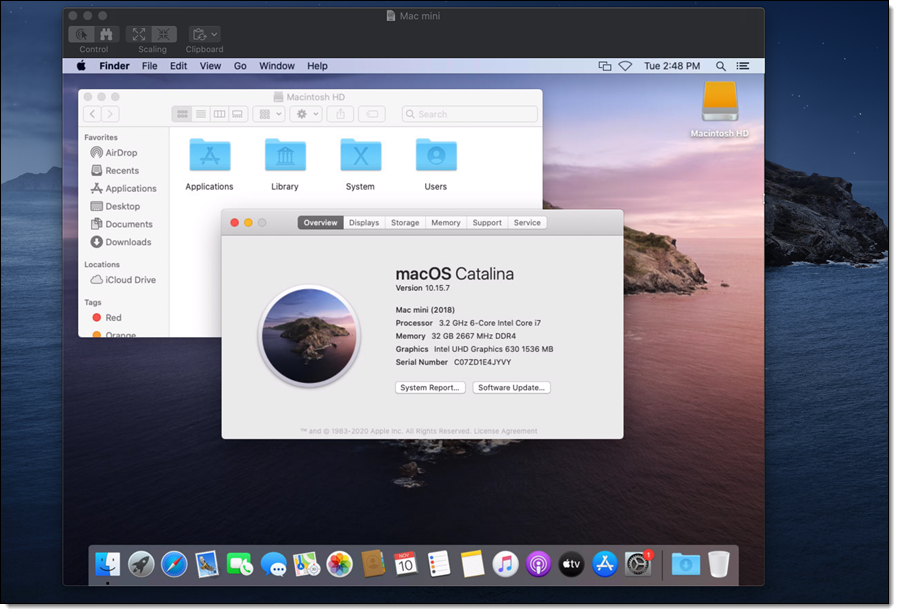
Image Credits: AWS
It’s also worth noting that AWS is not virtualizing the hardware. What you’re getting here is full access to your own device that you’re not sharing with anybody else. “We wanted to make sure that we support the Mac Mini that you would get if you went to the Apple store and you bought a Mac mini,” Brown said.
Unlike with other EC2 instances, whenever you spin up a new Mac instance, you have to pre-pay for the first 24 hours to get started. After those first 24 hours, prices are by the second, just like with any other instance type AWS offers today.
AWS will charge $1.083 per hour, billed by the second. That’s just under $26 to spin up a machine and run it for 24 hours. That’s quite a lot more than what some of the small Mac mini cloud providers are charging (we’re generally talking about $60 or less per month for their entry-level offerings and around two to three times as much for a comparable i7 machine with 32GB of RAM).

Image Credits: Ron Miller/TechCrunch
Until now, Mac mini hosting was a small niche in the hosting market, though it has its fair number of players, with the likes of MacStadium, MacinCloud, MacWeb and Mac Mini Vault vying for their share of the market.
With this new offering from AWS, they are now facing a formidable competitor, though they can still compete on price. AWS, however, argues that it can give developers access to all of the additional cloud services in its portfolio, which sets it apart from all of the smaller players.
“The speed that things happen at [other Mac mini cloud providers] and the granularity that you can use those services at is not as fine as you get with a large cloud provider like AWS,” Brown said. “So if you want to launch a machine, it takes a few days to provision and somebody puts a machine in a rack for you and gives you an IP address to get to it and you manage the OS. And normally, you’re paying for at least a month — or a longer period of time to get a discount. What we’ve done is you can literally launch these machines in minutes and have a working machine available to you. If you decide you want 100 of them, 500 of them, you just ask us for that and we’ll make them available. The other thing is the ecosystem. All those other 200-plus AWS services that you’re now able to utilize together with the Mac mini is the other big difference.”
Brown also stressed that Amazon makes it easy for developers to use different machine images, with the company currently offering images for macOS Mojave and Catalina, with Big Sure support coming “at some point in the future.” And developers can obviously create their own images with all of the software they need so they can reuse them whenever they spin up a new machine.
“Pretty much every one of our customers today has some need to support an Apple product and the Apple ecosystem, whether it’s iPhone, iPad or Apple TV, whatever it might be. They’re looking for that bold use case,” Brown said. “And so the problem we’ve really been focused on solving is customers that say, ‘hey, I’ve moved all my server-side workloads to AWS, I’d love to be able to move some of these build workflows, because I still have some Mac minis in a data center or in my office that I have to maintain. I’d love that just to be on AWS.’ ”
AWS’s marquee launch customers for the new service are Intuit, Ring and mobile camera app FiLMiC.
“EC2 Mac instances, with their familiar EC2 interfaces and APIs, have enabled us to seamlessly migrate our existing iOS and macOS build-and-test pipelines to AWS, further improving developer productivity,” said Pratik Wadher, vice president of Product Development at Intuit. “We‘re experiencing up to 30% better performance over our data center infrastructure, thanks to elastic capacity expansion, and a high availability setup leveraging multiple zones. We’re now running around 80% of our production builds on EC2 Mac instances, and are excited to see what the future holds for AWS innovation in this space.”
The new Mac instances are now available in a number of AWS regions. These include US East (N. Virginia), US East (Ohio), US West (Oregon), Europe (Ireland) and Asia Pacific (Singapore), with other regions to follow soon.

Cyber Monday scams? Fakespot says it can identify fraudulent reviews and sellers online
The pandemic has made it all but impossible for a retail company without an online presence to survive. Yet while companies heavily dependent on foot traffic like J.Crew and Sur la Table have filed for bankruptcy this year, companies that are expert in e-commerce have thrived, including Target and Walmart. Amazon alone now attracts roughly one quarter of all dollars spent online by U.S. shoppers.
Unfortunately, as more shopping moves online, fraud is exploding, too. The problem is such that startups working with enterprises — flagging transactions for banks, for example — are raising buckets of funding. Meanwhile, one New York-based startup, Fakespot, is taking a different approach. It’s using AI to notify online shoppers when the products they’re looking to buy are fake listings or when reviews they’re reading on marketplaces like Amazon or eBay are a fiction.
We talked earlier today with Kuwaiti immigrant Saoud Khalifah about the four-year-old business, which got started in his dorm room after his own frustrating experience in trying to buy nutritional supplements from Amazon. After he’d nabbed his master’s degree in software engineering, he launched the company in earnest.
Like many other startups, Fakespot was originally focused on helping enterprise customers identify counterfeit outfits and fake reviews. When the pandemic struck, company spied an “opening crack on the internet,” as Khalifah describes it, and instead began catering to consumers who use platforms that are struggling to keep up (and whose solutions are often more focused on protecting sellers from buyers and not the other way around).
The pivot seems to be working. Fakespot just closed on $4 million in Series A funding led by Bullpen Capital, which was joined by SRI Capital, Faith Capital and 500 Startups among others in a round that brings the company’s total funding to $7 million.
The company is gaining more attention from shoppers, too. Khalifah says that a Chrome browser extension introduced earlier this year has now been downloaded 300,000 times — and this on the heels of “millions of users” who have separately visited Fakespot’s site, typed in a URL of a product review, and through its “Fakespot analyzer,” been provided with free data to help inform their buying decisions.
Indeed, according to Khalifah, since Fakespot’s official founding it has amassed a database of more than 8 billion reviews — around 10 times as many as the popular travel site Tripadvisor — from which its AI has learned. He says the tech is sophisticated enough at this point to identify AI-generated text; as for the “lowest-hanging fruit,” he says it can easily spot when reviews or positive sentiments about a company are posted in an inorganic way, presumably published by click farms. (It also tracks fake upvotes.)
As for where shoppers can use the chrome extension, Fakespot currently scours all the largest marketplaces, including Amazon, eBay, Best Buy, Walmart, and Sephora. Soon, says Khalifah, users will also be able to use the technology to assess the quality of products being sold through Shopify, the software platform that is home to hundreds of thousands of online stores. (Last year, it surpassed eBay to become the No. 2 e-commerce destination in the U.S., according to Shopify.)
Right now, Fakespot is free to use, including because every review a consumer enters into its database helps train its AI further. Down the road, the company expects to make money by adding a suite of tools atop its free offering. It may also strike lead-generation deals with companies whose products and reviews it has already verified as real and truthful.
The question, of course, is how reliably the technology works in the meantime. While Khalifah understandably sings Fakespot’s praises, a visit to the Google Play store, for example, paints a mixed picture, with many enthusiastic reviews and some that are, well, less enthusiastic.
Khalifah readily concedes that Fakespot’s mobile apps need more attention, which he says they will receive. Though Fakespot has been focused predominately on the desktop experience, Khalifah notes that more than half of online shopping is expected to be conducted over mobile phones by some time next year, a shift that isn’t lost on him, even while it hinges a bit on the pandemic being brought effectively to an end (and consumers finding themselves on the run again).
Still, he says that “ironically, a lot of [bad] reviews are from sellers who are angry that we’ve given them F grades. They’re often mad that we revealed that their product is filled with fake reviews.”
As for how Fakespot moves past these to improve its own rating, Khalifah suggests that the best strategy is actually pretty simple.
“We hope we’ll have many more satisfied users,” he says, adding: “No one else really has consumers’ backs.”
EV bus and truck maker The Lion Electric to take SPAC route to public markets
Canadian electric truck and bus manufacturer The Lion Electric Company said Monday it plans to become a publicly traded company via a merger with special purpose acquisition company Northern Genesis Acquisition Corp.
The combined company, which will be listed on the New York Stock Exchange, will have a valuation of $1.9 billion. The companies raised $200 million in private investment in public equity, or PIPE, and hold about $320 million in cash proceeds.
The deal is the latest example of an electric automaker opting to go public via a SPAC merger in an aim to access the level of capital needed to become a high-volume vehicle manufacturer. Arrival, Canoo, Fisker, Lordstown Motors and Nikola Corp. have all announced SPAC mergers in 2020.
In Lion’s case, the combined net cash will be used to fund the company’s growth, notably the planned construction of a U.S.-based factory and to further develop its advanced battery systems. Lion is evaluating more than 10 potential brownfield plant sites in nine states, including California, Illinois, Indiana, Michigan, New York, Ohio, Oregon, Pennsylvania, Washington and Wisconsin. The company told TechCrunch it plans to pick a site and complete its industrialization plan by the end of the year. Production at this yet-to-be named factory is expected to start in the beginning of 2023.
Lion is already producing all-electric medium and heavy-duty urban trucks and buses at a 2,500-vehicle-per-year manufacturing facility. Some 300 vehicles are on the road today and the company has plans to deliver 650 trucks and buses in 2021. It even landed a contract with Amazon to supply the e-commerce giant with 10 electric trucks for its “middle mile” operations.
Completion of the proposed transaction is expected to occur in the first quarter of 2021. Lion is expected to be listed on the NYSE under the new ticker symbol “LEV.” Lion’s CEO and founder Marc Bedard will continue in his role. The combined company will have a board of directors consisting of nine directors, including Bedard, Pierre Larochelle from Power Sustainable as chairman, and five other existing Lion board members, as well as Ian Robertson and Chris Jarratt, who are co-founders of Algonquin Power & Utilities Corp.