Bandcamp Fridays will continue through next May

The past eight or so months have been profoundly difficult for musicians. With touring ground to a halt and streaming services offering fractions of cents, livelihoods have been utterly upended for countless artists. Since March, however, Bandcamp has been a rare beacon for many musicians.

On the first Friday of every month, the service has waved its fees, letting artists and labels reap the benefits in the process. Over the course of nine such Fridays, the service has generated some $40 million, as nearly 800,000 people have purchased music on those days. Artists have received, on average, 93% of the proceeds (transaction fees making up the remainder), versus 82% on normal days.

While the arrival of vaccines are a reason to be hopeful, it’s clear we’re not out of the woods yet. As such, the service announced today that Bandcamp Fridays will be extended at least through May of 2021. Those dates include, February 5, March 5, April 2, and May 7.

Other online services have been less proactive. In July, Spotify CEO Daniel Ek told the media, “Some artists that used to do well in the past may not do well in this future landscape, where you can’t record music once every three to four years and think that’s going to be enough.”

In spite of criticism around music royalty payments, Spotify has spent hundreds of millions to bolster its library of exclusive podcasting content.

Airbnb sets new diversity goals

Airbnb, which recently went public and became a $100 billion company, has set two goals to try to improve diversity at the home-sharing and experiences company because it “is nowhere near satisfied with the status quo,” the company wrote in a blog post.

By the end of 2025, Airbnb is aiming for 20% of its U.S. workforce to be underrepresented minorities, which includes folks who self-identify as American Indian or Alaska Native, Black or African American, Hispanic or Latinx, Native Hawaiian or Other Pacific Islander. Currently, underrepresented minorities make up just 12% of the company’s employee base.

The second goal is to increase the representation of women to 50% by the end of 2025. Currently, Airbnb says it is 46.9% female worldwide, but it’s worth noting Airbnb has not released a full diversity report since 2019 when it disclosed its 2018 numbers.

These goals come after Airbnb committed in June to making its board of directors and executive team 20% people of color by the end of 2021. Currently, Airbnb has one Black director on its board, Kenneth Chenault, and one Black person on its executive team, Melissa Thomas-Hunt, who is head of global diversity and belonging.

This is also not the first time Airbnb has set goals. In 2016, Airbnb committed to increasing the percentage of employees from underrepresented groups from 9.64% to 11% by the end of 2017. Airbnb achieved that goal, which supports the claim that setting goals are helpful in increasing DEI.

Inside Zoox’s six-year ride from prototype to product

Zoox, the autonomous vehicle company that was acquired this year by Amazon, revealed this week the product of six years of work: A purpose-built self-driving vehicle designed to carry people — and someday maybe even packages — in dense urban environments.

The company’s story has captured the attention of skeptics and supporters alike, perhaps because of its secretive nature and outsized mission. Unlike its rivals, Zoox is developing the self-driving software stack, the on-demand ride-sharing app and the vehicle itself. Zoox also plans to own, manage and operate its robotaxi fleet.

Unlike its rivals, Zoox is developing the self-driving software stack, the on-demand ride-sharing app and the vehicle itself.

It’s been an expensive pursuit that almost led to its demise before Amazon snapped it up — and the mission is still far from over. But today, as an independent Amazon subsidiary, it has the financial support of one of the world’s most valuable public companies.

TechCrunch interviewed Zoox co-founder and CTO Jesse Levinson about the company’s milestone, the vehicle design, its exit to Amazon and what lies ahead.

This interview has been edited for brevity and clarity.

TechCrunch: What was your trick or how did you remain focused for six years on something that is futuristic, expensive and possibly could fail? What did you personally do to keep that focus?

Jesse Levinson: Well, doing something like this is definitely challenging and it requires patience. I think the advice I would give is first to convince yourself that what you’re doing makes sense and is important and worth doing. If you’re starting a company because your goal is to make as much money as possible, if it turns out to be hard it’s going to be really difficult to convince yourself and your team and investors to stick with the idea.

One of the great things about Zoox is that the idea itself just makes a lot of sense. From first principles, there’s really a compelling reason to solve the problem the way we’ve been solving it and the market opportunity is unquestionably enormous. So armed with those facts and a team of wonderful employees and investors who strongly believed in that, we were able to weather some of the ups and downs of the industry, even though it’s not always been an easy ride.

Let’s go back in time to the very first concept when you started to think of what a purpose-built vehicle would look like. Those early drawings showed a very, very different looking type of vehicle.

Are you referring to maybe like the sports-car-looking vehicle? We were actually never planning on launching a sports car as our first product; that was more of like a vision statement. Honestly, if you’re trying to move people around cities, it makes much more sense to have the kind of compact carriage like we showed this morning. We were never actually building a sports car. 

What is it like to create a long-term, cutting-edge product that exists at the edge of regulation? It seems like a very unique problem. 

I would say that if you have a big idea and you’re confident that it makes sense, you should at least explore the idea, rather than giving up because the current regulations aren’t designed for it.

At the same time, it’s very important to be respectful of the regulatory process, and you can’t assume that you can ignore it. I think companies that have tried that approach have usually found that doesn’t work very well either. We’ve taken a very proactive approach to working with regulatory agencies at the local, state and federal level, and we’ve been very forthcoming with “this is how we look at the problem” and “this is what we want to do.”

We’ve also been fortunate because over time the regulations on the local, state and federal level have really evolved to accommodate what we’ve been working on since 2014, even though when we started the company in 2014, those regulations did not exist. 

The vehicle today, was that what you had in your mind, or what the team had in mind, from the very beginning? Or was it a bit different?

Yeah, honestly, there have been very few substantive changes to the vehicle’s design since we started working on it in 2014 and 2015. Obviously, we refined it and actually had to make it work from an engineering and crash perspective. But if you look at some of the drawings that we were exploring in 2014 and 2015, it’s extremely similar.

Financial aid-focused Frank expands into helping students take online classes

Frank, a startup best known for helping college students secure and manage financial aid, is expanding into a new part of the edtech world. Namely, finding and taking online classes, with the company helping students deploy their financial aid money to open digital slots at more than 100 colleges.

As a company, Frank straddles the ground between consumer fintech, which helps regular people better manage their money, and edtech, the application of tech to the venerable business of learning. TechCrunch covered the company’s 2017-era Series A, and recently discussed the company when it raised $5 million earlier in the year.

According to its CEO, Charlie Javice, her company has grown by around a factor of three this year. And, with Javice telling TechCrunch that Frank’s new class-finding service — dubbed Classfinder — could become “a primary driver” for her startup in time, we decided to dig in a little.

Classfinder

Frank is teaming up with colleges to offer discounted classes, hoping to match its users with unfilled slots in classes that are already set to take place. And the startup will help its user base utilize financial aid to help pay for their selected classes, possibly helping folks take more credits without extra debt.

There are 125 schools offering classes on the platform today, out of a rotating cadre of over 350. The Classfinder website claims 7,520 courses up for selection as of today.

TechCrunch asked Javice if offering access to online classes was a deviation from Frank’s better-known effort to help more students get more financial assistance in their college pursuit. In the CEO’s view, Classfinder fits inside what she views as her company’s mission, namely higher-education affordability.

If Classfinder works as well as the company hopes, that could bear out, even if the new product does appear to be more an evolution of Frank’s product lineup than merely a continuation of its initial vision.

Provided the model works, it could net out to a win for all involved parties. Colleges have spare digital capacity for students, and lots of students don’t have money for school, so if Frank can help those same kids get financial aid and deploy it to discounted, accredited classes, no one loses.

TechCrunch was curious about transferring credits — would classes taken with Classfinder count at other schools? Per the company, yes, and Frank will help prepare the needed information. Of course, some colleges may balk, but for some students the system could be a way to boost college affordability while not sacrificing learning.

Digital education became the norm this year, to middling results. Amongst children, the move to online schooling has been widely panned. But for higher education, online instruction was already an evolved industry even before the pandemic. Perhaps it will become even more normal in time.

How large the addressable market is for taking one-off classes is unclear, though the success of Guild Education could point to a large pool of potential students. Guild, which became a unicorn in 2019 after raising a $157 million Series D, helps corporate employees take continuing education classes to help bolster their careers. Even as the world of online classes clutters up, Frank’s decision to focus on college instead of the broader life-long learning market means that it thinks higher ed isn’t disappearing as fast as some edtech enthusiasts might think.

We’ll check back in with Frank in a quarter or two to see how the new product is helping, or not, its growth trajectory. If it does, Frank could raise a Series B in the next few quarters. Chegg, a public edtech company that previously backed the company, is worth $11 billion as of today’s trading. So if Frank keeps growing, there should be money available to it.

Get 90% off an annual DocSend plan with Extra Crunch

Extra Crunch is excited to announce we’re renewing our Partner Perk with DocSend. Annual and two-year members of Extra Crunch that are new to DocSend can get up to 90% off an annual plan. 

DocSend is a secure document-sharing platform that not only lets you share your documents with ease, but it also provides you with real-time actionable analytics. Whether you’re a founder, executive or VC, DocSend’s unique blend of security and control can help communicate more efficiently as you strengthen your business relationships. Whether you’re sending out a pitch deck, completing due diligence or sharing investor updates and board packs, DocSend gives you a strategic advantage with page-by-page insights. You also can connect DocSend to Salesforce, Gmail, Outlook, IFTTT and Zapier to get even more out of the product. 

Among Us launches on the Nintendo Switch

Surprise! Among Us is now available on the Nintendo Switch for $5.00. The Switch version features cross-platform play allowing PC, mobile and Switch players to play a game together.

The hit game just launched on the gaming platform after becoming a surprise hit during the COVID-19 pandemic. Originally launched in 2018, the game found an eager audience during the early days of the COVID-19 pandemic and its popularity is still soaring.

There’s a good chance one of my kids is playing the game right now.

The news came from Nintendo’s latest Indie World Showcase, where the gaming company highlights titles from smaller companies. The company left this title for the end of the presentation. And for good reason. Among Us is without question one of the hottest titles available right now, attracting gamers from all platforms. Prior to the election Rep. Alexandria Ocasio-Cortez used the game as a platform to drive voters to the polls and, at one point, drew 435,000 concurrent viewers.

The game costs $5.00 and is now available as a digital purchase through Nintendo’s eShop.

2020 was a disaster, but the pandemic put security in the spotlight

Let’s preface this year’s predictions by acknowledging and admitting how hilariously wrong we were when this time last year we said that 2020 “showed promise.”

In fairness (almost) nobody saw a pandemic coming.

With 2020 wrapping up, much of the security headaches exposed by the pandemic will linger into the new year.

The pandemic is, and remains, a global disaster of epic proportions that’s forced billions of people into lockdown, left economies in tatters with companies (including startups) struggling to stay afloat. The mass shifting of people working from home brought security challenges with it, like how to protect your workforce when employees are working outside the security perimeter of their offices. But it’s forced us to find and solve solutions to some of the most complex challenges, like pulling off a secure election and securing the supply chain for the vaccines that will bring our lives back to some semblance of normality.

With 2020 wrapping up, much of the security headaches exposed by the pandemic will linger into the new year. This is what to expect.

Working from home has given hackers new avenues for attacks

The sudden lockdowns in March drove millions to work from home. But hackers quickly found new and interesting ways to target big companies by targeting the employees themselves. VPNs were a big target because of outstanding vulnerabilities that many companies didn’t bother to fix. Bugs in enterprise software left corporate networks open to attack. The flood of personal devices logging onto the network — and the influx of malware with it — introduced fresh havoc.

Sophos says that this mass decentralizing of the workforce has turned us all into our own IT departments. We have to patch our own computers, install security updates, and there’s no IT just down the hallway to ask if that’s a phishing email.

Companies are having to adjust to the cybersecurity challenges, since working from home is probably here to stay. Managed service providers, or outsourced IT departments, have a “huge opportunity to benefit from the work-from-home shift,” said Grayson Milbourne, security intelligence director at cybersecurity firm Webroot.

Ransomware has become more targeted and more difficult to escape

File-encrypting malware, or ransomware, is getting craftier and sneakier. Where traditional ransomware would encrypt and hold a victim’s files hostage in exchange for a ransom payout, the newer and more advanced strains first steal a victim’s files, encrypt the network and then threaten to publish the stolen files if the ransom isn’t paid.

This data-stealing ransomware makes escaping an attack far more difficult because a victim can’t just restore their systems from a backup (if there is one). CrowdStrike’s chief technology officer Michael Sentonas calls this new wave of ransomware “double extortion” because victims are forced to respond to the data breach as well.

The healthcare sector is under the closest guard because of the pandemic. Despite promises from some (but not all) ransomware groups that hospitals would not be deliberately targeted during the pandemic, medical practices were far from immune. 2020 saw several high profile attacks. A ransomware attack at Universal Health Services, one of the largest healthcare providers in the U.S., caused widespread disruption to its systems. Just last month U.S. Fertility confirmed a ransomware attack on its network.

These high-profile incidents are becoming more common because hackers are targeting their victims very carefully. These hyperfocused attacks require a lot more skill and effort but improve the hackers’ odds of landing a larger ransom — in some cases earning the hackers millions of dollars from a single attack.

“This coming year, these sophisticated cyberattacks will put enormous stress on the availability of services — in everything from rerouted healthcare services impacting patient care, to availability of online and mobile banking and finance platforms,” said Sentonas.

AWS introduces new Chaos Engineering as a Service offering

When large companies like Netflix or Amazon want to test the resilience of their systems, they use chaos engineering tools designed to help them simulate worst-case scenarios and find potential issues before they even happen. Today at AWS re:Invent, Amazon CTO Werner Vogels introduced the company’s Chaos Engineering as a Service offering called AWS Fault Injection Simulator.

The name may lack a certain marketing panache, but Vogels said that the service is designed to help bring this capability to all companies. “We believe that chaos engineering is for everyone, not just shops running at Amazon or Netflix scale. And that’s why today I’m excited to pre-announce a new service built to simplify the process of running chaos experiments in the cloud,” Vogels said.

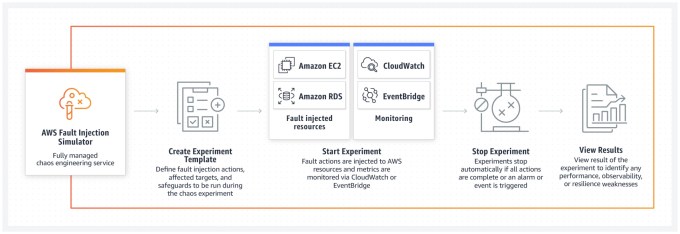
As he explained, the goal of chaos engineering is to understand how your application responds to issues by injecting failures into your application, usually running these experiments against production systems. AWS Fault Injection Simulator offers a fully managed service to run these experiments on applications running on AWS hardware.

AWS Fault Injection Simulator workflow.

Image Credits: Amazon / Getty Images

“FIS makes it easy to run safe experiments. We built it to follow the typical chaos experimental workflow where you understand your steady state, set a hypothesis and inject faults into your application. When the experiment is over, FIS will tell you if your hypothesis was confirmed, and you can use the data collected by CloudWatch to decide where you need to make improvements,” he explained.

While the company was announcing the service today, Vogels indicated it won’t actually be available until some time next year.

It’s worth noting that there are other similar services out there by companies, like Gremlin, which are already providing a broad Chaos Engineering Service as a Service offering.
