
Google’s AdWords Update: Are Desktops The New Fax Machines?

Image (1) googleadwordslogo-1.png for post 86414

Editor’s note: Richard Zwicky is CEO of BlueGlass Interactive, a digital marketing agency and software provider. Follow him on Twitter @rzwicky.

Does Wednesday’s AdWords announcement mean Google is already acknowledging the end of the desktop?

When AdWords was developed, people only worried about ads delivered from websites to people sitting at a desk in front of a computer. No one cared about phones, tablets were not on the market, and notebooks weren’t useful Internet devices unless they were connected to a wall, just like a desktop.

Over the last 10 years, the variety of devices and interfaces has increased dramatically, and AdWords has evolved to keep up, adding features, and offering campaign managers more options and ways to manage campaigns.

The problem is, like any IT project gone awry, it’s gotten out of hand. Ask any developer “Is it possible?” and invariably, the answer is “Yes but…” In Google’s case, whatever was requested usually got built. AdWords evolved like a really inspiring dev version of a Frankenstein experiment, built to address all the possibilities asked of it.

But on Wednesday, Google addressed this problem and changed the landscape when it announced it had to move on, even if we weren’t ready; the AdWords platform couldn’t continue to scale to add more device types and options ad infinitum. So, they took an ax to the options, and simplified everything into a campaign management interface called Enhanced Campaigns.

Few companies in the world consider the future the way Google does. If you take a long-term perspective, Google’s Enhanced Campaigns launch may indicate their belief that the decline in desktop search — first seen in October 2012 – is going to become an even stronger trend.

If this is the case, their move to do away with differentiation between mobile and desktop AdWords is quite logical and a well-thought-out, strategic move towards tomorrow, dragging the marketplace towards fulfilling Google’s vision, whether we are ready or not.

The change to AdWords also means Google doesn’t just see mobile as the future. It implies that from their perspective, the convergence has already happened, and we just don’t know it yet. For Google, the future is now. That’s probably the most important strategic takeaway.

If we listen to Google trumpet the changes, we’re to believe the platform is being simplified and enhanced. On the other hand, the doomsayers would have us believe the sky is falling. Regardless of whether you like the update or not, the move to Enhanced Campaigns really is a case of more is less.

Make no mistake, AdWords had to change. Google either had to move ahead of the market, or watch another company appear and force the issue. They chose the more aggressive route.

As Larry Page’s comments in 2012 would indicate, Google’s leadership team is convinced there should — and will — be no difference in the user experience between mobile and desktop platforms in the future.

Page has also gone on the record stating that he wishes more web designers would build for mobile, as that’s the future. I believe Google’s move will force everyone to begin to move in that direction today.

Is Google right? Will desktops become as passé and obsolete as fax machines?

No one knows, but it’s absolutely clear that Google has put a stake in the ground around mobile search. Google’s Q4 earnings call was dominated by questions focused on understanding mobile Cost Per Click (CPC), which has been used as a measuring stick by which the strength of Google’s mobile strategy has been calculated.

Despite all of Google’s revenue successes, these particular numbers weren’t inspiring, and I could hear frustration in the voices of Google’s leadership team when answering the many questions about their mobile CPC numbers. Rather than answer those questions in detail, they preferred to steer commentary towards other technological advances the company has made, such as the self-driving car.

Clearly, Google doesn’t want the focus of discussion about Google to be on mobile CPC; they want us talking about the amazing things they’re doing and where they could lead.

The change in AdWords removes the distracting mobile CPC topic from the table, and makes the old discussion obsolete. The number is no longer there to discuss. But to argue that the move to the new AdWords is simply to get rid of mobile CPC as a measuring stick would be understating both the implications and the rationale.

Google is absolutely correct when it says search behavior across devices is similar. However, conversion rates have proved to be dissimilar. Google is moving toward grouping ad management for desktop and mobile platforms together, thereby forcing advertisers, by default, to pay the same rates for all devices. This goes against the economic reality of today, but perhaps not of tomorrow, where the mobile experience will be the norm.

In a utopian world, this simplicity is awesome. If user behavior — and most importantly, conversion rates — on mobile platforms and desktops were similar, everyone would welcome this. The only problem is, we don’t live in that world. People don’t pay for clicks, they pay for conversions. Smart marketers understand that clicks from different platforms and devices result in differing conversion rates, and return on investment. Lumping all types of clicks together regardless of outcome just dilutes their value.

How will this change affect Google? The new platform should be simpler to maintain, and support; so that should be an obvious benefit. It’s also built with the future in mind, so better scalability would necessarily be factored in. For people observing Google, it might be a little more difficult to judge success, as this change effectively does away with many historically comparable numbers, and none will exist until a full calendar year under the new system has passed.

The new AdWords system starts rolling out immediately, and will be fully migrated by mid-2013, which ideally means by the end of June, or the end of Q2. So assuming that Q3 is the first full quarter where all advertisers are on the new system, Q3 2014 is the first year-over-year period we will be able to measure on an apples-to-apples basis.

At this point, you’re probably wondering how will the changes affect you if you’re an advertiser? Less complicated campaign management should mean fewer campaigns to manage, which is simpler and should theoretically be less work. Beyond that, I can foresee many implications — some broad, and some tactical.

For the less sophisticated advertiser, this update is a simplification, therefore less to worry about. But advertisers who manage highly effective, fine-tuned campaigns to maximize ROI will need to start over from scratch. Unfortunately, this change also means there are fewer insights to draw from in campaign testing that allow you to learn about and understand your client better.

For example, small advertisers who have a low, fixed monthly budget will see that budget used up more quickly than before. With the bids being set uniformly by default — and most people not knowing or understanding how to make adjustments for the mobile channel – advertisers will pay more for fewer clicks from mobile. This issue will be exacerbated because by default, all advertisers will automatically — and often unwittingly — become mobile advertisers, thus increasing competition for mobile’s highly limited ad-display space.

Previously, you could manage ad campaigns for desktop and mobile devices separately. You could also target by operating system and other factors depending on your level of sophistication. This still-live AdWords support page tells you all about the benefits:

People use mobile devices differently than desktop computers, so it probably won’t surprise you that people also interact differently with ads on mobile devices than those on desktop computers. Setting up a separate mobile ad campaign helps ensure that your ads can be as effective as possible.

Going forward, this will not be the case.

If you’re a more sophisticated advertiser running large global campaigns, the changes might be overwhelming. Some advertisers, like Intel, were looking at mobile as being more of a branding channel, and less about conversions. For these, I expect the changes will affect the personae they have developed over time based on iterative campaign data.

For example, Intel has a marketing persona representing the trendy mobile user that it created to represent and speak to millennials. From a strictly traditional PPC perspective, it is challenging to target a campaign at the persona level, unless you can have granular control across content, video, social, and paid channels.

In the area of persona marketing, the keyword triggers are just keywords; it’s the platforms and devices that really help advertisers segment and target most effectively. With the changes to AdWords, one of these channels just became much more difficult to use.

In the case of the millennial generation, mobile is the most common means of connecting to the web. The most effective way for advertisers to generate the budgets to target these audiences is to track their behavior. Advertisers will now need to adjust to the new reality that Enhanced Campaigns presents and find new and novel ways to build these relationships.

If you believe Google is correct, that in the future everyone’s Internet experience should be a mobile experience, then Wednesday’s move is absolutely brilliant. The question is: Is the market ready? Absolutely not, which is why I expect Google to backpedal lightly on some of these changes to make the transition easier.

X-Wing Squadron Seeks $11M On Kickstarter For Measured Response To Funding Of Intergalactic Weapon

x-wings

The Death Star may be well on its way to Kickstarter success, with £224,596 pledged out of total £20,000,000 goal, but its construction won’t go unopposed. Rebel forces have rallied to crowdfund a means to oppose Imperial tyranny, in the form of an X-Wing fighter and a pilot trained to use it to take down any moon-sized space stations that may end up floating around in the void.

The project’s creators are seeking $11,000,000 in funds to finance the development of a single X-Wing, and to train a pilot to use the fighter to deliver its deadly payload. Let me take this opportunity to volunteer myself to wear the orange jumpsuit, since I’ve logged countless hours on the X-Wing and TIE Fighter simulators that LucasArts wisely issued back in the 90s in anticipation of this exact scenario.

If somehow I’m not picked to be the first X-Wing pilot, then at least I hope to be considered for the entire X-Wing squadron that project creators Simon Kwan and Ed Dean hope to put together if they can manage to hit their stretch goal of $4,458,672,683. For backup, should the project achieve 13 million Galactic Standard Credits, the team will also fund and build the creation of a Corelleian YT-1300 freighter, which certainly came in handy when the Rebels took down the second death start in our distant past during that far-flung galactic struggle we all know so well from the re-enacted documentaries created by George Lucas.

While it’s likely true that the galaxy needs an X-Wing or two, I’m a little skeptical about this project’s ability to achieve its goals, for one reason: the conversion rate for Galactic Standard Credits is all wrong. The GSC was estimated to be worth around 0.62 USD back in May 2012, which means that that 13 million stretch goal would translate to around 8.6 million USD – under the total funding amount required to make the project successful in the first place.

That’s just crazy, and it definitely doesn’t give me any confidence in the ability this project’s creators to get the job done. If you can’t handle basic galactic currency conversion, how do you expect to manage planetary defence? There’s a lot of math involved.

How Much Equity Do Your Employees Deserve? The Dynamic-Split Model Breaks It Down

two-pies

Editor’s note: Mike Moyer is the author of Slicing Pie, a book about implementing dynamic equity splits. Follow him on Twitter @GruntFunds.

Few topics cause more rifts in startup teams than equity splits. Today, the vast majority of equity splits are fixed: set amounts of equity are issued to founders during the early days of a startup forcing them to renegotiate when things inevitably change. For instance, two founders split the equity “50/50” and one does all the work. Then what? Unanticipated changes in the contributions of individual members or the addition and subtraction of employees put team members at odds, each one vying for the largest share they can get of the pie.

However, there is another way that is gaining popularity among bootstrapped startups: the dynamic split. Using a dynamic-split model, entrepreneurs are able to determine exactly how much equity each person in the startup deserves with a level of precision not possible in a fixed-split model. In a fixed-split model, equity decisions are based on what founders anticipate each member of the team will contribute. In a dynamic-split model equity decisions are based on what founders actually contribute.

The dynamic model assigns a relative value to the various contributions from each participant. Time, for instance, is one of the main contributions. The value of an individual’s time is calculated relative to the other members of the team. A senior-level Oracle programmer’s time is more valuable relative to a recent college grad, for example. Other contributions include cash, intellectual property, facilities, supplies, equipment and even important relationships with potential customers or investors. A relative value can be set to each contribution (a list of relative value calculations can be found here).

The dynamic model determines the appropriate percentages by dividing the contributions of one individual by the contributions of all the members of the team. This provides an exact calculation of ownership based on a person’s actual influence on the organization.

Unlike a fixed-split, the dynamic model changes over time as additional contributions are made making it easy to add or subtract team members as needed. Because all values are relative, the model ensures fairness for all participants regardless of their contributions. Those who contribute the most will get the highest rewards.

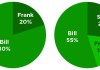
Take, for example, a small tech startup with two founders. Bill is a seasoned salesperson with 20 years’ experience and a well-developed personal network; and Frank is a young, talented developer. Bill and Frank decide that Bill’s “market value” is probably twice what Frank could get. They set Bill’s hourly rate at $200 and Frank’s at $100.

Additionally, Bill invests $5,000 cash into the company to pay miscellaneous expenses. Cash has a higher relative value than time because it’s much harder to save $5,000 than it is to earn $5,000 (not to mention that all startups need cash). They set the relative value of the cash at four times the actual value. This reflects the importance of the cash and the risk that Bill may lose it all.

At the end of the first month in business Bill and Frank have each worked 100 hours. So, Bill has contributed $20,000 in time and $20,000 in cash ($5,000 times four). Frank has contributed $10,000 in time. So, the total “value” of the firm is $50,000. Bill owns 80 percent and Frank owns 20 percent. Note that the dollar value isn’t an actual reflection of the firm’s value; it simply serves as a way to track the relative value of each person’s contribution (we hope it will be worth much more!)

The following month they hire Sally, another developer. They set her hourly rate at $100 because her skills and experience are similar to Frank’s. Sally also contributes some equipment valued at $10,000. They agree that the equipment isn’t the same as cash, but it’s still more valuable than their time. They value the equipment at twice the cash value ($20,000).

Each team member works 100 hours during the next month. Bill adds $20,000 to his existing $40,000, Frank adds $10,000 to his $10,000 and Sally contributes $10,000 in time plus $20,000 in equipment. Now the total “value” of the firm is $110,000. Bill owns 55 percent, Frank owns 18 percent and Sally owns 27 percent. The dynamic model has easily accommodated the new participant and percentages have adjusted fairly. What Bill owns is a perfect reflection of what he contributed; likewise for Frank and Sally. Bill and Frank have a lower ownership, but they are still happy because the value of the firm has increased.

The equity split will continue to adjust during the formation stages of the company. By the time the company is ready for a significant investment their team will be more settled. Investors will enjoy the benefit of a clean cap table that treats everyone fairly. If the company chooses not to seek outside investment the cap table provides a tool for distributing profits or dividends.

The dynamic equity split is most relevant for early-stage companies. The model virtually eliminates equity allocation mistakes that are common with fixed-equity models and allows teams to move forward with perfectly aligned interests. Equity programs that include traditional options and vesting schedules are better suited for larger companies with less volatility.

The perfect cap table is well within the grasp of any entrepreneur. Implementing a dynamic equity model will accommodate the inevitable changes that companies go through, especially in the early days of a startups life. Traditional fixed models run the risk of unfair equity splits that can cause relationship problems between founders that often lead to the startup’s demise.

Meet Kirsty Nathoo, Y Combinator’s Secret Financial And Operational Weapon

kirsty

The back office is an unglamorous but crucial part of any venture firm. At Y Combinator, which has grown its seed-stage fund and incubator quickly in recent years, it also has to move at the pace of a young startup.

The person who has made that happen is Kirsty Nathoo, a UK transplant with an accounting background. She joined a few years ago and has shepherded hundreds of companies from entry through incorporation, fundraising, and now even product development.

“Y Combinator would cease to operate if Kirsty wasn’t around,” said Y Combinator partner Harj Taggar.

“She’s the story behind Y Combinator,” said one YC founder, who us maintaining anonymity because his company is in stealth mode. “If you scratch the surface and see how YC works, Kirsty is critical to startups, and most YC companies are more likely to spend time with her than anyone else.”

As CFO of the incubator, she holds the keys to the kingdom – literally. Not only does she control and manage Y Combinator’s internal finances, from paying bills to helping organize demo days to actually making sure Y Combinator’s money is wired to startups from the proper accounts; but she helps YC startups coordinate outside financings, tax issues, incorporation and other fiscal matters. She’s the financial brains behind the entire operation, which has funded and incubated 368 startups under Nathoo’s watch. In short, Nathoo’s job could probably be handled by a staff of five.

As Nathoo tells the story of joining Y Combinator, timing was everything.

She first heard of Y Combinator back in 2008 when her husband, Amir Nathoo, was accepted into the Winter ’08 program. Amir ended up graduating and launching mobile development platform Trigger. At the time her husband entered Y Combinator, Nathoo, who studied at Cambridge, was working as an audit manager at accounting giant PricewaterhouseCoopers in England. At PwC, she helped look after company bookkeeping.

As soon as she visited San Francisco when Amir started Y Combinator, she fell in love with the city. Y Combinator also became a family of sorts, as her husband was immersed in the program. For the year following Amir’s program, Nathoo split time between the UK and the U.S. working for PwC until Y Combinator founders Paul Graham and Jessica Livingston approached Nathoo to help them with operations and accounting. In early 2010, Nathoo officially joined the incubator as its in-house accountant.

The Winter 2010 class was Nathoo’s first batch of startups, with the total number of companies incubated at 26 startups. That number has almost quadrupled in two years, Nathoo notes, with the Summer 2012 class graduating a whopping 85 startups (all under Nathoo’s watch).

“I was shocked at the amount of trust that was being placed on me at first”

She began looking after Y Combinator’s own bookkeeping efforts, organizing the money that Sequoia had invested in the organization, as well as keeping this separate from the original money that Graham, Livingston, Trevor Blackwell and Robert Morris put in the company back at its founding. It’s actually a complicated task. In March 2009, Sequoia invested $2 million in funding, which was kept in one account. In 2010, Sequoia, along with other angel investors, put $8.25 million into Y Combinator. This also had to be kept separate, and Nathoo has to report into Sequoia on the amounts invested, as well as the returns (if any).

“I was shocked at the amount of trust that was being placed on me at first,” Nathoo says.

She also started helping organize demo days, which are the presentations the startups make to investors and the press at the end of the program. She also began working with startups and founders, the part of her job which she truly enjoys the most, she says.

Taggar says that Y Combinator wants companies to do nothing during their program but write code and develop their ideas. “Kirsty is the person who let’s that happen. Founders don’t have to spend the mental energy on logistics and can focus on the things they want to focus on,” he adds.

There’s not a lot that Nathoo doesn’t do when it comes to helping Y Combinator entrepreneurs enter the program and navigate finances, both for the company and personally. Nathoo will coordinate with admitted entrepreneurs to ensure that they get their money when they start the program, and help them understand the terms of the agreements. Y Combinator puts in $11,000 plus $3,000 per founder (up to a maximum of 3 founders) in exchange for around 7 percent of equity. Nathoo ensures this money is wired to the proper bank accounts, which is a complicated task when you are dealing with 30, 40 or even 80 startups (and more founders).

Nathoo recalls a recent situation with an overseas founder who had flown to the country to attend Y Combinator with no U.S. bank account and no way to make payments. He didn’t even have access to money with which he could pay rent. So Nathoo met him at the San Francisco International Airport on his arrival with a wad of cash to take to a new landlord so the founder would have a place to sleep that night.

Another role Nathoo takes on with founders and startups is an accounting advisor. She’ll ensure that every company incorporates in the state of Delaware, and if they haven’t done this, she’ll help with that process. Y Combinator and most investors will only invest in companies that have been in incorporated in Delaware, and many founders don’t know this. Nathoo says that of the current class of 47 startups at Y Combinator, only one company’s incorporation documents were problem-free when joining the program. She also helps them open bank accounts and keep track of receipts and finances to be mindful of tax consequences. Most of the founders have never raised funding so don’t understand what a convertible note is or how a cap table works.

Jospeh Walla, CEO and founder of YC 2011 graduate and electronic signature startup HelloSign, recalls Nathoo’s help on 83(b) election forms. Whenever you issue stock, it’s important to report this via a 83(b) form to the IRS. Many startup founders don’t know this, however; and Nathoo helped Walla and a number of his classmates with this process.

“It’s interesting that she keeps a low profile, because she’s a significant part of Y Combinator. She has a lot of pattern recognition when it comes to financing and accounting. I can’t think of anyone in the Valley that has that level of experience,” he says. “She makes sure we become a real company rather than a group of people with different ideas.”

“She makes sure we become a real company rather than a group of people with different ideas”

As Nathoo became more entrenched in the day-to-day operations of Y Combinator, it made more sense for her to take on responsibilities like handling and helping with financings. Last year, she was promoted to CFO. Nathoo says that she has developed a systematic way to organize incorporation documents and financing term sheets from Y Combinator.

Because she’s helped form hundreds of these funding documents from both Y Combinator and outside investors, Nathoo also has a pattern recognition into what terms specific investors will back down on, or negotiate. While she didn’t name names, she said that she’s started to see patterns of what certain investors want or don’t want and will advise startups accordingly.

Additionally, Nathoo was also helping with the financial logistics of the Start Fund, which gave each Y Combinator company $150,000 in investment from Yuri Milner, Andreessen Horowitz and General Catalyst. Y Combinator recently replaced this with YC VC, which includes Milner, Andreessen Horowitz, General Catalyst and Maverick Capital. Instead of $150,000, YC VC puts $80,000 into each startup.

Needless to say, with all these different sources of money coming into Y Combinator startups, Nathoo is a master at Excel spreadsheets.

Beyond managing financials, Nathoo has taken on the role of operations manager as well as mediator/den mother to Y Combinator startups. She invites VCs and angel investors to demo day, and ensures each investor is vetted. With the rate of successful startups coming out of Y Combinator, investors are clamoring to attend demo days, and Nathoo ensures that each investor attending is vetted, and are the right fit for startups. That means some potential investors could be left out. There have been situations, says Nathoo, where some investors try to bring their friends to demo day that have not been vetted, and she has had to ask people to leave. There have been a few investor tantrums, she adds.

Some of Nathoo’s financial advice also gets personal. Many founders will come to her with personal tax and finance questions. And startups who have graduated Y Combinator continue to email Nathoo with tax inquiries and issues. Unfortunately, Nathoo also serves as mediator when things don’t go well between founders at Y Combinator, which does happen in each class. “I try not to take sides, but I am there to pick up the pieces,” she says. “I also advise them to establish rules and contracts at the beginning of their time at Y Combinator that establishes equity breakdowns and splits if one founder leaves.”

Another characteristic that makes Kirsty so unique is her efficiency in what are normally very complicated matters. For example, she helped architect a way for funds to be automatically transferred into bank accounts of founders as soon as the original Y Combinator funding documents are filed. Previously, this was a manual process, and Nathoo would be making 60 or more wire transfers herself for each class. Now this task has been automated.

The Future

Nathoo tells us that the last of the Sequoia money was used in the Summer 2012 class. Now Y Combinator is completely self funded through the money the incubator has made through its investments in startups (i.e. exits). Will Y Combinator continue to operate without any funding? Nathoo says she’s not sure how far it will go, but the organization is in a good place, financially.

Y Combinator has also recently bought a new building in Mountain View where the incubator will move into, as it has outgrown its current Mountain View headquarters. Nathoo will be managing the financials and operations around this as well.

Looking forward, she’s also working with founders on product strategy, which she says is her next big challenge. She’s also been part of the interview process for startups applying to be in the program.

“Y Combinator’s biggest challenge right now is scaling and figuring out how to do that,” she explains. We’re trying to figure out how to help more and more companies be successful, and there are many threads to that answer. Part of this is systematizing things that can be systemized, like finance.”

For Nathoo, Y Combinator is more than just a job, it is a family. “This is my dream job. I tell so many people I have the best job in the world.”

Apple And Google Still Lead WebKit Development, But More Smaller Companies Contributing

webkit_306

Apple and Google still represent the bulk of reviewed commits contributing to the ongoing development of WebKit, the open source web browser engine that powers Safari and Chrome, among others. Google accounts for the bulk of commits, having overtaken Apple in that regard back in 2009 (though Apple still does much more with fewer authors actually writing code), but the more interesting story here is that the impact of other parties is steadily growing.

Bitergia, a company that analyzes free, libre and open-source software projects, gathered data on the development of WebKit in a new report, showing that the share of reviewed commits coming from parties other than Apple and Google is at 25 percent and growing, higher than it has been in the past. Around five companies were actively contributing to WebKit back in 2007, but that number has risen to over 20 today, and the picture of which of those companies is contributing the most tells a story about changing fortunes and goals for companies building products for the web.

Nokia, for instance, was once a significant contributor to WebKit, with its contribution peaking around late 2011 (which is also when the Windows 7-powered Lumia line first appeared, and when MeeGo was still a going concern). Lately, however, Nokia’s contribution has dropped off dramatically, with both its monthly commits and authors working on WebKit taking a steep dive. That may show where Nokia’s priorities lie as it becomes more of a dedicated hardware partner running more or less on software provided by Microsoft.

BlackBerry, in stark contrast, has increased its contributions and authors working on WebKit by almost inverse proportion to Nokia. It’s impact has grown steeply since 2011, which is in keeping with the development of BB OS 10 and its WebKit-based browser, an element of the OS the company placed a lot of emphasis on at launch.

Apple and Google are still the most invested in the development of WebKit, and for good reason, but the changing picture of reviewed commits helping the engine along means we’re seeing a more diverse set of interests represented in the project than ever before, and it’ll be interesting to see where that takes us.

Gillmor Gang: Snow Kidding

gillmor-gang-test-pattern_excerpt

The Gillmor Gang — Danny Sullivan, John Borthwick, Kevin Marks, Keith Teare, and Steve Gillmor — take advantage of the East Coast blizzard to toast some marshmallows on the fire. First up is the Series A drought and impact of the cloud on startup funding. Next, the big pivot to Spoilerland, aka Binge TV.

House of Cards is having just that impact on the television industry, collapsing the mid tier pay networks into an environment much like planes stacked up over Newark. It’s Breaking Bad followed by Mad Men followed by Arrested Development and so forth. How the broadcast networks get past the new air traffic controllers is anybody’s guess, but Netflix continues to confound the experts and delight the customers.

@stevegillmor, @dannysullivan, @borthwick, @kevinmarks, @kteare

Produced and directed by Tina Chase Gillmor @tinagillmor

Microsoft’s 128GB Surface Pro Sells Out At MS Online Store Just Hours After Launch

surfaceproleft

Microsoft’s $999 128GB Surface Pro has sold out in the online Microsoft Store in the U.S. (via WinBeta), just a few hours after going on sale today, February 9. The 64GB version is still available as of this writing, and the Surface Pro is still likely in stock at physical retail locations like Best Buy, where it also went on sale today, although checking the stock levels via their online tool reports the Surface Pro as “Unavailable” across the board.

The Surface Pro is Microsoft’s more powerful, Intel-powered Windows 8 tablet, which runs the full version of Windows 8 unlike the Surface RT and can handle full-fledged Windows desktop applications. In the TC review, John Biggs said that the Pro was a much more compelling device than the RT, in part because of its ability to run software that enterprise IT departments depend upon from legacy windows installations.

The Surface RT sold out of the $500 32GB model within one day, but the Pro’s more expensive model has sold out even faster. That could indicate that users are placing a higher value on storage with the Pro, which is marketed as a device much more suited to getting serious work done than the Surface RT. The 64GB model remains in stock for now, and given that there’s only a $100 price difference to trade up to double the storage capacity with the 128GB version, that’s not surprising.

Storage was recently the subject of a number of back-and-forth reports regarding the Surface, with some claiming Microsoft left little room on-device for personal files once you accounted for the Windows 8 OS install. Ed Bott reported earlier today on the actual storage numbers, which beat the original estimates by a fair amount, but the free space on the 64GB version still represents a 200 percent increase from the actual usable space on the base Surface Pro model.

The 128GB Surface Pro is still available to order from the Microsoft Store online in Canada as of this publication date, and you may still be able to grab one by visiting a physical retail location.

Mailbox’s Virtual Queue Succeeds In The Waiting Game Where Peter Molyneux’s Curiosity Stumbles

mailbox-app

Mailbox, the email inbox management app for iPhone that was released in beta this week, currently has around 700,000 users queuing up for access, at the time of this writing. That’s according to the in-app counter that many of us have been staring at on and off for days now, which tells you how many people there are still ahead of you in line for the app, and how many people are joining up behind to wait their own turn.

It’s ostensibly a mechanism to help Mailbox’s servers manage the tremendous demand put upon them by users, though some believe it’s a marketing ploy designed to increase demand. Others think it could be an obnoxious experiment in human behavior. I’m inclined to believe that the Mailbox creators are truly looking for a more efficient and effective way to bring a server-intensive app online in a way that doesn’t result in huge outages, but intentionally or unintentionally, Mailbox is breaking new ground in virtual experiences that others have tried to explore with arguably less successful experimental games.

The Mailbox queue is in itself an experience, apart from the app itself, which is highly regarded according to most reviewers. It’s probably the app I open most frequently on my iPhone at the moment (besides another project currently in development with some oddly similar mechanics). That despite the fact that there’s nothing to actually “do” for the time being: I open the app, a counter ticks down and another ticks up, I close the app. Still, even that simple act of repeatedly opening and closing the app represents more engagement than I can muster for around 90 percent of the other titles currently gracing my iPhone’s home screen.

Compare that to Peter Molyneux’s recent exercise in patience for mobile devices, Curiosity. The app, built by Molyneux’s new 22cans studio, features a mystery wrapped inside a cube, which is chipped away gradually by all of the app’s users working in tandem to unlock the ultimate secret. Molyneux’s game has interactivity, an end goal that should be more exciting since it’s cloaked in secrecy, and manages to not simply replicate the experience of standing in line. Yet I’ve opened it exactly no times in the months following my initial exploration for a launch article.

One part of my interview with Molyneux at Curiosity’s launch stands out as extremely telling, and in retrospect, it foreshadows Mailbox’s current success. Molyneux said that in developing Curiosity, the 22cans team found that, by and large, players were content to just sit and watch while others did the work, and that they had to come up with tricks and incentives to convince those lurkers to participate. These “idle” players greatly outnumbered the active ones, so it stands to reason that Mailbox’s virtual queue, which is essentially exclusively about passive participation, would work so well.

Other games have experimented with delayed gratification, including the excellent The Heist by the team behind the MacHeist bundle. What’s interesting is seeing that concept applied to a productivity apps, and to see that implementation received as well as it has been. Sure, there’s been some groaning about the absurdity of having to wait for an app, both on Twitter and in the App Store reviews for Mailbox, but I’d argue that as vocal as complainers have been, there’s still more demand for the app than anything else.

So does that mean a participatory wait list becomes a staple of mobile app development? Don’t count on it; Mailbox benefitted from a unique blend of pre-launch hype, good design, and working in an area where people are immensely frustrated with existing solutions (i.e. email). But like Curiosity and The Heist before it, the example of Mailbox adds another data point to how software developers might use delayed gratification to engage users, and that could have interesting ramifications for the future of apps.

Amazon Coins Are Steroids For The Amazon Appstore

virtual-currency

Editor’s note: Charles Edward Hudson is a venture partner with SoftTech VC and the CEO and co-founder of San Francisco-based, mobile games company Bionic Panda Games. Follow him on Twitter @chudson.

I have been trying to wrap my head around Amazon’s decision to launch Amazon Coins as a currency. It works in the Amazon Appstore and allows consumers to pay for digital content, namely games, apps and in-app purchases, using virtual currency in lieu of cash. The reason this struck me as curious is that most major platforms that have offered universal, platform-wide virtual currencies have dialed back those efforts or simply abandoned them over time.

The most recent example of a platform that offered, and ultimately removed, a platform-wide currency is Facebook. Facebook launched the FB Credits system in 2011 to simplify the myriad payment experiences developers were rolling out for their Facebook apps and social games. At the time, each developer was hacking together his or her own payment system, which was normally a mixture of PayPal, incentivized offer walls, credit card processing, carrier billing and just about any other monetization scheme developers thought would generate revenue. The result was that every developer spent a lot of time playing with and optimizing payment options, rotating through offer wall providers, and generally coming up with what they thought would work best. Each and every app had its own checkout flow and payment system.

Facebook Credits was an attempt to standardize the payments and checkout experience across all Facebook applications. Facebook mandated the use of credits and took 30 percent for doing so. Facebook ultimately shut down its Facebook Credits offering a year and a half after launch. My sense is that Facebook realized what Apple, Google and others have realized – the real value is in controlling the payment experience and making that standardized across all apps in the ecosystem. You can control the cash register without having a universal, platform-wide currency.

If so many other people have concluded that platform-wide currencies are unnecessary, why does Amazon view things differently and how does it fit into their strategy? Well, Amazon is coming at this from a different angle than Facebook, Google or Apple, and Amazon Coins makes a lot of sense in the context of the company’s desire to build a big app developer ecosystem around its existing devices (Amazon Kindle Fire) and other products that are likely in the pipeline.

The Appstore On Steroids

The most compelling reason I can think of for Amazon to launch platform payments is as a way to drive more volume and velocity in digital goods purchases on the Kindle Fire and, more broadly, in the Amazon Appstore ecosystem. Amazon Coins, as they exist today, can only be used to do two things: purchase applications in the Amazon Appstore or make in-app purchases in Amazon Appstore applications.

In their press release announcing Amazon Coins, the company makes it clear that they are going to give away (not sell) tens of millions of dollars worth of Amazon Coins in the coming quarters. The only rational reason to give away tens of millions of dollars of virtual currency that has real-world value is to juice the market and get people who have Kindles spending more money on apps and in-app purchases. It will be great for developers who have apps live in the store and for consumers looking to get more free stuff.

Google and Apple don’t need a “coins” product given their current market positions. Google has Google Play gift cards that can only be spent in the Google Play store. Apple has gift cards that can be spent on both apps or anything else Apple sells. Those are crude but effective ways to drive digital content purchases. But for Amazon, simply giving people Amazon gift cards would not guarantee that the spend was done digitally – people could use those cards to buy anything in Amazon’s vast catalog of digital and physical goods. The only way to ensure that the spend is made on digital products is to come up with a form of currency (gift card, virtual currency, etc.) that can only be spent on digital products. And Amazon has done that with Amazon Coins.

Amazon Coins are basically restricted cash that can only be spent in the Kindle Fire ecosystem, And Amazon is going to use them the way some athletes use steroids – to boost performance and inject a burst into their ecosystem. Aside from the obvious benefits of putting free cash in the hands of consumers, this could also enable some other really interesting product combinations for Amazon:

  • Bundle Amazon Coins with Kindle hardware purchases. For example, if you buy a Kindle Fire, you get $50 in Amazon Coins to spend on apps and services. Amazon can be sure that this money will only be spent in their ecosystem and specifically on digital content.
  • Allow parents and family members to “gift” Amazon Coins to children to control digital content spend and to allow for usage without sharing credit card credentials or other information. This would be a very interesting play on the “digital allowance” that many people have been exploring.

One great lesson Amazon seems to have learned is that they are not asking developers to make any modifications to their apps to accept Amazon Coins. That’s a great way to get developers on your side when rolling out a new currency.

Kickstarter: The Coastliner Automatic Watch Is Brimming With Understated Retro Appeal

coastliner

Kickstarter occasionally has a watch project, but they’re relatively rare, and even when one does pop up, it usually isn’t impressive enough to turn my head. The Coastliner, a project going on right now, is definitely a noteworthy exception. From independent graphic designer-turned-watchmaker Tim Hadleigh working out of the U.K., the retro-cool Coastliner gets its design inspiration from American classic cars of the 1950s, and the result is a stunner.

Hadleigh’s Coastliner marries a mirror-polish stainless steel case with a cream-colored dial, tapered needle minute hands and a sea-foam green second hand that acts like a cherry on top of the 50s-theme sundae. A brown calfskin strap, with green interior lining to match the second hand completes the look. The Coastliner’s appeal isn’t all on the surface, either; the watch is powered by an ETA 2824-2 automatic Swiss movement, visible through the exhibition window on the watch’s case back.

The Coastliner’s face, with its small, sans-serif hour marker and the subtle relief design printed on the center may be my favorite part of the design, but every element comes together nicely. All of the elements of the fully functional prototype (save the sapphire glass and Swiss ETA movement) were designed and built by Hadleigh himself, who got his start in watchmaking as a hobbyist taking things apart, and eventually graduated to building his own designs, and even his own movements, by hand.

The project is set up to fund a limited production run of 50 Coastliner watches. As of this writing, there was just one remaining at the discounted pre-order level of £375 ($592 US), with another 25 available at the full price of £750 ($1185 US). The prices are fair given how much work Hadleigh is putting into the production (a process he describes in detail for a previous watch he built on the Kickstarter page), and given the quality of the components. A lot of collectors hesitate on new or young brands, but if you’re a fan of supporting a new generation of makers trying to deliver high-quality products outside of the heavily entrenched legacy watch brands, the Coastliner is a good pick.

10 Great Ideas Someone Should Invent

(Princess Leia's daughter?)

This article might change your life or make you rich. It’s time to save the world. There’s a lot of bad news out there. Rising unemployment, soldiers being replaced in their jobs by drones that kill babies, a new housing crisis that will end all housing crises, who is the real father of Kim Kardashian’s child, and on and on.

Meanwhile, many futurists are at work on “what’s new for 2013?” Will Lindsay Lohan play Princess Leia’s daughter in the new Star Wars movies? Will Tiger Woods make a comeback? Will the Middle East “have tension”?

Forget about 2013 and Princess Leia. While the futurists do their thing let’s actually get down to exercising our idea muscles. And no more “little ideas.” I’m guilty of this. Some of my failures: “a dating site for Twitter users,” “crowdsourcing TV ads,” “Myspace for finance,” blah! Some little ideas I’ve heard recently: “search engine for shared economy sites,” “real estate search engine.” Blech!

The idea muscle atrophies, just like any other muscle. I need to exercise mine every day or it starts to not work. It doesn’t matter if you come up with bad ideas or good ideas. There’s no such thing as a bad exercise session.

Let’s come up with some real ideas that can save the world. The only criteria – they have to help a million people. Or, if they don’t work, can be turned into a science-fiction novel that 1 million people would enjoy. Don’t be afraid to come up with bad ideas. Here are mine. Feel free to have idea sex between your ideas and mine so we can come up with even better ideas. This is just practice. Practice makes perfect.

A) I wrote down an idea here but I deleted it. I’m not afraid to admit when ideas are bad. More on this later.

B) Klout as currency. Think about it. It makes sense. If I give $5 to a donut shop that means a lot less than if Barack Obama gives $5 to a donut shop. Then that donut shop is “The Presidential Donut Shop.” B’s $5 was a lot more valuable than my $5. The $5 is just paper after all. It doesn’t matter who holds it.

Oprah has an infinite Klout score.

Klout + currrency = value in today’s world. So it makes complete sense that people with higher Klout should be able to buy more things. Because their currency is more valuable than mine. And when they buy things, that infers Klout on the seller, who can now buy more things. The world is heading in this direction anyway. Look at Oprah. Oprah has an infinite Klout score. When Oprah reads a book, that book’s author suddenly gets wealthier. If Oprah bought a pencil from me my Klout score would go up 80 percent, give or take. The middle class is disappearing. The temp staffers pay for goods with scrip and rich people buy Twitter followers. We’re moving towards a Klout-currency world anyway. Now make it happen.

(In all respect to Josh Gosfeld, author of “The Art of Doing,” I just stole the idea you told me you were going to do a science-fiction novel about. Sorry.)

C) Use Global Warming to Solve Global Warming. I don’t know why nobody has thought of this yet. Just look at the words “Global. Warming.” i.e. The surface of the planet is getting hotter. That means it’s giving off energy. Use photovoltaic strips to harness the energy coming off the planet to reduce our need for carbon-based energy. BAM! Problem solved.

The beauty of this is that if there is no global warming then the technique won’t work. No problem! Go back to carbon then until the planet starts heating again. I am all ready to meet Al Gore now.

D) 3D Printing of Humans. “3D Printing” seems to be the latest tech fad. But whatever. I don’t even know what it is. But here’s what “3D Human Printing” is. Let’s say I can’t make a meeting tomorrow that’s in India, 8,000 miles away. But I really want to go. I get in my virtual reality suit at home and turn it on. In the conference room in Bangalore, another suit opens up. It opens its eyes. On the video screen in my suit I see what those eyes see. I move my arms and that suit moves its arms. I talk and that suit talks with my voice. My entire awareness feels like it’s in the room in Bangalore.

Video conferencing can never replace face to face. And even though this is sort of like advanced video conferencing, the minds of the other people in the room are basically psychologically fooled into thinking I am right there with them. It’s just like if you take a robot and give it a human body, many people think it’s almost like an actual human even though it’s just a computer. This is one idea I can invent personally. And I have motivation. I don’t like to travel. I like to sit at home and do nothing. With this invention I can travel all over the world. I can even go to Easter Island. This is sort of like Teleportation 101.

Robot or human?

E) Advertising in Houses. This sounds ugly at first. An ad on a wall in your house? Maybe in a frame like a picture. Or a mirror. But here’s the deal: I get the price of my house reduced if I agree to allow advertising all over the house. Like if I’m sitting in the bathroom and I see “daily deals” projected onto the shower curtain. The ad agencies agree to subsidize part of the price of my house. It gets better. As part of this, they have software that listens to all my phone calls. Forget “social media.” Let’s see what I’m interested in when I’m ACTUALLY being social, i.e. talking to people on the phone. If I say on the phone, “I’d really love to go skiing this year but I can’t afford it” I start getting offers on my shower curtain for skiing trips at a discount. It’s win-win-win. I make money while talking to my friends. My house is cheaper. And companies sell more, improving the economy, hiring more people, and life goes from “bad” to “good.”

F) Happiness Hotspots. For 10 years I’ve been getting business proposals like “with our product you will get alerted when your friends are close by.” I actually think now is the time this will actually work because of the rise of phablets like the Galaxy Note II. But forget that. When I want to see my friends, I’m not an idiot. I just call my friends and say, “hey, let’s meet for coffee.”

But let’s make this localization thing really life improving. “Studies show” that it’s better to be around positive people than negative people. Positive people uplift you, negative people bring you down. So let’s do this. Everyone wears an earplug that takes constant scans of your brain activity. The brain scans are matched against a database of 10,000 brain scans labeled “happy” or “sad” and then use standard speech recognition techniques to classify the user brain scan as either “happy” or “sad.”

NOW, on my Google Maps on my phone I can see shades all over the map. The brightest colors denote areas where the happiest people seem to be. The darker colors denote areas where negative people are. So if I’m trying to decide today, “hmmm, uptown or downtown?” I can look at the Happiness Map to see where the happiest areas are and go there. Who cares if my friends are there or not? I’ll make new friends in the happy hotspots!

Everyone wears an earplug that takes constant scans of your brain activity.

G) 40 Percent Unemployment. The reality is, most people should not be at work. Why? Because they are bad at it. It’s rare that someone is actually good at what they do. I know maybe 10 people that are good at their jobs. This is not a criticism. It’s just a fact. And basically, robots are better. That’s why Apple is moving production back to the U.S. Because too many Chinese people were killing themselves in their factories. Robots don’t kill themselves and they get the job done faster.

So what society really needs is 40 or 50 percent unemployment. Here’s how you do it. My solution starts off Communist but ends up libertarian. Basically, companies get incentivized to replace all humans with robots. The excess profits you get from firing people get taxed at only half the rate. All of those “robot taxes” get put into a government fund that is used to subsidize the people who are fired (just like farmers are often paid subsidies not to farm). The subsidies, though, run out after three years. So you have three years from the day you are fired to start a new business. Hopefully the business uses robots instead of humans else you won’t be able to compete against your higher-margin competitors. If you can’t start a business then you end up being a temp staffer somewhere. Don’t say this is heartless. This is the way the world is going. That’s why the middle class is disappearing. Robots are the new middle class. And everyone else will either be an entrepreneur or a temp staffer. Don’t shoot the messenger here. It’s already happening. I’m just trying to figure out a way that we can actually accept the 40 percent unemployment or “underemployment” (which is already at 20 percent) which is coming.

H) Brain Dating. This is a slight take on “G” above. No dating service works. The divorce rate is going up. Many people are not happy and end up cheating. For the first time, five-star hotels like the Parker Meridien are charging by the hour because of cheating dating services like AshleyMadison.com.

So let’s solve this and end a lot of misery. Take the brain scans of 1,000 couples who are happily married after 40 years. You know the couples that say, “well, we’ve had our problems but we’ve survived.” Get rid of them. NO PROBLEMS. They are out there. Just a 1,000 couples of the 2 billion couples on the planet. Now average the brain scans together.

When you sign up for the brain dating service, you have to submit your brain scan. It averages your brain scan with the brain scans of all the women in the database. Then it matches the results against the database of 1,000 happily married people. Whichever combination for you results in the closest match to those 1,000 brain scans, you then get set up on date with the woman (or man) behind that brain scan. Price: $10,000. Guarantee: life-long marital bliss or your money back.

Successful result of “brain dating” from an ancient scientific civilization that disappeared

I) A “Like” button in my contact lenses. I just read they are making contact lenses that can read SMS texts. That’s nice. I like to be in constant communication with everyone I know all the time. But let’s take it one step further. I meet you, I like you, BAM, I blink twice quickly and my contact lens registers the like. Now you go about your day and other people who meet you can immediately see, “Sharon has 158 Likes today.” And I can also see which of my friends like you.

Life is stressful and maybe you need a break.

If you’re having a bad day maybe you have only “5 likes today.” No problem. People will avoid you on those days and give you your space. Life is stressful and maybe you need a break. Tomorrow you might be refreshed and get more likes again. I don’t want just “social media.” I want social LIFE.

Before I get to “J,” I want to explain “A.” The original idea was “Wi-Fi with protein.” When nomad tribes got to a new area 15,000 years ago they would think, “Where’s the food?” Now, in my nomadic wanderings (i.e. NYC Starbucks locations) I think, “where is the Wi-Fi?” Wi-Fi has clearly replaced food in our minds. So Wi-Fi with protein would solve the problem, right? But here’s the issue. For the life of me, I can’t figure out how you would do it. With every idea above I can think of the next step. Ideas are a dime a dozen. It’s all about EXECUTION. I just looked up everything I could about molecular biology on Wikipedia and I simply cannot figure out how to make Wi-Fi with protein. So I deleted that idea. No good. By the way, if you are Ridley Scott please call me about licensing any of these ideas for a science-fiction movie.

J) I don’t have a “J.” My brain is hurting. If you can come up with a good “J” to help me round this out into 10 ideas I’d be really grateful. And if I ever make a company out of it that makes a few billion dollars, I’ll give you a small piece of the company and part of my Klout score. Please follow me on Twitter so my Klout score goes up. I love you.

Editor’s note: James Altucher is an investor, programmer, author, and several-times entrepreneur. His latest books are I Was Blind But Now I See and40 Alternatives to College. Please follow him on Twitter @jaltucher.

Technical Debt Will Kill You Dead (If You Let It)

debt

A project I’ve been working on launched recently. Well, re-launched. A slick little iPhone app called Postography, which lets you send postcards with messages and pictures from your iPhone. Nifty, but sounds fairly straightforward, right? An app that shouldn’t have taken too much time to build.

Unfortunately, we didn’t build it; we rebuilt it. And the company that took the first crack at it (naming no names here) did a fairly good job on the server side…but epically botched the initial version of the app itself. Oh, it ultimately sort of kind of worked, other than the many bugs and frequent crashes. But quite aside from those, its codebase was such a festering abyss of global variables, spaghetti code, hacks, no-ops and race conditions that extending it or changing it at all was next to impossible without major reconstructive surgery.

This happens a lot more than anyone would like to admit. Behind the shiny UI many applications there lurk Lovecraftian architectural nightmares that challenge the very sanity of anyone charged with maintaining them or adding features. Ask a developer, any developer; they’ll have some horrific tales to tell.

And if yours is one of those–if your company is an app, and that app works, but doesn’t work cleanly, or elegantly, or extensibly, or scalably–then your company has already racked up a pile of technical debt, and whether you know it yet or not, you’re already in big trouble.

I like to use a housing metaphor: just because your house looks good, and its rooms are comfortable and well-decorated, doesn’t mean it isn’t built on such a poor foundation that it may collapse if a heavyset guest so much as runs down the stairs. Add another story? Are you kidding? Forget about it. Indeed, your house may have been built on poor ground to begin with, in which case not even a new foundation will do: you have to scrap it entirely and start again somewhere else.

This happens even at extremely technical companies. I give you RIM as an example. Remember when they released a tablet without an email app? Remember how they silently treaded water for an apparent eternity while iOS and Android left BlackBerry in their wake? These debacles were not design choices or deliberate executive decisions. They happened because RIM had run up an enormous amount of technical debt, and it took them years to pay it off.

Like monetary debt, technical debt is perfectly OK as long as a) you don’t accrue too much of it and b) you know all about it. Of course there are often compromises to be made between, for instance, scalability and speed of development. Of course when a deadline is approaching, and/or the funding is running low, and the task seems immense, the quick-hack shortcut is sometimes the right choice. Of course all developers are understandably biased towards the tools they know–or, sometimes, the tools they want to learn–rather than the one that’s ideal for the job at hand.

Like all debt, technical debt compounds with time.

But all too often the accumulation of technical debt in favor of short-term success is ultimately a terrible mistake. Like all debt, technical debt compounds with time. Worse yet, many non-technical people — i.e. too many managers, executives, and founders — tend to underestimate its danger, or fail to even realize when they’re running it up by the vault load…until they find themselves spending many months fighting to pay off their technical debt while their competitors are happily zooming ahead. Just like RIM.

So how can startups avoid such an awful fate?

Hiring the right people is critically important, of course. Pair programming helps, as does the primary/secondary model I favor. And I’ve long thought that technical assessments would be a good idea: have a few experienced people take a week or so to audit your code and architecture, once early in the application’s lifecycle and once more midway through. The company I work for has done that once or twice, but alas, it’s not really common industry practice, or at least not yet.

What can you do if you’ve already run up a load of technical debt? First, get your head out of the sand and accept that you have a major problem. Second, stop digging. Stop adding new features, and get things into a semi-stable state so that you can see what you do and don’t have. Then try to determine whether you can keep your metaphorical house, but need to rebuild the foundation — even though things that previously worked will start to break again while that repair is underway, which is always frustrating — or whether you have to throw it all out and start again. (Which can be both the best solution and the fastest one.)

Most of all, though, listen to your developers. If you’ve hired the right people, then they want clean, extensible, scalable code as much as you do. It was almost painful looking through the initial source code of the Postography app. Now I feel a bit like we performed surgery that saved the life of a dreadful-car-accident victim who has gone on to become an Olympic athlete. It’s never too late to rescue your app; but the earlier you start, the easier it gets.

Image Credit: “Images of Money”, Flickr.

Google Asks “Why Fly Private When You Can Fly Private – Out Of Your Own $82M Airport?”

google-airport

Google’s executives could soon be enjoying their own private airport space ahead of winging their way to various far-flung locations around the world, according to a news release from the Mineta San Jose International Airport (via MercuryNews). Signature Flight Support, in tandem with a company called Blue City Holdings which represents Google’s fleet of personal aircraft, will likely be awarded a 50-year lease on San Jose Airport’s West Side, in order to build a 29-acre, $82 million facility to house Google’s executive aircraft and those of other clients.

In the news release, the airport expresses its intent to recommend that Signature be granted the lease, which will see it construct a “full-service, world-class fixed base operation” on the site. The physical facility itself should occupy over 270,000 square feet on the 29 acre plot, according to the proposal, and will include an executive terminal, hangars for storing aircraft, ramp space capable of accommodating large business jets and aircraft maintenance facilities. In exchange, Signature and its partners will pay $2.6 million in annual rent, a minimum of $400,00 in fuel fee revenues, minimum annual taxes of $70- to 300,000, around 200 jobs during the construction phase, 36 jobs directly on premises and around 370 total jobs created.

Google’s fleet of aircraft included eight private jets spread across Larry Page, Sergey Brin and Eric Schmidt alone, according to news revealed back in December 2011, owned and operated by an independent company formed by the three executives apart from Google. Google almost definitely has more aircraft than that overall at this point, and establishing their own close-to-hand place from which to operate, maintain and store those means of transportation likely just makes more sense at this point that whatever other arrangements they previously had in place.

TechCrunch Goes To India — Bangalore Meetup On Tuesday

bangalore-mg-road

I’m heading out to India (Bangalore and Delhi) to meet with tech companies. We haven’t had time to put together a formal event, but I do want to meet startups, VCs and entrepreneurs, so to that end I’ll be throwing together a Meetup – probably in a bar – in Bangalore on Tuesday. The details are:

Day: Tuesday 12 February
Time: 3-5pm
Location: A venue in the MG Road are. We will announce the venue on Sunday. You can grab a free ticket here. But also please check back on this post or leave a comment below and we will inform everyone.
Format: Informal networking, casual event

I’m travelling with fifteen of the UK’s digital, wireless and mobile software technology companies on an entrepreneur-led trade mission called WebMission to Bangalore and New Delhi with the aim of developing new relationships and opening up their business to the Indian market. You can follow our journey via their blog, twitter @thewebmission, news stories and video

UPDATE: I didn’t realise we would sell out so fast! We have created a waiting list on the ticket page, so you can register your interest. Please try to understand that this is an informal meetup not a conference. For those of you in Delhi, watch for a separate post about a meetup there, likely to be on Wednesday night in the Connaught Place area at this stage.

Snapchat Raises $13.5M Series A Led By Benchmark, Now Sees 60M Snaps Sent Per Day

screen-shot-2012-12-23-at-11-58-18-am

Snapchat, the impermanent messaging app that won “Fastest Rising Startup” at the 2012 Crunchies, has finalized a $13.5 million Series A round led by Benchmark’s Mitch Lasky.

According to The New York Times, Snapchat is now valued between $60 and $70 million. In December, GigaOm’s Om Malik reported that Snapchat was raising an $8 million round from Benchmark at roughly a $50 million valuation; and our own Eric Eldon wrote that Snapchat was raising a Series A “north of $10 million” at a rough $70 million valuation, led by Lasky.

Snapchat co-founder Evan Spiegel confirmed the funding to me, and noted that the company now sees 60 million snaps sent per day, and users have sent over 5 billion snaps in total. The company has hired five new employees, bringing the total staff to 10, and has moved to a new office in Venice Beach, CA.

Spiegel tells me the company will use the funding for “hiring and servers, definitely. But most importantly, it allows us to remain independent and continue to grow the Snapchat community.”

The Times also reported that Mark Zuckerberg met with the Snapchat team in December, shortly before Facebook launched carbon copy competitor Poke.

Snapchat previously raised $485,000 from Lightspeed Venture Partners.

“I started hearing Snapchat in the same context as Twitter, Instagram and Facebook,” Lasky said to The Times, echoing Barry Eggers’ sentiments when he led Lightspeed’s investment. “That got me curious.”

Update: Lasky has posted about Snapchat on his personal blog, explaining that he will be joining the company’s board of directors along with Spiegel and co-founder Bobby Murphy.

“At Benchmark we search for entrepreneurs who want to change the world, and Evan and Bobby certainly have that ambition. We believe that Snapchat can become one of the most important mobile companies in the world, and Snapchat’s initial momentum — 60 million shared “snaps” per day, over 5 billion sent through the service to date — supports that belief. Snapchat’s ramp reminded us of another mobile app Benchmark had the good fortune to back at an early stage: Instagram.”

Lasky also noted that he spent most of his career in LA, where Snapchat’s offices are.