The deplatforming of President Trump

After years of placid admonishments, the tech world came out in force against President Trump this past week following the violent assault of the U.S. Capitol building in Washington D.C. on Wednesday. From Twitter to PayPal, more than a dozen companies have placed unprecedented restrictions or outright banned the current occupant of the White House from using their services, and in some cases, some of his associates and supporters as well.

The news was voluminous and continuous for the past few days, so here’s a recap of who took action when, and what might happen next.

Twitter: a permanent ban and a real-time attempt to shut down all possible account alternatives

Twitter has played a paramount role over the debate about how to moderate President Trump’s communications, given the president’s penchant for the platform and the nearly 90 million followers on his @realDonaldTrump account. In the past, Twitter has repeatedly warned the president, added labels related to electron integrity and misinformation, and outright blocked the occasional tweet.

This week, however, Twitter’s patience seemed to have been exhausted. Shortly after the riots at the Capitol on Wednesday, Twitter put in place a large banner warning its users about the president’s related tweet on the matter, blocking retweets of that specific message. A few hours later, the company instituted a 12-hour ban on the president’s personal account.

At first, it looked like the situation would return to normal, with Twitter offering Thursday morning that it would reinstate the president’s account after he removed tweets the company considered against its policies around inciting violence. The president posted a tweet later on Thursday with a video attachment that seemed to be relatively calmer than his recent fiery rhetoric, a video in which he also accepted the country’s election results for the first time.

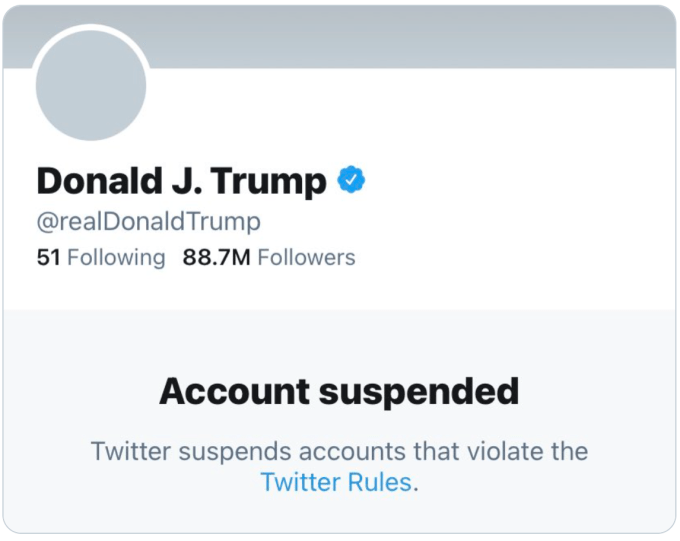
Enormous pressure externally on its own platform as well as internal demands from employees kept the policy rapidly changing though. Late Friday night, the company announced that it decided to permanently ban the president from its platform, shutting down @realDonaldTrump. The company then played a game of whack-a-mole as it blocked the president’s access to affiliated Twitter handles like @TeamTrump (his official campaign account) as well as the official presidential account @POTUS and deleted individual tweets from the president. The company’s policies state that a blocked user may not attempt to use a different account to evade its ban.

Twitter has also taken other actions against some of the president’s affiliates and broader audience, blocking Michael Flynn, a bunch of other Trump supporters, and a variety of QAnon figures.

With a new president on the horizon, the official @POTUS account will be handed to the new Biden administration, although Twitter has reportedly been intending to reset the account’s followers to zero, unlike its transition of the account in 2016 from Obama to Trump.

As for Trump himself, a permanent ban from his most prominent platform begs the question: where will he take his braggadocio and invective next? So far, we haven’t seen the president move his activities to any social network alternatives, but after the past few years (and on Twitter, the last decade), it seems hard to believe the president will merely return to his golf course and quietly ride out to the horizon.

Snap: a quick lock after dampening the president’s audience for months

Snap locked the president’s account late Wednesday following the events on Capitol Hill, and seemed to be one of the most poised tech companies to rapidly react to the events taking place in DC. Snap’s lock prevents the president from posting new snaps to his followers on the platform, which currently number approximately two million. As far as TechCrunch knows, that lock remains in place, although the president’s official profile is still available to users.

Following the death of George Floyd in Minneapolis and the concomitant Black Lives Matter protests, the company had announced back in June that it would remove the president’s account from its curated “Discover” tab, limiting its distribution and discoverability.

The president has never really effectively used the Snap platform, and with an indefinite ban in place, it looks unlikely he will find a home there in the future.

Facebook / Instagram: A short-to-medium ban with open questions on how long “indefinite” means

Facebook, like Twitter, is one of the president’s most popular destinations for his supporters, and the platform is also a locus for many of the political right’s most popular personalities. It’s moderation actions have been heavily scrutinized by the press over the past few years, but the company has mostly avoided taking direct action against the president — until this week.

On Wednesday as rioters walked out of the halls of Congress, Facebook pulled down a video from President Trump that it considered was promoting violence. Later Wednesday evening, that policy eventually extended into a 24-hour ban of the president’s account, which currently has 33 million likes, or followers. The company argued that the president had violated its policies multiple times, automatically triggering the one-day suspension. At the same time, Facebook (and Instagram) took action to block a popular trending hashtag related to the Capitol riots.

On Thursday morning, Mark Zuckerberg, in a personal post on his own platform, announced an “indefinite” suspension for the president, with a minimum duration of two weeks. That timing would neatly extend the suspension through the inauguration of president-elect Biden, who is to assume the presidency at noon on January 20th.

What will happen after the inauguration? Right now, we don’t know. The president’s account is suspended but not deactivated, which means that the president cannot post new material to his page, but that the page remains visible to Facebook users. The company could remove the suspension once the transition of power is complete, or it may continue the ban longer-term. Given the president’s prominence on the platform and the heavy popularity of the social network among his supporters, Facebook is in a much more intense bind between banning content it deems offensive, and retaining users important to its bottom line.

Shopify / PayPal: Ecommerce platforms won’t sell Trump official merchandise for the time being

It’s not just social networks that are blocking the president’s audience — ecommerce giants are also getting into moderating their platforms against the president. On Thursday, Shopify announced that it was removing the storefronts for both the Trump campaign and Trump’s personal brand.

That’s an evolution on policy for the company, which years ago said that it would not moderate its platform, but in recent years has removed some controversial stores, such as some right-wing shops in 2018.

PayPal meanwhile has been deactivating the accounts of some groups of Trump supporters this week, who were using the money-transfer fintech to coordinate payments to underwrite the rioters’ actions on Capitol Hill. PayPal has been increasingly banning some political accounts, banning a far-right activist in 2019 and also banning a spate of far-right organizations in the wake of violent protests in Charlottesville in 2017. These bans have so far not extended directly to the president himself from what TechCrunch can glean.

Given the president’s well-known personal brand and penchant for product tie-ins before becoming president, it’s a major open question about how these two platforms and others in ecommerce will respond to Trump once he leaves office in two weeks. Will the president go back to shilling steaks, water and cologne? And will he need an ecommerce venue to sell his wares online? Much will depend on Trump’s next goals and whether he stays focused on politics, or heads back to his more commercial pursuits.

Google removes Parler from the Google Play Store, while Apple mulls a removal as well

For supporters of Trump and others concerned about the moderation actions of Facebook and other platforms, Parler has taken the lead as an alternative social network for this audience. Right now, the app is number one in the App Store in the United States, ahead of encrypted and secure messaging app Signal, which is at number four and got a massive endorsement from Elon Musk this week.

Parler’s opportunism for growth around the riots on Capitol Hill though has run into a very real barrier: the two tech companies which run the two stores for mobile applications in the United States.

Google announced Friday evening that it would be removing the Parler app from its store, citing the social network’s lack of moderation and content filtering capabilities. The app’s page remains down as this article was going to press. That ban means that new users won’t be able to install the app from the Play Store, however, existing users who already have Parler installed will be able to continue using it.

Meanwhile, Buzzfeed reports that Apple has reportedly sent a 24-hour takedown notice to Parler’s developers, saying that it would mirror Google’s actions if the app didn’t immediately filter content that endangers safety. As of now, Parler remains available in the App Store, but if the timing is to be believed, the app could be taken down later this Saturday.

Given the complexities of content moderation, including the need to hire content moderators en masse, it seems highly unlikely that Parler could respond to these requests in any short period of time. What happens to the app and the president’s supporters long-term next is, right now, anyone’s guess.

Discord / Twitch / YouTube / Reddit / TikTok: All the socials don’t want to be social anymore with President Trump

Finally, let’s head over to the rest of the social networking world, where Trump is just as unpopular as he is at Facebook and Twitter HQ these days. Companies widely blocked the president from accessing their sites, and they also took action against affiliated groups.

Google-owned YouTube announced Thursday that it would start handing out “strikes” against channels — including President Trump’s — that post election misinformation. In the past, videos with election misinformation would have a warning label attached, but the channel itself didn’t face any consequences. In December, the company changed that policy to include the outright removal of videos purveying election misinformation.

This week’s latest policy change is an escalation from the company’s previous approach, and would result in lengthier and lengthier temporary suspensions for each additional strike that a channel receives. Those strikes could eventual result in a permanent ban for a YouTube channel if they happen within a set period of time. That’s precisely what happened with Steve Bannon’s channel, which was permanently banned Friday late afternoon for repeated violations of YouTube’s policies. Meanwhile, President Trump’s official channel has less than 3 million followers, and is currently still available for viewing on the platform.

Outside YouTube, Twitch followed a similar policy to Facebook, announcing Thursday morning that it would ban the president “indefinitely” and at least through the inauguration on January 20th. The president has a limited audience of just about 151,000 followers on the popular streaming platform, making it among the least important of the president’s social media accounts.

In terms of the president’s supporters, their groups are also being removed from popular tech platforms. On Friday, Reddit announced that it would ban the subreddit r/DonaldTrump, which had become one of a number of unofficial communities on the platform where the president’s most ardent supporters hung out. The social network had previously removed the controversial subreddit r/The_Donald back in June. Discord on Friday shut down a server related to that banned subreddit, citing the server’s “overt connection to an online forum used to incite violence.”

Lastly, TikTok announced on Thursday that it was limiting the spread of some information related to the Capitol riots, including redirecting hashtags and removing violent content as well as the president’s own video message to supporters. The president does not have a TikTok account, and therefore, most of the company’s actions are focused on his supporters and broader content surrounding the situation on Capitol Hill this week.
 

Who is underpricing Roblox?

?

Hello and welcome back to Equity, TechCrunch’s venture-capital-focused podcast, where we unpack the numbers behind the headlines. We’re back on this lovely Saturday with a bonus episode!

The normal crew assembled, including Alex, Natasha, Danny, and Chris, to chatter about a chunk of creator and gamer news. And some big numbers, the sorts that we always find fun to chat about.

A sneak peek at what we discussed during this second-ever Equity Leftovers:

  • Roblox’s epic pre-IPO raise, and its decision to go public through direct listing instead of the IPO that it had previously planned.
  • Niantic buying a gaming platform with an esports-focus.
  • Nintendo buying a gaming studio, leading the crew to declare that the famous company is the Disney of video games.
  • Cameo, which allows fans to pay celebrities for personalized messages, is on a hiring spree after bringing in $100 million in transactions last year. The Information says that the company is seeking funding, which isn’t entirely surprising. Axios reports that it has brought in a couple high-profile hires, as well.

Back to our regular schedule Monday! Chat then!

Equity drops every Monday at 7:00 a.m. PST and Thursday afternoon as fast as we can get it out, so subscribe to us on Apple PodcastsOvercastSpotify and all the casts.


Why Twitter says it banned President Trump

Twitter permanently banned the U.S. president Friday, taking a dramatic step to limit Trump’s ability to communicate with his followers. That decision, made in light of his encouragement for Wednesday’s violent invasion of the U.S. Capitol, might seem sudden for anyone not particularly familiar with his Twitter presence.

In reality, Twitter gave Trump many, many second chances over his four years as president, keeping him on the platform due to the company’s belief that speech by world leaders is in the public interest, even if it breaks the rules.

Now that Trump’s gone for good, we have a pretty interesting glimpse into the policy decision making that led Twitter to bring the hammer down on Friday. The company first announced Trump’s ban in a series of tweets from its @TwitterSafety account but also linked to a blog post detailing its thinking.

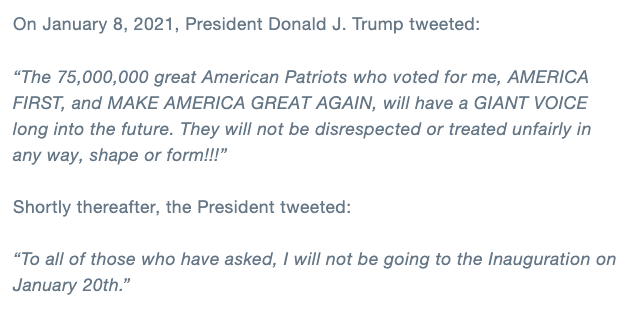
In that deep dive, the company explains that it gave Trump one last chance after suspending and then reinstating his account for violations made on Wednesday. But the following day, a pair of tweets the president made pushed him over the line. Twitter said those tweets, pictured below, were not examined on a standalone basis, but rather in the context of his recent behavior and this week’s events.

“… We have determined that these Tweets are in violation of the Glorification of Violence Policy and the user @realDonaldTrump should be immediately permanently suspended from the service,” Twitter wrote.

Screenshot via Twitter

This is how the company explained its reasoning, point by point:

  • “President Trump’s statement that he will not be attending the Inauguration is being received by a number of his supporters as further confirmation that the election was not legitimate and is seen as him disavowing his previous claim made via two Tweets (1, 2) by his Deputy Chief of Staff, Dan Scavino, that there would be an ‘orderly transition’ on January 20th.
  • “The second Tweet may also serve as encouragement to those potentially considering violent acts that the Inauguration would be a ‘safe’ target, as he will not be attending.
  • “The use of the words ‘American Patriots’ to describe some of his supporters is also being interpreted as support for those committing violent acts at the US Capitol.
  • “The mention of his supporters having a ‘GIANT VOICE long into the future’ and that ‘They will not be disrespected or treated unfairly in any way, shape or form!!!’ is being interpreted as further indication that President Trump does not plan to facilitate an ‘orderly transition’ and instead that he plans to continue to support, empower, and shield those who believe he won the election.
  • “Plans for future armed protests have already begun proliferating on and off-Twitter, including a proposed secondary attack on the US Capitol and state capitol buildings on January 17, 2021.”

All of that is pretty intuitive, though his most fervent supporters aren’t likely to agree. Ultimately these decisions, as much as they do come down to stated policies, involve a lot of subjective analysis and interpretation. Try as social media companies might to let algorithms make the hard calls for them, the buck stops with a group of humans trying to figure out the best course of action.

Twitter’s explanation here offers a a rare totally transparent glimpse into how social networks decide what stays and what goes. It’s a big move for Twitter — one that many people reasonably believe should have been made months if not years ago — and it’s useful to have what is so often an inscrutable high-level decision making process laid out plainly and publicly for all to see.

President Trump responds to Twitter account ban in tweet storm from @POTUS account

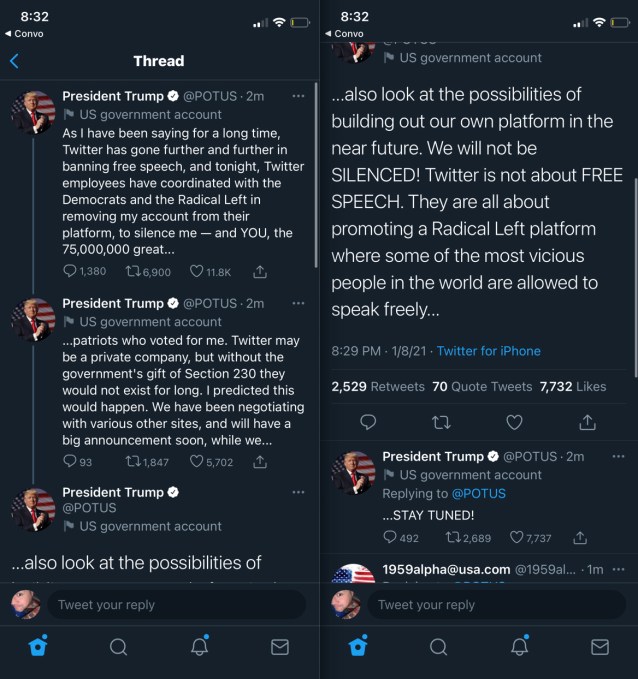
After Twitter took the major step Friday of permanently banning President Trump’s @realdonaldtrump Twitter account, the President aimed to get the last word in through his government account @POTUS which has a fraction of the Twitter followers but still offered the President a megaphone on the service to send out a few last tweets.

The tweets were deleted within minutes by Twitter which does not allow banned individuals to circumvent a full ban by tweeting under alternate accounts.

In screenshots captured by TechCrunch, Trump responds to the account ban by accusing Twitter employees of conspiring with his political opponents. “As I have been saying for a long time, Twitter has gone further and further in banning free speech, and tonight, Twitter employees have coordinated with the Democrats and Radical Left in removing my account from their platform, to silence me — and YOU, the 75,000,000 great patriots who voted for me.”

The President’s rant further contends that he will soon be joining a new platform or starting his own. Many contended Trump would join right wing social media site Parler following the ban, though Friday afternoon the site was removed from the Google Play Store with the company saying Apple had threatened to suspend them as well.

“We have been negotiating with various other sites, and will have a big announcement soon, while we also look at the possibilities of building out our own platform in the near future,” other tweets from the @POTUS account read in part.

The same messages were later tweeted from the President’s @Teamtrump campaign account, which Twitter subsequently suspended.

In a statement to TechCrunch, A Twitter spokesperson wrote, “As we’ve said, using another account to try to evade a suspension is against our rules. We have taken steps to enforce this with regard to recent Tweets from the @POTUS account. For government accounts, such as @POTUS and @WhiteHouse, we will not suspend those accounts permanently but will take action to limit their use.”

Parler removed from Google Play store as Apple App Store suspension reportedly looms

Shortly after Twitter announced Friday afternoon that they were permanently suspending the account of President Trump, Google shared that they were removing Parler, a conservative social media app, from their Play Store immediately, saying in a statement that they were suspending the app until the developers committed to a moderation and enforcement policy that could handle objectionable content on the platform.

In a statement to TechCrunch, a Google spokesperson said:

“In order to protect user safety on Google Play, our longstanding policies require that apps displaying user-generated content have moderation policies and enforcement that removes egregious content like posts that incite violence. All developers agree to these terms and we have reminded Parler of this clear policy in recent months. We’re aware of continued posting in the Parler app that seeks to incite ongoing violence in the US. We recognize that there can be reasonable debate about content policies and that it can be difficult for apps to immediately remove all violative content, but for us to distribute an app through Google Play, we do require that apps implement robust moderation for egregious content. In light of this ongoing and urgent public safety threat, we are suspending the app’s listings from the Play Store until it addresses these issues.“

Parler’s Play Store page is currently down.

The conservative platform garnered attention this week after posts surfaced detailing threats of violence and planning around Tuesday’s chaotic Capitol building riots which led to the deaths of 5 people including a Capitol police officer. While more mainstream social media sites raced to take down violent content related to the riots, death threats and violence were easy to find across the Parler platform.

The app hosts accounts from a variety of conservative figures including many in the President’s family, though not the President himself.

On Friday, Buzzfeed News reported that Parler had received a letter from Apple informing them that the app would be removed from the App Store within 24 hours unless the company submitted an update with a moderation improvement plan. Parler CEO John Matze confirmed the action from Apple in a post on his Parler account where he posted a screenshot of the notification from Apple.

“We want to be clear that Parler is in fact responsible for all the user generated content present on your service and for ensuring that this content meets App Store requirements for the safety and protection of our users,” text from the screenshot reads. “We won’t distribute apps that present dangerous and harmful content.

The app remains available in the App Store, though users are currently complaining of technical issues.

We have reached out to Apple for additional comment.

Twitter permanently bans President Trump

Twitter permanently removed the president of the United States from its platform Friday, citing concerns over the “risk of further incitement of violence” and Trump’s previous transgressions.

“In the context of horrific events this week, we made it clear on Wednesday that additional violations of the Twitter Rules would potentially result in this very course of action,” Twitter wrote. “… We made it clear going back years that these accounts are not above our rules and cannot use Twitter to incite violence.”

Trump will not be able to get around Twitter’s ban by making a new account or using an alias, a Twitter spokesperson clarified to TechCrunch. If the president attempts to evade his suspension, any account he uses will also be subject to a ban for breaking Twitter’s rules.

Update: Trump appeared to do just that Friday night, popping up on @POTUS. “We will not be SILENCED! Twitter is not about FREE SPEECH,” Trump tweeted through that account, indicating that his team might build his own platform in the “near future.”

Twitter emphasized that it made the threat of an impending ban clear and called this week’s events “horrific.” While Trump has previously broken the platform’s rules, the company’s maintained his account under its special guidance for world leaders and information in the public interest.

In an in-depth breakdown, Twitter published the assessments of Trump’s tweets that led to his suspension. Two of his tweets on Thursday appear to have pushed the account over the edge, and Twitter interpreted them as potentially inciting violence in the context of the week’s events.

On Wednesday, Twitter suspended President Trump’s account until he deleted three tweets that the company flagged as violating its rules. Trump’s account was set to reactivate 12 hours after those deletions, and he returned to the platform on Thursday night with a video in which he appeared to concede his election loss for the first time.

Trump crossed a line with Twitter when he failed to condemn a group of his supporters who staged a violent riot at the Capitol building while Congress met to certify the election results. In one tweet, Trump shared a video in which he gently encouraged the group to return home, while reassuring his agitated followers that he loved them and that they were “special.”

At that time, Twitter said that Trump’s tweets contained “repeated and severe violations” of its policy on civic integrity and threatened that any future violations would result in “permanent suspension” of the president’s account.

After close review of recent Tweets from the @realDonaldTrump account and the context around them we have permanently suspended the account due to the risk of further incitement of violence.https://t.co/CBpE1I6j8Y

— Twitter Safety (@TwitterSafety) January 8, 2021

Wednesday, January 6:

  • 1 PM ET: Trump wraps up a rally near the White House protesting the legitimate election results. During the event he urges attendees to march toward Congress.
  • 2:15 PM: Trump supporters breach the interior of the Capitol building.
  • 4:15 PM: Trump tweets a video gently telling rioters that they need to go home and “we love you.”
  • 5 PM: Twitter places a large warning label on the video.
  • 6 PM: Trump tweets again, failing to denounce the violence and urging his supporters to “Remember this day forever!”
  • 7 PM: Twitter locks Trump out his account until he deletes three tweets and waits for a 12-hour period.

As a result of the unprecedented and ongoing violent situation in Washington, D.C., we have required the removal of three @realDonaldTrump Tweets that were posted earlier today for repeated and severe violations of our Civic Integrity policy. https://t.co/k6OkjNG3bM

— Twitter Safety (@TwitterSafety) January 7, 2021

Thursday, January 7:

Friday, January 8:

  • 9:45 AM: Trump tweets again with a less conciliatory tone, declaring that anyone who voted for him will “not be treated unfairly in any way, shape or form!!!”
  • 10:45 AM: Trump tweets that he will not attend President-elect Joe Biden’s inauguration.
  • 6:20 PM: Twitter announces that @realDonaldTrump is suspended permanently.

While Facebook initially took more drastic action against Trump’s account in the aftermath of Wednesday’s chaotic siege on Capitol Hill, Twitter has a longer history of friction with the outgoing president. In early 2020, Twitter’s decision to add a contextual label to a Trump tweet calling mail-in voting “fraudulent” prompted the president to craft a retaliatory though largely toothless executive order targeting social media companies.

Trump held the same grudge through the end of the year, trying to push a doomed repeal of Section 230 of the Communications Decency Act — the law that protects online companies from liability for user-generated content — through Congress in increasingly unusual ways.

Twitter’s move Friday to suspend the sitting U.S. president from its platform is a historic decision — and one the company avoided making for the last four years. In the wake of Wednesday’s insurrectionist violence, and Trump’s role in inciting it, tech’s biggest social networks appear to have at last had enough.

But as with election conspiracies, dangerous COVID-19 misinformation and the camo-clad extremists who attacked the Capitol this week, it’s too late to undo the chaos that real-time Trump unleashed over the last four years, 280 characters at a time.

Holographic startup Envisics partners with Panasonic to fast-track in-car AR tech

Envisics founder and CEO Dr. Jamieson Christmas launched the startup three years ago to “revolutionize” the in-car experience with its holographic technology. Now, it has a partner that could help it achieve that mission.

The U.K.-based holographic technology startup said Friday it reached an agreement with Panasonic Automotive Systems to jointly develop and commercialize a new generation of head-up displays for cars, trucks and SUVs. Panasonic Automotive Systems is a Tier 1 automotive supplier and a division of Panasonic Corporation of North America. The head-up displays are units integrated in the dash of a vehicle that project images onto the windshield to aid drivers with navigation and provide other alerts. The Panasonic HUDs, as they’re often called, will use Envisics holographic technology.

The deal, announced ahead of the virtual 2021 CES tech trade show, follows Envisics’ $50 million Series B funding round and news that its tech will be integrated in the upcoming Cadillac Lyriq electric vehicle. The funding round, which brought Envisics a valuation of more than $250 million, included investments from Hyundai Mobis, GM Ventures, SAIC Ventures and Van Tuyl Companies.

Envisics’ technology, the foundation of which came out of Christmas’ PhD studies at Cambridge University more than 15 years ago, electronically manipulates the speed of light. This process enables images to appear three-dimensional, Christmas explained in a recent interview. The company has secured more than 250 patents and has another 160 pending certification.

The company is solely focused upon the automotive application of holography, Christmas said, adding that its first generation is already integrated in more than 150,000 Jaguar Land Rover vehicles.

Christmas said this new agreement aims to combine Panasonic’s expertise in optical design and its global reach as a Tier 1 supplier with Envisics’ technology to bring holography into the mainstream. Mass production of vehicles using its technology is slated for 2023, according to the companies.

“This is very much about part of our business plan, you know the Series B funding round we undertook was about scaling the business and enabling us to move forward as we enter the market,” Christmas said. “Part of that was a commitment to engage in partnerships with Tier ones that we can then work with to deliver these products to market.

“This is the first of those agreements,” he added, suggesting that Envisics has a much larger aim.

What that means, Christmas said, will be head-up displays with high resolution, wide color gamut and large images that can be overlaid upon reality. The technology can also project information at multiple distances simultaneously.

“That really unlocks very interesting applications,” he said. “In the short term, it will be kind of relatively simple augmented reality applications like navigation, highlighting the lane you’re supposed to be in and some safety applications. But as you look forward into things like autonomous driving it unlocks a whole realm of other opportunities like entertainment and video conferencing.”

He added that it could even be used for night vision applications such as overlaying enhanced information upon a dark road to make it clear where the road is going and what obstacles might be out there.

Daily Crunch: Roku buys Quibi’s content library

Quibi’s content will live on, Hyundai may partner with Apple and Donald Trump returns to Twitter. This is your Daily Crunch for January 8, 2021.

The big story: Roku buys Quibi’s content library

If you’re wondering what will happen to Quibi shows like “Most Dangerous Game” and “Chrissy Court,” wonder no longer: They’re going to Roku.

The streaming TV platform announced today that it has acquired the global rights to Quibi’s content library, which it plans to bring to The Roku Channel, free and ad-supported, some this year. This includes “more than a dozen” shows that never got a chance to stream on Quibi before the app shut down.

“The most creative and imaginative minds in Hollywood created groundbreaking content for Quibi that exceeded our expectations,” said Quibi founder Jeffrey Katzenberg in a statement. “We are thrilled that these stories, from the surreal to the sublime, have found a new home on The Roku Channel.”

The tech giants

Shares of Hyundai Motor Co. climb more than 20% on potential EV deal with Apple — Hyundai said discussions are still in the “early stage.”

Google’s plan to replace tracking cookies goes under UK antitrust probe — U.K.’s Competition and Markets Authority said it’s investigating “suspected breaches of competition law by Google.”

Trump returns to Twitter with what sounds like a concession speech — President Trump only had to wait 12 hours before returning to his social network of choice.

Startups, funding and venture capital

Jobandtalent tops up with $108M for its ‘workforce as a service’ platform — The startup operates a dual-sided platform that connects temp workers with employers.

Detroit’s Ludlow Ventures goes for fund four — The Detroit-based seed-stage firm is in the process of closing its fourth fund of $65 million.

Jumbotail raises $14.2M for its wholesale marketplace in India — Jumbotail said it serves more than 30,000 neighborhood stores, popularly known in India as kiranas.

Advice and analysis from Extra Crunch

VCs discuss gaming’s biggest infrastructure investment opportunities in 2021 — Investors highlighted numerous areas for new opportunity, including specialized engines, next-gen content creation platforms and tools to port desktop experiences to mobile.

What is up with Tesla’s value? — And a bunch of other stocks, for that matter.

The Roblox Gambit — So it turns out that Roblox is worth $29.5 billion.

(Extra Crunch is our membership program, which aims to democratize information about startups. You can sign up here.)

Everything else

Stolen computers are the least of the government’s security worries — The SolarWinds breach is likely to be a bigger cybersecurity threat than any computers stolen during the pro-Trump riot on Wednesday.

Five reforms necessary to create a truly cashless society — Convenience shouldn’t come at the cost of other aspects of commerce.

The Daily Crunch is TechCrunch’s roundup of our biggest and most important stories. If you’d like to get this delivered to your inbox every day at around 3pm Pacific, you can subscribe here.

You’ll never believe what this email thread says about the ad-funded ‘open’ web

Among a number of claims on U.K. adtech lobby group MOW’s website is the canonical biggie that “Advertising funds the open web.”

This coalition of “marketers,” whose members are not being made public despite its sweeping claims to love web openness — lest, MOW says, Google rain down punishment upon its ranks of “top companies from across the globe” — recently complained to the U.K.’s competition regulator about the tech giant’s plan to end support for tracking cookies.

If you didn’t already guess it the “OW” in MOW’s acronym stands for “Open Web.” Aka (unknown) Marketers for an Open Web.

And today the CMA duly announced it is investigating Mountain View’s “Privacy Sandbox.” Though, as yet, no conclusions have been reached on whether Google’s plan threatens competition.

In truth, a variety of business models support open access to information on the internet.

Wikipedia, for example — surely the canonical example of the open web — relies upon reader donations to keep the lights on as a not-for-profit.

While — on the “exclusive access” side — crowdfunding sites like Patreon and the subscription platform Substack offer tools for creators to solicit regular monetary subscriptions from fans and backers to unlock gated content.

But it’s instructive to note how many online publishers have shifted, year over year, from free (ad-supported) access to content to selling subscriptions for (paywalled) content, often in addition to running ads.

Whether it’s the Financial Times, the New York Times, the Telegraph or Business Insider, the list of pay-to-access news sites keeps getting longer. Much like the consent flows that (also) pop up asking to process visitors’ information in order to target them with ads.

TechCrunch joined the ranks of subscription publications almost two years ago when we launched Extra Crunch. The main TC site continues to be free to access supported by ads and our events business. (NB: In 2021 our events are going fully virtual — which means, as a brief, bonus aside, they’ve never been so open and accessible!)

So how come all these paywalls are being thrown up if advertising funds the open web, as MOW claims?

The concise answer is that digital advertising pays publishers so poorly it can’t support producing quality content at the required scale on its own — thanks to myriad adtech intermediaries, click fraud and the big two: Google and Facebook; aka, the adtech duopoly, who take the lion’s share of revenue generated by digital advertising. 

“We have found that intermediaries (the largest of which is Google) capture at least 35% of the value of advertising bought from newspapers and other content providers in the U.K.,” the CMA reported last summer, in a major market study.

Consumers turning to ad blockers to escape creepy ads and prevent privacy-hostile trackers from keeping real-time tabs on their digital activity and systematically passing this intel to scores of unknowns in an ad auction process that the U.K.’s own data protection regulator has said isn’t very lawful, is another relevant factor here.

Online advertising certainly funds something. But is that something the open web? That looks rather debatable at this point.

I bring all this up merely to provide context for a chance detail in the MOW story that I want to share — as it illustrates some of the issues in this high stakes tug-of-war between publishers, digital marketing and adtech players and a handful of big (ad)tech versus the poor, frustrated eyeballs of the average internet user.

It’s an important power struggle.

One which threatens to keep steamrollering internet users’ right to protect their personal information from exploitation (and wider security-related risks) by, in the latest twist, co-opting competition regulators to erect barriers to pro-privacy reform. Assuming, that is, the CMA ends up naively swallowing dubious claims about what advertising does for the “open” internet — when evidence of what it actually does is but a click and a paywall/tortuously long consent to “share” your private data with hundreds of unknown firms away.

The regulator’s announcement today suggests it’s alive to the dysfunction surrounding internet users’ privacy and will take more than a superficial look at that issue — though if the ICO is the main rep in the room batting for users’ interests here that’s suboptimal, to say the least, given the latter’s storied reluctance to enforce the actual law against adtech.

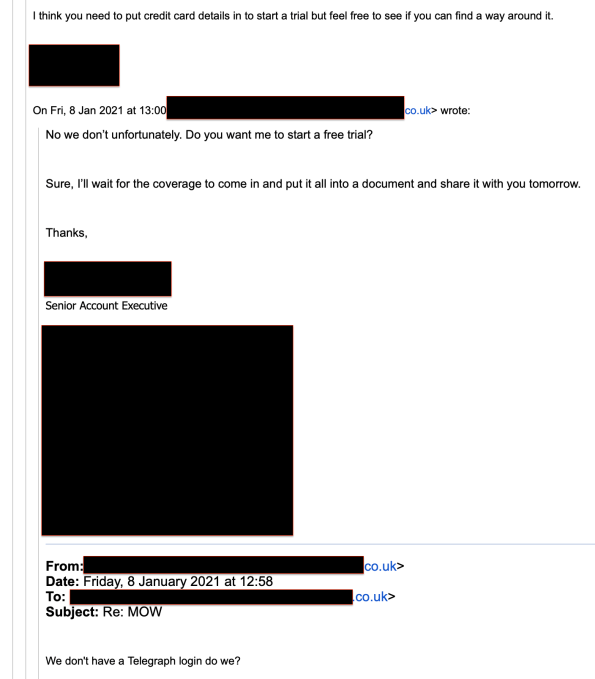
But here’s the tidbit — which comes by way of a PR agency working for MOW. Earlier today it CC’d me into an email thread in which several staffers had been discussing monitoring the CMA news on behalf of its client.

I’m not naming the agency or any of the individuals involved to spare their blushes but in the thread — which begins with “FYI — The CMA are just about to announce a formal investigation into Google. We’ve drafted a comment which we will be circulating shortly” — staff can be seen asking to share logins to a number of newspaper websites and/or start a free trial in order to access newspaper copy for free, i.e., without having to pay for new subscriptions. 

“Do we have an FT login? If so, could you get hte [sic] story they’ve just written on MOW off for me?” asks one staffer.

Shortly afterward there’s a discussion about starting a free trial on the Telegraph’s website as they talk about collating relevant coverage into a single document to be able to monitor developments for MOW.

One staffer chips in to warn “you need to put credit card details in to start a trial” — before suggesting the other has a go “to see if you find a way around it.”

This person follows up by saying they’ll “let you know if I manage to find a way around it.”

So, mmm, irony much?

Redacted screengrab showing part of an email thread in which MOW’s PR agency discusses how to access newspaper sites to access copy to collate coverage on behalf of their client. Image Credits: TechCrunch.

In light of MOW’s advocacy for a “vibrant” ad-supported open web — which its website implies is aligned with the interests of publishers, marketers and adtech providers alike, i.e., not just with opaque adtech interests — it seems pretty relevant that an agency working for the industry group is uninterested, to put it politely, in paying for relevant newspaper content while being paid to lobby on adtech’s behalf.

On its website MOW argues that letting Google switch off third-party tracking cookies will be bad news for publishers because it says it will cut off marketers’ ability to measure ad campaign performance across different sites — claiming that will result in less effective ads that yield a lower return and thus less cash remitted by marketers to publishers.

However the CMA’s recent deep dive study of the digital marketing sector found an industry so opaque and riddled with black box algorithms that the regulator listed “lack of transparency” itself as a competition concern.

“Platforms with market power have the incentive and ability to increase prices, for example, or to overstate the quality and effectiveness of their advertising inventory,” it warned in the report. “They can take steps to reduce the degree of transparency in digital advertising markets, reducing other publishers’ ability to demonstrate the effectiveness of their advertising and forcing advertisers to rely on information and metrics provided by those platforms. And the lack of transparency undermines the ability of market participants to make the informed decisions necessary to drive competition. The upshot of all of these issues is that competition is weakened and trust in the market is eroded.”

Given that overarching assessment, who would take an opaque coalition of marketers’ word for it that current-gen cookie tracking of the entire internet yields irreplaceably valuable performance metrics?

Or that such privacy-hostile tracking is the only viable way to support a “vibrant open web”?

“The lack of transparency is particularly severe in the open display market where publishers and advertisers rely on intermediaries to manage the process of real-time bidding and ad serving but cannot observe directly what the intermediaries are doing or, in some cases, how much they are being charged,” the CMA goes on, sharpening its concerns about the extent of the obfuscation that cloaks the practices of adtech middlemen. “Market participants such as newspapers and advertisers typically do not have visibility of the fees charged along the entire supply chain and this limits their ability to make optimal choices on how to buy or to sell inventory, reducing competition among intermediaries.”

One thing is clear: The adtech industry needs a whole lot of disinfecting sunlight to be shone in. And that clarification process will surely demand substantial reform.

Refusing to change how things are done by claiming there’s simply no other way to preserve the web “as we know it” is as ridiculous an idea as it is anti-innovation in sentiment.

Returning to the misfired email thread, we contacted MOW’s PR agency to ask whether or not the account includes expenses for relevant newspaper subscriptions. It told us these would come out of a central agency fund. Additionally — having checked back on it — the agency said it did in fact have subscriptions to the newspaper sites in question.

The spokesperson explained that the staffers involved just hadn’t realized at the time — in the heat of the “day-to-day PR” moment (and whilst wrangling remote-working-impacted comms). And, presumably, as all those subscription login screens threw up barriers to accessing the content they needed in the heat of the moment.

This (senior) spokesperson blamed themselves for what they described as a “cock up” — including the soliciting of a “paywall workaround” — going on to take full mea culpa responsibility and emphasizing it had nothing to do with MOW or with the MOW account.

But, well, if an agency working for an adtech lobby group whose key claim is that “ads support the open internet” is unable to access the online content they need to do their job without a subscription, what does that tell us about how much of an open internet the advertising industry is actually funding right now?

Extra Crunch roundup: 2 VC surveys, Tesla’s melt up, The Roblox Gambit, more

This has been quite a week.

Instead of walking backward through the last few days of chaos and uncertainty, here are three good things that happened:

  • Google employee Sara Robinson combined her interest in machine learning and baking to create AI-generated hybrid treats.
  • A breakthrough could make water desalination 30%-40% more effective.
  • Bianca Smith will become the first Black woman to coach a professional baseball team.

Despite many distractions in our first full week of the new year, we published a full slate of stories exploring different aspects of entrepreneurship, fundraising and investing.

We’ve already gotten feedback on this overview of subscription pricing models, and a look back at 2020 funding rounds and exits among Israel’s security startups was aimed at our new members who live and work there, along with international investors who are seeking new opportunities.

Plus, don’t miss our first investor surveys of 2021: one by Lucas Matney on social gaming, and another by Mike Butcher that gathered responses from Portugal-based investors on a wide variety of topics.

Thanks very much for reading Extra Crunch this week. I hope we can all look forward to a nice, boring weekend with no breaking news alerts.

Walter Thompson
Senior Editor, TechCrunch
@yourprotagonist


Full Extra Crunch articles are only available to members
Use discount code ECFriday to save 20% off a one- or two-year subscription


The Roblox Gambit

In February 2020, gaming platform Roblox was valued at $4 billion, but after announcing a $520 million Series H this week, it’s now worth $29.5 billion.

“Sure, you could argue that Roblox enjoyed an epic 2020, thanks in part to COVID-19,” writes Alex Wilhelm this morning. “That helped its valuation. But there’s a lot of space between $4 billion and $29.5 billion.”

Alex suggests that Roblox’s decision to delay its IPO and raise an enormous Series H was a grandmaster move that could influence how other unicorns will take themselves to market. “A big thanks to the gaming company for running this experiment for us.”

I asked him what inspired the headline; like most good ideas, it came to him while he was trying to get to sleep.

“I think that I had ‘The Queen’s Gambit’ somewhere in my head, so that formed the root of a little joke with myself. Roblox is making a strategic wager on method of going public. So, ‘gambit’ seems to fit!”

8 investors discuss social gaming’s biggest opportunities

girl playing games on desktop computer

Image Credits: Erik Von Weber (opens in a new window) / Getty Images

For our first investor survey of the year, Lucas Matney interviewed eight VCs who invest in massively multiplayer online games to discuss 2021 trends and opportunities:

  • Hope Cochran, Madrona Venture Group
  • Daniel Li, Madrona Venture Group
  • Niko Bonatsos, General Catalyst
  • Ethan Kurzweil, Bessemer Venture Partners
  • Sakib Dadi, Bessemer Venture Partners
  • Jacob Mullins, Shasta Ventures
  • Alice Lloyd George, Rogue
  • Gigi Levy-Weiss, NFX

Having moved far beyond shooters and sims, platforms like Twitch, Discord and Fortnite are “where culture is created,” said Daniel Li of Madrona.

Rep. Alexandria Ocasio-Cortez uses Twitch to explain policy positions, major musicians regularly perform in-game concerts on Fortnite and in-game purchases generated tens of billions last year.

“Gaming is a unique combination of science and art, left and right brain,” said Gigi Levy-Weiss of NFX. “It’s never just science (i.e., software and data), which is why many investors find it hard.”

How to convert customers with subscription pricing

Giant hand and magnet picking up office and workers

Image Credits: C.J. Burton (opens in a new window) / Getty Images

Startups that lack insight into their sales funnel have high churn, low conversion rates and an inability to adapt or leverage changes in customer behavior.

If you’re hoping to convert and retain customers, “reinforcing your value proposition should play a big part in every level of your customer funnel,” says Joe Procopio, founder of Teaching Startup.

What is up with Tesla’s value?

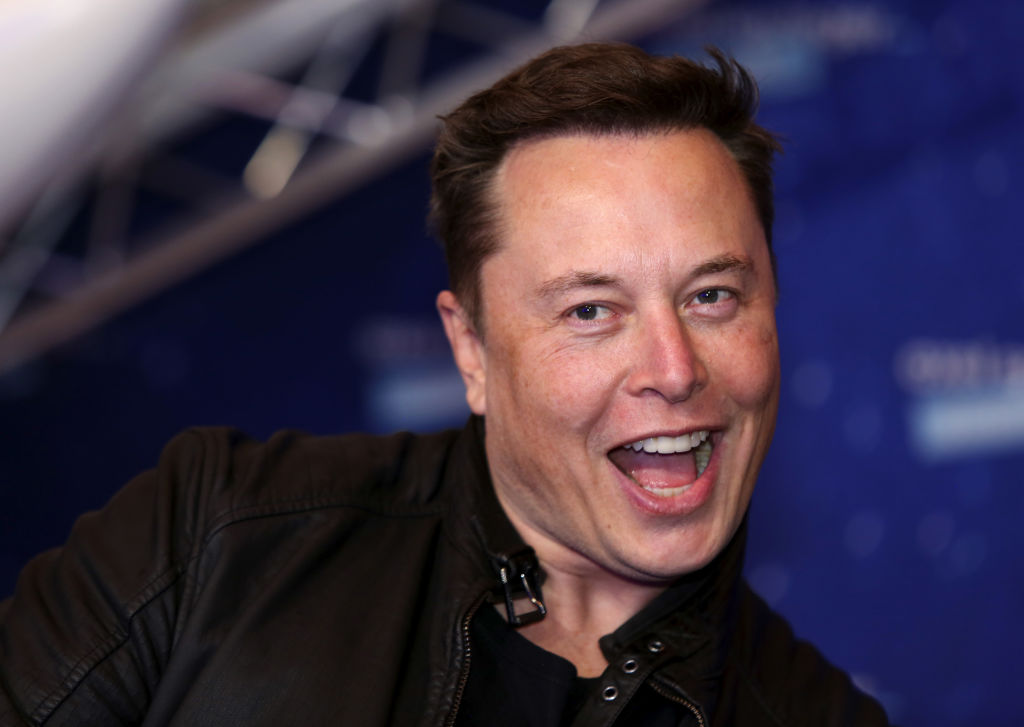
Elon Musk, founder of SpaceX and chief executive officer of Tesla Inc., arrives at the Axel Springer Award ceremony in Berlin, Germany, on Tuesday, Dec. 1, 2020. Tesla Inc. will be added to the S&P 500 Index in one shot on Dec. 21, a move that will ripple through the entire market as money managers adjust their portfolios to make room for shares of the $538 billion company. Photographer: Liesa Johannssen-Koppitz/Bloomberg via Getty Images

Image Credits: Bloomberg (opens in a new window) / Getty Images

Alex Wilhelm followed up his regular Friday column with another story that tries to find a well-grounded rationale for Tesla’s sky-high valuation of approximately $822 billion.

Meanwhile, GM just unveiled a new logo and tagline.

As ever, I learned something new while editing: A “melt up” occurs when investors start clamoring for a particular company because of acute FOMO (the fear of missing out).

Delivering 500,000 cars in 2020 was “impressive,” says Alex, who also acknowledged the company’s ability to turn GAAP profits, but “pride cometh before the fall, as does a melt up, I think.”

Note: This story has Alex’s original headline, but I told him I would replace the featured image with a photo of someone who had very “richest man in the world” face.

How Segment redesigned its core systems to solve an existential scaling crisis

Abstract glowing grid and particles

Image Credits: piranka / Getty Images

On Tuesday, enterprise reporter Ron Miller covered a major engineering project at customer data platform Segment called “Centrifuge.”

“Its purpose was to move data through Segment’s data pipes to wherever customers needed it quickly and efficiently at the lowest operating cost,” but as Ron reports, it was also meant to solve “an existential crisis for the young business,” which needed a more resilient platform.

Dear Sophie: Banging my head against the wall understanding the US immigration system

Image Credits: Sophie Alcorn

Dear Sophie:

Now that the U.S. has a new president coming in whose policies are more welcoming to immigrants, I am considering coming to the U.S. to expand my company after COVID-19. However, I’m struggling with the morass of information online that has bits and pieces of visa types and processes.

Can you please share an overview of the U.S. immigration system and how it works so I can get the big picture and understand what I’m navigating?

— Resilient in Romania

The first “Dear Sophie” column of each month is available on TechCrunch without a paywall.

Revenue-based financing: The next step for private equity and early-stage investment

Shot of a group of people holding plants growing out of soil

Image Credits: Hiraman (opens in a new window) / Getty Images

For founders who aren’t interested in angel investment or seeking validation from a VC, revenue-based investing is growing in popularity.

To gain a deeper understanding of the U.S. RBI landscape, we published an industry report on Wednesday that studied data from 134 companies, 57 funds and 32 investment firms before breaking out “specific verticals and business models … and the typical profile of companies that access this form of capital.”

Lisbon’s startup scene rises as Portugal gears up to be a European tech tiger

Man using laptop at 25th of April Bridge in Lisbon, Portugal

Image Credits: Westend61 (opens in a new window)/ Getty Images

Mike Butcher continues his series of European investor surveys with his latest dispatch from Lisbon, where a nascent startup ecosystem may get a Brexit boost.

Here are the Portugal-based VCs he interviewed:

  • Cristina Fonseca, partner, Indico Capital Partners
  • Pedro Ribeiro Santos, partner, Armilar Venture Partners
  • Tocha, partner, Olisipo Way
  • Adão Oliveira, investment manager, Portugal Ventures
  • Alexandre Barbosa, partner, Faber
  • António Miguel, partner, Mustard Seed MAZE
  • Jaime Parodi Bardón, partner, impACT NOW Capital
  • Stephan Morais, partner, Indico Capital Partners
  • Gavin Goldblatt, managing partner, Portugal Gateway

How late-stage edtech companies are thinking about tutoring marketplaces

Life Rings flying out beneath storm clouds are a metaphor for rescue, help and aid.

Image Credits: John Lund (opens in a new window)/ Getty Images

How do you scale online tutoring, particularly when demand exceeds the supply of human instructors?

This month, Chegg is replacing its seven-year-old marketplace that paired students with tutors with a live chatbot.

A spokesperson said the move will “dramatically differentiate our offerings from our competitors and better service students,” but Natasha Mascarenhas identified two challenges to edtech automation.

“A chatbot won’t work for a student with special needs or someone who needs to be handheld a bit more,” she says. “Second, speed tutoring can only work for a specific set of subjects.”

Decrypted: How bad was the US Capitol breach for cybersecurity?

Image Credits: Treedeo (opens in a new window) / Getty Images

While I watched insurrectionists invade and vandalize the U.S. Capitol on live TV, I noticed that staffers evacuated so quickly, some hadn’t had time to shut down their computers.

Looters even made off with a laptop from Senator Jeff Merkley’s office, but according to security reporter Zack Whittaker, the damages to infosec wasn’t as bad as it looked.

Even so, “the breach will likely present a major task for Congress’ IT departments, which will have to figure out what’s been stolen and what security risks could still pose a threat to the Capitol’s network.”

Extra Crunch’s top 10 stories of 2020

On New Year’s Eve, I made a list of the 10 “best” Extra Crunch stories from the previous 12 months.

My methodology was personal: From hundreds of posts, these were the 10 I found most useful, which is my key metric for business journalism.

Some readers are skeptical about paywalls, but without being boastful, Extra Crunch is a premium product, just like Netflix or Disney+. I know, we’re not as entertaining as a historical drama about the reign of Queen Elizabeth II or a space western about a bounty hunter. But, speaking as someone who’s worked at several startups, Extra Crunch stories contain actionable information you can use to build a company and/or look smart in meetings — and that’s worth something.

Twitter bans former Trump adviser Michael Flynn and other QAnon figures

Twitter took action against a pair of President Trump’s close associates Friday, banning them from the platform as part of a broader effort to contain the QAnon conspiracy movement.

Trump’s first national security adviser Michael Flynn and former Trump campaign lawyer Sidney Powell were both suspended under Twitter’s “coordinated harmful activity” policy. Ron Watkins, who previously ran 8kun (formerly 8chan) also saw his account removed.

“We’ve been clear that we will take strong enforcement action on behavior that has the potential to lead to offline harm, and given the renewed potential for violence surrounding this type of behavior in the coming days, we will permanently suspend accounts that are solely dedicated to sharing QAnon content,” a Twitter spokesperson told TechCrunch.

In recent months, each figure has promoted QAnon, an elaborate constellation of conspiracy theories purporting that President Trump is waging a secret battle against a cabal of political enemies who engage in child sex trafficking, among other baseless claims.

As part of Trump’s post-election legal team, Powell became a heroic figure to the QAnon crowd, which believes that a master plan being orchestrated behind the scenes will give the president a second term. Powell also amplified the Dominion voting machine conspiracy, which claims devices from that company switched votes from Trump to Biden. Dominion Voting Systems is suing Powell for $1.3 billion over the false claims, arguing that her “viral disinformation campaign” has damaged its business.

Flynn embraced the QAnon movement last year, reciting an oath and saying the popular QAnon motto “where we go one, we go all!” Flynn has also been actively involved in Trump’s quest to overturn the results of the November election. In what was then a shocking scandal, Flynn pleaded guilty for lying to the FBI in 2017. Last year, the Justice Department dropped the federal case against Flynn and Trump eventually issued his former adviser a pardon.

Of the three, Watkins is the furthest from Trump and the closest to the heart of QAnon. As the administrator of QAnon’s central online hub, Watkins played a key role QAnon’s explosion into the mainstream over the last few years. Beyond the ranks of believers, some QAnon observers believe that Ron Watkins or his father Jim Watkins are the mysterious “Q” figure, perpetuating the elaborate scheme by doling out cryptic bread crumbs for QAnon adherents.

Twitter first began restricting QAnon content in mid-2020, citing similar concerns over real-world harm. The new enforcement plan goes much further, and Twitter’s new commitment to permanently suspending any QAnon stands to have a much bigger impact.

We’ve been clear that we will take strong enforcement action on behavior that has the potential to lead to offline harm. In line with this approach, this week we are taking further action on so-called ‘QAnon’ activity across the service.

— Twitter Safety (@TwitterSafety) July 22, 2020

Venrock’s Bryan Roberts on the firm’s new $450 million fund, and where it’s shopping in 2021

Venrock, the 51-year-old firm that started as the venture arm of the Rockefeller family, has closed its ninth fund with $450 million, the same amount it raised for its last two funds. The outfit, with offices in Palo Alto, New York and Cambridge, clearly feels comfortable with the fund size, but it says change is otherwise a constant, given that trends and tech shift so fast that so-called pattern recognition can prove a liability if an investment team isn’t careful.

To learn more about what the team is tracking at Venrock — whose newest exits include last year’s IPOs of Cloudflare and 10x Genomics IPO, and the recent sales of Corvidia and Personal Capital — we were in touch earlier today with longtime partner Bryan Roberts, who has spent his 24-year career in venture with the firm.

Our exchange has been edited lightly for length and clarity.

TC: I talked with your colleague Camille Samuels earlier this year about aging biology. How big an area of focus is that for Venrock and why?

BR: It’s one of many interesting areas of biology on a go-forward basis, along with immunology, CNS (central nervous system) and other areas where there has been little progress and great unmet need.

TC: Speaking of unmet needs, Camille also talked about why infectious disease isn’t good business for new companies, as are cancers and orphan diseases. As she explained it, with something like the coronavirus, it’s hard to get funding before it’s an actual problem; once a treatment is developed, it has to be sold at low cost, and then you hope you won’t have repeat customers. Do you agree, and do you think this needs to change?

BR: Yes, I think things need to change, but there are several issues. In the case of one company on which I lost a bunch of money — Achaogen, which made a successful drug for a big unmet need [but faced] screwy commercialization dynamics in the infectious disease space — and for many historical infectious disease companies, the cost of a drug is borne by the hospital, not billed separately.

It has also been hard historically to get anyone to pay attention to much of anything from a preventive perspective — even more so in communicable diseases. COVID was, on the one hand, not a particularly hard biological problem to solve, but from an investing perspective, the issue was it was a problem tailor-made for an existent or large company to tackle, not a startup. Startups take 12 or more months to find their way out the front door, and the problem is largely solved by then by one of the very large competitors.

You saw this with Moderna. Its tech turned out to be specifically suited to vaccines — and then a pandemic hit.

TC: Venrock recently helped incubate a new microbiome startup called Federation Bio, which is the firm’s first bet on the space. Why not move faster into this area, and how would you describe the size of the opportunity now? Is this something you want to delve into more aggressively?

BR: We did spend 12 months or so helping get Federation started, including my partner Racquel Bracken acting as the initial CEO. We weren’t compelled by the prior approaches and teams, and it is really the intersection of those two dynamics that get us involved in new projects.

In this case, a terrific academic, Michael Fischbach, had generated great data, so we ran with it. We recently spent more than 12 months incubating a new gene therapy startup in the same manner — in the latter case, a couple of great academics generated exquisite cell type specificity — so we went out and found some leadership and just seeded the business.

TC: It’s one way to avoid crazy valuations. Where have valuations gone up the most?

BR: Everywhere, but especially for companies that appear — or actually have — reduced binary risk and become growth-stage businesses [and that’s] across sectors.

TC: You focus on so much: biotechnology, diagnostics, genomics, healthcare IT, medical devices. What are some of biggest trends you’re watching in some of these areas, and where do you think you might be spending a little more of your time in 2021?

BR: Personally, I am compelled these days by first, value-based care in healthcare delivery — meaning it’s more efficient, there are better outcomes, there’s better customer experience — and mostly from full-stack platforms versus point solutions. I’m also focused on biological insights and applications that new genomics tools — single cell; gene editing — can bring. Last, [I’m tracking what] novel therapeutic modalities can bring to really bad diseases. It feels like we’re in the first inning of cell and gene therapy.

TC: How do you think the new administration in Washington could impact your work?

BR: I think there will be lots of talk about material changes to healthcare and other stuff, but I think it will mostly be talk given the slim margin in the Senate, as well as the decreased and small margin [that Democrats have] in the House. I think it will be a positive in that a bunch of the silly stuff around the [Affordable Care Act] will fade to nothing and people can get on with trying to improve implementation and go build.

TC: What do you make of the recent collapse of Haven, the joint venture of Amazon, JPMorgan Chase and Berkshire Hathaway to reduce the healthcare costs of their own employees? Would you like to see Amazon focused more — or less — on healthcare?

BR: We’ve long been bears [about its odds] for a bunch of the reasons folks cited over the last few weeks [including lack of transparency into healthcare costs].

I would love to see Amazon use its brand, delivery logistics excellence and ability to compete at super-tight margins in healthcare. I don’t think it extends to real regulatory, privacy or risk appetite, but the company could be an awesome pharmacy/pharmacy benefit manager — and I hope they do it.

TC: Regarding Venrock’s new fund, have there been personnel changes? Will check sizes change? 

BR: We made Racquel Bracken and Ethan Batraski partners; it’s always fun when you can promote terrific young talent from within.

As for our high-level strategy, check sizes and stages all remain the same. We’ve raised $450 million for each of the last several funds because we like that size and our culture and personality is way more focused on performance than on asset accumulation. It also feels really hard to raise increasing amounts of capital without affecting performance excellence.

TC: Healthcare has never been hotter. How much of Venrock’s capital is focused on healthcare, and will that change with this newest fund?

BR: We’re pretty bottoms-up allocation driven; we invest based on the projects we find and fall in love with. Life sciences usually ends up being around 30% to 40% [of capital invested]. Healthcare IT, which depending who you talk to in the universe gets lumped into healthcare or tech — I confess those software-enabled services businesses feel much more tech-like than biotech — usually ends up being about a quarter of the fund and there are no anticipated changes. The balance will go into tech — primarily tech and data-enabled software and services businesses.

TC: Has Venrock considered forming a blank-check company to take a company public, as more VCs are doing?

BR: We have not. I feel like most investors that have formed SPACs have done so more because of the compelling sponsor economics than a compelling, durable mechanism to get awesome companies public in a much more efficient manner than they otherwise might. It’ll be interesting to see how the economics change as the supply and demand of SPACs versus “great targets” changes and the SPACs get closer to the end of their hunting-license period.

California vegan egg startup Eat Just yokes itself to China’s fast food chain

Eat Just, a food startup from San Francisco making chicken-less eggs, has ambitions to crack the Chinese market where consumer appetite for plant-based food is growing and other Western vegan substitute brands like Beyond became available in recent quarters.

The startup said this week it will be suppling to fast-food chain Dicos, a local rival to McDonald’s and KFC in China. The agreement will see Eat Just add its plant-based eggs to the restaurant’s breakfast items across more than 500 locations. The eggs are derived from a legume called mung beans, which have long been a popular ingredient for soup, noodles and dessert in China.

At Dicos in major Chinese cities, consumers will find Eat Just eggs in breakfast burgers, bagel sandwiches and Western-style breakfast plates. That diversifies the Dicos plant-based menu which already includes a vegan chicken burger supplied by local startup Starfield. Dicos also offers a gateway into China’s low-tier cities where it has built a stronghold and can potentially help evangelize plant-based proteins in communities beyond China’s urban yuppies. The chain operates a total of 2,600 stores in China and serves 600 million customers a year.

Eat Just first entered China in 2019 and currently generates less than 5% of its revenue from the country, Andrew Noyes, head of global communications at Eat Just, told TechCrunch. But over time, the company expects China to account for more than half of its revenue. Ten of its 160 employees are based in China.

Eat Just’s vegan egg recipe / Photo: Eat Just

“We have been intentional about starting small, going slow and hiring people who know the market and understand how to build a sustainable business there. We’ve also been focused on finding the right partners to work with on downstream manufacturing, sales and distribution, and that work continues,” said Noyes.

The partnership with Dicos arrived on the heels of Eat Just’s announcement to set up an Asia subsidiary. The nine-year-old company, formerly Hampton Creek, has raised over $300 million from prominent investors including Li Ka-Shing, Peter Thiel, Bill Gates and Khosla Ventures. It was last valued at $1.2 billion.

Before its tie-up with Dicos, Eat Just had already been selling online in China through Alibaba and JD.com among other retail channels. Its China business is currently growing by 70% year-over-year.

While there’s no shortage of strong competition in the plant-based food race in China, Eat Just claims it’s taken a unique angle by zeroing in on eggs.

“Plant-based meat companies offer products that pair deliciously with Just Egg,” the brand name of the startup’s main product, Noyes noted.

“Plant-based foods are increasing in popularity among Chinese consumers and more sustainable eating is becoming part of a national dialogue about the feeding of the country in the future. China produces about 435 billion eggs per year and demand for protein is increasing.”

Indeed, Euromonitor predicted that China, the world’s largest meat-consuming country, would see its “free from meat” market size grow to $12 billion by 2023, compared to $10 billion in 2018.

Facebook and Instagram block #StormTheCapitol, lock Trump out of posting for 24 hours

After removing a video in which President Trump praised a violent group of his supporters who broke into the U.S. Capitol building, Facebook is rolling out a new set of rules in response to the day’s shocking events.

Both Facebook and Instagram also announced that the president would be locked out of posting to his accounts for 24 hours, escalating the consequences for his role in sowing Wednesday’s violent chaos considerably.

We've assessed two policy violations against President Trump's Page which will result in a 24-hour feature block, meaning he will lose the ability to post on the platform during that time.

— Facebook Newsroom (@fbnewsroom) January 7, 2021

We are locking President Trump’s Instagram account for 24 hours as well. https://t.co/HpA79eSbMe

— Adam Mosseri ? (@mosseri) January 7, 2021

Facebook says that the group of people who rushed into the Capitol Wednesday now fall under the company’s policies on “dangerous individuals and organizations” — a designation it uses to enforce rules against terrorists, mass murderers and violent hate groups. Last June, the company added the anti-government “boogaloo” movement, which encourages its adherents to take up arms and prepare for or incite a civil war, to the same list.

“The violent protests in the Capitol today are a disgrace,” a Facebook spokesperson told TechCrunch.

Facebook and Instagram have both begun blocking content posted to the #StormTheCapitol hashtag. Facebook says that it is in the process of removing any content praising the Trump supporters who infiltrated the U.S. Capitol as well as any other “incitement or encouragement” of Wednesday’s events, including photos and videos from the individuals’ perspectives.

“At this point they represent promotion of criminal activity which violates our policies,” Facebook VP of Integrity Guy Rosen and VP of Global Policy Management Monika Bickert wrote in a blog post. Rosen and Bickert called Wednesday’s events an “emergency” for the platform:

“Let us speak for the leadership team in saying what so many of us are feeling. We are appalled by the violence at the Capitol today. We are treating these events as an emergency. Our Elections Operations Center has already been active in anticipation of the Georgia elections and the vote by Congress to certify the election, and we are monitoring activity on our platform in real time.”

The company will also crack down on anyone organizing any kind of protest that violates Washington D.C.’s newly implemented curfew, even peaceful gatherings. Any “attempts to restage violence” will also be removed.

Facebook says that it is also scouring the platform for any posts calling for people to bring weapons to a location “not just in Washington but anywhere in the US — including protests.”

Facebook also made a few tweaks to “emergency measures” it put in place for the U.S. election, including requiring additional admin review for group posts and auto-disabling comments on group posts that attract a “high rate” of hate speech or encouragement of violence.

Facebook’s blog post also mentions previous crackdowns on militias, the Proud Boys and the “violence-inducing” QAnon conspiracy. Each group connected and grew on Facebook before eventually eventually being booted from the platform and all three had a presence at Wednesday’s violent attempt to overthrow the U.S. election results.

Social media allowed a shocked nation to watch a coup attempt in real time

Today’s historic and terrifying coup attempt by pro-Trump extremists in Washington, D.C. played out live the same way it was fomented — on social media. Once again Twitter, streaming sites and other user-generated media were the only place to learn what was happening in the nation’s capital — and the best place to be misled by misinformation and propaganda.

In the morning, official streams and posts portended what people expected of the day: a drawn-out elector certification process in Congress while a Trump-led rally turned to general protests. But when extremists gathered at the steps of the U.S. Capitol building, the country watched isolated flare-ups between them and police turn into a full-blown violent invasion of several federal buildings, including where Congress was holding a joint session.

Network news and mainstream sources struggled to keep up as people on both sides documented the chaos that followed. As extremists pushed into the outlying buildings, then the rotunda, then the House and Senate chambers, everyone from White House press pool reporters to political aides and elected officials from both parties live-tweeted and streamed the events as they happened.

Videos of outnumbered security guards retreating from mobs or trading blows were seen by millions, who no doubt could barely believe it was really occurring. Meanwhile, reports propagated from around the country as smaller invasions of government buildings took place.

They’re shooting into the chamber. pic.twitter.com/l9owW7BAVt

— Matt Fuller (@MEPFuller) January 6, 2021

On one hand, it further demonstrated the power of social media to serve as a distributed, real-time aggregator of important information. It is hard to overstate the importance of receiving information directly from the source, such as when people inside the Senate chamber posted images of the rioters attempting to break through a barricaded door while security inside pointed their guns through broken windows.

Representatives, aides and reporters posted live as they were evacuated from their offices, told to lie on the ground to avoid being shot or given gas masks in case tear gas or pepper spray was deployed. What might have seemed an abstraction when reported by a talking head on the National Mall was rendered shockingly visceral as these people expressed fear for their lives. The people to whom we have been trained to alert of such things, our elected officials, were the very ones being threatened.

However, social media also allowed for the amplification and normalization of these historic crimes as rioters streamed as they went and posted images to fringe sites like Parler and Trump-themed Reddit clones. It wasn’t hard to spot rioters apparently “doing it for the ‘gram” despite those images and videos comprising what amounts to a confession of a federal crime.

Cops are taking selfies with the terrorists. pic.twitter.com/EjkQ83h1p2

— Timothy Burke (@bubbaprog) January 6, 2021

Meanwhile Trump and his allies downplayed the violence, blaming Democrats for using “malicious rhetoric” and repeating unfounded claims regarding the election.

Years of “we take this very seriously” by the likes of Jack Dorsey and Mark Zuckerberg have done little to curb the activity by the likes of white supremacists, self-styled “militias” like the Proud Boys, and misinformation aggregators like “Stop the steal” groups. Despite constant assurances that AI and a crack team of moderators are on the job, it is still on these platforms that we find misleading and false information about topics such as COVID-19 and election security.

Tech leaders today voiced, not for the first time, their frustration with these companies, and while deplatforming has proven effective in some ways, it is not a complete solution. As the cost and difficulty of launching, say, a streaming site, continues to decrease, it is only to be expected that when a YouTuber gets kicked off that platform, they will land softly on another and their audience will follow.

The promise and the danger of social media were both on display today at their absolute maximum. One can hardly imagine such an event playing out in the future without the intimate details to which we were treated from the sides of both government and insurrectionists.

While Twitter, Facebook and YouTube have taken varying actions, of varying seriousness and permanence, it seems clear that whether or not they want to crack down on the worst of it, they may no longer be able to, either because they lack the tools, or the offenders have built a Twitter, Facebook and YouTube of their own.