This Week in Apps: TikTok viral hit breaks Spotify records, inauguration boosts news app installs, judge rules against Parler

Welcome back to This Week in Apps, the weekly TechCrunch series that recaps the latest in mobile OS news, mobile applications and the overall app economy.

The app industry is as hot as ever, with a record 218 billion downloads and $143 billion in global consumer spend in 2020.

Consumers last year also spent 3.5 trillion minutes using apps on Android devices alone. And in the U.S., app usage surged ahead of the time spent watching live TV. Currently, the average American watches 3.7 hours of live TV per day, but now spends four hours per day on their mobile devices.

Apps aren’t just a way to pass idle hours — they’re also a big business. In 2019, mobile-first companies had a combined $544 billion valuation, 6.5x higher than those without a mobile focus. In 2020, investors poured $73 billion in capital into mobile companies — a figure that’s up 27% year-over-year.

This week, we’re looking into how President Biden’s inauguration impacted news apps, the latest in the Parler lawsuit, and how TikTok’s app continues to shape culture, among other things.

Top Stories

Judge says Amazon doesn’t have to host Parler on AWS
logos for AWS (Amazon Web Services) and Parler

Logos for AWS (Amazon Web Services) and Parler. Image Credits: TechCrunch

U.S. District Judge Barbara Rothstein in Seattle this week ruled that Amazon won’t be required to restore access to web services to Parler. As you may recall, Parler sued Amazon for booting it from AWS’ infrastructure, effectively forcing it offline. Like Apple and Google before it, Amazon had decided that the calls for violence that were being spread on Parler violated its terms of service. It also said that Parler showed an “unwillingness and inability” to remove dangerous posts that called for the rape, torture and assassination of politicians, tech executives and many others, the AP reported.

Amazon’s decision shouldn’t have been a surprise for Parler. Amazon had reported 98 examples of Parler posts that incited violence over the past several weeks before its decision. It told Parler these were clear violations of the terms of service.

Parler’s lawsuit against Amazon, however, went on to claim breach of contract and even made antitrust allegations.

The judge shot down Parler’s claims that Amazon and Twitter were colluding over the decision to kick the app off AWS. Parler’s claims over breach of contract were denied, too, as the contract had never said Amazon had to give Parler 30 days to fix things. (Not to mention the fact that Parler breached the contract on its side, too.) It also said Parler had fallen short in demonstrating the need for an injunction to restore access to Amazon’s web services.

The ruling only blocks Parler from forcing Amazon to again host it as the lawsuit proceeds, but is not the final ruling in the overall case, which is continuing.

TikTok drives another pop song to No. 1 on Billboard charts, breaks Spotify’s record

@livbedumb? drivers license – Olivia Rodrigo

We already knew TikTok was playing a large role in influencing music charts and listening behavior. For example, Billboard last year noted how TikTok drove hits from Sony artists like Doja Cat (“Say So”) and 24kGoldn (“Mood”), and helped Sony discover new talent. Columbia also signed viral TikTok artists like Lil Nas X, Powfu, StaySolidRocky, Jawsh 685, Arizona Zervas and 24kGoldn. Meanwhile, Nielsen has said that no other app had helped break more songs in 2020 than TikTok.

This month, we’ve witnessed yet another example of this phenomenon. Olivia Rodrigo, the 17-year-old star of Disney+’s “High School Musical: The Musical: the Series” released her latest song, “Drivers License” on January 8. The pop ballad and breakup anthem is believed to be referencing the actress’ relationship with co-star Joshua Bassett, which gave the song even more appeal to fans.

Upon its release the song was heavily streamed by TikTok users, which helped make it an overnight sensation of sorts. According to a report by The WSJ, Billboard counted 76.1 million streams and 38,000 downloads in the U.S. during the week of its release. It also made a historic debut at No. 1 on the Hot 100, becoming the first smash hit of 2021.

On January 11, “Drivers License” broke Spotify’s record for most streams per day (for a non-holiday song) with 15.17 million global streams. On TikTok, meanwhile, the number of videos featuring the song and the views they received doubled every day, The WSJ said.

Charli D’Amelio’s dance to it on the app has now generated 5 million “Likes” across nearly 33 million views, as of the time of writing.

@charlidamelio? drivers license – Olivia Rodrigo

Of course, other TikTok hits have broken out in the past, too — even reaching No. 1 like “Blinding Lights” (The Weeknd) and “Mood” (24kGoldn). But the success of “Drivers License” may be in part due to the way it focuses on a subject that’s more relevant to TikTok’s young, teenage user base. It talks about first loves and being dumped for the other girl. And its title and opening refer to a time many adults have forgotten: the momentous day when you get your driver’s license. It’s highly relatable to the TikTok crowd who fully embraced it and made it a hit.

Weekly News

Platforms: Apple

  • Apple stops signing iOS 12.5, making iOS 12.5.1 the only versions of iOS available to older devices.
  • A report claims Apple’s iOS 15 update will cut support for devices with an A9 chip, like the iPhone 6, iPhone 6s Plus and the original iPhone SE.
  • New analysis estimates Apple’s upcoming iOS privacy changes will cause a roughly 7% revenue hit for Facebook in Q2. The revenue hit will continue in following quarters and will be “material.”

Platforms: Google

  • Google adds “trending” icons to the Play Store. New arrow icons appeared in the Top Charts tab, which indicate whether an app’s downloads are trending up or down, in terms of popularity. This could provide an early signal about those that may still be rising in the charts or beginning to fall out of favor, despite their current high position.
  • Google appears to be working on a Restricted Networking mode for Android 12. The mode, discovered by XDA Developers digging in the Android Open Source Project, would disable network access for all third-party apps.

Gaming

  • Goama (or Go Games) introduced a way for developers to integrate social games into their apps, which was showcased at CES. The company focuses on Asia and Latin America and has more than 15 partners, including GCash and Rappi, for digital payments and communications.
  • Fortnite maker Epic Games is getting into movies. The animated feature film Gilgamesh will use Epic’s Unreal Engine technology to tell the story of the king-turned-deity. The movie is not an in-house project, but rather is financed through Epic’s $100M MegaGrants fund.

Augmented Reality

  • Patents around Apple’s AR and VR efforts describe how a system could be identified in a way that’s similar to FaceID, then either permitted or denied the ability to change their appearance in the game.
  • Pinterest launches AR try-on for eyeshadow in its mobile app using Lens technology and ModiFace data. The app already offered AR try-on for lipsticks.

Entertainment

  • The CW app became the No. 1 app on the App Store this week, topping TikTok, Instagram and YouTube, thanks to CW’s season premieres of Batwoman, All American, Riverdale and Nancy Drew.
  • Users of podcasting app Anchor, owned by Spotify, say the app isn’t bringing them any sponsorship opportunities, as promised, beyond those from Spotify and Anchor itself.
  • YouTube launches hashtag landing pages on the web and in its mobile app. The pages are accessible when you click hashtags on YouTube, not via search, and weirdly rank the “best” videos through some inscrutable algorithm.
  • Apple’s Podcasts app adds a new editorial feature, Apple Podcasts Spotlight, meant to increase podcast listening by showcasing the best podcasts as selected by Apple editors.

E-commerce

  • WeChat facilitated 1.6 trillion yuan (close to $250 billion) in annual transactions through its “mini programs” in 2020. The figure is more than double that of 2019.

Fintech

  • Douyin, the Chinese version of TikTok, launched an e-wallet, Douyin Pay. The wallet will supplement the existing payment options, Alipay and WeChat Pay, and will help to support the Douyin app’s growing e-commerce business.
  • Neobank Monzo founder Tom Blomfield left the startup, saying he struggled during the pandemic. “I think [for] a lot of people in the world…going through a pandemic, going through lockdown and the isolation involved in that has an impact on people’s mental health,” he told TechCrunch.
  • New estimates indicate about 50% of the iPhone user base (or 507 million users) now use Apple Pay. 
  • Samsung’s newest phones drop support for MST, which emulates a mag stripe at terminals that don’t support NFC.

Social

  • Indian messaging app, StickerChat, owned by Hike, is shutting down. Founder Kavin Bharti Mittal said India will never have a homegrown messenger unless it bars Western companies from its market. Hike pivoted this month to virtual social apps, Vibe and Rush, which it believes have more potential.
  • Instagram head Adam Mosseri, in a Verge podcast, said he’s not happy with Reels so far, and how he feels most people probably don’t understand the difference between Instagram video and IGTV. He says the social network needs to simplify and consolidate ideas.
  • Facebook and Instagram improve their accessibility features. The apps’ AI-generated image captions now offer far more details about who or what is in the photos, thanks to improvements in image recognition systems.
  • TikTok launches a Q&A feature that lets creators respond to fan questions using text or videos. The feature, rolled out to select creators with more than 10,000 followers, makes it easier to see all the questions in one place.

Health & Fitness

  • Health and fitness app spending jumped 70% last year in Europe to record $544 million, a Sensor Tower report says. The year-over-year increase is far larger than 2019, when growth was just 37.2%. COVID-19 played a large role in this shift as people turned to fitness apps instead of gyms to stay in shape.

Government & Policy
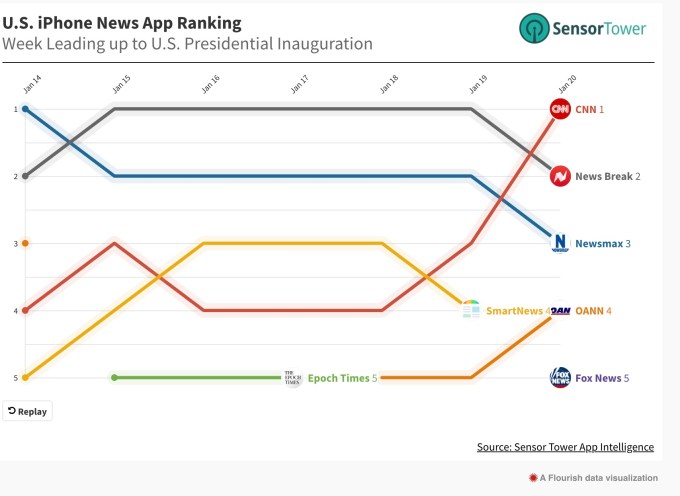
  • Biden’s inauguration boosted installs of U.S. news apps up to 170%, Sensor Tower reported. CNN was the biggest mover, climbing 530 positions to reach No. 41 on the App Store, and up 170% in terms of downloads. News Break was the second highest, climbing 13 positions to No. 65. Right-wing outlet Newsmax climbed 43 spots to reach No. 108. In 2020, the top news apps were: News Break (23.7 million installs); SmartNews (9 million); CNN (5 million); and Fox News (4 million). This month, however, News Break saw 1.2 million installs, followed by Newsmax with about 863,000 installs, the report said.
  • Ireland’s Data Protection Commission (DPC) sent a draft decision to fellow EU Data Protection Authorities over the WhatsApp-Facebook data sharing policy. This means a decision on the matter is coming closer to a resolution in terms of what standards of transparency is required by WhatsApp.
  • German app developer Florian Mueller of FOSS Patents filed a complaint with the EU, U.S. DOJ and other antitrust watchdogs around the world over Apple and Google’s rejection of his COVID-related mobile game. Both stores had policies to only approve official COVID-19 apps from health authorities. Mueller renamed the game Viral Days and removed references to the novel coronavirus to get the app approved. However, he still feels the stores’ rules are holding back innovation.

Productivity

  • Basecamp’s Hey, which famously fought back against Apple’s App Store rules over IAP last year, has launched a business-focused platform, Hey for Work, expected to be public in Q1. The app has more App Store ratings than rival Superhuman, a report found. Currently, Hey has a 4.7-star rating across 3.3K reviews; Superhuman has 3.9 rating across only 274 reviews.

Trends

  • Baby boomers are increasingly using apps. Baby boomers/Gen Xers in the U.S. spent 30% more time year-over-year in their most used apps, App Annie reports. That’s a larger increase than either Millennials or Gen Z, at 18% and 16%, respectively.

Funding and M&A

  • Curtsy, a clothing resale app for Gen Z women, raised an $11 million Series A led by Index Ventures. The app tackles some of the problems with online resale by sending shipping supplies and labels to sellers, and by making the marketplace accessible to new and casual sellers.
  • Storytelling platform Wattpad acquired by South Korea’s Naver for $600 million. The reading apps whose stories have turned into book and Netflix hits will be incorporated into Naver’s publishing platform Webtoon.
  • On-demand delivery app Glovo partnered with Swiss-based real estate firm, Stoneweg, which is investing €100 million in building and refurbishing real estate in key markets to build out Glovo’s network of “dark stores.”
  • Pocket Casts app is up for sale. The podcast app was acquired nearly three years ago by a public radio consortium of top podcast producers (NPR, WNYC Studios, WBEZ Chicago and This American Life). The owners have now agreed to sell the app, which posted a net loss in 2020. (NPR’s share of the loss was over $800,000.)
  • Travel app Maps.me raised $50 million in a round led by Alameda Research. The funding will go toward the launch of a multi-currency wallet. Cryptocurrency lender Genesis Capital and institutional cryptocurrency firm CMS Holdings also participated in the round, Coindesk reported.
  • Bangalore-based hyperlocal delivery app Dunzo raised $40 million in a round that included investment from Google, Lightbox, Evolvence, Hana Financial Investment, LGT Lightstone Aspada and Alteria.
  • London-based food delivery app Deliveroo raised $180 million in new funding from existing investors, led by Durable Capital Partners and Fidelity Management, valuing the business at more than $7 billion.
  • Dating Group acquired Swiss startup Once, a dating app that sends one match per day, for $18 million.

Downloads

Bodyguard

Image Credits: Bodyguard

A French content moderation app called Bodyguard, detailed here by TechCrunch, has brought its service to the English-speaking market. The app allows you to choose the level of content moderation you want to see on top social networks, like Twitter, YouTube, Instagram and Twitch. You can choose to hide toxic content across a range of categories, like insults, body shaming, moral harassment, sexual harassment, racism and homophobia and indicate whether the content is a low or high priority to block.

Beeper
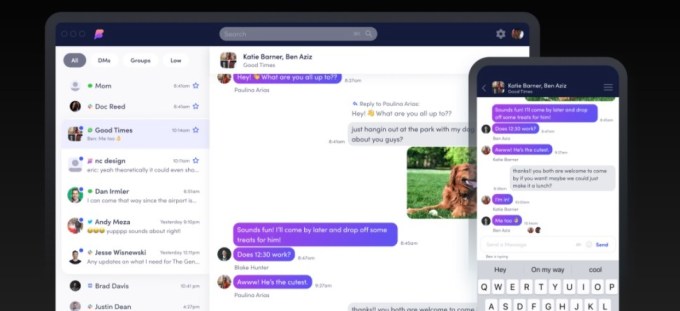
Image Credits: Beeper

Pebble’s founder and current YC Partner Eric Migicovsky has launched a new app, Beeper, that aims to centralize in one interface 15 different chat apps, including iMessage. The app relies on an open-source federated, encrypted messaging protocol called Matrix that uses “bridges” to connect to the various networks to move the messages. However, iMessage support is more wonky, as the company actually ships you an old iPhone to make the connection to the network. But this system allows you to access Beeper on non-Apple devices, the company says. The app is slowly onboarding new users due to initial demand. The app works across MacOS, Windows, Linux‍, iOS and Android and charges $10/mo for the service.

 

Watch SpaceX launch its first dedicated rideshare mission live, carrying a record-breaking number of satellites

[UPDATE: Today’s attempt was scrubbed due to weather conditions. Another launch window is available tomorrow at 10 AM ET]

SpaceX is set to launch the very first of its dedicated rideshare missions – an offering it introduced in 2019 that allows small satellite operators to book a portion of a payload on a Falcon 9 launch. SpaceX’s rocket has a relatively high payload capacity compared to the size of many of the small satellites produced today, so a rideshare mission like this offers smaller companies and startups a chance to get their spacecraft in orbit without breaking the bank.

The cargo capsule atop the Falcon 9 flying today holds a total of 133 satellites according to SpaceX, which is a new record for the highest number of satellites being launched on a single rocket – beating out a payload of 104 spacecraft delivered by Indian Space Research Organization’s PSLV-C37 launch back in February 2017. It’ll be a key demonstration not only of SpaceX’s rideshare capabilities, but also of the complex coordination involved in a launch that includes deployment of multiple payloads into different target orbits in relatively quick succession.

This launch will be closely watched in particular for its handling of orbital traffic management, since it definitely heralds what the future of private space launches could look like in terms of volume of activity. Some of the satellites flying on this mission are not much larger than an iPad, so industry experts will be paying close attention to how they’re deployed and tracked to avoid any potential conflicts.

Some of the payloads being launched today include significant volumes of startup spacecraft, including 36 of Swarm’s tiny IoT network satellites, and eight of Kepler’s GEN-1 communications satellites. There are also 10 of SpaceX’s own Starlink satellites on board, and 48 of Planet Labs’ Earth-imaging spacecraft.

The launch stream above should begin around 15 minutes prior to the mission start, which is set for 9:40 AM EST (6:40 AM PST) today.

How fintech and serial founders drove African pre-seed investing to new heights in 2020

When Stripe-subsidiary Paystack raised its seed round of $1.3 million in 2016, it was one of the largest disclosed rounds at that stage in Nigeria. 

At the time, seven-figure seed investments in African startups were a rarity. But over the years, those same seed-stage rounds have become more common, with some very early-stage startups even raising eight-figure sums. Nigerian fintech startup, Kuda, which bagged $10 million last year, comes to mind, for example.

Also notable amidst the growth in seven and eight-figure African seed deals have been gains in pre-seed fundraising. Typically, pre-seed rounds are raised when the startup is still in the product development phase, yet to make revenue or discover product-market fit. These investments are usually made by third-party investors (friends and family), and range between $25,000-$150,000.

But the narrative as to how much an early-stage African startup can raise as pre-seed has changed. 

Last year, African VCs who usually fund seed and Series A rounds began partaking in pre-seed rounds, and they don’t seem to be slowing down. Just a month into 2021,  Egyptian fintech startup Cassbana raised a $1 million pre-seed investment led by VC firm Disruptech in a bid to drive expansion within the country.

So why the sudden change in appetite from investors?

Andreata Muforo is a partner at TLcom Capital, a pan-African early-stage VC firm. She told TechCrunch that last year’s run of 23 pre-seed rounds (10 of which were $150,000+ deals) per Briter Bridges data, was due to the confidence investors had in the market, especially fintech.

Startups building financial infrastructure got noticed

While most African pre-seed investments in 2020 went to fintech, there were exceptions, including Egyptian edtech startup Zedny, which raised $1.2 million; Nigerian automotive tech startup Autochek Africa, which raised $3.4 million; and Nigerian talent startup TalentQL, which raised $300,000. 

Just as Paystack and Flutterwave built payment infrastructure for thousands of African businesses, these fintech startups are trying to make their mark in the sweet spots of credit and banking. 

“Fintech is compelling. But while most fintech startups play around the commodities side of fintech, it’s the companies building infrastructure around the market that got most of the pre-seed validation last year,” Muforo said. Her firm, TLcom, led the $1 million pre-seed investment in Okra.

Okra is an API fintech startup. So are Mono, OnePipe and Pngme. They are building Africa’s API infrastructure that connects bank accounts with financial institutions and third-party companies for different purposes. Within the past 18 months, Mono and Pngme raised $500,000, while OnePipe raised $950,000 in pre-seed.

It is noteworthy that while these startups are clamoring to solve Africa’s open API banking issues, three of the four deals came after Visa’s $5.3 billion acquisition of Plaid last year in January.

Although the Visa-Plaid acquisition has now been called off, it is safe to say some African investors developed FOMO, handing out sizable checks to fund “Africa’s Plaid” in the process.

Digital lenders remain one of their most important customers for fintech API startups. They can access customers’ financial accounts to understand their spending patterns and know who to loan to.

Egypt’s Shahry and Nigeria’s Evolve Credit are fintech startups building credit infrastructure for their markets. Evolve Credit connects digital lenders to those who need loan services in Nigeria via its online loan marketplace. Shahry, on the other hand, employs an AI-based credit scoring engine so users in Egypt can apply for credit. The pair also secured impressive pre-seed funding — Evolve Credit, $325,000, and Shahry, $650,000.

A recurring theme: Serial founders

Muforo points out that aside from startups building fintech infrastructure, the caliber of founders was another reason pre-seed funding peaked last year.

Adewale Yusuf, co-founder and CEO of TalentQL, a startup that hires, manages and outsources talent for Nigerian and global companies, seemed to agree. He told TechCrunch that trust between the VCs and founders involved played a major role in most pre-seed rounds last year. 

“It wasn’t surprising that a lot of investors put money in pre-seed rounds. I say this because we also saw existing founders and serial entrepreneurs coming back to the market. To me, these founders’ credibility was a major part of why those rounds were large,” he said.

A second-time founder himself, Yusuf is the co-founder of Nigerian tech media publication Techpoint Africa. His partner at TalentQL, Opeyemi Awoyemi, is also a serial entrepreneur. He co-founded Ringier One Africa Media-owned Jobberman, one of Africa’s most popular recruitment platforms.

According to Adedayo Amzat, founder of Zedcrest Capital, which is the lead investor in TalentQL’s round, the founders’ experience proved vital in closing the deal. 

He says investors are more comfortable backing experienced founders in pre-seed rounds because they have a more mature understanding of the problems they’re trying to solve. So, in essence, they tend to raise more capital.

“If you look at pre-seed sizes, experienced founders can demand a significant premium over first-time founders,” Amzat said. “Pre-seed valuation cap for first-time founders will typically be between 400K to $1 million while we frequently see up to $5 million for experienced founders.” 

It was a recurring theme last year. Yele Bademosi, who runs Microtraction, a West African early-stage VC firm, is the CEO of Bundle Africa, a Nigerian-based crypto-exchange startup that raised $450,000 in April 2020. 

Shahry co-founders Sherif ElRakabawy and Mohamed Ewis also run Egypt’s largest shopping engine and price comparison website, Yaoota.

Mono co-founder and CEO Abdulhamid Hassan was the co-founder of Nigerian fintech startup OyaPay and data science startup Voyance. Also, Etop Ikpe, the co-founder and CEO of Autochek Africa, was CEO of DealDey and Cars45.

That said, Fara Ashiru Jituboh of Okra and Akan Nelson of Evolve Credit as first-time founders got investments that most of their counterparts would only dream of. For Jituboh, her solid tech background spoke for her — boasting a senior software engineering job at Pexels and engineering consultant role at Canva before founding Okra.

“We backed Fara because she’s a strong tech founder. When you look at the core of what Okra does as a tech-heavy company, you see how important it was to make the decision,” Muforo said about backing Okra’s CEO and CTO.

Nelson also told TechCrunch that his finance background helped Evolve Credit raise its six-figure sum. The team’s bullishness on finding product-market fit and the potential of Africa’s loan marketplace was also enough to bring foreign and local VCs like Samurai Incubate, Future Africa, Ingressive Capital and Microtraction on board.

While early-stage investments in African startups haven’t reached full speed, the explosion in the number of angel investors has lowered entry barriers into early-stage investing. 

Now investors are beginning to show readiness toward African startups that have promise as they continue to search for the next Paystack. 

“More people are willing to take risks now in the market, especially angel investors. They can easily let go of $10K-$50K because of success stories like Paystack,” Yusuf said about the $200 million acquisition by U.S. payments startup Stripe

For all of its significance to the African tech ecosystem, what particularly stands out about Paystack’s exit is the return on investment made for early investors.

By the time it exited in October 2020, some angel investors had an ROI of more than 1,400% according to Jason Njoku in his blog post. Njoku, who took part in the round as an angel investor, is the CEO of IROKO, a Nigerian VOD internet company.

For Muforo, witnessing more early-stage investments is a big deal, one the African tech ecosystem should savor regardless of the round in question.

“Pre-seed or seed are just names investors and founders give,” she said. “What I think is most important is the fact that we’re getting more early-stage capital into Africa, and startups are getting more attention from investors, which is fantastic.”

Could giant SPACs be next?

While many deemed 2020 the year of SPAC, short for special purpose acquisition company, 2021 may well make last year look quaint in comparison.

It’s probably not premature to be asking: is there any company too big to be SPAC’d?

Just today, we saw the trading debut of the most valuable company to date go public through a merger with one of these SPACs: 35-five-year-old, Pontiac, Michigan-based United Wholesale Mortgage, which is among the biggest mortgage companies in the U.S.

Its shares slipped a bit by the end of trading, closing at $11.35 down from their starting price of $11.54, but it’s doubtful anyone involved is crying into their cocktails tonight. The outfit was valued at a whopping $16 billion when its merger with the blank-check outfit Gores Holdings IV was approved earlier this week.

Why is this interesting? Well, first, despite UWM’s size, its path to going public took less than a year, beginning with Gores Holdings IV completing its IPO in late January 2020 and raising approximately $425 million in cash.

Alec Gores, the billionaire founder of of the private equity firm Gores Group, led the deal. The tie-up was announced back in September and ultimately included an additional $500 million private placement. (It’s typical to tack-on these transactions once a target company has been identified and accepts the terms of the proposed merger. Most targets are many times larger than the blank check companies with which they are joining forces.)

Also notable is that UWM is a mature company, one that says it generated $1.3 billion in revenue in the third quarter of last year alone and whose CEO, whose father started the company in 1986, said last fall that the company is “massively profitable.”

It’s a story unlike that of most outfits to go public recently through the SPAC process. Consider Opendoor, Luminar Technologies, and Virgin Galactic. Each is still developing a business that needs capital to keep going and which might not have found much more funding from private market investors.

SpaceX director Steve Jurvetson underscored the point pretty bluntly last week, saying, for example, that Virgin Galactic has seen “no positive business development” since being taken public. “They announced that they’re going to develop a hypersonic plane, but that has zero synergy with the current business they’re trying to launch, which is suborbital spaceflights, which have yet to happen for customers.”

If more profitable, more mature, more businesses with a very clear path to future revenue — more companies like UMW — begin choosing SPACs over traditional IPOs, it could change widespread perceptions of SPAC candidates as businesses that had nowhere else to go.

It could also broaden thinking about what size companies are appropriate to take public this way and lead to much bigger transactions.

More certain: UWM isn’t likely to hold the record for ‘biggest SPAC deal ever’ for long. Not only is interest in SPACs as feverish as ever, but one vehicle in particular seems poised to take the title, and that’s the SPAC of billionaire investor William Ackman, whose blank-check company raised $4 billion last summer.

Presumably, the deal will be a doozy. Reportedly, Ackerman was at one point looking to take public Airbnb with his SPAC. When Airbnb passed on the proposed merger, he reportedly reached out to the privately held media conglomerate Bloomberg. (Bloomberg has said it’s untrue.)

Because SPACs typically complete a merger with a private company in two years or less, speculation has been running rampant about what Ackman — who plans to kick in an additional $1 billion in cash from his hedge fund — will piece together with all that money.

In the meantime, there have been 67 new SPAC offerings in the last 22 days alone — as many as in all of 2019. They’ve raised $19.2 billion. And there’s seemingly no end to the fundraising in sight.

Just this week, Fifth Wall Ventures, the four-year-old, L.A.-based proptech focused venture firm, registered plans to raise $250 million for a new blank-check company.

Intel Chairman Omar Ishrak, who previously ran medical device giant Medtronic, was reported to be planning to raise between $750 million and $1 billion for a blank-check firm targeting deals in the health tech sector.

As for Gores Group, on Wednesday, it registered plans to raise $400 million in an IPO for its newest blank-check company. It will be the outfit’s seventh SPAC to date.

Daily Crunch: Alphabet shuts down Loon

Alphabet pulls the plug on its internet balloon company, Apple is reportedly developing a new MacBook Air and Google threatens to pull out of Australia. This is your Daily Crunch for January 22, 2021.

The big story: Alphabet shuts down Loon

Alphabet announced that it’s shutting down Loon, the project that used balloons to bring high-speed internet to more remote parts of the world.

Loon started out under Alphabet’s experimental projects group X, before spinning out as a separate company in 2018. Despite some successful deployments, it seems that Loon was never able to find a sustainable business model.

“While we’ve found a number of willing partners along the way, we haven’t found a way to get the costs low enough to build a long-term, sustainable business,” Loon CEO Alastair Westgarth wrote in a blog post. “Developing radical new technology is inherently risky, but that doesn’t make breaking this news any easier.”

The tech giants

Apple reportedly planning thinner and lighter MacBook Air with MagSafe charging — The plan is reportedly to release the new MacBook Air as early as late 2021 or 2022.

Google threatens to close its search engine in Australia as it lobbies against digital news code — Google is dialing up its lobbying against draft legislation intended to force it to pay news publishers.

Cloudflare introduces free digital waiting rooms for any organizations distributing COVID-19 vaccines — The goal is to help health agencies and organizations tasked with rolling out COVID-19 vaccines to maintain a fair, equitable and transparent digital queue.

Startups, funding and venture capital

‘Slow dating’ app Once is acquired by Dating Group for $18M as it seeks to expand its portfolio — Once has 9 million users on its platform, with an additional 1 million users from a spin-out app called Pickable.

MotoRefi raises $10M to keep pedal on auto refinancing growth — CEO Kevin Bennett sees the opportunity to service Americans who collectively hold $1.2 trillion in auto loans.

Backed by Vint Cerf, Emortal wants to protect your digital legacy from ‘bit-rot’ —  Emortal is a startup that wants to help you organize, protect, preserve and pass on your “digital legacy” and protect it from becoming unreadable.

Advice and analysis from Extra Crunch

How VCs invested in Asia and Europe in 2020 — The unicorns are feasting.

End-to-end operators are the next generation of consumer business — VC firm Battery has tracked seismic shifts in how consumer purchasing behavior has changed over the years.

Drupal’s journey from dorm-room project to billion-dollar exit — Twenty years ago, Drupal and Acquia founder Dries Buytaert was a college student at the University of Antwerp.

(Extra Crunch is our membership program, which helps founders and startup teams get ahead. You can sign up here.)

Everything else

UK resumes privacy oversight of adtech, warns platform audits are coming — The U.K.’s data watchdog has restarted an investigation of adtech practices that, since 2018, have been subject to scores of complaints under GDPR.

Boston Globe will consider people’s requests to have articles about them anonymized — It’s reminiscent of the EU’s “right to be forgotten,” though potentially less controversial.

The Daily Crunch is TechCrunch’s roundup of our biggest and most important stories. If you’d like to get this delivered to your inbox every day at around 3pm Pacific, you can subscribe here.

The far right’s favorite registrar is building ‘censorship-resistant’ servers

“The digital divide is now a matter of life and death for people who are unable to access essential healthcare information,” said UN Secretary General António Guterres in June 2020. Almost half the global population currently has no internet access, and many who do cannot freely access all information sources. 

Freedom House, which tracks internet restrictions worldwide, says the coronavirus pandemic is accelerating a dramatic decline in global internet freedom. It found that governments in at least 28 countries censored websites and social media posts in 2020 to suppress unfavorable health statistics, corruption allegations and other COVID-19-related content.

Now, U.S. company Toki is building “school-in-a-box” devices to connect up to 1 billion people across Africa and Asia, using technologies that it claims could filter content to avoid some information sources and bypass local censorship. The devices will be Wi-Fi-ready servers that run on electric power or batteries and can handle dozens of concurrent users. If no networks are available, the servers will also come pre-installed with digital libraries curated to provide “locally relevant content.” 

One of Toki’s country managers describes on LinkedIn that the devices would also run a decentralized search engine, designed to be anonymous, private and censorship-resistant. They will be donated to communities in the developing world by U.S.-based eRise*, which was founded in 2019 to, according to its website, “focus on digital empowerment initiatives that are capital-efficient, and which improve access to content, community and commerce.”

Both Toki and eRise were founded by entrepreneur and free speech advocate Rob Monster. Monster owns domain registration company Epik, which allowed controversial social network Parler to come briefly back online last week after the site was booted from Amazon’s cloud service. Parler is just one of several platforms enabled by Epik, and Monster’s other domain and web hosting companies, that have been home to far-right content. Parler is accused of hosting users that helped to coordinate the attack on the U.S. Capitol on January 6. 

The “school-in-a-box” would contain a memory card with educational content, games, books, maps and modules related to prayers, the story of religions and “the art of being grateful.” It says the device is intended for “parents who want their kids to be smarter and curious; schools who can’t afford a computer; [and] religious places who wish to spread awareness about education and empower the society.” 

But one researcher says this effort recalls Facebook’s heavily criticized project offering free connectivity in India, which spawned accusations of bias and self-censorship. 

“We’ve seen a similar tactic by Facebook, to provide digital access points that can also serve the purpose of delivering favorable content and ensuring that these groups become dependent on your benevolence,” said Dr. Joan Donovan, director of the Technology and Social Change Research Project at the Shorenstein Center. “It becomes that much harder later on to change the power dynamics when the ideology is in the infrastructure.”

Monster has used free speech arguments to defend Epik’s working with platforms that either welcome or tolerate extreme content. The Southern Poverty Law Center, which tracks hate groups, has been reported as saying that Monster “offers services to the most disreputable horrific people on the Internet.” 

Epik spokesperson Rob Davis told TechCrunch that Epik actively works with its clients to help them moderate content, and claimed that the company has deplatformed Nazi groups and deleted those promoting genocide.

“Lawful, responsible freedom of speech is an amazing right,” said Davis. “Every [domain registrar] has groups like this but Epik is often held to a higher standard.”

In a series of posts in 2019 on a forum dedicated to domain-name trading, Monster provided more details about the Toki technology. The servers would be powered by cheap Raspberry Pi processors and run a proprietary version of Linux that would enable file sharing, peer-to-peer commerce, a digital wallet and a personalized search engine, with the option of “ignoring certain data sources.” 

“Decentralization not only means decentralization of the narrative and talking points of big tech groups like Google, Twitter and Facebook,” said Epik’s Davis. “It also means anti-censorship by empowering people with things that they didn’t know.” The spokesperson gave the example of naturopathic remedies for minor health complaints. Naturopathic remedies have not been proven to be effective against COVID-19.

Eventually, each device might come pre-loaded with a “snapshot” of the internet, said Davis, although he did not describe how the internet might be reduced to fit on a single, small physical device. The eRise website notes that content would be curated by local digital librarians that it would recruit. Davis told TechCrunch that Toki has working models of its server, is already conducting field trials and hopes to start deploying the devices to 6,000 villages in Africa in 2022 or 2023, perhaps in collaboration with an unnamed Asian telecoms company. 

The Toki devices’ selectivity, if practical, could raise its own content and censorship concerns; for example, if eRise allowed extreme content similar to that seen on Epik’s clients like Gab and Parler, or ignored scientific advice on COVID-19 or other health issues. 

Donovan said she is wary of any one-box solution. “We have to focus on decoupling information companies from service providers,” she said. “That much control can be used for political gain. Technology is politics by other means.”

* ERise had claimed to be a 501(c)(3) nonprofit, which would have exempted it from some taxes and allow tax-free donations. TechCrunch could not locate it on the IRS’s database of nonprofits. Monster later admitted eRise was not a registered 501(c)(3)) and removed its 501(c)(3) claim.

End-to-end operators are the next generation of consumer business

Roger Lee
Contributor

Roger Lee is a general partner at Battery Ventures, based in Menlo Park, CA, who focuses on investments in software and consumer tech, including online marketplaces.

Justin Da Rosa
Contributor

Justin Da Rosa is a vice president with Battery Ventures in San Francisco. He focuses on consumer internet, online marketplace and software investments.

At Battery, a central part of our consumer investing practice involves tracking the evolution of where and how consumers find and purchase goods and services. From our annual Battery Marketplace Index, we’ve seen seismic shifts in how consumer purchasing behavior has changed over the years, starting with the move to the web and, more recently, to mobile and on-demand via smartphones.

The evolution looks like this in a nutshell: In the early days, listing sites like Craigslist, Angie’s List* and Yelp effectively put the Yellow Pages online — you could find a new restaurant or plumber on the web, but the process of contacting them was largely still offline. As consumers grew more comfortable with the web, marketplaces like eBay, Etsy, Expedia and Wayfair* emerged, enabling historically offline transactions to occur online.

More recently, and spurred in large part by mobile, on-demand use cases, managed marketplaces like Uber, DoorDash, Instacart and StockX* have taken online consumer purchasing a step further. They play a greater role in the operations of the marketplace, from automatically matching demand with supply, to verifying the supply side for quality, to dynamic pricing.

The key purpose of being end-to-end is to deliver an even better value proposition to consumers relative to incumbent alternatives.

Each stage of this evolution unlocked billions of dollars in value, and many of the names listed above remain the largest consumer internet companies today.

At their core, these companies are facilitators, matching consumer demand with existing supply of a product or service. While there is no doubt these companies play a hugely valuable role in our lives, we increasingly believe that simply facilitating a transaction or service isn’t enough. Particularly in industries where supply is scarce, or in old-guard industries where innovation in the underlying product or service is slow, a digitized marketplace — even when managed — can produce underwhelming experiences for consumers.

In these instances, starting from the ground up is what is really required to deliver an optimal consumer experience. Back in 2014, Chris Dixon wrote a bit about this phenomenon in his post on “Full stack startups.” Fast forward several years, and more startups than ever are “full stack” or as we call it, “end-to-end operators.”

These businesses are fundamentally reimagining their product experience by owning the entire value chain, from end to end, thereby creating a step-functionally better experience for consumers. Owning more in the stack of operations gives these companies better control over quality, customer service, delivery, pricing and more — which gives consumers a better, faster and cheaper experience.

It’s worth noting that these end-to-end models typically require more capital to reach scale, as greater upfront investment is necessary to get them off the ground than other, more narrowly focused marketplacesBut in our experience, the additional capital required is often outweighed by the value captured from owning the entire experience.

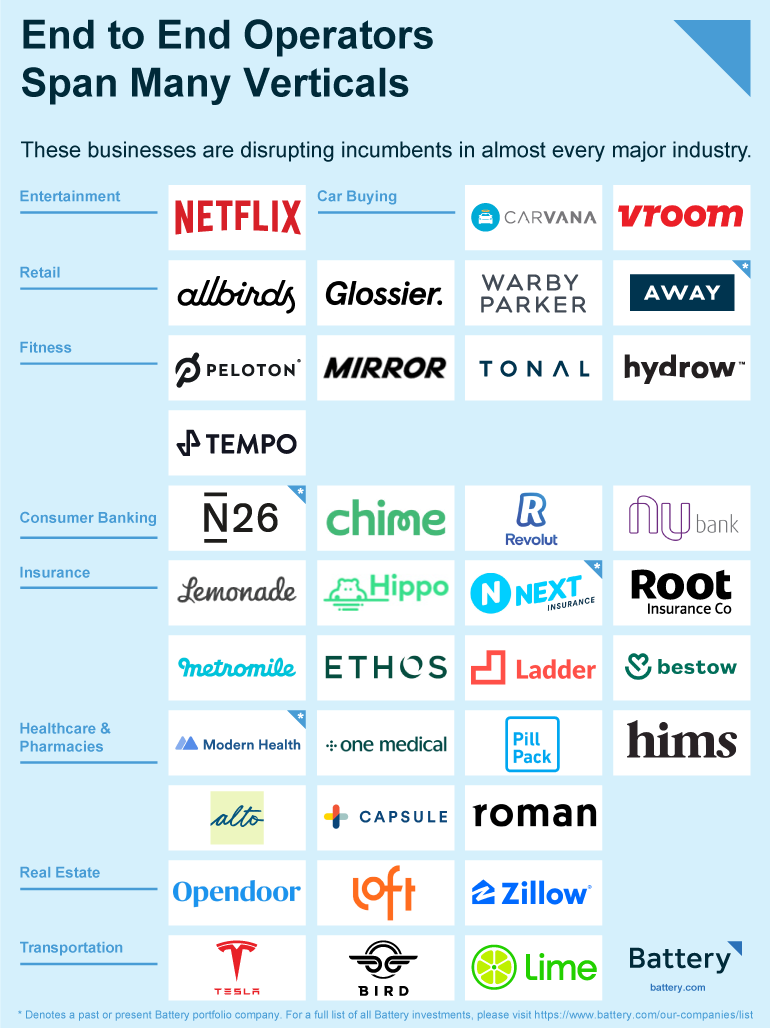
End-to-end operators span many verticals

Many of these businesses have reached meaningful scale across industries:

All of these companies have recognized they can deliver more value to consumers by “owning” every aspect of the underlying product or service — from the bike to the workout content in Peloton’s case, or the bank account to the credit card in Chime’s case. They have reinvented and reimagined the entire consumer experience, from end to end.

What does success for end-to-end operator businesses look like?

As investors, we’ve had the privilege of meeting with many of these next-generation end-to-end operators over the years and found that those with the greatest success tend to exhibit the five key elements below:

1. Going after very large markets

The end-to-end approach makes the most sense when disrupting very large markets. In the graphic above, notice that most of these companies play in the largest, but notoriously archaic industries like banking, insurance, real estate, healthcare, etc. Incumbents in these industries are very large and entrenched, but they are legacy players, making them slow to adopt new technology. For the most part, they have failed to meet the needs of our digital-native, mobile-savvy generation and their experiences lag behind consumer expectations of today (evidenced by low, or sometimes even negative, NPS scores). Rebuilding the experience from the ground up is sometimes the only way to satisfy today’s consumers in these massive markets.

2. Step-functionally better consumer experience versus the status quo