IAC’s Teltech acquired encrypted mobile messaging app Confide

IAC has acquired Confide, the encrypted mobile messaging that once made headlines for its use by White House staffers during the Trump administration. The deal, which closed on Dec. 1, 2020 but was not publicly announced, sees Confide joining Teltech, the makers of spam call-busting app Robokiller, which itself had joined IAC’s Mosaic Group by way of a 2018 acquisition.

Teltech confirmed the Confide acquisition, but declined to share the deal terms. The confidential mobile messaging app had raised just $3.5 million in funding, according to Crunchbase data, and had been valued between $10 to $50 million, as a result. (Pitchbook put the valuation at ~$14 million around the same time.)

According to Teltech, the deal was for the Confide IP and technology, but not the team.

The company believes Confide makes for a good fit among its growing group of mobile communication apps, including Robokiller and its latest app, SwitchUp, which offers users a second phone number for additional privacy and spam blocking purposes. Other Teletech apps include phone call recorder TapeACall and blocked call unmasker TrapCall.

Confide, however, may end up being one of the better-known additions among that group, thanks to being remembered as a favored tool of choice among frustrated Washington Republicans during the Trump years.

But despite the user growth that news had driven, things slowed in the months that followed, when researchers published a report that claimed Confide wasn’t as secure as it had promised. Confide quickly fixed its vulnerabilities but then a month later was facing a class action lawsuit (later dismissed by the plaintiff) over the security issues.

Teltech says it was aware of the security concerns, but it had conversations with the prior Confide team and understands that the earlier issues had been “quickly and effectively remediated.”

While IAC won’t speak to its specific plans for Confide’s future, the app will continue to offer users a safe and secure way to communicate. What it won’t do, though, is try to directly compete with Telegram or other private apps that offer large channels or group chats that support tens of thousands of people at once.

“I think one kind of key differentiators is that Confide is definitely more for one-on-one and smaller group communication, rather than with Signal and Telegram where there’s some larger chat dynamics,” notes Giulia Porter, Teltech’s VP of Marketing. “One thing that makes us a little bit different is just that we’re more personal,” she says.

Despite having hit some bumps in the road over the years, Confide as of the time of the acquisition, still had around 100,000 monthly active users. There’s now a team of around 10 assigned to work on the app, adding needed resources to its further development, and soon, an updated logo and branding.

Confide’s existing desktop and mobile apps will also continue to be available, but later updated with new features as part of Teltech’s efforts.

Investors and IAC alike have declined to talk about deal price, but that may speak for itself.

“With the absolute explosion in privacy over the past several years, Confide, which started as a side project, has become a mission-critical platform for sensitive communication throughout the world,” said Confide co-founder and President Jon Brod, in a statement shared with TechCrunch about Confide’s exit.

“We’re thrilled that IAC shares our passion for secure communication and recognizes the unique business we have built. IAC has a proven track record of providing fast-growing companies with the support to reach their full potential and we are excited to see IAC take Confide to the next level,” he said.

Squarespace files privately to go public

Squarespace announced this afternoon that it is going public. The online website creation and hosting service is a venture-backed entity, having raised Series A and B rounds in 2010 and 2014, respectively. Those deals were worth a combined $78.5 million, according to Crunchbase data.

But Squarespace is perhaps best known for its epic 2017-era $200 million secondary round that General Atlantic financed. A secondary round is a transaction in which an external party buys share from existing shareholders, instead of the company issuing new equity. Some private companies execute secondary transactions when they do not need additional capital, but are also not near a liquidity event.

The 2017 transaction fits well with the company’s now-impending 2021 IPO.

At the time TechCrunch reported that the company had revenues of around $300 million and that it was profitable.

By filing, Squarespace joins a growing list of companies pursuing the public markets in recent months. At the end of 2020 C3.ai, DoorDash and Airbnb listed. To kick off 2021, Affirm and Poshmark listed to great effect. Coinbase has filed, Robinhood is a hot IPO prospect, and now Squarespace is throwing its hat into the ring.

The Squarespace filing is private, which means that we are waiting for a future public S-1 from the company. Here’s its own words on the current state of affairs:

Squarespace, Inc. today announced that it has confidentially submitted a draft registration statement on Form S-1 with the Securities and Exchange Commission (the “SEC”). The registration statement is expected to become effective after the SEC completes its review process, subject to market and other conditions.

As Squarespace is a software company, a cloud company and a company with a hand in the e-commerce space, we can only presume that it will suffer from a stultifying lack of investor interest when it does file, price and list.1 After all, we’ve not seen a hot software IPO for weeks.

Hat’s off to Squarespace for freeing us from the news doldrums. We’re going back to our nap now.

1This is sarcasm.

Investors don’t seem that impressed by Apple’s $111 billion quarter

On Wednesday, Apple announces that it had banked $111.4 billion of revenue in a single quarter, beating investor expectations and blowing past its previous all-time revenue record. Investors yawned with the stock down slightly in after-hours trading following the report’s release.

It’s a big number but it also bested analyst’s forecasts for Apple’s first quarter. Apple beat investor expectations on both earnings per share and revenues, delivering much more than the expected $103.3 billion in revenues and $1.68 EPS versus the $1.41 the Street had expected.

As meme stocks like GameStop and AMC see 100%+ stock gains, it’s a sober reminder that for the rest of the broader public market it’s business as usual and investors have big expectations for massive tech stocks that have seen their market caps and stock prices reach new heights in recent months. Despite the lack of a shock adjustment from the earnings report release this afternoon, Apple’s share price has risen more than 23% since it released its last earnings report in late October.

Apple’s revenue gains from Q1 represented 20 percent year-over-year revenue growth, but a big chunk of that growth came from a single region: China. Quarterly revenues in the region were up nearly 57% eclipsing $21.3 billion compared to $13.6 billion in the same quarter last year.

In terms of revenues via product vertical, iPhone of course reigned supreme with $65.6 billion in sales compared to $56 billion in sales during the same quarter last year. Due to a later-than-usual release timeline for Apple’s latest iPhones, this quarter encapsulates a more substantial swath of the early sales for the device.

It wasn’t just a big quarter for iPhone, iPad sales growth exceeded that of Mac, nearly pushing the category above the other with $8.7 billion in Mac sales and $8.4 billion in iPad sales. Wearables, Home and Accessories grew to $13 billion and Services reached new heights at $15.8 billion.

We’ll be updating with details from the earnings call.

Facebook predicts ‘significant’ obstacles to ad targeting and revenue in 2021

While Facebook’s fourth quarter earnings report included solid user and revenue numbers, the company sounded a note of caution for 2021.

In the “CFO outlook” section of the earnings release, Facebook said it anticipates facing “more significant advertising headwinds” this year.

“This includes the impact of platform changes, notably iOS 14, as well as the evolving regulatory landscape,” the company wrote. “While the timing of the iOS 14 changes remains uncertain, we would expect to see an impact beginning late in the first quarter.”

Facebook has already been waging a bit of a campaign against Apple’s upcoming privacy changes, which will require app developers to ask users for permission in order to use their IDFA identifiers for ad targeting — although the PR focus has been the impact on small businesses, not Facebook.

Facebook also highlighted two broad economic trends that it says it has benefited from during the pandemic: The “ongoing shift toward online commerce” and “the shift in consumer demand toward products and away from services.” But again, it took a cautious stance, writing that “a moderation or reversal in one or both of these trends could serve as a headwind to our advertising revenue growth.”

As for those fourth quarter earnings earnings, Facebook reported $28.1 billion in revenue, of which $27.2 billion came from ads, with earnings per share of $3.88. Wall Street analysts had predicted EPS of $3.22 and revenue of $26.4 billon.

Facebook also reported an average of 1.84 billion daily active users and 2.8 billion monthly active users for the quarter, up 11% and 12% year over year, respectively.

“We had a strong end to the year as people and businesses continued to use our services during these challenging times,” said CEO Mark Zuckerberg in a statement. “I’m excited about our product roadmap for 2021 as we build new and meaningful ways to create economic opportunity, build community and help people just have fun.”

As of 4:45 p.m. EST, Facebook shares were up 0.7% in after-hours trading.

How trading apps are responding to the GameStop fustercluck

The furor surrounding GameStop and its stock price has consumed social media, business television, and the hopes and dreams of many retail investors. It has even convinced some folks that causing short-term economic damage to a few hedge funds is similar to shaking up the global financial market.

It isn’t, but a lot of folks are doing some downright risky things with their personal capital all the same. And some of them are making those investments — bets, let’s be honest — on platforms that have lowered barriers to buying and selling stocks by cutting trading fees to zero. Apps and services like Robinhood, Public, M1 Finance and Freetrade.

After noting reports that some traditional brokers were limiting access to GameStop and other so-called meme stocks, TechCrunch was curious what the newer, app-based investing services were doing for their own users.

A spokesperson for M1 Finance, a Midwest-based consumer fintech player that offers a basket of banking and investing services — more on its growth here and here — told TechCrunch via email that it wasn’t taking “specific” steps regarding individual stocks.

But the company also provided a statement from its CEO, Brian Barnes. In his comment, Barnes drew a delineation between investing, and trading, which he likened to a casino, adding that his firm “question[s] whether short-term trading is predictable, sustainable or repeatable.”

It isn’t for nearly anyone, of course. Barnes went on to say that his company thinks that “ownership of great companies and assets at reasonable prices that compound for long periods of time is the most straightforward and repeatable way to build wealth,” and that they have focused their company more around that ethos, “forego[ing] the mania of the moment.”

Turning to the well-known Robinhood, an impressive 2020 growth story, TechCrunch asked the same question regarding warnings or other guardrails for users concerning certain equities.

In an email a Robinhood spokesperson directed TechCrunch to a comment that its CEO, Vlad Tenev, made on CNBC earlier today:

Like other brokerages do, we monitor volatility and we take steps as appropriate like raising the margin requirements. I do think it’s wrong to assume though that most of our activity is characterized by trading of volatile stocks. As I’ve said before, most of our customers are what’s called buy and hold. They deposit and buy over the long term.

Robinhood changed margin requirements for GameStop and AMC Entertainment to 100%, TechCrunch understands. And like M1, Robinhood doesn’t allow users to short equities. So, there’s that.

Something notable about the companies we are discussing is that not one of them wants to be labeled as the place where folks like to trade a lot. Which amuses me as cutting fees to zero, which they have largely done, is at once a great way to democratize investing, and, also, a great way to encourage folks to trade more frequently. And as the apps and services that offer free trading often make money when users trade (read this), their chatter about their users being focused on buying and holding always rings slightly thin.

Anyhoo, some apps are going as far as adding warnings. Public, a company that TechCrunch recently covered, said that the company has added “‘High Risk’ safety labels” to the meme stocks that are causing so much ruckus.

Public has long had a stated focus on building community over trading, which led to us having a question or two about when it is going to kickstart its monetization plans. The company did just hire a CFO, which makes this move appear in concert with its general ethos, so more to come there we presume.

And, finally, U.K.-based Freetrade. TechCrunch has covered the service before, making it a good company to rope into this group. Per the company, Freetrade restricts small-cap stocks to the subscription tier of its service, which should limit access amongst its user base to GameStop and other memetic equities.

The company also stressed that it does not offer options or “any other form of leveraged derivatives” and has made “huge investment in investor education and financial literacy.”

So there’s a general bent toward either building products that are not tuned for day trading in silly stocks or providing some protection against users’ worst instincts amongst the cohort of companies that have also made it inexpensive to trade. There’s tension there, akin to this.

But they can only do so much. People are dumb, and it’s not looking like that’s going to get much better anytime soon.

SoftBank teams with home-goods maker Iris Ohyama for new robotics venture

You’d be forgiven for being underwhelmed by the output from SoftBank Robotics thus far. The firm’s best-known product to date is almost certainly Pepper, a humanoid robot designed for greeting and signage that grew out of it 2015 acquisition of French robotics company Aldebaran.

There’s also the matter of the investment firm’s acquisition and eventual sale of Boston Dynamics. The deal certainly went a ways toward accelerating the company’s go-to-market approach, but Boston Dynamics changed hands fairly quickly, when it was sold to Hyundai late last year (SoftBank maintains 20%).

The latest wrinkle in SoftBank’s robotic ambitions is nothing if not interesting. The firm announced today that it is joining forces with Iris Ohyama. The Japanese brand, which will hold a 51% stake in the venture (with SoftBank controlling the remainder), is best known for its home goods. The company makes a broad range of products, that includes, as Reuters put it, “everything from rice to rice cookers.”

You’ll be able to add robotics to that list, soon enough. The newly formed Iris Robotics has set an extremely aggressive goal of $965 million in sales by 2025. In a joint press release, the company noted COVID-19-related concerns as a major catalyst in the launch of the division. Certainly that makes strategic sense. There’s little question that the past year has kickstarted serious interest in robotics and automation.

The first couple of products from the venture don’t appear especially ambitious out of the gate, however. To start, it seems they’ll be rolling out “Iris Editions” of a pair of existing devices: Bear Robotics’ restaurant robot Servi and cleaning robot Whiz.

Here’s a quote from SoftBank Robotics CEO (forgive the Google translate):

With the urgent need to realize the new normal in the coronavirus, various new expectations are being placed on robots. This strong partnership with Iris Ohyama is a huge step forward for the expansion and penetration of robot solutions. Taking full advantage of the strengths of both companies, we will respond quickly to the challenges facing society.

Certainly the technical ambitions seem more modest than what the folks at companies like Boston Dynamics are currently working on, but Iris Ohyama seems well-positioned to make some headway in the home robotics category to start.


VC investment in proptech can yield profits and change lives

D. Hara Perkins
Contributor

D. Hara Perkins is a partner at Goulston & Storrs, PC in New York City, where she focuses her practice on affordable housing and economic development.

Alexander Shermansong
Contributor

Alexander Shermansong is CEO of Civic Consulting USA and an adjunct assistant professor of public service at New York University’s Robert F. Wagner Graduate School of Public Service.

In 2020, nearly $24 billion in venture capital poured into companies creating new technology products or innovative business models for the real estate market.

While things like smart home apps and digital mortgage financing services make life easier for upmarket renters and homeowners, none of these technologies help improve the day-to-day struggles of the vast majority of low-income families.

Many of these emergent technologies could be adapted to become “housing tech” solutions — focused on financial resilience, fresh food access, healthcare access and workforce development — which have the potential to transform the lives of our most at-risk populations.

You can make money while serving the public good.

Consider this: Nearly eight million Americans have slipped into poverty since May, according to a study released by Columbia University. Before the COVID-19 crisis hit, approximately half of all American households struggled to pay rent; a problem that is growing larger by the day as pandemic job losses continue to mount.

About 23.5 million people — half of whom are low income — live in food deserts where access to affordable, healthy food is limited or nonexistent. And good health care is almost impossible to access, let alone pay for, if you are poor.

As the global crisis continues to lay bare the deep inequities in our society, it’s clear that we need new ways of thinking to address these systemic issues. Investment in technology innovation in the affordable housing area could help solve these problems.

Local governments and nonprofits are doing what they can. In 2015, New York launched Urbantech NYC to uncover new technology solutions to urbanization problems faced by government, businesses and urban residents, tackling issues related to food, water, medicine, waste management and other problems.

In 2019, Enterprise Community Partners, a national nonprofit, partnered with MetaProp, a leading proptech venture capital firm, to invest in housing tech companies that are developing technology innovations to help families find an affordable place to live.

These efforts are commendable, but it is not enough. The housing tech movement needs more champions.

First, we need a more patient venture capital source, with a better understanding of underserved communities. Most venture capital firms fund what they know, and unfortunately few understand the affordable housing community, which is largely minority with female heads of household. But pay attention: There are lucrative opportunities here.

Affordable housing property managers tend to invest far more in social services for their tenant population than market rate property managers considering the coolest new piece of technology. You can make money while serving the public good.

Second, housing tech is in desperate need of an accelerator. The tech is out there, but most entrepreneurs don’t know how to “sell” to this specific customer base, which they must do if they want to create viable businesses that will attract venture capital. There are numerous existing technologies ready for an accelerator to take to the next level. These are a few of our favorites:

  • Financial Resilience. Low-income people who live in affordable housing are often burdened with confiscatory payday loans and check-cashing services. Many don’t have banking relationships and pay rent in cash. The Lifesaver app helps households, especially those without banking relationships, navigate financial services and become more financially resilient. Earnin allows people to access their pay, with no fees, as soon as they work the hours without waiting for the payday to arrive. Research shows that people who take these short-term loans from nonpredatory lenders actually find themselves more financially stable in following months.
  • Fresh Food Access. Cheetah, a wholesale grocery delivery app, has placed community fridges as fresh-food pantries. Via, a transit-on-demand provider, partnered with LA Metro and First 5 LA to subsidize food delivery during the pandemic, especially to women-led households with little children.
  • Healthcare Access. Roundtrip provides booking for affordable nonemergency hailed rides, wheelchair vans and other specialized medical transports. Healthify offers a database of vetted and curated community resources, as well as information about the social determinants of health. Emerging software apps that facilitate telemedicine could also expand access to necessary health care.
  • Workforce Development. Skilling America is a new workforce platform from Goodwill that improves placement, retention and promotion rates, and most people using the platform are doing so on their smartphones.

An accelerator could also connect housing tech to affordable housing owners and property managers looking for ways to magnify the impact of the social services available on site. The top 50 owners of affordable housing developments have the reach to connect tech developers with almost a million households.

These owners and property managers could act as leadership ambassadors of collaborative efforts among tech developers, venture capital investors and potential housing tech users.

We work every day with the inspiring stakeholders in the affordable housing community, as well as local governments and tech entrepreneurs looking to bridge this digital divide. This isn’t a pie- in-the-sky vision. The future is here and the call to action is now.

SAP is buying Berlin business process automation startup Signavio

Rumors have been flying this week that SAP was going to buy Berlin business process automation startup Signavio, and sure enough the company made it official today. The companies did not reveal the purchase price, but Bloomberg reported earlier this week that the deal could be worth $1.2 billion.

With Signavio SAP gets a cloud-native business process management tool. SAP CFO Luka Mucic sees a world where understanding and automating businesses processes has become a key part of a company’s digital transformation efforts.

“I cannot overstress the importance for companies to be able to design, benchmark, improve and transform business processes across the enterprise to support new capabilities and business models,” he said in a statement.

While traditional enterprise BPA tools have existed for years, having a cloud-native tool gives SAP a much more modern approach to attacking this problem, and being able to automate business processes via the cloud has become more important during the pandemic when many employees are working entirely from home.

SAP also sees Signavio as a key missing piece in the company’s business process intelligence unit. “The combination of business process intelligence from SAP and Signavio creates a leading end-to-end business process transformation suite to help our customers achieve the requirements needed to gain a competitive edge,” he said.

SAP has been making moves into process automation of late. In fact at SAP TechEd in December, the company announced SAP Intelligent Robotic Process Automation, its foray into the RPA space. This should fit in nicely alongside it.

Dr. Gero Decker, Savigno co-founder and CEO, sees SAP resources helping push the company beyond what it could have done on its own. “Considering the positioning of SAP, its geographical coverage and financial muscle, SAP is the biggest and best platform to bring process intelligence to every organization,” he said in a statement.

The increased resources and reach argument is one that just about every acquired company CEO makes, but being pulled into a company the size of SAP can be a double-edged sword. Yes, it has vast resources, but it also can be hard for an acquired company to find its place in such a large pond. How well they fit in and make that transition from startup to big company cog, will go a long way in determining the success of this transaction in the long run.

Signavio launched in 2009 in Berlin and has raised almost $230 million, according to Crunchbase data. Investors include Apax Digital and Summit Partners. The most recent investment was a July 2019 Series C for $177 million, which came in at a $400 million valuation.

Customers include Comcast, Bosch, Liberty Mutual and yes SAP. Perhaps it will be getting a discount now.

Could meme stocks like GameStop kill bitcoin’s rise?

Cryptocurrencies, more so than most other things, are only valuable because of a shared agreement that they are valuable. Their value is a product of digital handshakes over millions of transactions firming up that consensus. For bitcoin, the trust that it has worth has turned more valuable in the past several months; it’s been on a tear.

The (very bizarre) question is whether a new avenue of applying blind trust by brigading trashcan-level stocks and turning them into memes could threaten the appeal of cryptocurrencies for retail investors.

Over the past several days, we’ve seen stocks ranging from GameStop, Blockbuster and AMC make unjustifiable gains as a result of Reddit users in the r/WallStreetBets subreddit triggering a stampede toward stocks being heavily shorted by institutional investors. That in turn has led to a short squeeze troubling hedge funds, causing the price of a stock worth around $5 for the majority of 2020 to swell well above $300 today. In some ways it’s just an Occupy Wall Street protest being held on Robinhood; in other ways it’s a complete rejection of the hypothesis of efficient markets and a reinvention of institutional trust.

I think it's time we finally classify GameStop stock as a Cryptocurrency $GME pic.twitter.com/IpiYXlmuZW

— S.F (@SSSulaa) January 25, 2021

Bitcoin holds fundamental differences from publicly traded stocks, many of which might matter an awful lot to those betting on the coin as a currency of the future. But to retail investors who aren’t hardcore proponents, I’d imagine FOMO was one of the most intriguing pulls into the cryptocurrency space. But if Bitcoin’s purpose for the time being is merely a “store of value,” I think there’s a world where individual investors might be evolving their interests elsewhere.

Bitcoin and other cryptocurrencies haven’t seen notable price movement in recent days  — Bitcoin is down around 6% in the past 24 hours, a hiccup as far as crypto moves go — but after a few weeks hovering well above $30,000 and peeking above $40,000, the currency seems poised to dip below the $30,000 range soon unless its trend reverses course.

All that said, Bitcoin is certainly an entity of a different scale than all of these meme stocks bundled together with a market cap above $560 billion and a 24-hour trading volume of $56 billion. Bitcoin has seen stratospheric growth over the past few months so barring an outsized crash, it’s perhaps unlikely that retail investors are going to fully abandon it in favor of buying up crusty old shares of Blockbuster stock. That said …

It’s cheaper to trade these meme stocks and easier for retail investors to get leverage via options. In short, for investors looking to have a good time or shoot the moon, meme stocks are a more fun place to be than crypto is.

If you don't like suits, buy $GME and $AMC. If you don't like the bankers, buy #Bitcoin

— Cameron Winklevoss (@cameron) January 27, 2021


The main thing to consider is what happens if GameStop, for no reason at all, becomes a long-term store of value? When investors collectively begin placing blind trust in more financial assets for the long haul, does that devalue blind trust itself and the mammoth entities that had more of a monopoly on it? Most investors aren’t expecting this to happen, but stocks like Tesla are beginning to live comfortably at ridiculous premiums that analysts can’t understand. Tesla and GameStop are very different beasts, but if anything I think institutions have a better grasp of GameStop’s rise.

The foil to all of this is whether this pandemonium births some regulatory backlash, a possibility that of course does not exist in quite the same way for cryptocurrencies from a central governance standpoint. TD Ameritrade and Schwab are already limiting trades of some of these meme stocks today and I think there is certainly a universe in which the SEC aims to take a pot shot at this saga by means of promoting market sanity and I am much more confident that there’s a world where Reddit is pushed to at least temporarily ban r/WallStreetBets for some unclear reason.

Biden team is "monitoring the situation" around GameStop.

— Jennifer Epstein (@jeneps) January 27, 2021

Robert Downey Jr. is launching a new ‘rolling’ venture fund to back sustainability startups

A little less than two years ago, when the actor, producer and investor Robert Downey Jr. unveiled his new, sustainability focused initiative called the FootPrint Coalition at Amazon’s re:MARS conference it was little more than a static website and a subscription prompt.

Jump cut to today, and the firm now has five portfolio companies, a nonprofit initiative, and is launching a rolling venture fund, Footprint Coalition Ventures, at the World Economic Forum’s Digital Davos event.

With the new rolling fund, managed through AngelList, Downey Jr.’s initiative sits at the intersection of two of the biggest ideas reshaping the world economy — the democratization of access to capital and investment vehicles and the $10 trillion opportunity to decarbonize global industry.

It’s another arrow in the quiver for an institution that aims to combine storytelling, investing and nonprofit commitments to combat the world’s climate crisis.

Rolling funds and the revolution in finance

There’s a revolution happening in finance right now, whether it’s the rise of the Redittors trying to avenge the malfeasance of short-sellers and big institutional investors that’s happening through investments in stocks like Blockbuster, Nokia, GameStop and AMC, or the new crowdfunding sources and rolling funds that are allowing regular investors to finance early-stage companies, things on Wall Street are definitely changing.

And while the public market gambles are undoubtably minting some new millionaires, opening up access to interesting startup investments is a thesis that’s a stark contrast to the cynicism of day-trading gambles.

Both could leave investors with less than zero in some cases, but with rolling funds or crowdfunding, there’s a real opportunity to build something rather than just sticking it to the man.

Unlike traditional venture funds, rolling funds raise new capital commitments on a quarterly basis and invest as they go, hence the “rolling.” Investors come on for a minimum one-year commitment and invest at a quarterly cadence. In Downey Jr.’s fund that commitment amounts to $5,000 per quarter for up to 2,000 qualified investors (and a smaller number of accredited ones), according to a person with knowledge of the firm’s plans.

“The idea of opening [the fund] to real people, rather than the ivory tower of the institutional bigwigs … It’s a little bit more Slamdance than Sundance [and] I kind of dig it,” said Downey Jr.

A guide to recognizing FootPrint Coalition Ventures

FootPrint Coalition Ventures will be split between early and late-stage investment funds and will be looking to make six investments per year in early-stage companies and four later-stage deals.

Helping Downey Jr. manage the operations are investors like Jonathan Schulhof, who previously founded LOOM Media, which leverages smart urban infrastructure for advertising, founded Motivate International, which manages bike sharing services in cities across the U.S., and served as a managing partner for Global Technology Investments. Schulhof is joined by Steve Levin, who co-founded Team Downey, Downey Jr.’s media production company and Downey Ventures, which invests in media and technology companies. 

The firm already has four companies in its portfolio through investments it made using the founders’ own capital. And while those investments were all under $1 million, the firm expects that the size of its commitments will grow as it raises additional cash. Footprint Coalition has also maintained pro-rata investment rights so that it can increase the size of its stake in businesses over time. And the investments it made to date were sized in anticipation of potential for follow-ons at much higher valuations.

A venture fund inside of a coalition

The initiative that Downey Jr. hopes to build is more than just an investment arm. Both he and his co-founders see the investment side as a single piece of a broader platform that leverages the massive social following Downey Jr. has created and the storytelling skills he and his team have mastered through decades spent working in the movie business.

That broader team includes Rachel Kropa, the former head of the CAA Foundation, who will lead scientific and philanthropic efforts and serve as the fund’s Impact Advisor and liaison to the scientific and research communities, according to a statement.

Rachel Kropa, former head of the CAA Foundation who joined Footprint Coalition to lead scientific and philanthropic efforts last year, will serve as the fund’s Impact Advisor and liaison to the scientific and research communities.

“The idea that the content that we made can be related back to the individual is very powerful,” said Kropa. “This problem is so intractable and interconnected across the world. It does matter that the fish that you eat are made using a sustainable feed.”

Kropa is referring to a piece that the FootPrint Coalition put out around sustainable aquaculture tied to the group’s recent investment in Ÿnsect, a company that makes protein from crickets for use in animal feed and human food.

“Our content around Cellular Agriculture, exemplifies the type of content we can create in the course of taking a deep dive into a particular industry. Though we have not (yet) invested in the space, we do believe there are interesting stories to tell,” said one person who works with the company.

That media is additive to activate the group’s audience, and is not something that it charges for — or considers part of its investment valuation. “We’ve been creating edited video segments with Robert doing voice over and overlaying animation all of which we’ve been posting to social. We do this for free to the companies, and we don’t charge/strong-arm/cajole for warrants, advisor shares, or the like in return,” the person said.

Weird science and sustainability

While Ÿnsect is one example of a company that the FootPrint Coalition has backed that’s doing something that may be a little outside of the purview of most of Downey Jr.’s following, other businesses like the bamboo toilet paper company, Cloud Paper, and the new investment in the sustainability focused financial services company, Aspiration, have definite direct consumer ties.

That balance is something that Schulhof said the firm was looking for as it pursues not just environmental and sustainability returns, but, more concretely, profit.

“We look at things that are meaningful and impactful [and] I get to be purely capitalist. The question is this a good opportunity is something that has to do with its margins, its scale, its risk profile, the people involved and fundamentally what are the terms … do we think the company will deliver value to investors,” said Schulhof. “We’re looking for returns.”

The opportunity for returns is enormous. As the group noted, the ESG sector — funds that focus on the environmental, social and governance issues — continues to grow rapidly. Part of the broader stakeholder capitalism movement, impact investing funds have topped $250 billion, and sustainability assets have doubled in value over the past three years.

“We see two powerful trends working together to support the environment. First, engaging content and media distribution enable us to create a passionate community from Robert’s 100 million followers and to use that audience to access great investments. Second, a turnkey technology platform now enables us to manage a broad set of individual investors,” said Schulhof in a statement. “Venture funds traditionally have high minimums that exclude only the wealthiest individuals, or endowments and foundations. With much lower minimums and shorter investment periods, we can now offer access to these same companies to a much broader group. When these investors further ignite our passionate audience, we hope to set a positive feedback loop in motion with environmental technologies as the ultimate beneficiary.”


Spin bets its scooter future on 3 wheels and remote-control tech

Spin, the micromobility startup acquired by Ford, has developed a new scooter with partners Segway-Ninebot and software startup Tortoise that aims to solve the sidewalk clutter problem for good.

The Spin S-200 scooter not only has three wheels — a design change that helps it stand out in a crowded pool of two-wheelers — it’s also equipped with repositioning software that allows remote operators thousands of miles away to move vehicles off the sidewalk and into a proper parking spot. A fleet of about 300 Spin S-200 scooters will be tested in Boise, Idaho this spring. But the goal is much grander. Spin ultimately wants to roll out remotely operated scooters to cities in North America and Europe in 2021.

These scooters, which operate on the so-called Spin Valet platform, are equipped with front and rear-facing cameras. When combined with Tortoise’s software, the scooters can be controlled remotely.

The remote operations team will initially use the repositioning software to move the scooters if they’re blocking a sidewalk, crosswalk or handicapped space. Eventually, users will be able to hail a scooter, which will travel up to several blocks to their location, according to Tortoise co-founder and president Dmitry Shevelenko. 

“We’re focused on making Boise wildly successful and I think if that happens, then the numbers kind of take care of themselves,” Shevelenko said in a recent interview. “If this Spin scooter gets even 25% more rentals per day than their standard fleet, they’re going to shift their fleet as quickly as possible.”

If that happens, the only real hurdle is getting the scooters manufactured. Shevelenko said a manufacturing bottleneck is unlikely because Segway-Ninebot has the tooling in place to make this a mass-produced product. “They have a lot of conviction around it,” he added in reference to Segway.

spin_parking scooter

Image Credits: Spin

“There has been a lot of fanfare around the potential of remote-controlled e-scooters, but this partnership marks a turning point in tangible operational plans to bring them to city streets,” Spin’s chief business officer Ben Bear said in a statement. “In addition to providing reliability to consumers and more order to city streets, this could significantly improve unit economics, reducing carbon emissions and the operational work required to maintain and reposition fleets.”

Shevelenko said as important as the reposition is, the design of the actual scooter deserves attention as well. The S-200 is equipped with three independent braking systems — a regenerative rear brake, front and rear drum brakes — and turn signals located on handlebars and near the rear wheel.

“I think in some ways the three-wheeled scooter is as big of a deal,” Shevelenko said. “It’s necessary because it solves the balancing issue without a kickstand, but it’s also appealing to riders who aren’t dudes in their 20s. It’s higher up, you feel sturdier and it’s really hard to tip over and fall. And so, in terms of making sure people in their 40s and 50s and 60s feel comfortable getting on, I think this going to be very disruptive.”

Dear Sophie: How can I sponsor my mom and stepdad for green cards?

Sophie Alcorn
Contributor

Sophie Alcorn is the founder of Alcorn Immigration Law in Silicon Valley and 2019 Global Law Experts Awards’ “Law Firm of the Year in California for Entrepreneur Immigration Services.” She connects people with the businesses and opportunities that expand their lives.

Here’s another edition of “Dear Sophie,” the advice column that answers immigration-related questions about working at technology companies.

“Your questions are vital to the spread of knowledge that allows people all over the world to rise above borders and pursue their dreams,” says Sophie Alcorn, a Silicon Valley immigration attorney. “Whether you’re in people ops, a founder or seeking a job in Silicon Valley, I would love to answer your questions in my next column.”

Extra Crunch members receive access to weekly “Dear Sophie” columns; use promo code ALCORN to purchase a one- or two-year subscription for 50% off.


Dear Sophie:

I just got my U.S. citizenship! My husband and I want to bring my mom and her husband to the U.S. to help us take care of our preschooler and toddler.

My biological dad passed away several years ago when I was an adult and my mom has since remarried. Can they get green cards?

— Appreciative in Aptos

Dear Appreciative:

Congrats on becoming a citizen! That is a long road, and you did it. 🙂 For all those out there awaiting citizenship, good news: It’s a priority for the Biden administration to speed up processing times. Other good news — the Muslim Ban is cancelled! And USCIS is going to make things a lot better for Dreamers seeking DACA.

We can definitely figure out a plan to support your mom and stepdad to get green cards in the U.S. As your mom married your stepdad after you turned 18, you can’t sponsor him directly. You need to sponsor your mom for a green card first, and then she can sponsor him as her husband. My law partner, Anita Koumriqian, who is an expert in family-based immigration, and I discussed getting green cards for parents and siblings in a recent podcast. Check it out for more details. To set clear expectations, this is a multistep process that will probably take a few years. So you may want to consider hiring a nanny if you need childcare sooner than that! 😉

Alternatively, to speed things up for your stepdad, if he has a daughter, son or sibling who is a U.S. citizen, any of them can sponsor him for a green card. If your mom ends up sponsoring him once she’s a permanent resident, that’s quicker than a U.S. citizen sibling sponsoring a brother, for example, but generally is not as quick as a U.S. citizen child sponsoring a parent.

Since your mom is abroad, she won’t be able to come to the U.S. until the U.S. embassy or consulate in her home country reopens and resumes processing routine visa and green card applications. However, U.S. Citizenship and Immigration Services (USCIS) is currently open.

It’s possible to get started sponsoring your mom for a green card now, and you can work with an attorney to streamline the process. You need to be at least 21 years of age and be a U.S. citizen. As her sponsor, you will also need to accept legal responsibility for financially supporting her.

You will need to initially submit to USCIS documents such as your birth certificate and proof of U.S. citizenship, and make sure that all foreign language documents have certified English translations. Currently, the USCIS California Service Center is taking about seven months to process green card applications for parents.

Autonomous driving startup Uisee attracts Chinese state investor in $150M round

There is no lack of state funding for China’s smart driving startups nowadays as the country advances its goal to become a global leader in artificial intelligence in a decade’s time. The latest to get a financial boost is Uisee, a Beijing-based company founded by a group of tech veterans including the former head of Intel Labs China, Wu Gansha.

Uisee said Monday it has closed a funding round north of 1 billion yuan ($150 million) from investors including the National Manufacturing Transformation and Upgrade Fund, a $21 billion state-backed fund set up in 2019 to promote and upgrade the manufacturing value chain in China, with the Ministry of Finance as the biggest shareholder.

Five-year-old Uisee is the first autonomous driving company the Fund has ever backed, according to the announcement, and the firm is expected to help propel forward the public transit and logistics sectors and become a “benchmark” autonomous driving enterprise in China, said a manager from the Fund in a statement.

Unlike Mobileye or China’s Momenta, which sell advanced driver-assistance systems as they invest in the development of more advanced Level 4 driving, Uisee leapfrogs ADAS and focuses on unmanned driving, co-founder and CEO Wu Gansha said in a previous interview.

Uisee supplies technology for cases ranging from robotaxis and city buses to airports and logistics hubs. It’s secured a handful of major customers, including the Hong Kong International Airport, which is using Uisee’s solutions to automate its baggage tractors, alongside state-backed automakers FAW Group, Dongfeng Motor, and more.

The new financial injection, which also counts a number of undisclosed “industrial investors,” will allow Uisee to ramp up research and development and promote the industry’s at-scale monetization. The company claims that the joint venture between SAIC Motor, General Motors, and Liuzhou Wuling Motors has used its technology to enable 300,000 kilometers of vehicle operation without safety drivers inside a logistics hub.

Existing investors include Bosch the German electronics giant, which participated in Uisee’s Series B round last year, alongside Shenzhen government-backed Shenzhen Capital Group and state-backed CCI Investment.

Several other Chinese startups have also received sizable fundings in recent months to accelerate their smart driving solutions such as WeRide, which closed its Series B of $310 million at the start of 2021; chipmaker Horizon Robotics, which landed $150 million in December; Pony.ai, which pocked $267 million in November; and ride-hailing platform Didi, which from last May raised $500 million for its new entity dedicated to autonomous driving.

Wingcopter raises $22 million to expand to the U.S. and launch a next-generation drone

German drone technology startup Wingcopter has raised a $22 million Series A – its first significant venture capital raise after mostly bootstrapping. The company, which focuses on drone delivery, has come a long way since its founding in 2017, having developed, built and flown its Wingcopter 178 heavy-lift cargo delivery drone using its proprietary and patented tilt-rotor propellant mechanism, which combines all the benefits of vertical take-off and landing with the advantages of fixed-wing aircraft for longer distance horizontal flight.

This new Series A round was led by Silicon Valley VC Xplorer Capital, as well as German growth fund Futury Regio Growth. Wingcopter CEO and founder Tom Plümmer explained to the in an interview that the addition of an SV-based investor is particularly important to the startup, since it’s in the process of preparing its entry into the U.S., with plans for an American facility, both for flight testing to satisfy FAA requirements for operational certification, as well as eventually for U.S.-based drone production.

Wingcopter has already been operating commercially in a few different markets globally, including in Vanuatu in partnership with Unicef for vaccine delivery to remote areas, in Tanzania for two-way medical supply delivery working with Tanzania, and in Ireland where it completed the world’s first delivery of insulin by drone beyond visual line of sight (BVLOS, the industry’s technical term for when a drone flies beyond the visual range of a human operator who has the ability to take control in case of emergencies).

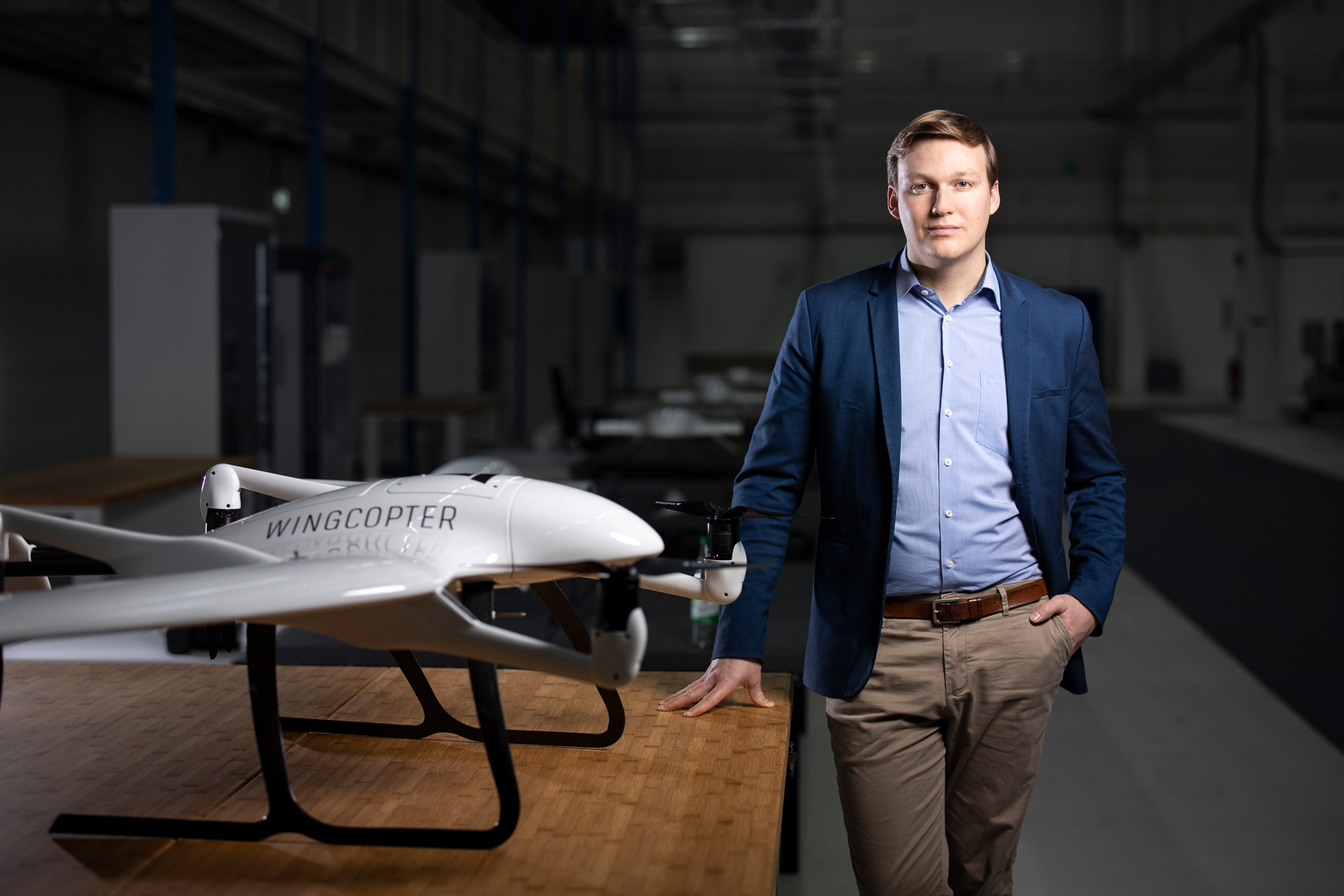
Wingcopter CEO and co-founder Tom Plümmer. Credit: Jonas Wresch

While Wingcopter has so far pursued a business as an OEM manufacturer of drones, and has had paying customers eager to purchase its hardware effectively since day one (Plümmer told me that they had at least one customer wiring them money before they even had a bank account set up for the business), but it’s also now getting into the business of offering drone delivery-as-a-service. After doing the hard work of building its technology from the ground up, and seeking out the necessary regulatory approvals to operate in multiple markets around the world, Plümmer says that he and his co-founders realized that operating a service business not only meant a new source of revenue, but also better-served the needs of many of its potential customers.

“We learned during this process, through applying for permission, receiving these permissions and working now in five continents in multiple countries, flying BVLOS, that actually operating drones is something we are now very good at,” he said. This was actually becoming a really good source of income, and ended up actually making up more than half of our revenue at some point. Also looking at scalability of the business model of being an OEM, it’s kind of […] linear.”

Linear growth with solid revenue and steady demand was fine for Wingcopter as a bootstrapped startup founded by university students supported by a small initial investment from family and friends. But Plümmer says the company say so much potential in the technology it had developed, and the emerging drone delivery market, that the exponential growth curve of its drone delivery-as-a-service model helped make traditional VC backing make sense. In the early days, Plümmer says Wingcopter had been approached by VCs, but at the time it didn’t make sense for what they were trying to do; that’s changed.

“We were really lucky to bootstrap over the last four years,” Plümmer said. “Basically, just by selling drones and creating revenue, we could employ our first 30 employees. But at some point, you realize you want to really plan with that revenue, so you want to have monthly revenues, which generally repeat like a software business – like software as a service.”

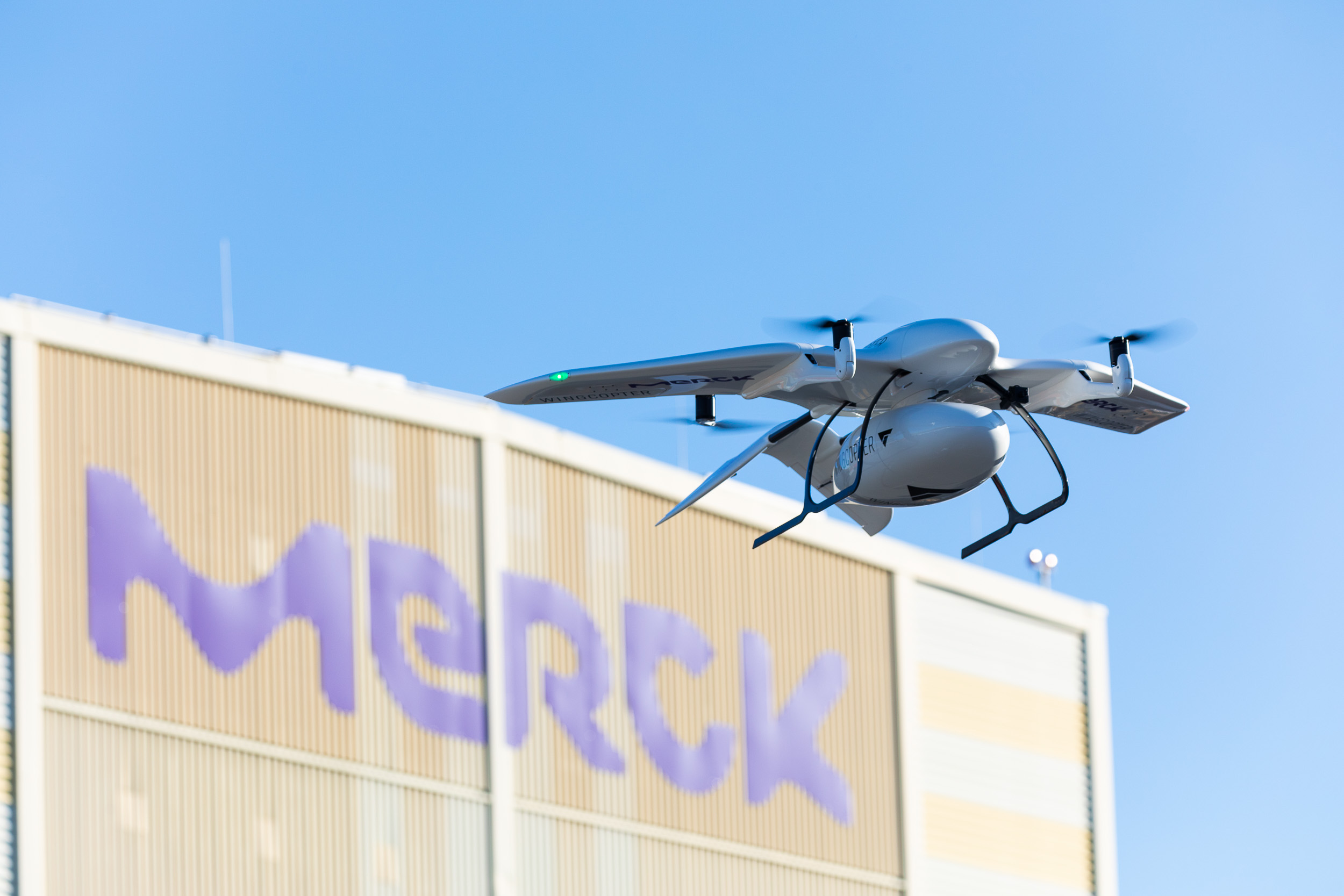
Wingcopter 178 cargo drone performing a delivery for Merck.

Wingcopter has also established a useful hedge regarding its service business, not only by being its own hardware supplier, but also by having worked closely with many global flight regulators on their regulatory process through the early days of commercial drone flights. They’re working with the FAA on its certification process now, for instance, with Plümmer saying that they participate in weekly calls with the regulator on its upcoming certification process for BVLOS drone operators. Understanding the regulatory environment, and even helping architect it, is a major selling point for partners who don’t want to have to build out that kind of expertise and regulatory team in-house.

Meanwhile, the company will continue to act as an OEM as well, selling not only its Wingcopter 178 heavy-lift model, which can fly up to 75 miles, at speeds of up to 100 mph, and that can carry payloads up to around 13 lbs. Because of its unique tilt-rotor mechanism, it’s not only more efficient in flight, but it can also fly in much windier conditions – and take-off and land in harsher conditions than most drones, too.

Plümmer tells me that Wingcopter doesn’t intend to rest on its laurels in the hardware department, either; it’s going to be introducing a new model of drone soon, with different capabilities that expand the company’s addressable market, both as an OEM and in its drones-as-a-service business.

With its U.S. expansion, Wingcopter will still look to focus specifically on the delivery market, but Plümmer points out that there’s no reason its unique technology couldn’t also work well to serve markets including observation and inspection, or to address needs in the communication space as well. The one market that Wingcopter doesn’t intend to pursue, however, is military and defense. While these are popular customers in the aerospace and drone industries, Plümmer says that Wingcopter has a mission “to create sustainable and efficient drone solutions for improving and saving lives,” and says the startup looks at every potential customer and ensures that it aligns with its vision – which defense customers do not.

While the company has just announced the close of its Series A round, Plümmer says they’re already in talks with some potential investors to join a Series B. It’s also going to be looking for U.S. based talent in embedded systems software and flight operations testing, to help with the testing process required its certification by the FAA.

Plümmer sees a long tail of value to be built from Wingcopter’s patented tilt-rotor design, with potential applications in a range of industries, and he says that Wingcopter won’t be looking around for any potential via M&A until it has fully realized that value. Meanwhile, the company is also starting to sow the seeds of its own potential future customers, with training programs in drone flights and operations it’s putting on in partnership with UNICEF’s African Drone and Data Academy. Wingcopter clearly envisions a bright future for drone delivery, and its work in focusing its efforts on building differentiating hardware, plus the role it’s playing in setting the regulatory agenda globally, could help position it at the center of that future.