Does SoftBank have 20 more DoorDashes?

Hello and welcome back to Equity, TechCrunch’s venture capital-focused podcast, where we unpack the numbers behind the headlines.

Natasha and Danny and Alex and Grace were all here to chat through the week’s biggest tech happenings. This week felt oddly comforting from a tech news perspective: Facebook is copying something, early-stage startup data is flawed enough to talk about and sweet DoorDash is buying robots for undisclosed sums.

So, here’s a rundown of the tech news we got into (as always, jokes aren’t previewed so you’ll have to listen to the actual show to get our critique and Award Winning Analysis*):

In good news, long-time Equity producer Chris Gates is back starting next week, which means we’ll have our biggest crew ever helping get the show put together. And, in other good news, there’s going to be more Equity than ever for you to hear. Coming soon.

Equity drops every Monday at 7:00 a.m. PST and Thursday afternoon as fast as we can get it out, so subscribe to us on Apple PodcastsOvercastSpotify and all the casts.

*OK, so not award-winning yet. But soon enough, because manifestation works.

Best practices for Zoom board meetings at early-stage startups

Issac Roth
Contributor

Issac Roth is a Managing Director at Shasta Ventures, and a seasoned entrepreneur who advises founders on open-source technology and keeping communities engaged. Over this career, he’s created and sold multiple enterprise software companies and stays active as an advisor and investor.

The world has spent most of 2020 adapting to ever-changing guidelines and restrictions (with no end in sight, even as the vaccines start to roll out). Board meetings are quickly increasing in their significance to foster consistent and vital interactions as an organization. It’s essential for companies to capitalize on the essential time together during these uncertain times.

While we might look like the Brady Bunch while sharing a Zoom window, are you actually communicating more like the family from “Succession?”

Are your meetings organized? Do people talk over one another? Do you usually run over time? Are you giving people time to digest information?

As we move into 2021 and Q1 meetings are being put onto calendars, take some time to modernize how you conduct your board meetings.

Board meetings are quickly increasing in their significance to foster consistent and vital interactions as an organization.

Having served on public company boards, growth-stage businesses and Series A startups, an observation I have made in boards that are later stage are more about financial analysis and governance. Whereas earlier-stage board discussions hinge more on product strategy, key partnerships, sharing best practices to help develop founders as executives and important hiring decisions.

Since the nature of the discussions is more, let’s call it … creative in earlier-stage businesses, where the focus is on where they’ve been particularly impacted by reduced bandwidth for collaboration while meeting remotely.

As said best by Mike Maples and paraphrased by Jeff Bonforte — there are only four things a board really needs to consider:

  • Has the market changed since we last met? If so, did it affect us negatively or positively?
  • Has the team changed? For better or worse?
  • Has our position in the market changed?
  • Can we do what we said we would?

Collecting data around those points is the job. In the meeting, the team can add color.

Remember the board works for you, so be sure to put them to work. Sharing materials with participants about three days ahead of time tends to be the best. Any later and they may not get enough time to digest, send earlier and the information might be out of date by the time you meet. It’s most common to format as a deck, but lately I’m seeing more written format and even magazine-style.

The number one request I get from early-stage companies is “help find me more customers.”

Other common requests are “help me find or land this type of talent, help me with industry benchmarks for this type of business deal or compensation structure, connect me to people that have experience with X so I can learn ways we could structure our process.” It’s helpful to put these asks in the materials you send ahead because sometimes board members might not be able to react quickly and now “homework” comes up spontaneously in the discussions.

Another purpose of these meetings is to build working relationships so when strategic decisions need to be made, board members are used to working together. Sometimes it is a forum for executives to gain exposure to board members and for board members to have the opportunity to evaluate and provide input on executives. For that reason execs are often invited to participate in certain discussions.

Like the product person who presents a roadmap or a market analysis, the head of sales should give color on pipeline and competitive deals, the marketing person may lead a discussion on ABM or channel marketing tactics, the engineering lead might ask for feedback on their metrics versus other companies, etc. Generally, CEOs also bring forth an interesting topic to have a discussion, such as channel strategy, market mapping/sizing, hiring plan and related issues.

Logistics

As far as logistics, we reserve two hours in calendars but we try to hit 90 minutes. I suggest something like this for a 90-minute session:

Twitter suspends over 500 accounts in India amid government warning

Twitter said on Wednesday it has taken actions on more than 500 accounts and reduced visibility of some hashtags in India in the past 10 days to comply with “several” orders from the Indian government after New Delhi threatened to take action against executives with American social network for not obeying its notices.

Twitter said since January 26, when protests from millions of farmers over agriculture reforms in India took a violent turn and misinformation started to spread on the platform, the company has suspended — in some cases, permanently — hundreds of accounts that violated its rules and prevented certain terms from appearing in the Trends section.

“Over the course of the last 10 days, Twitter has been served with several separate blocking orders by the Ministry of Electronics and Information Technology (MeitY), Government of India, under Section 69A of the Information Technology Act,” the company wrote in a blog post, in part to be transparent about the steps it has taken in the world’s second largest internet market.

“Out of these, two were emergency blocking orders that we temporarily complied with but subsequently restored access to the content in a manner that we believe was consistent with Indian law. After we communicated this to MeitY, we were served with a non-compliance notice,” it added.

The company said it has also withheld a portion of the accounts that New Delhi had ordered to be blocked, keeping them available outside of the country. It did not take any action on accounts that consist of news media entities, journalists, activists, and politicians, the company said. “To do so, we believe, would violate their fundamental right to free expression under Indian law. We informed MeitY of our enforcement actions today, February 10, 2021,” it said.

Several users in India had tweeted using the hashtag #modiplanningfarmersgenocide that were aimed at New Delhi’s agriculture reforms. The company said several accounts and hashtags violated the Twitter Rules, particularly inciting violence, abuse, wishes of harm, and threats that could trigger the risk of offline harm. A Twitter spokesperson told TechCrunch that hashtags that were merely supporting farmers have not been restricted.

India demanded Twitter to block hundreds of accounts earlier this month over concerns that many users were producing false, intimidatory and provocative tweets late last months.

Twitter had initially complied with the order, which resulted in blocking accounts of several high-profile names such as The Caravan (a news outlet that conducts investigative journalism), political commentator Sanjukta Basu, activist Hansraj Meena, actor Sushant Singh, and Shashi Shekhar Vempati, chief executive of state-run broadcasting agency Prasar Bharti. Accounts of at least two politicians with Aam Aadmi Party — Preeti Sharma Menon and Jarnail Singh — that governs the National Capital Territory of Delhi were also blocked.

However, hours later, Twitter lifted the block, citing users’ freedom of speech. The move prompted New Delhi to issue a more serious warning to Twitter and executives under the nation’s Section 69A, which allows “punishment with an imprisonment for a term which may extend to seven years and shall also be liable to fines.”

“We will continue to advocate for the right of free expression on behalf of the people we serve and are actively exploring options under Indian law — both for Twitter and for the accounts that have been impacted. We remain committed to safeguarding the health of the conversation occurring on Twitter, and strongly believe that the Tweets should flow,” the company said today.

This is a developing story. More to follow…

Dating juggernaut Match buys Seoul-based Hyperconnect for $1.73B, its biggest acquisition ever

In a large win for the Korean startup ecosystem, dating powerhouse Match Group announced this afternoon that it would buy social networking company Hyperconnect for a combined cash and stock deal valued at $1.73 billion.

Hyperconnect, which is projected to have $200 million in revenue in 2020 (up 50% from 2019) according to the company, offers two apps — Azar and Hakuna Live — which allow users to connect to each other across language barriers. The two are complementary, with Azar focused on one-to-one video chats and Hakuna Live focused on the online live broadcast market. In their press statement, the companies noted that 75% of Hyperconnect’s revenue originates in Asia.

It’s the largest acquisition to date by Match Group, which also owns the popular dating apps Tinder and Hinge along with many other assorted properties.

One theme of the acquisition and Hyperconnect’s story is technology. The company built what it describes as “the first mobile version” of WebRTC, a now well-developed standard that is designed to offer resilient peer-to-peer connections between users without relying on a company to serve as a middleman server.

For instance, a video chat between two participants would be transmitted directly between the two of them using WebRTC, without the video being broadcast through Hyperconnect’s servers. That’s designed to improve reliability by removing latency while also reducing the cost of bandwidth for the service to Hyperconnect. WebRTC is now a well-deployed open-source standard, with companies such as Google using it in products like Google Meet.

In addition to its innovative work on WebRTC, Hyperconnect built infrastructure to support two users who speak and text in different languages to interact with each other directly through its apps using real-time translation. In a marketing post on Google Cloud, Hyperconnect is a marquee customer of the cloud service’s speech, real-time translation and messaging APIs.

In the companies’ joint press statement, both sides emphasized R&D and engineering as key wins for the deal. That begs the question then what Match Group is looking to build with its massive new purchase? While the group has largely confined itself to dating, live broadcast and other media verticals may well be in its sights once it acquires the technology from Hyperconnect.

The deal is expected to close in 2021Q2.

Big data VC OpenOcean hits $111.5M for third fund, appoints Ekaterina Almasque to GP

OpenOcean, a European VC which has tended to specialise in big data-oriented startups and deep tech, has reach the €92 million ($111.5 million) mark for its third main venture fund, and is aiming for a final close of €130 million by mid-way this year. LPs in the new fund include the European Investment Fund (EIF), Tesi, pension funds, major family offices and Oxford University’s Corpus Christi College.

Ekaterina Almasque — who has already led investments in IQM (superconducting quantum machines) and Sunrise.io (multi-cloud hyper-converged infrastructure) and is leading the London team and operations for the firm — has been appointed as general partner. Before joining, Almasque was a managing director at Samsung Catalyst Fund in Europe, led investments in Graphcore’s processor for Artificial Intelligence, Mapillary’s layer for rapid mapping and AIMotive’s autonomous driving stack.

The enormous wealth of data in the modern world means the next generation of software is being built at the infrastructure. Thus, the fund said it would invest primarily at the Series A level with initial investments of €3 million to €5 million, across OpenOcean’s principle areas of artificial intelligence, application-driven data infrastructure, intelligent automation and open source.

OpenOcean’s team includes Michael “Monty” Widenius, the “spiritual father” of MariaDB, and one of the original developers of MySQL, the predecessor to MariaDB; Tom Henriksson, who invested in MySQL and MariaDB; as well as Ralf Wahlsten and Patrik Backman.

Tom Henriksson, general partner at OpenOcean, commented: “Ekaterina… brings an immense amount of expertise to the team and exemplifies the way we want to support our founders. Fund 2020 is an important step for OpenOcean, with prestigious LPs trusting our approach and our knowledge, and believing in our ability to identify the very best data solutions and infrastructure technologies in Europe.”

Almasque said: “The next five years will be critical for digital infrastructure, as breakthrough technologies are currently being constrained by the capabilities of the stack. Enabling this next level of infrastructure innovation is crucial to realising digitisation projects across the economy and will determine what the internet of the future looks like. We’re excited by the potential of world-leading businesses being built across Europe and are looking forward to supporting the next generation of software leaders.”

Speaking to TechCrunch she added: “It’s very rare to find such a VC so deep in the stack which also invested in one of the first unicorns in Europe and really built the open source ecosystem globally. So for me, this was absolutely an interesting team to join. And what OpenOcean was doing since inception in 2011 was very unique among pioneering ecosystems, such as big data analytics… and it remains very pioneering, pushing the frontiers in artificial intelligence and now quantum computing. This is what really attracts me, and I think there is a very, very big future.”

In an interview Henriksson told me: “What we are seeing is that our economy is shifting more and more towards the digital, data-driven economy. It started with few industries, but now we see a larger shift, including new industries like healthcare, like manufacturing.”

Asked about the effects of the pandemic on the sector, he said: “Obviously we see a lot of startups who are plugging into things like the UiPath platform. This is very relevant for the pandemic. Because the companies that had started automating strongly before the pandemic hit… they’ve actually accelerated and they find benefits for their teams and organisations and actually the people are happier because they have better automation technologies in place. The ones that didn’t start before [the pandemic hit] they’re a little behind now.”

NASA picks SpaceX Falcon Heavy for $332M mission to launch lunar Gateway components in 2024

NASA has announced that SpaceX will take two major parts of the Gateway lunar orbiter that will function as a pit stop for future moon missions. The Power and Propulsion Element and Habitation and Logistics Outpost — which together will form the first usable lunar space station — will go up in 2024 on a Falcon Heavy, with an estimated price tag of $332 million.

The Falcon Heavy, which provides a far larger lift capacity than SpaceX’s now commonly used Falcon 9, has only had two commercial launches since its successful test launch in early 2018 (with Starman and a Tesla Roadster, you may remember). Arabsat-6A launched in April of 2019, and STP-2 a few months later, but since then the Heavy hasn’t seen any action. (Several missions are planned for the next year, however.)

NASA’s selection of the launch vehicle as the one that will bring these two crucial components to lunar orbit is a huge endorsement, however, and may actually snowball into more work down the line if the agency’s own Space Launch System continues to be delayed.

The PPE and HALO, as the two pieces are called, provide the essentials for a self-sustaining lunar orbital habitat: essentially the pressurized cabin and the power source that keeps it operational and allows maneuvering. So you could say they’re fundamental.

They’re also big, and can’t be sent up in 10 different pieces on smaller rockets. But there are precious few heavy launch vehicles available — and it looks like they decided that SpaceX’s was the best bet, having flown three successful missions already.

This mission is valued at $332 million in launch and related costs, so it’s a serious investment that will require a lot of collaboration between SpaceX, NASA, Northrop Grumman (which is building the HALO) and Maxar (making the PPE).

CG image of the lunar Gateway with the propulsion element and first habitable element attached. Not particularly roomy, but you can’t beat the view. Image: NASA

For now launch is set for no earlier than may of 2024, but that date may (and in fact is highly likely to) slip as various delays accrue. The whole Artemis program is experiencing a period of reality alignment, and while new target dates haven’t been given for all the ambitious plans made during the last four years, few of the old ones have been repeated the way they were as recently as last fall. Nevertheless even a five or six-year plan to return to the moon’s surface is still quite ambitious, considering — as has become the standard NASA refrain — “we’re going there to stay.”

We’ll likely hear more about the new timeline as the agency comes to grips with it itself over the next few months.

Sharify makes it super simple to rediscover your city’s social side

The pandemic has upended many aspects of urban life but perhaps the most visible upheaval is to citydwellers’ social lives, with curfews calling time on traditional night life across much of the Western world and social distancing putting a chilly spin on opportunities for getting together with people outside your usual circle. Who knew leaving the house was going to seem like such a mission?

Opportunities to escape the city entirely — such as by jetting off somewhere — remain severely limited or even impossible right now, depending on where you live. And for many urbanites COVID-19 may feel as if it’s turned the advantages of city living on its head, despite lockdowns generally not being as hard-line as they were at times last year and vaccines now (slowly) being rolled out.

Sharify is a startup that reckons it can help with the weird flatness of pandemic city living. It’s a real-time events app (iOS and Android) that wants to bring back a little of the serendipitous joy of urban living by making it easier to discovery things going on around you — maybe even just a few blocks away. To do this it’s combined real-time event listings with a map view (via the medium of emoji-style icons plus filters) to quickly and cheerfully surround you with stuff that’s happening in the vicinity.

Though the business idea predates COVID-19, Sharify isn’t blind to the changes wrought by the pandemic. And the app displays a star icon next to events that are deemed COVID-19 ‘safe’ — a subtle promotion meaning the organizer has measures in place to reduce the risk of contagion, such as controlling venue capacity, providing disinfectant hand gel and ensuring tables/seating are safety spaced. (Which may well be legal requirements for a venue to be open for business, of course.)

At the same time, the app lets users share their own meeting plan with other users — potentially encouraging a bunch of strangers to meet up to play some music or hang out in the park or whatnot — so its appropriateness for the pandemic moment in which we find ourselves does depend on how you use it.

It’s open to social swings or roundabouts, you could say. (And limits on when/how clubs and bars can open may well be pushing a socially oriented and app-savvy demographic toward alternative ways (and tools) to mingle with strangers.)

More broadly, Sharify invites users to rethink the concept of travel and trips — asking them to refocus their attention and energy on discovering entertaining things to do without having to go far or plan far ahead. Because, well, what else can anyone really do right now? Apart from stay at home ofc.

The app does have two ‘view’ modes: One for events geared towards locals and/or a dedicated ‘tourist’ view to cater to those wanting to do more typical sightseeing — though content for the latter is obviously thinner on the ground at the moment. (And, well, ‘tourism’ as a concept is starting to feel rather quaint and old-fashioned vs properly exploring your own backyard.)

Officially Sharify is launched in Barcelona, Madrid and New York City — but says it’s “expanding quickly” and touts being “present” in 25+ cities around the world (presumably with a lighter events cadence vs those three).

I tested the app in Barcelona and quickly found a bunch of local events that looked interesting — at least compared to another night of thumbing through the Netflix catalogue — from a Banksy art exhibition, to a stand up comedy show (in English!), lots of theatre, a bunch of markets, yoga classes and a skateboarding event all going on within, at most, a couple of miles and days from where I’ve been spending the vast majority of my time for, like, almost a whole entire year.

Just the act of seeing stuff still going on in a city which, frankly, hasn’t felt very familiar or open for much of anything for close to 12 months was a bit of an eye opener.

After so much time locked down indoors maybe we all need a bit of a nudge/visual reminder that life is still going on — and socializing is still possible (with appropriate safety measures and distancing) — beyond the front door and away from the Zoom screen (or any other screen tbh). Even if I’m not about to sign up for everything I spotted in the app. But feeling like I could is almost exciting enough.

As well as providing key details about each event (when, where, any website etc), Sharify lets you signal an intent to go that’s visible to other users by ‘joining’ an event. It also hosts per event chat where those who have joined are invited to “talk to people who join the plan” — which is another neat little nudge to get users excited about going to a local thing, maybe without their usual friend group in tow.

Sharify isn’t disclosing how many users it has but it says it has 100,000+ monthly event views (3K+ daily), and 5,000+ events every month. (On Google Play the app has had 10,000+ installs.)

Where users create their own plans to advertise to others it touts an impressively high “join” rate of 95%. (Albeit saying you’re going to something you found via an app isn’t the same as actually turning up.)

To encourage users to discover and attend others’ events, Sharify displays a smilie face on the map in locations where several people are up for ‘sharing plans’ — listing the number of people theoretically up for joining in stuff around there and nudging you to ‘create a plan in this area’ to tap into that potential guest pool.

It also lets you drill down to check out micro profiles of these (public) socially interested locals — displaying a first name, perhaps a photo and any ‘interests’ if they’ve chosen to select some from its curated lists of culture, hobbies, sports and social activities etc. (Happily there’s no option to message individual users via their profile so no fear of stupid in-app spam.)

Location-based and social sharing is not new, of course. Indeed, it’s an idea that’s been around the tech block so many times the sound of a ‘real-time events map’ probably triggers a fuzzy feeling of ‘haven’t I seen this before somewhere?’ The deja vu may be real but context is ever shifting, is the point. Or, to put it another way, here and now, in an open-ended pandemic, going about finding something to do probably looks and feels quite a bit different to how you did it, pre-March 2020.

Put simply: Best laid plans are toast. Friends who don’t live in the same city are likely reachable only on Zoom or by text. And at very least you’re dealing with hard limits on how far you can range for your entertainment in time and space.

Local and/or virtual is the new global, all of a sudden. So Sharify reckons its real-time events map is just the ticket/tonic in this curtailed context — by cheerfully surrounding you with nearby stuff to do. The 2017-founded startup says it’s been growing “despite” the pandemic.

“We’re stuck at home, and we saw all the Netflix series. Is there any plan near my home for this afternoon? Event agendas simply don’t work in this user case. That’s why we built a real-time map,” says co-founder and CEO Gemma Prenafeta. “And the problem we will face in some months from now: I’m not stuck at home anymore. Where do I find new events easily?”

“As Sharify is a collaborative platform, we let people share their own events for free, we scrape different event sources such as Google and Tiqets, and we highlight those businesses that want to promote themselves,” she adds, giving a succinct explainer on how the app populates the map view with stuff to do.

Social maps aren’t new, of course — and features like Snap Map, which was added to Snap’s social network via its acquisition of Zenly, certainly has a bit of overlap (while Sharify’s smiley octopus logo on a yellow background has more than a little of Snap’s ghost in look and feel), though Snap Map is more obviously focused on friends’ location and social sharing vs Sharify being about event discovery, first and foremost. (Friends may follow from this real-life socializing, is the suggestion.)

There are also event discovery network startups (like calendar-focused IRL). But, again, with such a glance-friendly map view, Sharify is paying closer attention to immediacy/hyper-local event discovery vs IRL — which pivoted to helping people surface virtual events as the pandemic shuttered lots of real world events last year and has since focused on building out its own social network.

“The ‘immediacy’ factor is key at Sharify, as you can see what’s happening, in real-time,” says Prenafeta. “We say going to a local event is a kind of ‘Local Trip’. Traveling before was about taking flights, now it’s about taking a Bird or a eCooltra to an event nearby.”

Whether mapping real-time events is a standalone business or a feature/tool that could just be added to a dominant platform/social network is perhaps a more pressing question for this fledgling startup. And it’s notable that tech (and mapping) giant Google added a ‘Community Feed’ to Maps late last year.

Facebook has also had an ‘Events Near Me‘ feature on its platform for years. Albeit, anything listed inside its walled garden has to contend with all the baggage Facebook brings with it. So an indie app with a fresh approach should have a chance to attract users who wouldn’t be caught dead on Facebook (even in a pandemic).

Sharify has certainly come up with a really effortless way to spark a sense of possibility — to feel like you can cut through the monotony of lockdown life — just by firing up a super simple overview of stuff going on around you.

It then layers on some more powerful tools that are designed to help you find others to do stuff with, which adds a subtle but maybe deeper hook in these socially distanced times.

“Life is still pretty locked down, and that’s why it’s more important than ever to know what’s open and what isn’t, close to our house,” suggests Prenafeta. And, well, it’s pretty hard to argue with that.

She’s looking beyond the pandemic too — back to more normalcy and anticipating helping local businesses announce their reopenings, once that’s possible. The team is “currently working on a seed investment round to prepare for the post-pandemic momentum”, she says.

So far the Barcelona-based startup has raised a pre-seed and an angel round led by IESE Group, per Prenafeta — with a total of €501,000 (~$600k) invested to date into what has turned out to be a contextually fresh twist on the old SoMoLo trend.


Hyundai shrinks its ‘walking car’ robot to carry cargo, get rides from drones

Hyundai Motor Group is back with a new “walking car” robot that can use its wheels to roll along a path or stand up and navigate tougher terrain on its legs. This time, the concept is designed to carry cargo and is small enough to be carried by a drone.

The TIGER robot — short for transforming intelligent ground excursion robot — is the first “uncrewed” ultimate mobility vehicle (UMV) concept to come out of New Horizons Studio, the Mountain View, California facility that is home to Hyundai Motor Group’s UMV development. Tiger follows in the wheeled-footsteps of Elevate, a larger concept vehicle designed to carry people that the company unveiled in 2019 at the CES tech trade show.

Hyundai walking elevate robot

Image Credits: Screenshot/Hyundai

While concepts don’t always translate into real products, New Horizons Studio head John Suh told TechCrunch that his aim is to bring Tiger to life “as soon as possible,” adding that it would likely be a five-year process.

Suh said the team will spend the next two years focused on solving some core technical problems to establish a baseline design. In 2023 and 2024, the team will get to the beta-product stage and advanced testing will begin before finally becoming a product customers can buy.

Today’s version of the Tiger is based on a modular platform architecture, just like its larger cousin. The robot has a leg and wheel locomotion system, 360-degree directional control, a storage bay that can carry goods and a range of sensors for remote observation. It’s also designed to connect to a drone, which can charge the robot while flying it to its destination.

The Tiger has two modes that are deployed depending on the terrain. On smoother, less complex surfaces, the robot’s legs retract and the vehicle uses all four wheels to move. If the vehicle gets stuck or faces an obstacle like a small wall, berm or log, it can stand up, lock the wheels and then walk.

This is the first version of Tiger — known as X-1 for experimental — suggesting New Horizons will be bringing out more variants in the future. This one was created in partnership with engineering design software company Autodesk and concept design firm Sundberg-Ferar.

Researchers look to ‘worm blobs’ to improve robotic movement

What, you are no doubt asking, is a worm a blob? Well, it’s a blob of worms, obviously. More specifically, it’s a blob of California blackworms. It’s not a flock, nor a swam nor a school. It’s a big, undulating mass of a Lumbriculus variegatus tangled up, but somehow moving as one.

Roboticists, of course, have a long, storied history of drawing inspiration from nature. This time out, a team at Georgia Tech studied the aforementioned worm blob in hopes of learning gaining insight into its unusual form of locomotion. The researchers believe they can apply some of the learnings to rethink the way robots move.

The team published its findings in an academic journal earlier this month. According to the research, the blobs — which range from 10 to 50,000 individual organisms — are a kind of survival mechanism to adapt to things like changing temperatures. A few individuals are capable of moving the larger group, with around two or three being required to move a group of five.

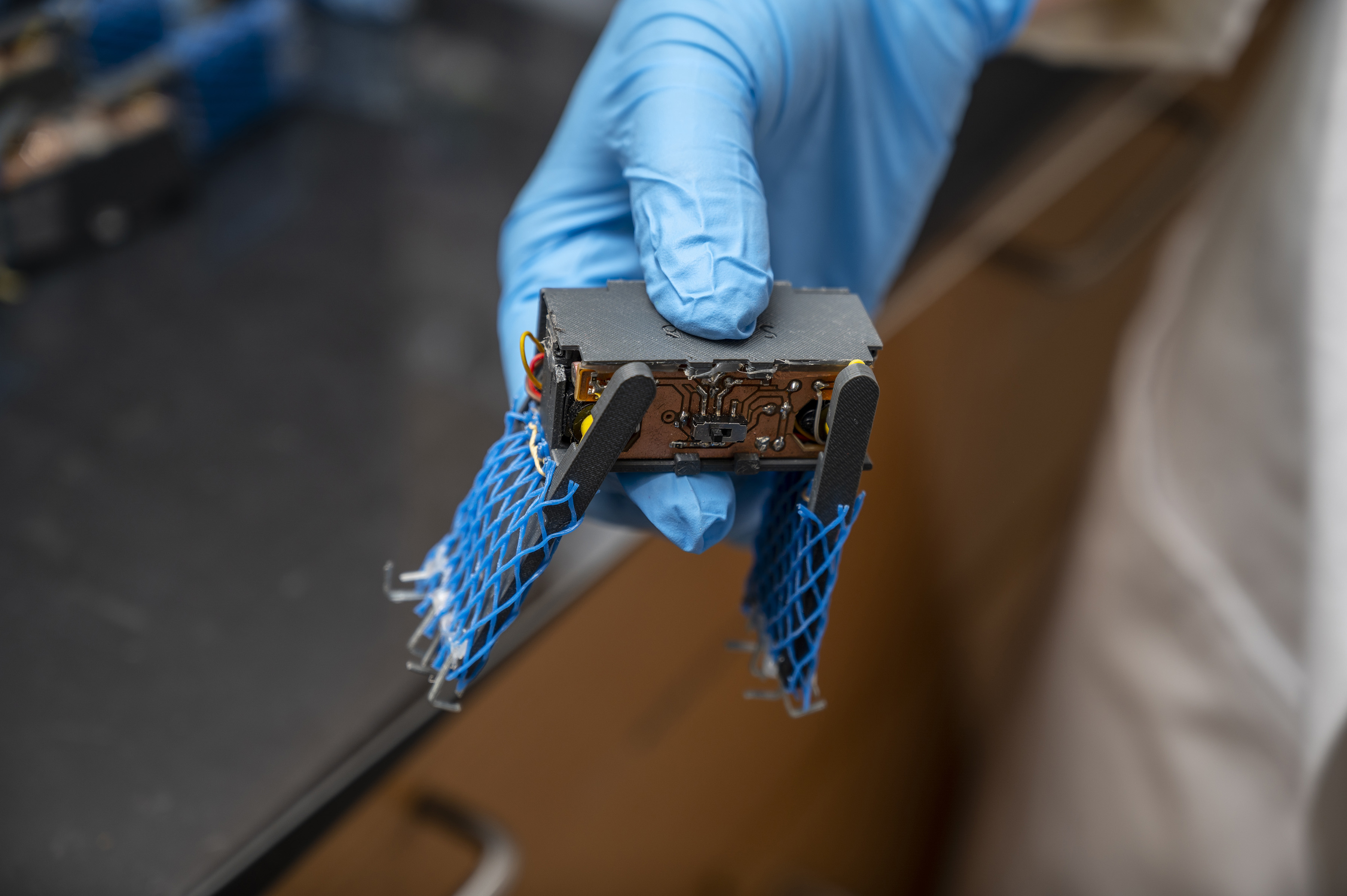
The researchers set up a series of six 3D-printed robots with two arms and two light sensors a piece. Mesh and pins on the arms allowed the robots to become entangled with one another.

“Depending on the intensity, the robots try to move away from the light,” researcher Yasemin Ozkan-Aydin said in a release tied to the news. While there was no direct communication between the robots, they effectively operated as a group. “They generate emergent behavior that is similar to what we saw in the worms.”

Image Credits: Georgia Tech

The scientists think that sort of collective action can be applied to make individual robots more collaborative and cohesive units. “Often people want to make robot swarms do specific things, but they tend to be operating in pristine environments with simple situations,” Professor Daniel Goldman says of the research. “With these blobs, the whole point is that they work only because of physical interaction among the individuals. That’s an interesting factor to bring into robotics.”

Daily Crunch: Reddit raises $250M

Reddit raises more funding, Shopify expands payments to Facebook and a study suggests that the Apple Watch might be able to predict COVID diagnoses. This is your Daily Crunch for February 9, 2021.

The big story: Reddit raises $250M

This latest funding announcement comes after Reddit has returned to the headlines, with the WallStreetBets subreddit playing a crucial role in the spectacular rise and fall of GameStop shares (along with other stocks). The company also ran a five-second Super Bowl ad on Sunday, consisting of a single static image.

Reddit announced the round in a blog post that said the money comes from “existing and new investors” and will allow the company to “make strategic investments in Reddit including video, advertising, consumer products and expanding into international markets.”

The tech giants

Shopify expands its payment option, Shop Pay, to its merchants on Facebook and Instagram — This is the first time Shop Pay will be made available outside of Shopify’s own platform.

CD Projekt hit by ransomware attack, refuses to pay ransom — “We have already secured our IT infrastructure and begun restoring data,” the game company said.

Spotify confirms it’s (finally) testing a live lyrics feature in the US — Though the streaming music service today offers live lyrics in a number of markets, it has not done so in the U.S. for many years.

Startups, funding and venture capital

Swarm’s low-cost satellite data network is now available to commercial clients — One of the original startups that set out to create a low-Earth orbit satellite constellation to provide a data network here on Earth is now open for business.

Mighty Buildings nabs $40M Series B to 3D print your next house — The startup says it can 3D print a 350-square-foot studio apartment in just 24 hours.

Seed firm Eniac Ventures raises $125M for its fifth fund — The size of Eniac’s funds has grown dramatically over the past decade, from its $1.6 million first fund in 2010 to its $100 million fourth fund in 2017.

Advice and analysis from Extra Crunch

Decrypted: A hacker attempted to poison Florida town’s water supply — Oldsmar is a small town in Florida that became the center of the cyber world this week.

Are SAFEs obscuring today’s seed volume? — SAFEs are a quick and cheap method for raising capital.

(Extra Crunch is our membership program, which helps founders and startup teams get ahead. You can sign up here.)

Everything else

Announcing the agenda for TC Sessions: Justice — Our second-ever dedicated event to diversity, equity, inclusion and labor in tech is coming up on March 3.

Mount Sinai study finds Apple Watch can predict COVID-19 diagnosis up to a week before testing — The investigation, dubbed the “Warrior Watch Study,” used a dedicated Apple Watch and iPhone app and included participants from Mount Sinai staff.

The Daily Crunch is TechCrunch’s roundup of our biggest and most important stories. If you’d like to get this delivered to your inbox every day at around 3pm Pacific, you can subscribe here.

Is overseeing cloud operations the new career path to CEO?

When Amazon announced last week that founder and CEO Jeff Bezos planned to step back from overseeing operations and shift into an executive chairman role, it also revealed that AWS CEO Andy Jassy, head of the company’s profitable cloud division, would replace him.

As Bessemer partner Byron Deeter pointed out on Twitter, Jassy’s promotion was similar to Satya Nadella’s ascent at Microsoft: in 2014, he moved from executive VP in charge of Azure to the chief exec’s office. Similarly, Arvind Krishna, who was promoted to replace Ginni Rometti as IBM CEO last year, also was formerly head of the company’s cloud business.

Could Nadella’s successful rise serve as a blueprint for Amazon as it makes a similar transition? While there are major differences in the missions of these companies, it’s inevitable that we will compare these two executives based on their former jobs. It’s true that they have an awful lot in common, but there are some stark differences, too.

Replacing a legend

For starters, Jassy is taking over for someone who founded one of the world’s biggest corporations. Nadella replaced Steve Ballmer, who had taken over for the company’s face, Bill Gates. Holger Mueller, an analyst at Constellation Research, says this notable difference could have a huge impact for Jassy with his founder boss still looking over his shoulder.

“There’s a lot of similarity in the two situations, but Satya was a little removed from the founder Gates. Bezos will always hover and be there, whereas Gates (and Ballmer) had retired for good. [ … ] It was clear [they] would not be coming back. [ … ] For Jassy, the owner could [conceivably] come back anytime,” Mueller said.

But Andrew Bartels, an analyst at Forrester Research, says it’s not a coincidence that both leaders were plucked from the cloud divisions of their respective companies, even if it was seven years apart.

“In both cases, these hyperscale business units of Microsoft and Amazon were the fastest-growing and best-performing units of the companies. [ … ] In both cases, cloud infrastructure was seen as a platform on top of which and around which other cloud offerings could be developed,” Bartels said. The companies both believe that the leaders of these two growth engines were best suited to lead the company into the future.

Mate Fertility is aiming to create a franchise of fertility clinics open to everyone

Mate Fertility, the new Los Angeles startup launching today with $2.8 million in financing, has a mission to create a more inclusive network of family planning services for people struggling with the high cost and low availability of fertility clinics around the country.

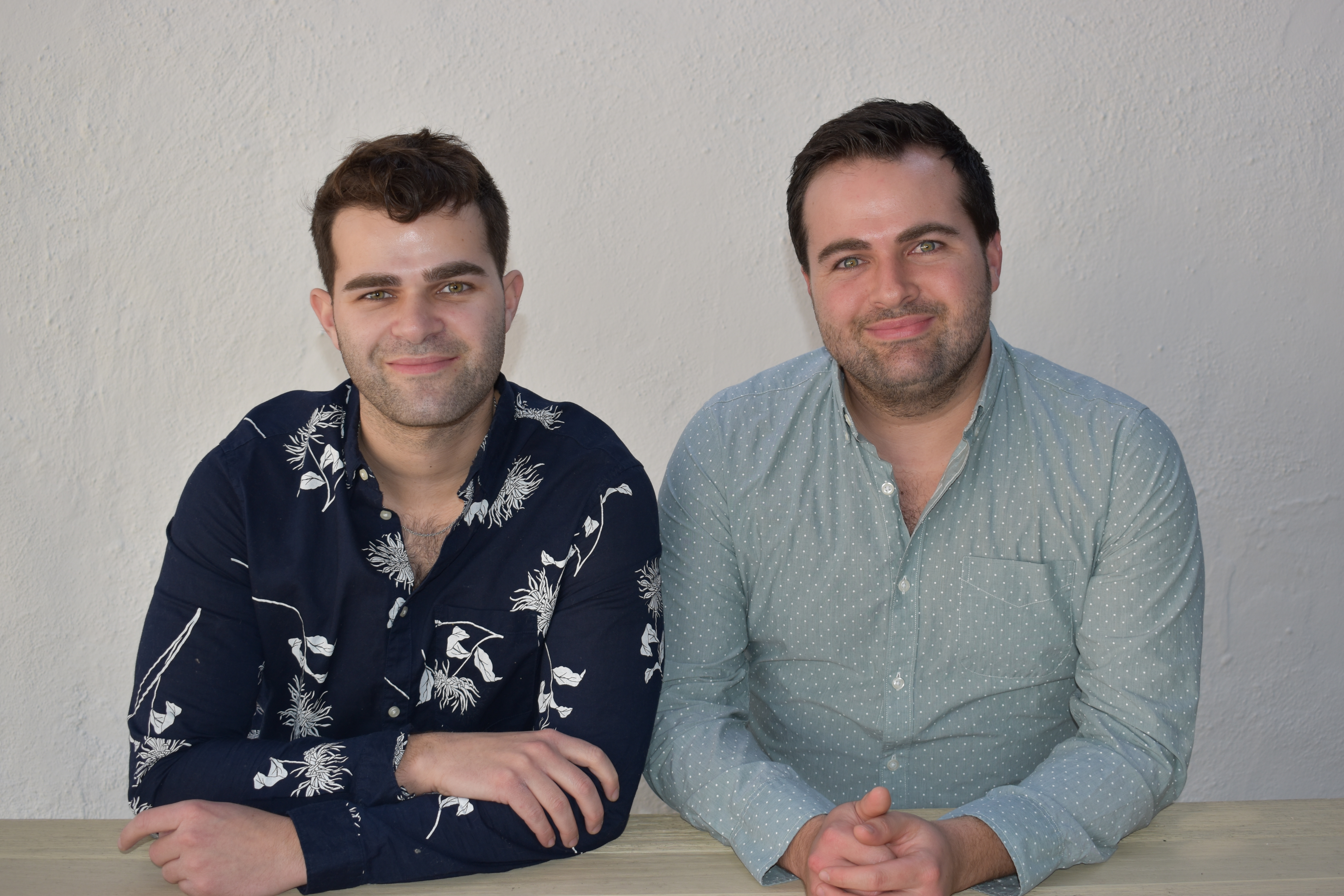
Founded by serial entrepreneur Oliver Bogner and his brother Gabriel, Mate was born from both brothers’ struggles with trying to start a family. For Oliver, that was when he and his partner were looking at IVF as a way to screen for the BRCA1 gene from her embryos after she found out that she was a carrier. Meanwhile, Gabriel, an IVF baby who is a member of the LGBTQ community, felt that the services for family planning weren’t always accepting of the gay community.

“IVF and surrogacy were the only options for me to have kids,” the younger Bogner said. “And the queer community has been locked out of these services. It became my mission to democratize healthcare for my community.”

Once Oliver started doing research into the market and discovered that there were only 460 fertility clinics in the U.S. and that over 80% were concentrated in five major metropolitan areas, he knew there was an opportunity for a new business.

Mate Fertility co-founders Gabriel and Oliver Bogner. Image Credit: Mate Fertility

The Bogner brothers enlisted famed reproductive endocrinologist Dr. Jeffrey Steinberg, who trained under the British doctors that pioneered In Vitro Fertilization, to come on board and together the three men launched Mate Fertility.

The co-founders have enlisted an impressive array of financiers to back their business, boasting an investor base that includes Andy Dunn, the founder of Bonobos; Peter Pham, the co-founder of the LA-based consumer-focused company incubator, Science; Patrick Schwarzenegger; Brian Schwartz; the investors behind Roman, Allbirds and Caspar, Rosecliff Ventures; Pure Imagination Brands; Mana Ventures; and Maschmeyer Group Ventures.

Mate is launching first in Oklahoma City, where two legacy providers are charging anywhere from 10% to 15% above the national average for family planning services. “We’re going in at anywhere from 50% to 60% lower costs than they are,” said Oliver Bogner.

The company said it would offer egg freezing services for as low as $5,000 and IVF for $9,400*, while the national average for IVF cycle costs ranges from $15,000 to $18,000, including medication.

“We’re still making healthy margins that allow us to operate the business. It’s not a matter of these procedures costing more. These 460 clinics are allowed to radically mark up the process,” said the elder Bogner. “One of these clinics is making approximately 1,000% profit margin on every procedure.”

Given the fact that the company estimates roughly 18% of the U.S. population will face some fertility issue, the need for more clinics — setting aside the lower costs — would be enormous.

We need 3,000 clinics to properly serve our population; today we have 460. There’s a huge gap in care,” said Bogner. 

The company is working with the architects behind Dry Bar, Heitler Houstoun, to design its clinics in an effort to popularize and destigmatize the services.

“We were really intrigued by Oliver and Gabe. In terms of what the biggest risks are… you’re not playing around. You’re not creating software, you’re creating life,” said Adam Struck, the founder of Mate Fertility’s lead investment firm, Struck Capital. “The ultimate KPI which is success rate for our patients is top tier. There’s a lot that Mate is doing to ensure that some of the best medical personnel in the world are part of the Mate mission.” 

Mate Fertility offers modern EHR platforms, an e-pharmacy, proven protocols, payment assistance and digital patient and provider portals for services that include IVF, genetic screening, egg freezing, surrogacy and LGBTQ family building treatments, the company said.

Its first locations will be clinics in Oklahoma City, Anchorage, Alaska; Bakersfield, California; Lancaster, Pennsylvania; Austin, Texas; and Portland, Oregon.

*An earlier version of this story cited the company’s IVF price as $8,000.

ClubLink offers a better Clubhouse link for sharing on social media

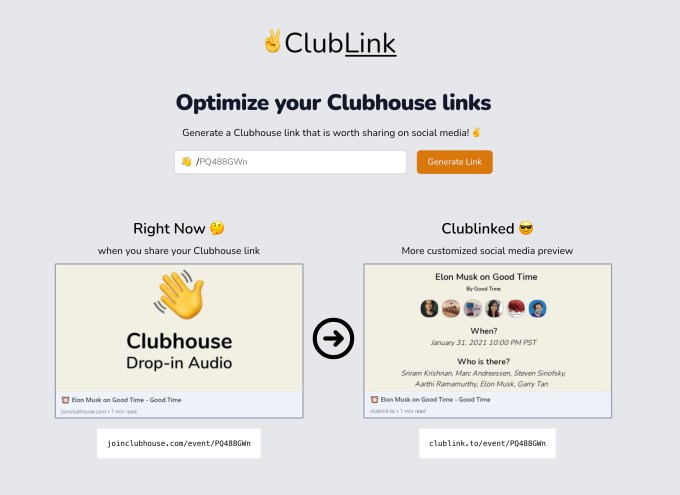
Although the popular audio chat platform Clubhouse today includes a way to share your upcoming hangouts and events across social media, the resulting link that displays is fairly boring. A new link-sharing tool called ClubLink can help. The tool allows hosts to better promote their events by offering a more customized social media preview featuring a photo that includes the room name, who’s attending, the date and time (using the host’s time zone) and even profile icons of the hosts themselves.

The tool was built by two Germany-based colleagues, online marketer Jens Polomski and coder and digital marketer, Peter Thaleikis.

Polomski says he came up with the idea last month because he kept seeing Clubhouse links shared on Twitter and thought they just didn’t look that good.

“I noticed many people share — especially on Twitter — because Clubhouse has this built-in sharing feature,” he says. “But the preview image is not well-optimized and lacks any relevant information.”

Polomski reached out to Thaleikis and convinced him to help build a better version.

Their resulting ClubLink tool is simple to use. You just paste in your Clubhouse event link on the ClubLink website, and it automatically generates the ClubLink you can use. It’s a similar process as to how URL shorteners like tinyurl.com work, for example.

Image Credits: ClubLink

In ClubLink’s case, though, it’s doing a bit more than just returning a shorter URL. The tool visits the Clubhouse link provided and takes a screenshot to help create the image — but it’s not scraping data from Clubhouse, Polomski says. The tool also renames the image file it creates to include the host’s name for better discoverability and, perhaps, for better search engine optimization in the future.

In fact, the SEO aspects of the ClubLink URLs were considered when the tool was built, given its creators have digital marketing backgrounds.

“We’re taking care that the technical SEO background from the links are as good as possible — and that’s something Clubhouse, right now, didn’t do,” notes Polomski. However, he notes that it’s too soon to tell how well those efforts have paid off, as the first ClubLink URLs were just launched last week and only a few have been indexed by Google so far.

After you’ve created the link on the ClubLink website, you’re directed to a page where you have the option to immediately share it out to Twitter, Facebook and LinkedIn.

Being able to publicize your rooms in advance is a important way to build a following on the audio-based social network, so likely many hosts will begin to put this new tool to use in the days ahead.

Here’s one example of a ClubLink in action:

? THIS FRIDAY ON CLUBHOUSE…
? Geekout Weekly
? Join me + friends to discuss ALL the week's biggest social media news, updates, and platform features
? More info: https://t.co/82nkYItqAk

— Matt Navarra (@MattNavarra) February 9, 2021

Of course, sharing a link while you’re in a room is useful too — especially if you’ve landed in a great room you think others should know about. Clubhouse, in its most recent update, noted that you’re now able to click the “+” sign while in a room to get a link that you can post to social media. Unfortunately, these “room” links don’t work yet in the ClubLink tool, but the team said they’re already discussing a solution for that.

ClubLink is one of now several small tools that’s popped up in recent days to offer expanded functionality and new features for Clubhouse power users.

We’ve also come across the Clubhouse Bio Creator at clubhousebio.xyz, which helps people perfect their profile bio on the desktop, then copy it over to Clubhouse on their phone. Other popular tools help users make their profile picture stand out, like Clubhouse Glow, Clubhouse Avatar Maker and Thriveepic‘s Canva template.

Sentropy launches tool for people to protect themselves from social media abuse, starting with Twitter

Last year, in the midst of a particularly spiky U.S. presidential election campaign, a startup called Sentropy emerged from stealth with an AI-based platform aimed at social media and other companies that corralled people together for online conversation.

Sentropy had built a set of algorithms, using natural language processing and machine learning, to help these platforms detect when abusive language, harassing tendencies and other harmful content was coming around the bend, and to act on those situations before they became an issue.

Today, the startup is unveiling a new product, now aimed at consumers.

Using the same technology that it originally built for its enterprise platform, Sentropy Protect is a free consumer product that detects harmful content on a person’s social media feed and, by way of a dashboard, lets a person have better control over how that content and the people producing it are handled.

Starting initially with Twitter, the plan is to add more social feeds over time, based initially on which services provide APIs to let Sentropy integrate with them (not all do.)

Sentropy CEO John Redgrave said the consumer product launch is not a pivot but an expansion of what the company is building.

The idea is that Sentropy will continue to work with enterprise customers — its two products in that department are called Sentropy Detect, which provides API-based access to its abuse detection technologies; and Sentropy Defend, a browser-based interface that enables end-to-end moderation workflows for moderators.

But at the same time, the Protect consumer product will give people an added option — whether or not Sentropy is being used by a particular platform — to take the reins and have more hands-on control over their harassment graph, as it were.

“We always had deep conviction of going after the enterprise as a start, but Sentropy is about more than that,” he said. “Cyber safety has to have both enterprise and consumer components.”

It’s refreshing to hear about startups building services that potentially affect millions of people also being cognizant of how individuals themselves want to keep an element of self-determination in the equation.

It’s not just, “Well, it’s your choice if you use service X or not,” but a grasp of the concept that when someone chooses to use a service, especially a popular one, there should be and can be more than just a hope that the platform will always be looking out for that user’s best interests, by providing tools to help the user do that, too.

And it’s not a problem that is going away, and that goes not just for the hottest platforms today, which are continuing to look for ways to handle complex content — but also on emerging platforms.

The recent popularity of Clubhouse, for example, highlights not just new frontiers in social platforms, but how, for example, those new models — with Clubhouse based on “rooms” for conversations and a reliance on audio rather than written text for interactions — are handling issues of harassment and abuse. Some striking examples so far point to the problem being one that definitely needs addressing before it grows any bigger.

Protect is free to use today, and Redgrave said that Sentropy is still working on deciding how and if it will charge for it. One likely scenario will be that Protect might come in freemium tiers: a free and limited product for individuals with “pro” services featuring enhanced tools, and perhaps a tier for companies who are managing accounts on behalf of one or several high-profile individuals.

Of course, services like Twitter, Reddit, Facebook, YouTube and many others have made a big point over the years — and especially recently — to put in more rules, moderators and automated algorithms to help identify and stop abusive content in its tracks, and to help users report and stop content before it gets to them.

But if you are one of the people who gets targeted regularly, or even occasionally, you know that this is often not enough. Sentropy Protect seems to be built with that mindset in mind, too.

Indeed, Redgrave said that even though the company had consumers on its roadmap all along, its strategy was accelerated after the launch of its enterprise product last year in June. 

“We started getting pinged by people saying, ‘I get abused online. How can I get access to your technology?’” He recalled that the company realized that the problem was at once bigger and more granular than Sentropy could fix simply by working its way through a list of companies, hoping to win them over as customers, and then successfully integrating its product.

“We had a hard decision to make then,” he recalled. “Do we spend 100% of our time focused on enterprises, or do we take a portion of our team and start to build out something for consumers, too?” It decided to take the latter route.

On the enterprise side, Sentropy is continuing to work with social networks and other kinds of companies that host interactions between people — for example, message boards connected to gaming experiences or dating apps. It’s not publicly disclosing any customer names at the moment, but Redgrave describes them as primarily smaller, fast-growing businesses, as opposed to larger and more legacy platforms.

Sentropy’s VP of product, Dev Bala — who has previously been an academic, and also worked at Facebook, Google and Microsoft — explained that bigger, legacy platforms are not outside of Sentropy’s remit. But more often than not, they are working on bigger trust and safety strategies and have small armies of engineers in-house working on building products.

While larger social networks do bring in third-party technology for certain aspects of their services, those deals will typically take longer to close, even in urgent cases such as around working with online abuse.

“I think abuse and harassment are rapidly evolving to be an existential challenge for the likes of Facebook, Reddit, YouTube and the rest,” Bala said. “These companies will have a 10,000 person organization thinking just about trust and safety, and the world is seeing the ills of not doing that. What’s not as obvious to people on the outside is that they are also taking a portfolio approach, with armies of moderators and a portfolio of technology. Not all is built in-house.

“We believe there is value from Sentropy for these bigger guys but also know there are a lot of optics around companies using products like ours. So we see the opportunities of going earlier, in cases where the company in question is not a Facebook, and having a less sophisticated approach.”

As a sign of the changing tides and sentiment in the market. It seems that the tackling of abuse and content is starting to get taken seriously as a business concept. And so Sentropy is not the only company tackling this opportunity.

Two other startups — one called Spectrum Labs, and another called L1ght — have also built a set of AI-based tools aimed at various platforms where conversations are happening to help those platforms detect and better moderate instances of toxicity, harassment and abuse.

Another, Block Party, is also looking to work across different social platforms to give users more control over how toxicity touches them, and has, like Sentropy, focused first on Twitter.

With Protect, after content is detected and flagged, users can set up wider, permanent blocks against specific users (who can also be muted through Protect) or themes, manage filtered words, and monitor content that gets automatically flagged for being potentially abusive, in case you want to override the flags and create “trusted” users. Tweets get labelled when they are snagged by Sentropy by the type of abuse (for example, threat of physical violence, sexual aggression or identity attacks).

Since it’s based on a machine-learning platform, Sentropy then takes all of those signals, including the tweets that have been flagged and uses them to teach Protect to identify future content along those same lines. The platform is also monitoring chatter on other platforms all the time, and that too feeds into what it looks for and moderates.

If you’re familiar with Twitter’s own abuse protection, you’ll know that all this takes the situation several steps further than the controls Twitter itself provides.

This is still a version one though. Right now, you don’t see your full timeline through Protect, so essentially it means that you toggle between Protect and whatever Twitter client you are using. Some might find that onerous, although on the other hand Bala noted that a sign of Sentropy’s success is that people will actually let it work in the background and you won’t feel the need to constantly check in.

Redgrave also noted that the service is still exploring how to add in other features, such as the ability to also filter direct messages.

Audi’s new 2022 e-tron GT is a real electric performance sedan, not just another electrified crossover

Audi revealed Tuesday the 2022 e-tron Quattro GT and its higher-performing sibling the RS e-tron GT — flagships of the German automaker’s growing electric vehicle portfolio and its first departure from the crossovers and SUVs that have so far dominated the lineup.

The Audi e-tron GT and RS are the third and fourth all-electric vehicles in the company’s U.S. portfolio, following the 2018 e-tron SUV and e-tron Sportback that debuted in 2019. The Audi Q4 e-tron — another SUV — will be the automaker’s fifth electric vehicle. All of these e-tron models are part of Audi’s plan to launch more than 30 electric vehicles and plug-in hybrids by 2025.

“This car is a new, very progressive interpretation of the classical GT,” Marc Lichte, head of Audi design, said in Tuesday’s presentation. “That means proportions like a super sports car, and the usability of a real four-seater. And that’s something completely new.”

audi gt

Image Credits: Audi

The e-tron GT, which goes into production this spring and will hit the U.S. market this summer, packs in performance and luxury in its sporty package. The base e-tron GT has two motors that produce the equivalent of 469 horsepower — or 522 hp with “overboost” — and can travel an estimated 238 miles on the 93.4-kilowatt battery. Under the European WLTP standard, the e-tron GT range is 298 miles.

The RS e-tron has the same front motor as the entry-level GT, but has a more powerful rear motor. Together, the motors can produce 590 horsepower and up to 637 horsepower with overboost. As a result, the RS e-tron GT can accelerate from zero to 60 miles per hour in 3.1 seconds and has a 155 mph top track speed, the company said. The RS has an estimated EPA range of 232 miles.

The company has yet to receive an official EPA estimate for either variant.

The vehicles also have an 800-volt electrical architecture — the same that is in the Porsche Taycan. That architecture allows the e-tron GT, like the Taycan, to replenish its battery from 5% to 80% in 22.5 minutes, one of the quickest charging rates in the industry. 

The e-tron GT shares more than just the 800-volt electrical architecture with Porsche. Audi and Porsche, which are both VW Group companies, co-developed the e-tron GT and the Taycan. The two vehicles also have the same chassis and J1 EV battery platform. 

Inside, the e-tron GT comes standard with a 12.3-inch Audi virtual cockpit digital instrument cluster and a central 10.1-inch touchscreen, where drivers can control music, navigation and other controls as well as electric vehicle-specific features such as searching for charging stations. Owners can opt for an upgrade and add a head-up display as well.

audi etron gt

Image Credits: Audi

The vehicle also comes standard in a leather-free interior featuring recycled materials, including an artificial suede called Dinamica, although a Nappa leather option is also available as an upgrade.

All of this performance and luxury comes at a price. The base model of the e-tron GT quattro starts at $99,900, followed by a higher trim level priced at $107,100. The RS e-tron GT starts at $139,900. Those prices push even higher for those that opt for the additional features, notably the company’s Matrix LED headlights, which are only available in Europe.