Wyndly aims to bring allergy drops to the masses

Chronic allergy sufferers know well the daily discomfort of seasonal allergies and environmental allergies. They also likely know about allergy shots — the treatment that requires you to go into an office to get shots on a weekly or monthly basis. But there is a lesser-known treatment, allergy drops, that requires a bit less effort. Wyndly, a startup participating in Y Combinator’s current batch, aims to make allergy drops more accessible to people.

Before the pandemic, Dr. Manan Shah, an otolaryngologist (an ear, nose, throat doctor), would have his patients come in for an evaluation and then prescribe them personalized allergy drops to train their immune system to fight off allergy triggers.  When the COVID-19 pandemic hit, Shah, began treating his patients suffering from allergies via telemedicine. That went well so Dr. Shah and his cousin, Aakash Shah, took their idea to Y Combinator. They showed their idea was working well in Denver, Colorado but wanted help taking it nationwide.

Through Wyndly, Dr. Shah can conduct both allergy testing and treatment via telemedicine. Unlike allergy shots, allergy drops can be taken at home. Wyndly aims to treat environmental allergies, like cats, dogs, dust mites, mold, pollen, trees, grasses and weeds.

“Most people don’t realize there is this other option,” Dr. Shah said. “I think most people think the only option for allergies are shots or taking antihistamines every day. we educate people there is this wonderful therapy and we can make it available to you in the most convenient way.”

Wyndly works by first evaluating a patient’s allergies. Patients can either submit a recent allergy test to Wyndly, or take Wyndly’s at-home finger prick test. Next, Wyndly prepares personalized allergy drops for the patient and sends a vial to the patient’s home. Then, at some point during the day, patients take five drops under the tongue. Dr. Shah said most patients see a decrease in their symptoms after taking these drops daily for six months.

Wyndly costs $99 per month for allergy drop treatment, which could come out to around $594 in total, if a patient takes them for six months. If you become a patient, the allergy test costs $0 but if you don’t become a patient, the test costs $200.

While allergy drops are easy to take, there’s a caveat. Insurance companies typically do not cover the cost of the treatment, while they generally do for allergy shots. But Wyndly says it aims to be the same cost as what someone would pay for insurance-covered allergy shots plus co-pays.

It’s also worth noting that these allergy drops are not approved by the Food and Drug Administration. While they are made using the same medications that are FDA-approved for allergy shots, the compounded medication is not itself approved and regulated by the FDA, Dr. Shah said.

Down the road, Wyndly may look to treat food allergies but Shah says there’s not enough data about its safety.

“I just want to see a little more research and for the field to reach a consensus on safety,” Shah said. “We hope to do food in the future if it ends up being proven to be really effective.”

Wyndly is has been in Y Combinator for a little over a month now and has been slowly expanding its offerings. Through partnerships with physicians, Wyndly is able to offer its services in 38 states throughout the country. By the end of 2022, Wyndly hopes to be in all 50 states.

Felicis’ Aydin Senkut and Guideline’s Kevin Busque on the value of simple pitch decks

Even though Kevin Busque is a co-founder of TaskRabbit, he didn’t get the response he was hoping for the first time he pitched his new venture to Felicis Ventures’ Aydin Senkut. Nonetheless, he said the outcome was one of the best things that could have happened.

“I’m kind of glad that he didn’t invest at the time because it really forced me to take a hard look at what we were doing and really enabled us to become Guideline,” said Busque. “That seed round was an absolute slog. I think I spent seven or eight months trying to raise a round for a product that didn’t exist, going purely on vision.”

Eventually, that idea evolved into Guideline, which describes itself as “a full-service, full-stack 401(k) plan” for small businesses. Eventually, Senkut did write a check — Felicis led Guideline’s $15 million Series B round. Today, Guideline has more than 16,000 businesses across 60+ cities, with more than $3.2 billion in assets under management. The company has raised nearly $140 million.

This week on Extra Crunch Live, Busque and Senkut discussed Guideline’s Series B pitch deck — which Senkut described as a “role model” — and how they built trust over time.

The duo also offered candid, actionable feedback on pitch decks that were submitted by Extra Crunch Live audience members. (By the way, you can submit your pitch deck to be featured on a future episode using this link right here.)

We’ve included highlights below as well as the full video of our conversation.

We record new episodes of Extra Crunch Live each Wednesday at 12 p.m. PST/3 p.m. EST/8 p.m. GMT. Check out the February schedule here.

Episode breakdown:

  • How they met: 1:30
  • Building trust: 11:30
  • Inside Guideline’s Series B deck: 16:00
  • Pitch deck teardown: 33:00

How they met

Senkut and Busque met nearly a decade ago, when Busque was still at TaskRabbit. Several years later, Busque launched out on his own and went fundraising for his original idea. Even though he got a no from Senkut, it wasn’t an easy decision.

Looking back, Senkut said he had much more freedom to follow his instincts while angel investing.

“As an institutional fund with LPs, we were feeling the pressure of checking all the checkmarks,” explained Senkut. “It’s amazing how, sometimes, being more structured or analytical actually does not always lead you to make better decisions.”

When Busque came back around after the pivot, looking to raise a Series B, Senkut called it a “no-brainer,” particularly because of the type of CEO Busque is.

“My opinion of Kevin as a person is that he’s an excellent wartime CEO, but also he’s a product visionary,” said Senkut. “We call them ‘missionary CEOs.’ There are mercenary CEOs who can extract every ounce of dollar from a rock, but we are gravitating much more toward CEOs like Kevin who are focused on product first. People who have a really acute vision of what the problem is, and. a very specific vision for how to solve that problem and ultimately turn it into a long-term scalable and successful company.”

Busque said he was drawn to Senkut based on his level of conviction, explaining that Senkut doesn’t always have to go by the book.

“If he wants to write a check because the founder is great or the product is great, he does it,” said Busque. “It’s not necessarily that he has to see a certain metric or growth pattern.”

Building trust

Obviously, years of staying connected and communicating (and not just about Guideline) laid the foundation for building a relationship. Busque said the honesty in their conversations, including Senkut’s initial rejection, lended itself greatly to the trust they have.

2 years in, Extra Crunch is helping readers build and grow companies around the world

Remote-first startups were still controversial in Silicon Valley when we launched Extra Crunch two years ago today. Back then, if you can recall, the rest of the world was not even sure how all those unicorns were going to do on the public markets.

Today, Silicon Valley resides on the cloud and is publicly traded. We’ve covered the stunning changes, and as we help founders navigate the path from idea to first check to IPO, we also tripled the number of Extra Crunch members.


Take 20% off the price of a 2-year Extra Crunch membership
Offer expires Monday, February 15, 2021


Now, as the world glimpses a brighter, post-pandemic future, we are doubling down on the news and analysis that’s helped many early-stage companies make better decisions.

As Extra Crunch enters its third year, we’re putting our foot on the gas so we can bring you more:

We’ll also publish more articles with inside tips from industry experts to help you solve nonsoftware problems that face every company, like fundraising, growth and hiring, as well as deep dives into different industry sectors and pre-public companies.

We’re tying all of these efforts back in with the editorial coverage and event plans at TechCrunch. And to make this holistic approach truly successful, we’re ramping up efforts to engage and expand the Extra Crunch community.

In recent weeks, reporters and editors have appeared on Clubhouse and Discord to discuss their work with readers. We’re planning to expand this outreach, so stay tuned!

To show our appreciation for your support, we’re offering a 20% discount on two-year subscriptions through Monday, February 15 to celebrate our second anniversary. If you’re already a member, you can renew at a discount.

If you’re not a Extra Crunch member yet, we hope you’ll join us.

BuzzFeed uses AI to create romantic partners in its latest quiz

A new BuzzFeed quiz is the first in what Director of Product for Quizzes Chris Johanesen said he’s hoping will be a series of “stunt-y experiments” that the publisher launches this year.

The quiz, timed for Valentine’s Day weekend, promises to “create your perfect boyfriend (or girlfriend) using AI technology.” Johanesen said it’s designed to “poke fun at the situation we’re all in” (quarantine, obviously), as well as the “weird world of online dating.”

To take the quiz, you answer a series of multiple-choices questions about what you’re looking for in your ideal romantic partner.

The questions will probably feel familiar to anyone who’s taken a quiz on BuzzFeed or elsewhere online, but the answer should be a lot more unique: Johanesen noted that in a normal online quiz, there might be “12 or 20 different results that are written, and that’s pretty much it.” With this one, “you could retake it dozens of times and never get the same results.”

Johanesen explained that the BuzzFeed team generated an enormous variety of different profile images using StyleGAN technology. For the text, BuzzFeed staff contributed personality traits, text messages quotes, hobbies and “weird, dark stuff” that the quiz combines algorithmically.

“I think we’re mostly trying to embrace the absurdity of it,” he added. (I saw this myself when I tried out a demo earlier this week and was assigned a girlfriend who wanted to show off her “collection of scabs.”) “We try to match it a little bit to some of your inputs so that it’s not totally random. … An early version was more realistic, but it wasn’t as fun.”

Looking ahead, Johanesen said he’s hoping to create more quizzes that are “more generative,” where a writer might come up with a concept but they don’t have to “handwrite every single option.” Still, it sounds like this approach requires significant editorial work, which Johanesen doesn’t expect to change.

“We could definitely use machine learning models to write a quiz, but it probably wouldn’t be very good,” he said. Instead, the team is interested in “that intersection of what technology can do that humans can’t, and what humans can do that technology can’t.”

More broadly, he noted that BuzzFeed is experimenting to find new ways to refresh the quiz format, for example with the Quiz Party feature and Quiz Streaks.

Coupang files for mega US IPO

Earlier today, South Korean e-commerce and delivery giant Coupang filed to go public in the United States. As a private company, Coupang has raised billions, including capital from American venture capital firm Sequoia and Japanese telecom giant SoftBank and its Vision Fund.

Coupang’s revenue growth is nothing short of fantastic.

Coupang’s offering, coming amidst the public debut of a number of well-known technology brands, will be a massive affair. Its first S-1 filing indicates that its IPO will raise capital in the range of $1 billion, far larger than the $100 million placeholder that is more common.

But the company’s scale makes its lofty IPO fundraising goals reasonable. Coupang is huge, with revenues north of $10 billion in 2020 and in improving financial health as it scales. And its revenue growth has accelerated.

Perhaps that explains why the company is reportedly targeting a valuation of $50 billion.

This afternoon, let’s dig into the company’s historical growth, its improving cash flow and its narrowing losses. Coupang’s debut will create a splash when it lands, so we owe it to ourselves to grok its numbers.

And as there are other e-commerce brands with a delivery function waiting in the wings to go public — Instacart comes to mind — how Coupang fares in its IPO matters for a good number of domestic startups and unicorns.

Coupang’s surging scale

The company’s growth across the last half-decade is impressive. Observe its yearly revenue totals from 2016 through 2020:

  • 2016: $1.67 billion.
  • 2017: $2.4 billion (+43.7%).
  • 2018: $4.05 billion (+68.8%).
  • 2019: $6.27 billion (+54.8%).
  • 2020: $11.97 billion (+90.9%).

Sure, some of that 2020 growth is COVID-19 related, but even taking that into account, Coupang’s revenue growth is nothing short of fantastic. And what’s better is that the company has cut its losses in recent years:

Minneapolis bans its police department from using facial recognition software

Minneapolis voted Friday to ban the use of facial recognition software for its police department, growing the list of major cities that have implemented local restrictions on the controversial technology. After an ordinance on the ban was approved earlier this week, 13 members of the city council voted in favor of the ban, with no opposition.

The new ban will block the Minneapolis Police Department from using any facial recognition technology, including software by Clearview AI. That company sells access to a large database of facial images, many scraped from major social networks, to federal law enforcement agencies, private companies and a number of U.S. police departments. The Minneapolis Police Department is known to have a relationship with Clearview AI, as is the Hennepin County Sheriff’s Office, which will not be restricted by the new ban.

The vote is a landmark decision in the city that set off racial justice protests around the country after a Minneapolis police officer killed George Floyd last year. The city has been in the throes of police reform ever since, leading the nation by pledging to defund the city’s police department in June before backing away from that commitment into more incremental reforms later that year.

Banning the use of facial recognition is one targeted measure that can rein in emerging concerns about aggressive policing. Many privacy advocates are concerned that the AI-powered face recognition systems would not only disproportionately target communities of color, but that the tech has been demonstrated to have technical shortcomings in discerning non-white faces.

Cities around the country are increasingly looking to ban the controversial technology and have implemented restrictions in many different ways. In Portland, Oregon, new laws passed last year block city bureaus from using facial recognition but also forbid private companies from deploying the technology in public spaces. Previous legislation in San Francisco, Oakland and Boston restricted city governments from using facial recognition systems, though didn’t include a similar provision for private companies.

EchoVC’s Eghosa Omoigui to talk about how founders can avoid blind spots at Early Stage 2021

The All-22 tape is perhaps one of the most valued tools for professional football coaches because it allows the viewer to see all 22 players on the field at the same time. It improves a coach’s line of sight and, most importantly, helps avoid missing a critical motion or player.

The upshot: It removes the blind spot. The concept of this tool can — and should — be applied in the startup world as well. Successful founders and investors understand the playbook on both sides of the ball. For founders, that means being able to zoom out and see each of their employees’ points of view and being inclusive. Without an All-22 tape, founders can mistakenly spend too much on engineering while ignoring the product rollout strategy, or forget to communicate with employees outside of their bubble of interest. A company can become fragmented as more blind spots emerge, which can ultimately lead to oversights that damage its reputation, operations or even its ability to raise money from investors.

It’s a skillset that is developed through practice. Luckily, Eghosa Omoigui, the founder and managing general partner of EchoVC Partners, a seed and early-stage technology venture capital firm serving underrepresented founders and underserved markets, is coming to Early Stage 2021 to give early-stage founders the tools they need to develop their own All-22 tape.

TC Early Stage – Operations & Fundraising is a virtual event focused on early-stage founders happening on April 1 & 2. The event will include breakout sessions led by investors and experts that break down the most difficult parts of building a business.

Here’s a look of Omoigui’s talk:

The All-22 View

Improving line of sight and dynamic field of play aperture is rarely discussed but hugely important. Great founders, operators and investors have an understanding of playbooks on both sides of the ball. We’ll talk through learnings and some ideas on how to build muscle memory and skillsets.

Omoigui, who was previously director of consumer internet and semantic technologies at Intel Capital, will share his experiences and tips to help founders see every aspect of their company. Register for TC Early Stage 2021 today and catch his All-22 Tape talk.


Use today’s tech solutions to meet the climate crisis and do it profitably

Bertrand Piccard
Contributor

Bertrand Piccard initiated the Solar Impulse Foundation after his history-making flight around the world in a solar-powered plane. Fueled only by the rays of the sun, his flight proved that existing methods and technologies can provide clean energy and solutions that protect the environment in a profitable way.

Five years ago I landed the Solar Impulse 2 in Abu Dhabi after flying around the globe powered solely by solar energy, a first in aviation history.

It was also a milestone in energy and technology history. Solar Impulse was an experimental plane, weighing as little as a family car and using 17,248 solar cells. It was a flying laboratory, full of groundbreaking technologies that made it possible to produce renewable energy, store it and use it when necessary in the most efficient manner.

The time has come to use technology again to address the climate crisis affecting us all. As we enter the most crucial decade of climate action — and most likely our last chance to limit global warming to 1.5°C — we need to ensure that clean technologies become the only acceptable norm. These technologies exist now and they can be profitably implemented at this crucial moment.

Hundreds of clean tech solutions exist that protect the environment in a profitable way,

Here are just four innovations from our solar-powered plane that the market can start using now before it’s too late.

From insulating the cabin to insulating our homes

The building sector is one of the largest energy consumers in the world. Next to a reliance on carbon-heavy fuels for heating and cooling, poor insulation and associated energy loss are among the main reasons.

Inside Solar Impulse’s cockpit, insulation was crucial for the plane to fly at very high altitudes. Covestro, one of our official partners, developed an ultra-lightweight and insulating material. The cockpit insulation performance was 10% higher than the standards at the time because the pores in the insulating foam were 40% smaller, reaching a micrometer scale. Thanks to its very low density of fewer than 40 kilograms per cubic meter, the cockpit was ultra-lightweight.

This technology and many others exist. We now need to ensure that all market players are motivated to make hyperefficient building insulation their standard operating procedure.

From propelling an electric aircraft to propelling clean mobility

Solar Impulse was first and foremost an electric airplane when it flew 43,000 km without a single drop of fuel. Its four electric motors had a record-beating efficiency of 97%, far ahead of the miserable 27% of standard thermal engines. This means that they only lost 3% of the energy they used versus 73% for combustion propulsion. Today, electric vehicle sales are soaring. According to the International Energy Agency, when Solar Impulse landed in 2016, there were approximately 1.2 million electric cars on the road; the figure has now risen to over 5 million.

Nevertheless, this acceleration is far from enough. Power sockets are still far from replacing petrol pumps. The transport sector still accounts for one-quarter of global energy-related CO2 emissions. Electrification must happen much more quickly to reduce CO2 emissions from our tailpipes. To do so, governments need to boost the adoption of electric vehicles through clear tax incentives, diesel and petrol engine bans, and major infrastructure investments. 2021 should be the year that puts us on a one-way road to zero-emission vehicles and puts thermal engines in a dead end.

An aircraft microgrid can work for off-grid communities

To fly for several days and nights, reaching a theoretically endless flight potential, Solar Impulse relied on batteries that stored the energy collected during the day and used it to power its engines during the night.

What was made possible with Si2 on a small scale should guide the way to future-proofing power-generation systems that are made up entirely of renewable energy. In the meantime, microgrids, like those used in Si2, could benefit off-grid systems in remote communities or energy islands, allowing them to abolish diesel or other carbon-heavy fuels already today.

On a larger scale, we are looking at smart grids. If all “stupid grids” were replaced by smart grids, it would allow cities, for example, to manage production, storage, distribution and consumption of energy and to cut peaks in energy demand that would reduce CO2 emissions dramatically.

Energy efficiency in the air and on the ground

Solar Impulse’s philosophy was to save energy instead of trying to produce more of it. This is why the relatively small amount of solar energy we collected became enough to fly day and night. All the airplane parameters, including wingspan, aerodynamics, speed, flight profile and energy systems, had therefore been designed to minimize energy loss.

Unfortunately, this approach still stands out against the inefficiency of most of our energy use today. Even though the IEA found energy efficiency improved by an estimated 13% between 2000 and 2017, it is not enough. We need bolder action by policymakers to encourage investors. One of the best ways to do so is to put strict energy efficiency standards in place.

For example, California has set efficiency standards on buildings and appliances, such as consumer electronics and household appliances, estimated to have saved consumers more than $100 billion in utility bills. These measures are as good for the environment as they are for the economy.

Si2 was the future; now, it should define the present

When we used all these different innovations to build Solar Impulse, they were groundbreaking and futuristic. Today, they should define the present; they should be the norm. Next to the technologies mentioned above, hundreds of clean tech solutions exist that protect the environment in a profitable way, many of which have received the Solar Impulse Efficient Solution Label.

Just as for the Si2 technologies, we must now ensure that they enter the mainstream market. The faster we scale them, the faster we will set our economy on track to achieve the Paris Agreement goals and attain sustainable economic growth.

Will ride-hailing profits ever come?

Uber and Lyft lost a lot of money in 2020. That’s not a surprise, as COVID-19 caused many ride-hailing markets to freeze, limiting demand for folks moving around. To combat the declines in their traditional businesses, Uber continued its push into consumer delivery, while Lyft announced a push into business-to-business logistics.

But the decline in demand harmed both companies. We can see that in their full-year numbers. Uber’s revenue fell from $13 billion in 2019 to $11.1 billion in 2020. Lyft’s fell from $3.6 billion in 2019 to a far-smaller $2.4 billion in 2020.


The Exchange explores startups, markets and money. Read it every morning on Extra Crunch, or get The Exchange newsletter every Saturday.


But Uber and Lyft are excited that they will reach adjusted profitability, measured as earnings before interest, taxes, depreciation, amortization and even more stuff stripped out, by the fourth quarter of this year.

Ride-hailing profits have long felt similar to self-driving revenues: just a bit over the horizon. But after the year from hell, Uber and Lyft are pretty damn certain that their highly adjusted profit dreams are going to come through.

This morning, let’s unpack their latest numbers to see if what the two companies are dangling in front of investors is worth desiring. Along the way we’ll talk BS metrics and how firing a lot of people can cut your cost base.

Uber

Using normal accounting rules, Uber lost $6.77 billion in 2020, an improvement from its 2019 loss of $8.51 billion. However, if you lean on Uber’s definition of adjusted EBITDA, its 2019 and 2020 losses fall to $2.73 billion and $2.53 billion, respectively.

So what is this magic wand Uber is waving to make billions of dollars worth of red ink go away? Let’s hear from the company itself:

We define Adjusted EBITDA as net income (loss), excluding (i) income (loss) from discontinued operations, net of income taxes, (ii) net income (loss) attributable to non-controlling interests, net of tax, (iii) provision for (benefit from) income taxes, (iv) income (loss) from equity method investments, (v) interest expense, (vi) other income (expense), net, (vii) depreciation and amortization, (viii) stock-based compensation expense, (ix) certain legal, tax, and regulatory reserve changes and settlements, (x) goodwill and asset impairments/loss on sale of assets, (xi) acquisition and financing related expenses, (xii) restructuring and related charges and (xiii) other items not indicative of our ongoing operating performance, including COVID-19 response initiative related payments for financial assistance to Drivers personally impacted by COVID-19, the cost of personal protective equipment distributed to Drivers, Driver reimbursement for their cost of purchasing personal protective equipment, the costs related to free rides and food deliveries to healthcare workers, seniors, and others in need as well as charitable donations.

Er, hot damn. I can’t recall ever seeing an adjusted EBITDA definition with 12 different categories of exclusion. But, it’s what Uber is focused on as reaching positive adjusted EBITDA is key to its current pitch to investors.

Indeed, here’s the company’s CFO in its most recent earnings call, discussing its recent performance:

We remain on track to turn the EBITDA profitable in 2021, and we are confident that Uber can deliver sustained strong top-line growth as we move past the pandemic.

So, if investors get what Uber promises, they will get an unprofitable company at the end of 2021, albeit one that, if you strip out a dozen categories of expense, is no longer running in the red. This, from a company worth north of $112 billion, feels like a very small promise.

And yet Uber shares have quadrupled from their pandemic lows, during which they fell under the $15 mark. Today Uber is worth more than $60 per share, despite shrinking last year and projecting years of losses (real), and possibly some (fake) profits later in the year.

Datadog to acquire application security management platform Sqreen

Cloud monitoring platform Datadog has announced that it plans to acquire Sqreen, a software-as-a-service security platform. Originally founded in France, Sqreen participated in TechCrunch’s Startup Battlefield in 2016.

Sqreen is a cloud-based security product to protect your application directly. Once you install the sandboxed Sqreen agent, it analyzes your application in real time to find vulnerabilities in your code or your configuration. There’s a small CPU overhead with Sqreen enabled, but there are some upsides.

It can surface threats and you can set up your own threat detection rules. You can see the status of your application from the Sqreen dashboard, receive notifications when there’s an incident and get information about incidents.

For instance, you can see blocked SQL injections, see where the injection attempts came from and act to prevent further attempts. Sqreen also detects common attacks, such as credential stuffing attacks, cross-site scripting, etc. As your product evolves, you can enable different modules from the plugin marketplace.

Combining Datadog and Sqreen makes a lot of sense, as many companies already rely on Datadog to monitor their apps. Sqreen has a good product, Datadog has a good customer base. So you can expect some improvements on the security front for Datadog.

Sqreen raised a $2.3 million round from Alven Capital, Point Nine Capital, Kima Ventures, 50 Partners and business angels. It then participated in TechCrunch’s Startup Battlefield — it made it to the finals but didn’t win the competition. The startup attended Y Combinator a bit later.

In 2019, Sqreen raised a $14 million Series A round led by Greylock Partners with existing investors Y Combinator, Alven and Point Nine participating once again.

Datadog and Sqreen have signed a definitive acquisition agreement. Terms of the deal remain undisclosed and the acquisition should close in Q2 2021.

Online workspace startup Notion hit by outage, citing DNS issues

Notion, the online workspace startup that was last year valued at over $2 billion, was knocked offline after a DNS outage.

The collaborative online office and document service was not loading as of around 9 a.m. ET on Friday, preventing anyone who relies on the service from accessing their cloud-stored data.

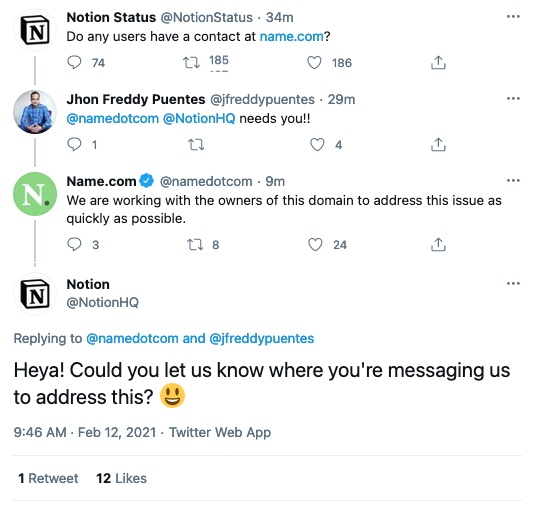
In a since-deleted tweet, Notion asked if “any users have a contact at Name.com,” the web host that Notion relies on for its domain name. In a reply, Name.com said it was “working with the owners of this domain to address this issue as quickly as possible.” Notion replied: “Could you let us know where you’re messaging us to address this?”

The now-partially deleted tweet thread noting the apparent Notion outage. (Image: TechCrunch)

In a statement shortly after its first tweet went out, Notion told TechCrunch: “We’re experiencing a DNS issue, causing the site to not resolve for many users. We are actively looking into this issue, and will update you with more information as we receive it via our status page on Twitter.”

Notion didn’t say specifically what the DNS issue is. Domain name servers, or DNS, is an important part of how the internet works. Every time you go to visit a website, your browser uses a DNS server to convert web addresses to machine-readable IP addresses to locate where a web page is located on the internet. But if a website or its DNS server is not configured correctly, it can cause the website not to load.

It appears a misconfiguration on @NotionHQ’s domain is causing a site-wide outage

The https://t.co/JfK06CSXK0 domain currently resolves to nothing pic.twitter.com/VLn8GBHe52

— Jane Manchun Wong (@wongmjane) February 12, 2021

It’s not clear exactly who is responsible for this particular DNS issue. When reached, a spokesperson for Name.com did not immediately comment, and Sonic.so, the Somali-based registrar that oversees the .so country-code top level domain on which Notion relies, did not return a request for comment.

We’ll update once we know more.

Read more on TechCrunch:

Ember names former Dyson head as consumer CEO, as the startup looks beyond the smart mug

Ember today announced that founder Clay Alexander will transition to Group CEO effective February 16. In his place, the Los Angeles-based smart mug company is bringing on Jim Rowan as Consumer CEO. The executive served as CEO of Dyson from 2017 to 2020, after five years as COO.

It’s a big get for a relatively small company like Ember, which is best known for its smart, heated mugs. Founded in 2012, the hardware startup most recently raised a $20 million Series D in early 2019, bringing its total funding up to just shy of $50 million.

Alexander’s continued role at the company points to additional categories for Ember beyond consumer. “When I founded Ember, I knew there were endless applications for our temperature control technology and with Jim joining our team, we’ll be able to focus on our emerging healthcare vertical and use our technology to help improve and even save lives,” the exec said in a statement.

Courtesy of clever technology and smart design, the company has built a pretty sizable footprint for what might otherwise be a fairly niche product, expanding retail sales to Target, Costco, Best Buy and Starbucks, among others. The startup has done so while maintaining a low headcount of around 100 staffers.

“They have great IP, great design and great innovation, all around precise temperature control,” Rowan said in an interview with TechCrunch. “Obviously that started with the temperature control mugs and flasks, but that IP lends itself to so many other application. For me, that golden thread of being able to use that in myriad of different industries and markets is really, really exciting. One of them, of course, is the cold chain, which has become a lot more important since the beginning of the pandemic. That’s a good indication of how you can disrupt and innovate in new markets.

Rowan has previously served as the COO of BlackBerry and as a senior exec at Flextronics. After exiting Dyson, he joined both PCH International and KKR as an advisor. It’s Dyson, however, that provides the most direct analogy for what the executive hoping to do at Ember. At its core, Dyson is a company that moves air. That translates to vacuums, fans, hairdryers and myriad other product categories.

The underlying question is how Ember’s proprietary heating and cooling tech can translate to other fields. On an industrial level, it means, potentially, helping keep foodstuff and medicine at a predetermined temperate while shipping in the international cold chain. It also means additional consumer products built around the same underlying tech.

“There will be a lot more products that come out, beyond the current mugs and travel mugs,” Rowan says. “There’s a whole bunch of new products which are in the consumer pipeline and will launch in the next year or couple of years. And then you have the expansion into new geographies with existing products.”

That largely means Asia (Rowan will remain based in Singapore) and Europe. Thus far Ember’s footprint has been U.S.-centric, though a push toward online commerce amid the pandemic has helped expand it some. There does, however, remain a question of how high the ceiling is on adoption for a $130 electric smart mug. Ember has yet to release any actual numbers, and Rowan, whose experience at Dyson has more than familiarized him with selling premium products at a premium price point, isn’t ready to commit to a lower price point or less premium take on the space.

It’s worth noting, of course, that low end of the mug category is ready available at your local 99 cent store, and that’s not likely a space Ember is raring to compete in. And certainly those products — unlike its current lineup — likely wouldn’t end up in Apple Stores. Instead, it seems likely the company will continue a play as a premium consumer brand into additional categories at a more rapid pace. “The actual technology can expand into a whole bunch of new areas beyond just beverages because of the temperature control technology,” Rowan said.

With a reported deal in the wings for Joby Aviation, electric aircraft soars to $10B business

One year after nabbing $590 million from investors led by Toyota, and a few months after picking up Uber’s flying taxi businessJoby Aviation is reportedly in talks to go public in a SPAC deal that would value the electric plane manufacturer at nearly $5.7 billion.

News of a potential deal comes on the heels of another big SPAC transaction in electric planes (for Archer Aviation). If the Financial Times’ reporting is accurate, then that would mean the two will soon be publicly traded at a total value approaching $10 billion.

It’s a heady time for startups making vehicles powered by anything other than hydrocarbons, and the SPAC wave has hit it hard.

Electric car companies Arrival, Canoo, ChargePoint, Fisker, Lordstown Motors, Proterra and The Lion Electric Company are some of the companies that have merged with SPACs — or announced plans to — in the past year.

Now it appears that any company that has anything to do with the electrification of any mode of transportation is going to get waved onto the runway for a public listing through a special purpose acquisition company vehicle — a wildly popular route at the moment for companies that might find traditional IPO listings more challenging to carry out but would rather not stay in startup mode when it comes to fundraising.

The investment group reportedly taking Joby to the moon! out to public markets is led by the billionaire tech entrepreneurs and investors Reid Hoffman, the co-founder of LinkedIn, and Mark Pincus, who launched the casual gaming company, Zynga.

Together the two men had formed Reinvent Technology Partners, a special purpose acquisition company, earlier in 2020. The shell company went public and raised $690 million to make a deal.

Any transaction for Joby would be a win for the company’s backers, including Toyota, Baillie Gifford, Intel Capital, JetBlue Technology Ventures (the investment arm of the U.S.-based airline) and Uber, which invested $125 million into Joby.

Joby has a prototype that has already taken 600 flights, but has yet to be certified by the Federal Aviation Administration. And the success of any transaction between the company and Hoffman and Pincus’ SPAC group is far from a sure thing, as the FT noted.

The deal would require an additional capital infusion into the SPAC that the two men established, and without that extra cash, all bets are off. Indeed, that is probably one reason why anyone is reading about this now.

Alternatively powered transportation vehicles of all stripes and covering all modes of travel are the rage right now among the public investment crowd. Part of that is due to rising pressure among institutional investors to find companies with an environmental, sustainability and good governance thesis that they can invest in, and part of that is due to tailwinds coming from government regulations pushing for the decarbonization of fleets in a bid to curb global warming.

The environmental impact is one chief reason United chief executive Scott Kirby cited when speaking about his company’s $1 billion purchase order from the electric plane company that actually announced it would be pursuing a public offering through a SPAC earlier this week.

“By working with Archer, United is showing the aviation industry that now is the time to embrace cleaner, more efficient modes of transportation,” Kirby said. “With the right technology, we can curb the impact aircraft have on the planet, but we have to identify the next generation of companies who will make this a reality early and find ways to help them get off the ground.”

It’s also an investment in a possible new business line that could eventually shuttle United passengers to and from an airport, as TechCrunch reported earlier. United projected that a trip in one of Archer’s eVTOL aircraft could reduce CO2 emissions by up to 50% per passenger traveling between Hollywood and Los Angeles International Airport.

The agreement to go public and the order from United Airlines comes less than a year after Archer Aviation came out of stealth. Archer was co-founded in 2018 by Adam Goldstein and Brett Adcock, who sold their software-as-a-service company Vettery to The Adecco Group for more than $100 million. The company’s primary backer was Marc Lore, who sold his company Jet.com to Walmart in 2016 for $3.3 billion. Lore was Walmart’s e-commerce chief until January.

For any SPAC investors or venture capitalists worried that they’re now left out of the EV plane investment bonanza, take heart! There’s still the German tech developer Lilium. And if an investor is interested in supersonic travel, there’s always Boom.

Jack Dorsey and Jay Z invest 500 BTC to make Bitcoin ‘internet’s currency’

Twitter and Square CEO Jack Dorsey and rapper Jay Z have created an endowment to fund bitcoin development initially in Africa and India, Dorsey said on Friday.

The duo is putting 500 bitcoin, which is currently worth $23.6 million, in the endowment called ?trust. The fund will be set up as a blind irrevocable trust, Dorsey said, adding that the duo won’t be giving any direction to the team.

?trust is looking to hire three board members. The mission of the fund is to “make bitcoin the internet’s currency,” a job application describes.

Government in India has so far been reluctant to embrace bitcoin and other cryptocurrencies. Friday’s move comes as New Delhi is inching closer to introducing a law that would ban private cryptocurrencies in the nation. It is also looking to create its own digital currency.

“Even though India is the software development capital of the world, we haven’t contributed to bitcoin core development in any significant way,” explained Varun Deshpande, co-founder of OnJuno, which is building a digital banking platform from India for Asian Americans, to TechCrunch.

“India always had the skills to contribute but lacked the right incentives. Today’s initiative is even more significant since it provides the right incentives for developers from the world’s largest democracy to contribute and have a say in bitcoin’s protocol development and bring in a diversity of thoughts in shaping the future of money. The irony is as India prepares a bill to ban bitcoin in India, the world is turning to our massive technical talent in India to secure and safeguard the bitcoin network.”

Africa, most especially Nigeria, on the other hand, has experienced a surge in cryptocurrency transactions in recent years. Last year, Nigerians traded more than $400 million worth of cryptocurrency on major local crypto exchanges, and the country is only second to the U.S. in terms of volume of bitcoin traded in the last five years.

Africans that trade cryptocurrencies rely on them because they offer protection against currency devaluation and for value exchange during cross-border transactions. In Nigeria, bitcoin trading became ubiquitous last year during the #EndSARS protests that rocked the country. When donations for the protests began to flow from all parts of the country and in the diaspora, the Nigerian government shut down the bank accounts used for this effort. But bitcoin became a lifeline keeping the crowdfunding activities alive.

Since then, there have been growing concerns that the Nigerian government had intentions to regulate cryptocurrency in the country. Last week, those doubts were actualized as the country’s apex bank gave a directive to banks and financial institutions from dealing in cryptocurrency or facilitating payments for cryptocurrency exchange platforms.

Dorsey has long supported the adoption of cryptocurrency. Square already supports bitcoin and last year acquired about $50 million worth of bitcoin for its corporate treasury, and Twitter is studying the potential use of bitcoin to pay its employees and vendors.

In an interview with CNBC earlier this week, Twitter Chief Financial Officer Ned Segal said, “We’ve done a lot of the upfront thinking to consider how we might pay employees should they ask to be paid in bitcoin, how we might pay a vendor if they ask to be [paid] in bitcoin and whether we need to have bitcoin on our balance sheet should that happen. It’s something we continue to study and look at, we want to be thoughtful about over time, but we haven’t made any changes yet.”

Many high-profile industry executives have called for nations to embrace bitcoin. Balaji Srinivasan, an angel investor and entrepreneur who previously served as the chief technology officer of Coinbase, earlier this month made a case for why India should embrace bitcoin.

“India has the talent to pull this off. Such a move would make international headlines, attract global support from the world’s technologists and financiers, differentiate India from the increasingly zero-sum economic policies pushed by America and China, and put the country at the forefront of a trillion dollar industry,” he wrote, envisioning the potential unblocking bitcoin would create for India.

Meanwhile, the Central Bank of Kenya said this week that it will use bitcoin as a reserve currency amid the Kenyan Shilling volatility against the dollar. Last year, the country was only second to Nigeria in bitcoin trading in Africa. Dorsey’s plan is a follow-up on his visit to the continent in 2019 when amid meeting with key political and tech stakeholders, he made a startling reference to the continent’s budding cryptocurrency usage. “Africa will define the future (especially the bitcoin one!),” he said at the time.

Sweden’s data watchdog slaps police for unlawful use of Clearview AI

Sweden’s data protection authority, the IMY, has fined the local police authority €250,000 ($300,000+) for unlawful use of the controversial facial recognition software Clearview AI, in breach of the country’s Criminal Data Act.

As part of the enforcement the police must conduct further training and education of staff in order to avoid any future processing of personal data in breach of data protection rules and regulations.

The authority has also been ordered to inform people whose personal data was sent to Clearview — when confidentiality rules allow it to do so, per the IMY.

Its investigation found that the police had used the facial recognition tool on a number of occasions and that several employees had used it without prior authorization.

Earlier this month Canadian privacy authorities found Clearview had breached local laws when it collected photos of people to plug into its facial recognition database without their knowledge or permission.

“IMY concludes that the Police has not fulfilled its obligations as a data controller on a number of accounts with regards to the use of Clearview AI. The Police has failed to implement sufficient organisational measures to ensure and be able to demonstrate that the processing of personal data in this case has been carried out in compliance with the Criminal Data Act. When using Clearview AI the Police has unlawfully processed biometric data for facial recognition as well as having failed to conduct a data protection impact assessment which this case of processing would require,” the Swedish data protection authority writes in a press release.

The IMY’s full decision can be found here (in Swedish).

“There are clearly defined rules and regulations on how the Police Authority may process personal data, especially for law enforcement purposes. It is the responsibility of the Police to ensure that employees are aware of those rules,” added Elena Mazzotti Pallard, legal advisor at IMY, in a statement.

The fine (SEK2.5 million in local currency) was decided on the basis of an overall assessment, per the IMY, though it falls quite a way short of the maximum possible under Swedish law for the violations in question — which the watchdog notes would be SEK10 million. (The authority’s decision notes that not knowing the rules or having inadequate procedures in place are not a reason to reduce a penalty fee so it’s not entirely clear why the police avoided a bigger fine.)

The data authority said it was not possible to determine what had happened to the data of the people whose photos the police authority had sent to Clearview — such as whether the company still stored the information. So it has also ordered the police to take steps to ensure Clearview deletes the data.

The IMY said it investigated the police’s use of the controversial technology following reports in local media.

Just over a year ago, U.S.-based Clearview AI was revealed by The New York Times to have amassed a database of billions of photos of people’s faces — including by scraping public social media postings and harvesting people’s sensitive biometric data without individuals’ knowledge or consent.

European Union data protection law puts a high bar on the processing of special category data, such as biometrics.

Ad hoc use by police of a commercial facial recognition database — with seemingly zero attention paid to local data protection law — evidently does not meet that bar.

Last month it emerged that the Hamburg data protection authority had instigated proceedings against Clearview following a complaint by a German resident over consentless processing of his biometric data.

The Hamburg authority cited Article 9 (1) of the GDPR, which prohibits the processing of biometric data for the purpose of uniquely identifying a natural person, unless the individual has given explicit consent (or for a number of other narrow exceptions which it said had not been met) — thereby finding Clearview’s processing unlawful.

However, the German authority only made a narrow order for the deletion of the individual complainant’s mathematical hash values (which represent the biometric profile).

It did not order deletion of the photos themselves. It also did not issue a pan-EU order banning the collection of any European resident’s photos as it could have done and as European privacy campaign group, noyb, had been pushing for.

Indeed, noyb is encouraging all EU residents to use forms on Clearview AI’s website to ask the company for a copy of their data and ask it to delete any data it has on them, as well as to object to being included in its database. It also recommends that individuals who find Clearview holds their data submit a complaint against the company with their local DPA.

European Union lawmakers are in the process of drawing up a risk-based framework to regulate applications of artificial intelligence — with draft legislation expected to be put forward this year, although the Commission intends it to work in concert with data protections already baked into the EU’s General Data Protection Regulation (GDPR).

Earlier this month the controversial facial recognition company was ruled illegal by Canadian privacy authorities — who warned they would “pursue other actions” if the company does not follow recommendations that include stopping the collection of Canadians’ data and deleting all previously collected images.

Clearview said it had stopped providing its tech to Canadian customers last summer.

It is also facing a class action lawsuit in the U.S. citing Illinois’ biometric protection laws.

Last summer the U.K. and Australian data protection watchdogs announced a joint investigation into Clearview’s personal data handling practices. That probe is ongoing.