6 Copenhagen investors share their outlook on investing in 2021

While Denmark and Copenhagen don’t often come up as a destination for European startups, it has a thriving local tech scene that’s home to some of the better startup conferences. After all, who doesn’t want to visit Copenhagen?

A highly educated population, great universities, excellent healthcare and great transport links to Europe make the city as good a place as any to start up a company.

Amongst our investors, we found the trends they were most interested in included sustainable supply chain logistics, esports and gaming, enterprise SaaS, climate tech, deep tech hardware, agritech and edtech. And many said they are interested in the future of work and the transition to different ways of working.

Companies they are excited by included: Afresh Technologies, Seaborg Technologies (nuclear reactors), Labster (virtual science labs), Normative.io (social and environmental impact measurement) and DEMI (connecting with chefs).

In general, investors said they are focused on their home ground but are also spreading their wings to the “New Nordics” (Nordic and Baltic) region. Some are also investing in large European and North American hub cities.

The “green shoots” of recovery they see are appearing in anything digital that comes with a community, as well as among startups that are able to leverage the pandemic to generate new business models that are faster than incumbents.


Use discount code EXTRAKNASE to save 25% off a 1-year Extra Crunch membership.
This offer is only available to readers in Europe and expires on April 30, 2021.


We surveyed:


Sara Rywe, associate, byFounders

What trends are you most excited about investing in, generally?
Software and tech (I’m personally extra excited about the “future of work,” fintech, and “future of food”).

What’s your latest, most exciting investment?
Digitail (a veterinary software provider solving the gap between the ever-growing expectations of millennial pet parents and the experience offered by veterinarians with their current tools).

Are there startups that you wish you would see in the industry but don’t? What are some overlooked opportunities right now?
I would like to see more founders with global ambitions in the “uniquely transformative” software category (the same way Airbnb transformed the hotel industry and Uber transformed the taxi industry). Many startups we see today are building a feature instead of a full solution and their vision is about making industries incrementally better. So, here’s a callout to all of you Nordic or Baltic visionary founders out there: Write me!

What are you looking for in your next investment, in general?
We always look for competent, visionary and passionate founders building products that people love. As an industry-agnostic VC, we keep our eyes open for a range of different opportunities.

Which areas are either oversaturated or would be too hard to compete in at this point for a new startup? What other types of products/services are you wary or concerned about?
Some of the current trends that I see include:
Fintech: salary advances, factoring, sustainability reporting and measurements.
Food tech: alternative protein, pet food, food waste.
Future of work: virtual offices, collaboration, productivity tools.
If you decide to enter any of the above-mentioned industries, I therefore encourage you to really be thoughtful in how you differentiate yourself and/or how your team is better suited to execute on the mission.

How much are you focused on investing in your local ecosystem versus other startup hubs (or everywhere) in general? More than 50%? Less?
<50%. We invest across the Nordics and Baltics and I’m covering Sweden, Norway and Denmark.

Which industries in your city and region seem well positioned to thrive, or not, long term? What are companies you are excited about (your portfolio or not), which founders?
Denmark is very well positioned to succeed in sustainability and energy (many good talents coming from e.g., Vestas and DTU), consumer goods (there’s a large history in the country around building brands such as Lego, Carlsberg, etc.), and biotech (Novo Nordisk among others playing a big part). Moreover, software scaleups such as Peakon, Pleo, and Templafy are really leading the way for a new generation of tech startups to thrive in Denmark. When looking at Danish founder particularly, I’m very excited to see companies such as Qvin revolutionizing healthcare for women by using period blood as an opportunity for a noninvasive blood test.

How should investors in other cities think about the overall investment climate and opportunities in your city?
They should be very excited! Just look at what we’ve seen in 2021 so far:
Exits: Peakon $700 million exit and Humio $400 million exit.
Large rounds: Public.com raising $220 million, Vivino raising $115 million and Labster raising $60 million led by Andreessen Horowitz

Do you expect to see a surge in more founders coming from geographies outside major cities in the years to come, with startup hubs losing people due to the pandemic and lingering concerns, plus the attraction of remote work?
Somewhat. We already see a lot of innovation outside of Copenhagen in cities such as Aarhus and Odense.

Which industry segments that you invest in look weaker or more exposed to potential shifts in consumer and business behavior because of COVID-19? What are the opportunities startups may be able to tap into during these unprecedented times?
One industry that has been hit hard by COVID-19 is of course travel and hospitality. The flipside of this is that we see a lot of innovation due to that. Examples from our own portfolio include:
AeroGuest — a platform that allows for a “touch-free” travel experience (skipping lines and reception desks, direct online room booking, etc.).
BobW — a new type of sustainable travel accommodation bringing the best of both worlds: “home meets hotel.”

How has COVID-19 impacted your investment strategy? What are the biggest worries of the founders in your portfolio? What is your advice to startups in your portfolio right now?
COVID-19 has not impacted our investment strategy massively and we have the same focus as before (investing in software and tech). With that said, we are happy to see some industries getting an uplift in these difficult times, such as sustainability and impact.
The biggest worries of our portfolio company founders have been around volatility and uncertainty. Since the first lockdown our advice has been simple: You can’t control the outcome. We’ve therefore worked together to ensure that they have some proper scenario planning in place and that we think creatively of how to mitigate eventual negative effects on their business.

Are you seeing “green shoots” regarding revenue growth, retention or other momentum in your portfolio as they adapt to the pandemic?
Tame — one of our portfolio companies — expanded their event platform to also include virtual events, which made it really take off in COVID times.
Corti — another portfolio company of ours — could in less than four weeks build a product for helping fight COVID-19 with artificial intelligence.
Both of these companies are good examples of how “adapting their products” due to the pandemic led to great results.

What is a moment that has given you hope in the last month or so? This can be professional, personal or a mix of the two.
The sudden rise of awareness around impact and ESG among VCs! Several great conversations have been held on how to improve our ways of working.

Who are key startup people you see creating success locally, whether investors, founders or even other types of startup ecosystems roles like lawyers, designers, growth experts, etc. We’re trying to highlight the movers and shakers who outsiders might not know.
Some of the extraordinary founders that I look up to from Denmark include:
Jakob Jønck (Simple Feast), Andreas Cleve and Lars Maaløe (Corti), Sara Naseri and Søren Therkelsen (Qvin), Niels Martin Brochner, Jarek Owczarek and Viktor Heide (Contractbook), Jacob Hansen, Esben Friis-Jensen, Jakob Storm and Christian Hansen (Cobalt) among others.
There’s also a range of great investors in Denmark including Helle Uth, Christel Piron, Alexander Viterbo-Horten and Anders Kjær amongst others at PreSeed Ventures and Daniel Nyvang Mariussen with his team at Bumble Ventures. Also, the Danish tech ecosystem would not be what it is without all the work that Vækstfonden does.

Mads Hørlyck, associate, Maersk Growth

What trends are you most excited about investing in, generally?
Supply chain/logistics including sustainable supply chains.

What’s your latest, most exciting investment?
Afresh Technologies.

Are there startups that you wish you would see in the industry but don’t? What are some overlooked opportunities right now?
In general there are still plenty of opportunities across various parts of the supply chain. We have no particular specific preferences as such at the moment.

What are you looking for in your next investment, in general?
Digital solution to drive efficiencies across one or more subparts of the supply chain, both upstream and downstream focus.

Which areas are either oversaturated or would be too hard to compete in at this point for a new startup? What other types of products/services are you wary or concerned about?
Freight forwarding has been maturing in Europe and North America with several large startups in both regions. However, the market is still large but it requires a strong new model as it’s also low margins.

How much are you focused on investing in your local ecosystem versus other startup hubs (or everywhere) in general? More than 50%? Less?
Less/little focus on Denmark. Main priority in large European/North American hubs.

Which industries in your city and region seem well positioned to thrive, or not, long term? What are companies you are excited about (your portfolio or not), which founders?
Startups with the medical and supporting functions tech are doing well. We are excited about Onomondo in the Danish scene — also a portfolio company of ours.

How should investors in other cities think about the overall investment climate and opportunities in your city?
As an upcoming opportunity. Several tech hubs have been created and there is a general good environment including state-backed loans/pre-seed investments and fairly many angels to get going.

Do you expect to see a surge in more founders coming from geographies outside major cities in the years to come, with startup hubs losing people due to the pandemic and lingering concerns, plus the attraction of remote work?
We don’t expect any significant changes to the founder-environment in Denmark (too little country).

Which industry segments that you invest in look weaker or more exposed to potential shifts in consumer and business behavior because of COVID-19? What are the opportunities startups may be able to tap into during these unprecedented times?
We see an increased focus on our investment area: Supply chain/logistics as people throughout the pandemic have been much more exposed to and dependent on flexible and reliable supply chains. All the way from supply resilience, supply chain visibility, fulfillment and to last-mile delivery. Consumers have the power to drive changes in supply chains.

How has COVID-19 impacted your investment strategy? What are the biggest worries of the founders in your portfolio? What is your advice to startups in your portfolio right now?
Sales conversion rates decreasing/pipelines drying out. Advice is, like everyone else, to minimize cost and extend runway by getting as close to profitability as model allows. Based on this funding needs can be discussed.

Are you seeing “green shoots” regarding revenue growth, retention or other momentum in your portfolio as they adapt to the pandemic?
Yes, we have seen some startups being able to leverage the pandemic over incumbents due to their more flexible and digital structure.

What is a moment that has given you hope in the last month or so? This can be professional, personal or a mix of the two.
We have yet to see a default wave both globally within our investment area but also in general in Denmark.

Henrik Møller Kristensen, associate, Bumble Ventures

What trends are you most excited about investing in, generally?
Some of the trends we’re excited about are (1) the growing market of digital media and entertainment, in particular esports and gaming, (2) enterprise SaaS, e.g., related to the future of work, (3) climate change solutions, e.g., deep tech hardware and software, and (4) e-commerce businesses, in particular digital native vertical brands and direct-to-consumer cases.

Are there startups that you wish you would see in the industry but don’t? What are some overlooked opportunities right now?
Products and services to satisfy the needs of the aging population. The number of elderly people will be growing significantly over the next decades, establishing a growing market for products and services to satisfy the needs from this demographic change and reduce the pressure on societies.

What are you looking for in your next investment, in general?
We highly value team and traction. We are looking for exceptional founders with strong competencies in engineering, product and commercial, preferably with years of experience from the industry they are entering with a new solution. We prefer some indication of product-market fit. We like methodical revenue growth driven by paying customers, rich cohort grids and controllable funnels that proves a robust core business. We don’t like products that are still 2-3 years away from monetization. This means that we will miss the next Facebook, but we are okay with that.

Which areas are either oversaturated or would be too hard to compete in at this point for a new startup? What other types of products/services are you wary or concerned about?
Traditional social media and apps that require millions of users before being able to turn on the business model. SaaS marketing tools also seem crowded.

How much are you focused on investing in your local ecosystem versus other startup hubs (or everywhere) in general? More than 50%? Less?
Next week we will announce our first investment outside Denmark. This is our first step toward being present not only in Denmark, but in the Nordics.

Which industries in your city and region seem well positioned to thrive, or not, long term? What are companies you are excited about (your portfolio or not), which founders?
Well-positioned industries in Denmark are medtech, fintech, gaming and clean tech. We’re excited about GamerzClass, Pie Systems, LeadFamly, Omnigame, Organic Basics, Cap desk, Roccamore, Too Good To Go, Pleo, Tradeshift, SYBO, Unity and more. Exceptional founders are Victor Folmann from GamerzClass, Sunny Long from Pie Systems, Frederikke Antonie Schmidt from Roccamore and Christian Gabriel from Capdesk.

How should investors in other cities think about the overall investment climate and opportunities in your city?
Historically, there has been a need for more capital and talent to keep successful growth-stage startups in Denmark and not have to move to foreign countries to attract talent and capital. However, the investment climate is getting better. Greater access to capital and talent go hand in hand, and what is really changing the investment climate for the better is founders of successful Danish startups turning back to Denmark and reinvesting in the startup community.

Do you expect to see a surge in more founders coming from geographies outside major cities in the years to come, with startup hubs losing people due to the pandemic and lingering concerns, plus the attraction of remote work?
I think we’ll see more attraction to remote work in the future. However, I believe it is important for startups to be close to other great like-minded startups, founders, advisors and investors, not only virtually but in real life. Establishing a great network and personal relationships are very important factors to succeed and remote is not suited very well for that in my opinion.

Which industry segments that you invest in look weaker or more exposed to potential shifts in consumer and business behavior because of COVID-19? What are the opportunities startups may be able to tap into during these unprecedented times?
The travel and hospitality industry look weaker and we’ll see a shift toward lower demand due to remote work and sustainability issues. On the other side, gaming, e-commerce and digital products and services are growing as you will have more people online behind the screens.

How has COVID-19 impacted your investment strategy? What are the biggest worries of the founders in your portfolio? What is your advice to startups in your portfolio right now?
We are still happy to invest despite COVID-19. Gaming has, for example, been positively affected by COVID-19, however, many startups are also struggling due to COVID-19. The best a startup can do is to manage the runway, have close dialogue with their investors, cut costs and try to pivot to the changes. Look for opportunities, not boundaries.

Are you seeing “green shoots” regarding revenue growth, retention or other momentum in your portfolio as they adapt to the pandemic?
Not yet. Only a few of our portfolio companies are negatively affected by COVID-19.

What is a moment that has given you hope in the last month or so? This can be professional, personal or a mix of the two.
Investors are willing to make new investments and help out struggling portfolio companies. Founders are keeping their heads high and making the best out of the new circumstances. In some cases it actually stimulates new innovations.

Benjamin Ratz, partner, Nordic Makers

What trends are you most excited about investing in, generally?
Energy and the transition to a fossil fuel society, data as governance and the changing role of education.

What’s your latest, most exciting investment?
Seaborg — building modular, small and safe nuclear reactors.
Labster — virtual science labs that help students all over the world immerse in science and STEM.

Are there startups that you wish you would see in the industry but don’t? What are some overlooked opportunities right now?
Improving the public sector.

What are you looking for in your next investment, in general?
Views on how and if the world has permanently changed in behavior due to the pandemic.

Which areas are either oversaturated or would be too hard to compete in at this point for a new startup? What other types of products/services are you wary or concerned about?
Micromobility, teledocs.

How much are you focused on investing in your local ecosystem versus other startup hubs (or everywhere) in general? More than 50%? Less?
100%.

What are companies you are excited about (your portfolio or not), which founders?
Willa. Corti.

How should investors in other cities think about the overall investment climate and opportunities in your city?
A lot of founders leaving success stories of the region.

Do you expect to see a surge in more founders coming from geographies outside major cities in the years to come?
No but we expect the cities to produce more.

Mark Emil Hermansen, associate, Astanor

What trends are you most excited about investing in, generally?
Food and agrotech.

What’s your latest, most exciting investment?
DEMI.

Are there startups that you wish you would see in the industry but don’t? What are some overlooked opportunities right now?
I’d love to see more food tech companies that “get food” — the human element of it that is. Too many startups focus only on the technology, less on the fact that it should be deeply human centered. This is so prevalent that I instinctively stay away from startups dubbing themselves as “food tech” — food is not tech and tech is not food and therein lies the challenge and the prize. Here’s a read that kind of sums it up.

What are you looking for in your next investment, in general?
Anything that reminds me of these first lines from “On The Road”: “They danced down the streets like dingledodies, and I shambled after as I’ve been doing all my life after people who interest me, because the only people for me are the mad ones, the ones who are mad to live, mad to talk, mad to be saved, desirous of everything at the same time, the ones that never yawn or say a commonplace thing, but burn, burn, burn …”.

Which areas are either oversaturated or would be too hard to compete in at this point for a new startup? What other types of products/services are you wary or concerned about?
DNVB.

How much are you focused on investing in your local ecosystem versus other startup hubs (or everywhere) in general? More than 50%? Less?
25% local (DK is still immature from a startup standout — yet the opportunity is that the VC footprint is small and relatively unsophisticated).

Which industries in your city and region seem well positioned to thrive, or not, long term? What are companies you are excited about (your portfolio or not), which founders?
Companies: Online communities such as DEMI.
Founder: Erez Galonska of Infarm.

How should investors in other cities think about the overall investment climate and opportunities in your city?
Tons of opportunity if you have access to the right deal flow/pedigree.

Which industry segments that you invest in look weaker or more exposed to potential shifts in consumer and business behavior because of COVID-19? What are the opportunities startups may be able to tap into during these unprecedented times?
Communities that transcend digital (like Tonsser and DEMI).

How has COVID-19 impacted your investment strategy? What are the biggest worries of the founders in your portfolio? What is your advice to startups in your portfolio right now?
Worries: Uncertainty and recruitment strategy.
Advice: Survive and prepare.

Are you seeing “green shoots” regarding revenue growth, retention or other momentum in your portfolio as they adapt to the pandemic?
Anything physical that has retail footprint. Anything digital that has a community footprint.

What is a moment that has given you hope in the last month or so? This can be professional, personal or a mix of the two.
That everyone’s pumped for what’s about to come (post-COVID) and the realization (or hope?) that nothing will be as before.

Who are key startup people you see creating success locally?
Kasper Ottesen, Highbridge (legal).
Kasper Hulthin (entrepreneur and investor).
Christian Tang-Jespersen (investor).

Eric Lagier, managing partner, byFounders

What trends are you most excited about investing in, generally?
Future of work, productivity improvement platforms.

What’s your latest, most exciting investment?
Normative.

Are there startups that you wish you would see in the industry but don’t? What are some overlooked opportunities right now?
Future of recruiting.

What are you looking for in your next investment, in general?
Passionate founders, solving big problems to build a better tomorrow.

How much are you focused on investing in your local ecosystem versus other startup hubs (or everywhere) in general? More than 50%? Less?
We are focused on the New Nordics (Nordic and Baltic) region having shown the biggest growth potential in Europe.

Which industries in your city and region seem well positioned to thrive, or not, long term? What are companies you are excited about (your portfolio or not), which founders?
Climate tech, health tech, fintech. Normative, Corti, Lucinity.

How should investors in other cities think about the overall investment climate and opportunities in your city?
Copenhagen is booming and there is now a strong foundation of experienced founders building really transformative companies.

Do you expect to see a surge in more founders coming from geographies outside major cities in the years to come, with startup hubs losing people due to the pandemic and lingering concerns, plus the attraction of remote work?
No — but I expect to see much more diverse teams with a priority on remote first.

Which industry segments that you invest in look weaker or more exposed to potential shifts in consumer and business behavior because of COVID-19? What are the opportunities startups may be able to tap into during these unprecedented times?
An acceleration of online, remote, e-commerce and general faster pace of transactions.

How has COVID-19 impacted your investment strategy? What are the biggest worries of the founders in your portfolio? What is your advice to startups in your portfolio right now?
COvid-19 is a giant accelerator of future trends. Those founders that have adapted best will be the winners of tomorrow.

Are you seeing “green shoots” regarding revenue growth, retention or other momentum in your portfolio as they adapt to the pandemic?
Absolutely.

What is a moment that has given you hope in the last month or so? This can be professional, personal or a mix of the two.
How founders persevere in these times of massive change.

Who are key startup people you see creating success locally?
Jakob Jønck, founder, SimpleFeast; Kristian Rönn, founder, Normative; Andreas Cleve and Lars Maaløe, founders, Corti.

What the NFT? VC David Pakman dumbs down the intensifying digital collectibles frenzy

Non-fungible tokens have been around for two years, but these NFTs, one-of-one digital items on the Ethereum and other blockchains, are suddenly becoming a more popular way to collect visual art primarily, whether it’s an animated cat or an NBA clip or virtual furniture.

“Suddenly” is hardly an overstatement. According to the outlet Cointelegraph, during the second half of last year, $9 million worth of NFT goods sold to buyers; during one 24-hour window earlier this week, $60 million worth of digital goods were sold.

What’s going on? A thorough New York Times piece on the trend earlier this week likely fueled new interest, along with a separate piece in Esquire about the artist Beeple, a Wisconsin dad whose digital drawings, which he has created every single day for the last 13 years, began selling like hotcakes in December. If you need further evidence of a tipping point (and it is ample right now), consider that the work of Beeple, whose real name is Mike Winkelmann, was just made available through Christie’s. It’s the venerable auction house’s first sale of exclusively digital work.

To better understand the market and why it’s blowing up in real time, we talked this week with David Pakman, a former internet entrepreneur who joined the venture firm Venrock a dozen years ago and began tracking Bitcoin soon after, even mining the cryptocurrency at his Bay Area home beginning in 2015. (“People would come over and see racks of computers, and it was like, ‘It’s sort of hard to explain.’”)

Perhaps it’s no surprise that he also became convinced early on of the promise of NFTs, persuading Venrock to lead the $15 million Series A round for a young startup, Dapper Labs, when its primary offering was CryptoKitties, limited-edition digital cats that can be bought and bred with cryptocurrency.

While the concept baffled some at the time, Pakman has long seen the day when Dapper’s offerings will be far more extensive, and indeed, a recent Dapper deal with the NBA to sell collectible highlight clips has already attracted so much interest that Dapper is reportedly right now raising $250 million in new funding at a post-money valuation of $2 billion. While Pakman declined to confirm or correct that figure, he did answer our other questions in a chat that’s been edited here for length and clarity.

TC: David, dumb things down for us. Why is the world so gung-ho about NFTs right now?

DP: One of the biggest problems with crypto — the reason it scares so many people — is it uses all these really esoteric terms to explain very basic concepts, so let’s just keep it really simple. About 40% of humans collect things — baseball cards, shoes, artwork, wine. And there’s a whole bunch of psychological reasons why. Some people have a need to complete a set. Some people do it for investment reasons. Some people want an heirloom to pass down. But we could only collect things in the real world because digital collectibles were too easy to copy.

Then the blockchain came around and [it allowed us to] make digital collectibles immutable, with a record of who owns what that you can’t really copy. You can screenshot it, but you don’t really own the digital collectible, and you won’t be able to do anything with that screenshot. You won’t be able to to sell it or trade it. The proof is in the blockchain. So I was a believer that crypto-based collectibles could be really big and actually could be the thing that takes crypto mainstream and gets the normals into participating in crypto — and that’s exactly what’s happening now.

TC: You mentioned a lot of reasons that people collect items, but one you didn’t mention is status. Assuming that’s one’s motivation, how do you show off what you’ve amassed online? 

DP: You’re right that one of the other reasons why we collect is to show it off status, but I would actually argue it’s much easier to show off our collections in the digital world. If I’m a car collector, the only way you’re going to see my cars is to come over to the garage. Only a certain number of people can do that. But online, we can display our digital collections. NBA Top Shop, for example, makes it very easy for you to show off your moments. Everyone has a page and there’s an app that’s coming and you can just show it off to anyone in your app, and you can post it to your social networks. And it’s actually really easy to show off how big or exciting your collection is.

TC: It was back in October that Dapper rolled out these video moments, which you buy almost like a Pokemon set in that you’re buying a pack and know you’ll get something “good” but don’t know what. Yet almost half its sales have come in through the last week. Why?

DP: There’s only about maybe 30,000 or 40,000 people playing right now. It’s growing 50% or 100% a day. But the growth has been completely organic. The game is actually still in beta, so we haven’t been doing any marketing other than posting some stuff on Twitter. There hasn’t been attempt to market this and get a lot of players [talking about it] because we’re still working the bugs out, and there are a lot of bugs still to be worked out.

But a couple NBA players have seen this and gotten excited about their own moments [on social media]. And there’s maybe a little bit of machismo going on where, ‘Hey, I want my moment to trade for a higher price.’ But I also think it’s the normals who are playing this. All you need to play is a credit card, and something like 65% of the people playing have never owned or traded in crypto before. So I think the thesis that crypto collectibles could be the thing that brings mainstream users into crypto is playing out before our eyes.

TC: How does Dapper get paid?

DP: We get 5% of secondary sales and 100% minus the cost of the transaction on primary sales. Of course, we have a relationship with the NBA, which collects some of that, too. But that’s the basic economics of how the system works.

TC: Does the NBA have a minimum that it has to be paid every year, and then above and beyond that it receives a cut of the action?

DP: I don’t think the company has gone public with the exact economic terms of their relationships with the NBA and the Players Association. But obviously the NBA is the IP owner, and the teams and the players have economic participation in this, which is good, because they’re the ones that are creating the intellectual property here.

But a lot of the appreciation of these moments — if you get one in a pack and you sell it for a higher price — 95% of that appreciation goes to the owner. So it’s very similar to baseball cards, but now IP owners can participate through the life of the product in the downstream economic activity of their intellectual property, which I think is super appealing whether you’re the NBA or someone like Disney, who’s been in the IP licensing business for decades.

And it’s not just major IP where this NFT space is happening. It’s individual creators, musicians, digital artists who could create a piece of digital art, make only five copies of it, and auction it off. They too can collect a little bit each time their works sell in the future.

TC: Regarding NBA Top Shot specifically, prices range massively in terms of what people are paying for the same limited-edition clip. Why?

DP: There are two reasons. One is that like scarce items, lower numbers are worth more than higher numbers, so if there’s a very particular LeBron moment, and they made 500 [copies] of them, and I own number one, and you own number 399, the marketplace is ascribing a higher value to the lower numbers, which is very typical of limited-edition collector pieces. It’s sort of a funny concept. But it is a very human concept.

The other thing is that over time there has been more and more demand to get into this game, so people are willing to pay higher and higher prices. That’s why there’s been a lot of price appreciation for these moments over time.

TC: You mentioned that some of the esoteric language around crypto scares people, but so does the fact that 20% of the world’s bitcoin is permanently inaccessible to its owners, including because of forgotten passwords. Is that a risk with these digital items, which you are essentially storing in a digital locker or wallet?

DP: It’s a complex topic,  but I will say that Dapper has tried to build this in a way where that won’t happen, where there’s effectively some type of password recovery process for people who are storing their moments in Dapper’s wallet.

You will be able to take your moments away from Dapper’s account and put it into other accounts, where you may be on your own in terms of password recovery.

TC: Why is it a complex topic?

DP: There are people who believe that even though centralized account storage is convenient for users, it somehow can be distrustful — that the company could de-platform you or turn your account off. And in the crypto world, there’s almost a religious ferocity about making sure that no one can de-platform you, that the things that you buy — your cryptocurrencies or your NFTs — are your own. Long term, Dapper supports that. You’ll be able to take your moments anywhere you want. But today, our customers don’t have to worry about that I-lost-my-password-and-I’ll-never-get-my-moments-again problem.

For more, including why Dapper Labs built its own blockchain and what Pakman thinks of the U.S. establishing a digital USD, you can listen to our full conversation here

Daily Crunch: Facebook launches rap app

Facebook unveils another experimental app, Atlassian acquires a data visualization startup and Newsela becomes a unicorn. This is your Daily Crunch for February 26, 2021.

The big story: Facebook launches rap app

The new BARS app was created by NPE Team (Facebook’s internal R&D group), allowing rappers to select from professionally created beats, and then create and share their own raps and videos. It includes autotune and will even suggest rhymes as you’re writing the lyrics.

This marks NPE Team’s second musical effort — the first was the music video app Collab. (It could also be seen as another attempt by Facebook to launch a TikTok competitor.) BARS is available in the iOS App Store in the U.S., with Facebook gradually admitting users off a waitlist.

The tech giants

Atlassian is acquiring Chartio to bring data visualization to the platform — Atlassian sees Chartio as a way to really take advantage of the data locked inside its products.

Yelp puts trust and safety in the spotlight — Yelp released its very first trust and safety report this week, with the goal of explaining the work that it does to crack down on fraudulent and otherwise inaccurate or unhelpful content.

Startups, funding and venture capital

Newsela, the replacement for textbooks, raises $100M and becomes a unicorn —  If Newsela is doing its job right, its third-party content can replace textbooks within a classroom altogether, while helping teachers provide fresh, personalized material.

Tim Hortons marks two years in China with Tencent investment — The Canadian coffee and doughnut giant has raised a new round of funding for its Chinese venture.

Sources: Lightspeed is close to hiring a new London-based partner to put down further roots in Europe — According to multiple sources, Paul Murphy is being hired away from Northzone.

Advice and analysis from Extra Crunch

In freemium marketing, product analytics are the difference between conversion and confusion — Considering that most freemium providers see fewer than 5% of free users move to paid plans, even a slight improvement in conversion can translate to significant revenue gains.

As BNPL startups raise, a look at Klarna, Affirm and Afterpay earnings — With buy-now-pay-later options, consumers turn a one-time purchase into a limited string of regular payments.

(Extra Crunch is our membership program, which helps founders and startup teams get ahead. You can sign up here.)

Everything else

Jamaica’s JamCOVID pulled offline after third security lapse exposed travelers’ data — JamCOVID was set up last year to help the government process travelers arriving on the island.

AT&T is turning DirecTV into a standalone company — AT&T says it will own 70% of the new company, while private equity firm TPG will own 30%.

How to ace the 1-hour, and ever-elusive, pitch presentation at TC Early Stage — Norwest’s Lisa Wu has a message for founders: Think like a VC during your pitch presentation.

The Daily Crunch is TechCrunch’s roundup of our biggest and most important stories. If you’d like to get this delivered to your inbox every day at around 3pm Pacific, you can subscribe here.

Astra awarded NASA launch contract for storm observation satellites

Astra, the Alameda-based space launch startup that recently announced its intent to go public via a SPAC merger, has secured a contract to deliver six cube satellites to space on behalf of NASA. Astra stands to be paid $7.95 million by the agency for fulfilment of the contract. This will be a key test of Astra’s responsive rocket capabilities, with a planned three-launch mission profile spanning up to four months, currently targeting sometime between January 8 and July 31 of 2022.

The satellites are for NASA’s Time-Resolved Observations of Precipitation Structure and Storm Intensity with a Constellation of SmallSats (TROPICS) mission, which is a science mission that will collect data about hurricanes and their formation, including temperature, pressure and humidity readings. Like the extremely long, tortured-for-an-acronym name of the mission suggests, the data will be collected using a small constellation of satellites, each roughly the size of a shoebox.

Astra completed late last year its second of three planned launches designed to ultimately achieve orbit, and exceeded its own expectations by reaching space and nearly achieving orbit. The company said that based on the data it collected from that mission, the final remaining barriers to actually making orbit are all fixable via changes to its software. Based on that, Astra CEO and founder Chris Kemp said that it believes it’s now ready to begin flying commercial payloads.

Kemp was formerly CTO of NASA, and has co-founded a number of technology companies over the years, as well. This latest NASA mission isn’t its first contracted launch — far from it, in fact, since the company has said it currently has more than 50 total missions on its slate from both private and government customers, with a total value of more than $150 million in revenue.

Salesforce delivers, Wall Street doubts as stock falls 6.3% post-earnings

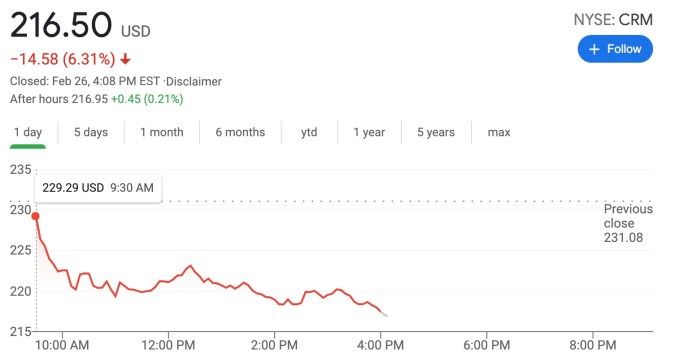
Wall Street investors can be fickle beasts. Take Salesforce as an example. The CRM giant announced a $5.82 billion quarter when it reported earnings yesterday. Revenue was up 20% year over year. The company also reported $21.25 billion in total revenue for the just-closed FY2021, up 24% YoY. If that wasn’t enough, it raised its FY2022 guidance (its upcoming fiscal year) to over $25 billion. What’s not to like?

You want higher quarterly revenue, Salesforce gave you higher revenue. You want high growth and solid projected revenue — check and check. In fact, it’s hard to find anything to complain about in the report. The company is performing and growing at a rate that is remarkable for an organization of its size and maturity — and it is expected to continue to perform and grow.

How did Wall Street react to this stellar report? It punished the stock with the price down over 6%, a pretty dismal day considering the company brought home such a promising report card.

2/6/21 Salesforce stock report with stock down 6.31%

Image Credits: Google

So what is going on here? It could be that investors simply don’t believe the growth is sustainable or that the company overpaid when it bought Slack at the end of last year for over $27 billion. It could be it’s just people overreacting to a cooling market this week. But if investors are looking for a high-growth company, Salesforce is delivering that.

While Slack was expensive, it reported revenue over $250 million yesterday, pushing it over the $1 billion run rate with more than 100 customers paying over $1 million in ARR. Those numbers will eventually get added to Salesforce’s bottom line.

Canaccord Genuity analyst David Hynes Jr. wrote that he was baffled by investors’ reaction to this report. Like me, he saw a lot of positives. Yet Wall Street decided to focus on the negative, and see “the glass half empty,” as he put it in his note to investors.

“The stock is clearly in the show-me camp, which means it’s likely to take another couple of quarters for investors to buy into the idea that fundamentals are actually quite solid here, and that Slack was opportunistic (and yes, pricey), but not an attempt to mask suddenly deteriorating growth,” Hynes wrote.

During the call with analysts yesterday, Brad Zelnick from Credit Suisse asked how well the company could accelerate out of the pandemic-induced economic malaise, and Gavin Patterson, Salesforce’s president and chief revenue officer, says the company is ready whenever the world moves past the pandemic.

“And let me reassure you, we are building the capability in terms of the sales force. You’d be delighted to hear that we’re investing significantly in terms of our direct sales force to take advantage of that demand. And I’m very confident we’ll be able to meet it. So I think you’re hearing today a message from us all that the business is strong, the pipeline is strong and we’ve got confidence going into the year,” Patterson said.

While Salesforce execs were clearly pumped up yesterday with good reason, there’s still doubt out in investor land that manifested itself in the stock starting down and staying down all day. It will be, as Hynes suggested, up to Salesforce to keep proving them wrong. As long as they keep producing quarters like the one they had this week, they should be just fine, regardless of what the naysayers on Wall Street may be thinking today.

EC roundup: BNPL startups, growth marketing tips, solid state battery market map, more

When I needed a new sofa several months ago, I was pleased to find a buy now, pay later (BNPL) option during the checkout process. I had prepared myself to make a major financial outlay, but the service fees were well worth the convenience of deferring the entire payment.

Coincidentally, I was siting on said sofa this morning and considering that transaction when Alex Wilhelm submitted a column that compared recent earnings for three BNPL providers: Afterpay, Affirm and Klarna.

I asked him why he decided to dig into the sector with such gusto.


Full Extra Crunch articles are only available to members.
Use discount code ECFriday to save 20% off a one- or two-year subscription.


“What struck me about the concept was that we had just seen earnings from Affirm,” he said. “So we had three BNPL players with known earnings, and I had just covered a startup funding round in the space.”

“Toss in some obvious audience interest, and it was an easy choice to write the piece. Now the question is whether I did a good job and people find value in it.”

Thanks very much for reading Extra Crunch this week! Have a great weekend.

Walter Thompson
Senior Editor, TechCrunch
@yourprotagonist

As BNPL startups raise, a look at Klarna, Affirm and Afterpay earnings

Pilot CEO Waseem Daher tears down his company’s $60M Series C pitch deck

Smashing brick work with hammer

Image Credits: Colin Hawkins (opens in a new window) / Getty Images

I avoid running Extra Crunch stories that focus on best practices; you can find those anywhere. Instead, we look for “here’s what worked for me” articles that give readers actionable insights.

That’s a much better use of your time and ours.

With that ethos in mind, Lucas Matney interviewed Pilot CEO Waseem Daher to deconstruct the pitch deck that helped his company land a $60M Series C round.

“If the Series A was about, ‘Do you have the right ingredients to make this work?’ then the Series B is about, ‘Is this actually working?’” Daher tells TechCrunch.

“And then the Series C is more, ‘Well, show me that the core business is really working and that you have unlocked real drivers to allow the business to continue growing.’”

Can solid state batteries power up for the next generation of EVs?

market-maps-battery-alt

Image Credits: Bryce Durbin

A global survey of automobile owners found three hurdles to overcome before consumers will widely embrace electric vehicles:

  • 30-minute charging time
  • 300-mile range
  • $36,000 maximum cost

“Theoretically, solid state batteries (SSB) could deliver all three,” but for now, lithium-ion batteries are the go-to for most EVs (along with laptops and phones).

In our latest market map, we’ve plotted the new and established players in the SSB sector and listed many of the investors who are backing them.

Although SSBs are years away from mass production, “we are on the cusp of some pretty incredible discoveries using major improvements in computational science and machine learning algorithms to accelerate that process,” says SSB startup founder Amy Prieto.


Dear Sophie: Which immigration options are the fastest?

lone figure at entrance to maze hedge that has an American flag at the center

Image Credits: Bryce Durbin/TechCrunch

Dear Sophie:

Help! Our startup needs to hire 50 engineers in artificial intelligence and related fields ASAP. Which visa and green card options are the quickest to get for top immigrant engineers?

And will Biden’s new immigration bill help us?

— Mesmerized in Menlo Park


Why F5 spent $2.2B on 3 companies to focus on cloud native applications

Dark servers data center room with computers and storage systems

Image Credits: Jasmin Merdan / Getty Images

Founded in 1996, F5 has repositioned itself in the networking market several times in its history. In the last two years, however, it spent $2.2 billion to acquire Shape Security, Volterra and NGINX.

“As large organizations age, they often need to pivot to stay relevant, and I wanted to explore one of these transformational shifts,” said enterprise reporter Ron Miller.

“I spoke to the CEO of F5 to find out the strategy behind his company’s pivot and how he leveraged three acquisitions to push his organization in a new direction.”


DigitalOcean’s IPO filing shows a two-class cloud market

Cloud online storage technology concept. Big data data information exchange available. Magnifying glass with analytics data

Image Credits: Who_I_am (opens in a new window) / Getty Images

Cloud hosting company DigitalOcean filed to go public this week, so Ron Miller and Alex Wilhelm unpacked its financials.

“AWS and Microsoft Azure will not be losing too much sleep worrying about DigitalOcean, but it is not trying to compete head-on with them across the full spectrum of cloud infrastructure services,” said John Dinsdale, chief analyst and research director at Synergy Research.


Oscar Health’s initial IPO price is so high, it makes me want to swear

I asked Alex Wilhelm to dial back the profanity he used to describe Oscar Health’s proposed valuation, but perhaps I was too conservative.

In March 2018, the insurtech unicorn was valued at around $3.2 billion. Today, with the company aiming to debut at $32 to $34 per share, its fully diluted valuation is closer to $7.7 billion.

“The clear takeaway from the first Oscar Health IPO pricing interval is that public investors have lost their minds,” says Alex.

His advice for companies considering an IPO? “Go public now.”


If Coinbase is worth $100 billion, what’s a fair valuation for Stripe?

Last week, Alex wrote about how cryptocurrency trading platform Coinbase was being valued at $77 billion in the private markets.

As of Monday, “it’s now $100 billion, per Axios’ reporting.”

He reviewed Coinbase’s performance from 2019 through the end of Q3 2020 “to decide whether Coinbase at $100 billion makes no sense, a little sense or perfect sense.”


Winning enterprise sales teams know how to persuade the Chief Objection Officer

woman hand stop sign on brick wall background

Image Credits: Alla Aramyan (opens in a new window) / Getty Images

A skilled software sales team devotes a lot of resources to pinpointing potential customers.

Poring through LinkedIn and reviewing past speaker lists at industry conferences are good places to find decision-makers, for example.

Despite this detective work, GGV Capital investor Oren Yunger says sales teams still need to identify the deal-blockers who can spike a deal with a single email.

“I call this person the Chief Objection Officer.


3 strategies for elevating brand authority in 2021

Young woman standing on top of tall green bar graph against white background

Image Credits: Klaus Vedfelt / Getty Images

Every startup wants to raise its profile, but for many early-stage companies, marketing budgets are too small to make a meaningful difference.

Providing real value through content is an excellent way to build authority in the short and long term,” says Amanda Milligan, marketing director at growth agency Fractl.


RIBS: The messaging framework for every company and product

Grilled pork ribs with barbecue sauce on wooden background

Image Credits: luchezar (opens in a new window) / Getty Images

The most effective marketing uses good storytelling, not persuasion.

According to Caryn Marooney, general partner at Coatue Management, every compelling story is relevant, inevitable, believable and simple.

“Behind most successful companies is a story that checks every one of those boxes,” says Marooney, but “this is a central challenge for every startup.”


Ironclad’s Jason Boehmig: The objective of pricing is to become less wrong over time

On a recent episode of Extra Crunch Live, Ironclad founder and CEO Jason Boehmig and Accel partner Steve Loughlin discussed the pitch that brought them together almost four years ago.

Since that $8 million Series A, Loughlin joined Ironclad’s board. “Both agree that the work they put in up front had paid off” when it comes to how well they work together, says Jordan Crook.

“We’ve always been up front about the fact that we consider the board a part of the company,” said Boehmig.


TC Early Stage: The premiere how-to event for startup entrepreneurs and investors

From April 1-2, some of the most successful founders and VCs will explain how they build their businesses, raise money and manage their portfolios.

At TC Early Stage, we’ll cover topics like recruiting, sales, legal, PR, marketing and brand building. Each session includes ample time for audience questions and discussion.

Use discount code ECNEWSLETTER to take 20% off the cost of your TC Early Stage ticket!

With $62.5M in debt financing, Road Runner Media puts digital ads behind commercial vehicles

If Southern California-based Road Runner Media succeeds, you’ll start seeing a lot more ads while you’re driving.

That’s because the startup is placing digital screens on the back of technicians’ vans, delivery vehicles, buses and other commercial vehicles. Those screens can show both ads and serve as a brake light — according to founder and chairman Randall Lanham, the brake light functionality is required if you’re putting a sign on the back of a vehicle.

“The way we look at it, we are a digital brake light,” Lanham said. Yes, the brake light is showing ads, but “the driver touching the brakes interrupts the ad.” (The sign can also indicate turns, reversing and emergency flashers. You can see a mock-up ad in the image above, and real footage in the video below.)

To pursue this idea, Lanham (who described himself as a “recovering attorney”) enlisted Chris Riley as CEO — Riley’s experience includes several years as CEO of PepsiCo Australia and New Zealand. And the company announced this week that it has secured $62.5 million in debt financing from Baseline Growth Capital.

The idea of putting ads on moving vehicles isn’t new. There are, of course, ads on the tops of taxis, and startups like Firefly are also putting digital signage on top of Ubers and Lyfts. But Riley said Road Runner’s ruggedized, high-resolution LCD screens are very different, due to their size, quality and placement.

“[Taxi-top ads] don’t have the color, the brilliance, the clarity,” he said. “We can run a true video ad on the screen.”

Riley also said the ads can be targeted based on GPS and time of day, and that the company eventually plans to add sensors to collect data on who’s actually seeing the ads.

As for concerns that these big, bright screens might distract drivers, Lanham argued they’re actually attracting driver’s eyes to exactly where they should be, and creating a brake light that’s much harder to ignore.

“Your eyes are affixed on the horizon, which is what the [Department of Transportation] wants — as opposed to on the floor or the radio or directly off to the left or right,” he said. “That’s where your safest driving occurs, when your eyes are up above the dashboard.”

In fact, Lanham said he’s “very passionate” about the company’s mission, which in his view will make roads safer, and is creating a platform that could also be used to spread public service messages.

“We have the ability to retrofit any vehicle and make it safer on the highways,” he added. “I really, truly believe that we will save lives, if we already haven’t.”

The company says it already has 150 screens live in Atlanta, Boulder, Chicago, Dallas and Los Angeles, with plans to launch screens in Philadelphia and Washington, D.C. in March.


Yelp puts trust and safety in the spotlight

Yelp released its very first trust and safety report this week, with the goal of explaining the work that it does to crack down on fraudulent and otherwise inaccurate or unhelpful content.

With its focus on local business reviews and information, you might think Yelp would be relatively free of the misinformation that other social media platforms struggle with. But of course, Yelp reviews are high stakes in their own way, since they can have a big impact on a business’ bottom line.

Like other online platforms, Yelp relies on a mix of software and human curation. On the software side, one of the main tasks is sorting reviews into recommended and not recommended. Group Product Manager for Trust and Safety Sudheer Someshwara told me that a review might not be recommended because it appears to be written by someone with a conflict of interest, or it might be solicited by the business, or it might come from a user who hasn’t posted many reviews before and “we just don’t know enough information about the user to recommend those reviews to our community.”

“We take fairness and integrity very seriously,” Someshwara said. “No employee at Yelp has the ability to override decisions the software has made. That even includes the engineers.”

He added, “We treat every business the same, whether they’re advertising with us or not.”

Yelp trust and safety report

Image Credits: Yelp

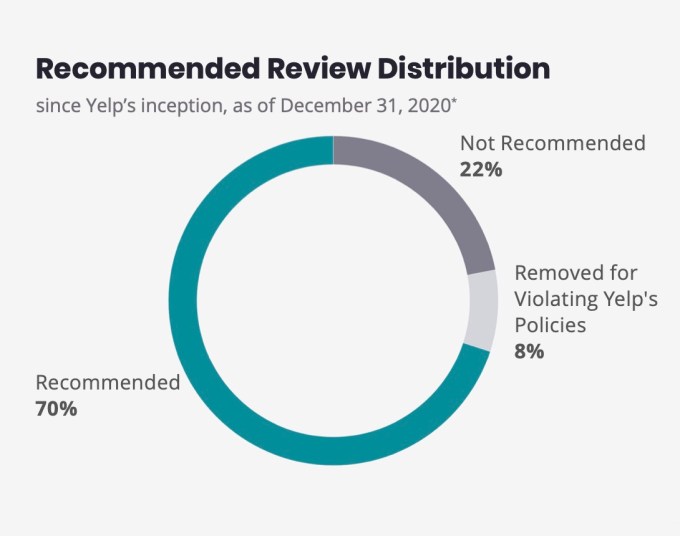
So the company says that last year, users posted more than 18.1 million reviews, of which 4.6 million (about 25%) were not recommended by the software. Someshwara noted that even when a review is not recommended, it’s not removed entirely — users just have to seek it out in a separate section.

Removals do happen, but that’s one of the places where the user operations team comes in. As Vice President of Legal, Trust & Safety Aaron Schur explained, “We do make it easy for businesses as well as consumers to flag reviews. Every piece of content that’s flagged in that way does get reviewed by a live human to decide whether it should should be removed for violating our guidelines.”

Yelp says that last year, about 710,000 reviews (4%) were removed entirely for violating the company’s policies. Of those, more than 5,200 were removed for violating the platform’s COVID-19 guidelines (among other things, they prohibit reviewers from claiming they contracted COVID from a business, or from complaining about mask requirements or criticizing a business had to close due to safety regulations). Another 13,300 were removed between May 25 and the end of the year for threats, lewdness, hate speech or other harmful content.

“Any current event that takes place will find its way onto Yelp,” acknowledged Vice President of User Operations Noorie Malik. “People turn to Yelp and other social media platforms to have a voice.”

But expressing political beliefs can conflict with what Malik said is Yelp’s “guiding principle,” namely “genuine, first-hand experience.” So Yelp has built software to detect unusual activity on a page and will also add a Consumer Alert when it believes there are “egregious attempts to manipulate ratings and reviews.” For example, it says there was a 206% increase in media-fueled incidents year over year.

It’s not that you can’t express political opinions in your reviews, but the review has to come from firsthand experience, rather than being prompted by reading a negative article or an angry tweet about the business. Sometimes, Malik added, that means the team is “removing content with a point of view that we agree with.”

One example that illustrates this distinction: Yelp will take down reviews that seem driven by media coverage suggesting that a business owner or employee behaved in a racist manner, but at the same time, it also labeled two businesses in December 2020 with a “Business Accused of Racism” alert reflecting “resounding evidence of egregious, racist actions from a business owner or employee.”

Beyond looking at individual reviews and spikes in activity, Someshwara said Yelp will also perform “sting operations” to find groups that are posting fraudulent reviews.

In fact, his team apparently shut down 1,200 user accounts associated with review rings and reported nearly 200 groups to other platforms. And it just rolled out an updated algorithm designed to better detect and unrecommend reviews coming from those groups.

Broaden your view of ‘best’ to make smarter, more inclusive investments

David Teten
Contributor

David Teten is founder of Versatile VC and writes periodically at teten.com and @dteten.

Katherine Boe Heuck
Contributor

Katherine Boe Heuck is a MBA candidate at MIT Sloan (class of 2022), a past intern at Versatile VC and a current intern at Metaprop NYC.

What can we learn from the best 40 venture capital investments of all time? Well, we learn to invest exclusively in men, preferably white or Asian.

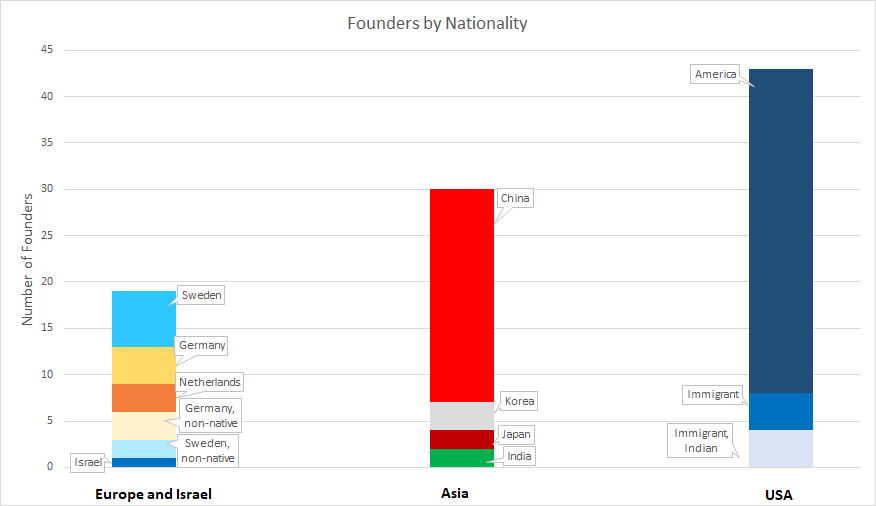
We reviewed CB Insights’ global list of “40 of the Best VC Bets of all Time.” All of the 40 companies’ 92 founders were male.

  • Of the 43 U.S.-based founders, 35 were white American; four were white immigrant/first generation, from France, Ukraine, Russia and Iran; and four were Indian immigrant/first generation.
  • Of the 19 Western Europe/Israel-based founders, all were white.
  • Of the 30 Asia-based founders, all were natives of the country in which they built their businesses: 23 Chinese, three Japanese, two Korean and two Indian.

Of course, this dataset is incomplete. There are numerous examples of founders from underrepresented backgrounds who have generated extremely impressive returns. For example, Calendly’s Tope Awotona is Nigerian American; Sendgrid’s Isaac Saldana is Latinx; and Bumble’s Whitney Wolfe Herd is the second-youngest woman to take a company public.

That said, the pattern in the dataset is striking. So, why invest in anyone who’s not a white or Asian male? 

The conventional answer is that diversity pays. Research from BCG, Harvard Business Review, First Round Capital, the Kauffman Foundation and Illuminate Ventures shows that investors in diverse teams get better returns:

  • Paul Graham, co-founder of Y Combinator (2015): “Many suspect that venture capital firms are biased against female founders. This would be easy to detect: among their portfolio companies, do startups with female founders outperform those without? A couple months ago, one VC firm (almost certainly unintentionally) published a study showing bias of this type. First Round Capital found that among its portfolio companies, startups with female founders outperformed those without by 63%.”
  • Kauffman Fellows Report (2020): “Diverse Founding Teams generate higher median realized multiples (RMs) on Acquisitions and IPOs. Diverse Founding Teams returned 3.3x, while White Founding Teams returned 2.5x. The results are even more pronounced when looking at the perceived ethnicity of the executive team. Diverse Executive Teams returned 3.3x, while White Executive Teams only returned 2.0x. As mentioned above, we report realized multiples (RMs) only for successful startups that were acquired or went through the IPO process.”
  • BCG (June 2018): “Startups founded and co-founded by women actually performed better over time, generating 10% more in cumulative revenue over a five-year period: $730,000 compared with $662,000.”
  • BCG (January 2018): “Companies that reported above-average diversity on their management teams also reported innovation revenue that was 19 percentage points higher than that of companies with below-average leadership diversity — 45% of total revenue versus just 26%.”
  • Peterson Institute for International Economics (2016): “The correlation between women at the C-suite level and firm profitability is demonstrated repeatedly, and the magnitude of the estimated effects is not small. For example, a profitable firm at which 30% of leaders are women could expect to add more than 1 percentage point to its net margin compared with an otherwise similar firm with no female leaders. By way of comparison, the typical profitable firm in our sample had a net profit margin of 6.4%, so a 1 percentage point increase represents a 15% boost to profitability.”

How do we reconcile these two sets of data? Research going back a decade shows that diverse teams, companies and founders pay, so why are all of the VC home runs from white men, or Asian men in Asia, plus a few Asian men in the U.S.?

First Round did not include their investment in Uber in their analysis we reference above on the grounds that it was an outlier. Of course, one could rebut that by saying traditional VC is all about investing in outliers.

  • Seth Levine analyzed data from Correlation Ventures (21,000 financings from 2004-2013) and writes that “a full 65% of financings fail to return 1x capital. And perhaps more interestingly, only 4% produce a return of 10x or more, and only 10% produce a return of 5x or more.” In Levine’s extrapolated model, he found that in a “hypothetical $100 million fund with 20 investments, the total number of financings producing a return above 5x was 0.8 — producing almost $100 million of proceeds. My theoretical fund actually didn’t find their purple unicorn, they found four-fifths of that company. If they had missed it, they would have failed to return capital after fees.”
  • Benedict Evans observes that the best investors don’t seem to be better at avoiding startups that fail. “For funds with an overall return of 3x-5x, which is what VC funds aim for, the overall return was 4.6x but the return of the deals that did better than 10x was actually 26.7x. For >5x funds, it was 64.3x. The best VC funds don’t just have more failures and more big wins — they have bigger big wins.”

The first problem with the outlier model of investing in VC is that it results in, on average, poor returns and is a risker proposition compared to alternative models. The Kauffman Foundation analyzed their own investments in venture capital (100 funds) over a 20-year period and found “only 20 of the hundred venture funds generated returns that beat a public-market equivalent by more than 3% annually,” while 62 “failed to exceed returns available from the public markets, after fees and carry were paid.”

The outlier model of investing in VC also typically results in a bias toward investing in homogeneous teams. We suggest that the extremely homogeneous profiles of the big wealth creators above reflect the fact that these are people who took the biggest risks: financial, reputational and career risk. The people who can afford to take the biggest risks are also the people with the most privilege; they’re not as concerned about providing for food, shelter and healthcare as economically stressed people are. According to the Kauffman Foundation, a study of “549 company founders of successful businesses in high-growth industries, including aerospace, defense, computing, electronics and healthcare” showed that “more than 90% of the entrepreneurs came from middle-class or upper-lower-class backgrounds and were well-educated: 95.1% of those surveyed had earned bachelor’s degrees, and 47% had more advanced degrees.” But when you analyze the next tier down of VC success, the companies that don’t make Top 40 lists but land on Top 500 lists, you see a lot more diversity.

In VC, 100x investment opportunities only come along once every few years. If you bet your VC fund on opportunities like that, you’re relying on luck. Hope is not a strategy. There are many 3x-20x return opportunities, and if you’re incredibly lucky (or Chris Sacca), you might get one 100x in your career.

We prefer to invest based on statistics, not luck. That’s why Versatile VC provides companies with the option of an “alternative VC” model, using a nontraditional term sheet designed to better align incentives between investors and founders. We also proactively seek to invest in diverse teams. Given the choice of running a fund with one 100x investment, or a fund with two 10x investments, we’ll take the latter. The former implies that we came perilously close to missing our one home run, and therefore we’re not doing such a great job investing.

“While we all want to have invested in those exciting home runs/unicorns, most investors are seeking the data points to construct reliable portfolios,” Shelly Porges, co-founder and managing partner of Beyond the Billion, observed. “That’s not about aiming for the bleachers but leveraging experience to reliably deliver on the singles and doubles it takes to get to home base. A number of the institutional investors we’ve spoken to have gone so far as to say that they can no longer meet their targets without alternatives, including venture investments. “

Lastly, the data above reflects companies that typically took a decade to build. As the culture changes, we anticipate that the 2030 “Top 40” wealth creators list will include many more people with diverse backgrounds. Just in 2018, 15 unicorns were born with at least one woman founder; in 2019, 21 startups founded or co-founded by a woman became unicorns. Why?

  • “All else being equal, a larger pool of female-founded companies to select from for VC investing should increase the odds of a higher number of female-founded VC home runs,” said Michael Chow, research director for the National Venture Capital Association and Venture Forward. According to PitchBook, investments in women-led companies grew approximately 54% from 2015 to 2019, from 459 to 709. In the first three quarters of 2020, there have been 468 fundings of women-led companies; this figure beats 2015, 2016 and nearly 2017 total annual fundings. ProjectDiane highlights that from 2018 to 2020, the number of Black women who have raised $1 million in venture funding nearly tripled, and the number of Latinx women doubled. Their average two-year fail rate is also 13 percentage points lower than the overall average.
  • “Millennials value a diverse workforce,” Chow added, according to Gallup and Deloitte Millennial surveys. “In the battle for talent, diverse founders may have the edge in attracting the best and brightest, and talent is what is required for going from zero to one.”
  • The rise in popularity of alternative VC models, which are disproportionately attractive to women and underrepresented founders. We are in the very early days of this wave; according to research by Bootstrapp, 32 U.S. firms have launched an inaugural Revenue-Based Finance fund. Clearbanc notes on their site they have “invested in thousands of companies using data science to identify high-growth funding opportunities. This data-driven approach takes the bias out of decision-making. Clearbanc has funded 8x more female founders than traditional VCs and has invested in 43 states in the U.S. in 2019.”
  • More VCs are working proactively to market to underrepresented founders. Implicit biases are robust and pervasive; it takes a proactive and intentional approach to shift the current status quo of funding,” Dreamers & Doers Founder Gesche Haas said. Holly Jacobus, an investment partner at Joyance Partners and Social Starts, noted that “we’re proud to boast a portfolio featuring ~30% female founders in core roles — well above the industry average — without specific targeting of any sort. However, there is still work to be done. That’s why we lean heavily on our software and CEOs to find the best tech and teams in the best segments, and we are always actively working on improving the process with new systems that remove bias from the dealflow and diligence process.”

Thanks to Janet Bannister, managing partner, Real Ventures, and Erika Cramer, co-managing member, How Women Invest, for thoughtful comments. David Teten is a past Advisor to Real Ventures.

Facebook launches BARS, a TikTok-like app for creating and sharing raps

Facebook’s internal R&D group, NPE Team, is today launching its next experimental app, called BARS. The app makes it possible for rappers to create and share their raps using professionally created beats, and is the NPE Team’s second launch in the music space following its recent public debut of music video app Collab.

While Collab focuses on making music with others online, BARS is instead aimed at would-be rappers looking to create and share their own videos. In the app, users will select from any of the hundreds of professionally created beats, then write their own lyrics and record a video. BARS can also automatically suggest rhymes as you’re writing out lyrics, and offers different audio and visual filters to accompany videos as well as an autotune feature.

There’s also a “Challenge mode” available, where you can freestyle with auto-suggested word cues, which has more of a game-like element to it. The experience is designed to be accommodating to people who just want to have fun with rap, similar to something like Smule’s AutoRap, perhaps, which also offers beats for users’ own recordings.

Image Credits: Facebook

The videos themselves can be up to 60 seconds in length and can then be saved to your Camera Roll or shared out on other social media platforms.

Like NPE’s Collab, the pandemic played a role in BARS’ creation. The pandemic shut down access to live music and places where rappers could experiment, explains NPE Team member DJ Iyler, who also ghostwrites hip-hop songs under the alias “D-Lucks.”

“I know access to high-priced recording studios and production equipment can be limited for aspiring rappers. On top of that, the global pandemic shut down live performances where we often create and share our work,” he says.

BARS was built with a team of aspiring rappers, and today launched into a closed beta.

Image Credits: Facebook

Despite the focus on music, and rap in particular, the new app in a way can be seen as yet another attempt by Facebook to develop a TikTok competitor — at least in this content category.

TikTok has already become a launchpad for up-and-coming musicians, including rappers; it has helped rappers test their verses, is favored by many beatmakers and is even influencing what sort of music is being made. Diss tracks have also become a hugely popular format on TikTok, mainly as a way for influencers to stir up drama and chase views. In other words, there’s already a large social community around rap on TikTok, and Facebook wants to shift some of that attention back its way.

The app also resembles TikTok in terms of its user interface. It’s a two-tabbed vertical video interface — in its case, it has  “Featured” and “New” feeds instead of TikTok’s “Following” and “For You.” And BARS places the engagement buttons on the lower-right corner of the screen with the creator name on the lower-left, just like TikTok.

However, in place of hearts for favoriting videos, your taps on a video give it “Fire” — a fire emoji keeps track. You can tap “Fire” as many times as you want, too. But because there’s (annoyingly) no tap-to-pause feature, you may accidentally “fire” a video when you were looking for a way to stop its playback. To advance in BARS, you swipe vertically, but the interface is lacking an obvious “Follow” button to track your favorite creators. It’s hidden under the top-right three-dot menu.

The app is seeded with content from NPE Team members, which includes other aspiring rappers, former music producers and publishers.

Currently, the BARS beta is live on the iOS App Store in the U.S., and is opening its waitlist. Facebook says it will open access to BARS invites in batches, starting in the U.S. Updates and news about invites, meanwhile, will be announced on Instagram.

Facebook’s recent launches from its experimental apps division include Collab and collage maker E.gg, among others. Not all apps stick around. If they fail to gain traction, Facebook shuts them down — as it did last year with the Pinterest-like video app Hobbi.

In freemium marketing, product analytics are the difference between conversion and confusion

Jeremy Levy
Contributor

Jeremy Levy is CEO and co-founder of Indicative, a product analytics platform for product managers, marketers and data analysts. A serial entrepreneur, Jeremy co-founded Xtify, acquired by IBM in 2013, and MeetMoi, a location-based dating service sold to Match.com in 2014.

The freemium marketing approach has become commonplace among B2C and B2B software providers alike. Considering that most see fewer than 5% of free users move to paid plans, even a slight improvement in conversion can translate to significant revenue gains. The (multi) million-dollar question is, how do they do it?

The answer lies in product analytics, which offer teams the ability to ask and answer any number of questions about the customer journey on an ad-hoc basis. Combined with a commitment to testing, measurement and iteration, this puts data in the driver’s seat and helps teams make better decisions about what’s in the free tier and what’s behind the paywall. Successful enterprises make this evaluation an ongoing exercise.

Often, the truth of product analytics is that actionable insights come from just a fraction of the data and it can take time to understand what’s happening.

Sweat the small stuff

A freemium business model is simply a set of interconnected funnels. From leads all the way through to engagement, conversion and retention, understanding each step and making even small optimizations at any stage will have down-funnel implications. Start by using product analytics to understand the nuances of what’s working and what isn’t, and then double down on the former.

For example, identify specific personas that perform well and perform poorly. While your overall conversion average may be 5%, there can be segments converting at 10% or 1%. Understanding the difference can shine a light on where to focus. That’s where the right analytics can lead to significant results. But if you don’t understand what, why and how to improve, you’re left with guesswork. And that’s not a modern way of operating.

There’s a misconception that volume of data equals value of data. Let’s say you want to jump-start your funnel by buying pay-per-click traffic. You see a high volume of activity, with numbers going up at the beginning of your funnel and a sales team busy with calls. However, you come to learn the increased traffic, which looked so promising at the outset, results in very few users converting to paid plans.

Now, this is a story as old as PPC, but in the small percentage that do convert, there’s a lot to learn about where to focus your efforts — which product features keep users hooked and which ones go unused. Often, the truth of product analytics is that actionable insights come from just a fraction of the data and it can take time to understand what’s happening. Getting users on board the free plan is just the first step in conversion. The testing and iteration continue from there.

The dropped and the languished

Within the free tier, users may languish — satisfied with whatever features they can access. If your funnel is full of languishing users, you’ve at least solved the adoption problem, so why are they stuck? Without a testing and tracking approach, you’ll struggle to understand your users and how they respond, by segment, to changes.

Sources: Lightspeed is close to hiring a new London-based partner to put down further roots in Europe

Lightspeed Venture Partners, the well-known Silicon Valley venture capital firm that has backed the likes of DoubleClick and Snapchat, is in the midst of hiring a second London-based investment partner as it looks to put down further roots in Europe, TechCrunch has learned.

According to multiple sources, Paul Murphy, whose investments include Tier, Hopin, Klang and Bunch, is being hired away from Northzone, the European VC firm that’s probably best known for being an early backer of Spotify. The signing is still in progress but could be announced in the next few weeks. Murphy has been at Northzone for three years and was promoted to general partner in late 2019 when the firm raised a new $500 million fund.

I’ve reached out to Murphy and Lightspeed for comment and will update this article if or when I hear back.

Prior to VC, Murphy co-founded Dots, the mobile games company in New York. He also built and invested in various companies at startup studio Betaworks. (Notably, Murphy helped launch Giphy in the U.S., which Lightspeed ended up backing and later sold to Facebook for $400 million). Before that, he held several roles at Microsoft in the U.S., U.K. and India. He also holds a BS in Computer Engineering from Virginia Tech and an MBA from The IE Business School in Spain, according to the Northzone website.

Meanwhile, the fact that Lightspeed is formally putting more people on the ground in Europe should come as no surprise to close watchers of the ecosystem here. TechCrunch first heard rumors that the Menlo Park-based VC was recruiting a partner in London as far back as August in 2019. That saw Rytis Vitkauskas join the U.S. firm as its first partner in London the following September, according to LinkedIn. Should Murphy’s recruitment be confirmed it would signal a significant expansion of a Lightspeed London “office,” and confirmation that the VC is doubling down in the region.

Those rumors in late last 2019 coincided with news spreading that another Silicon Valley VC heavyweight, Sequoia, was also doing the same — along with talk of other U.S. VC firms — as European tech companies continue to create more value than ever before. Sequoia’s own plans were finally announced in November, including that it had poached Luciana Lixandru away from rival Accel Partners.