Address cybersecurity challenges before rolling out robotic process automation

Alan Radford
Contributor

Alan Radford is regional CTO of One Identity and has a passion for helping organizations solve unique challenges in the identity and access management space.

Robotic process automation (RPA) is making a major impact across every industry. But many don’t know how common the technology is and may not realize that they are interacting with it regularly. RPA is a growing megatrend — by 2022, Gartner predicts that 90% of organizations globally will have adopted RPA and its received over $1.8 billion in investments in the past two years alone.

Due to the shift to remote work, companies across every industry have implemented some form of RPA to simplify their operations to deal with an influx of requests. For example, when major airlines were bombarded with cancellation requests at the onset of the pandemic, RPA became essential to their customer service strategy.

Throughout 2021, security teams will begin to realize the unconsidered security challenges of robotic process automation.

According to Forrester, one major airline had over 120,000 cancellations during the first few weeks of the pandemic. By utilizing RPA to handle the influx of cancellations, the airline was able to simplify its refund process and assist customers in a timely matter.

Delivering this type of streamlined cancellation process with such high demand would have been extremely challenging, if not impossible, without RPA technology.

The multitude of other RPA use cases that have popped up since COVID-19 have made it evident that RPA isn’t going away anytime soon. In fact, interest in the usage of RPA is at an unprecedented high. Gartner inquiries related to RPA increased over 1,000% during 2020 as companies continue to invest.

However, there’s one big issue that’s commonly overlooked when it comes to RPA — security. Like we’ve seen with other innovations, the security aspect of RPA isn’t implemented in the early stages of development — leaving organizations vulnerable to cybercriminals.

If the security vulnerabilities of RPA aren’t addressed quickly, there will be a string of significant RPA breaches in 2021. However, by realizing that these new “digital coworkers” have identities of their own, companies can secure RPA before they make the headlines as the latest major breach.

Understanding RPA’s digital identity

With RPA, digital workers are created to take over repetitive manual tasks that have been traditionally performed by humans. Their interaction directly with business applications mimics the way humans use credentials and privilege — ultimately giving the robot an identity of its own. An identity that is created and operates much faster than any human identity but doesn’t eat, sleep, take holidays, go on strike or even get paid.

Eco raises $26M in a16z-led round to scale its digital cryptocurrency platform

‍Eco, which has built out a digital global cryptocurrency platform, announced Friday that it has raised $26 million in a funding round led by a16z Crypto.

Founded in 2018, the SF-based startup’s platform is designed to be used as a payment tool around the world for daily-use transactions. The company emphasizes that it’s “not a bank, checking account, or credit card.”

“We’re building something better than all of those combined,” it said in a blog post. The company’s mission has also been described as an effort to use cryptocurrency as a way “to marry savings and spending,” according to this CoinList article.

Eco users can earn up to 5% annually on their deposits and get 5% cash back when transacting with merchants such as Amazon, Uber and others. Next up: The company says it will give its users the ability to pay bills, pay friends and more “all from the same, single wallet.” That same wallet, it says, rewards people every time they spend or save.

After a “successful” alpha test with millions of dollars deposited, the company’s Eco App is now available to the public.

A slew of other VC firms participated in Eco’s latest financing, including Founders Fund, Activant Capital, Slow Ventures, Coinbase Ventures, Tribe Capital, Valor Capital Group and more than one hundred other funds and angels. Expa and Pantera Capital co-led the company’s $8.5 million funding round.

CoinList co-founder Andy Bromberg stepped down from his role last fall to head up Eco. The startup was originally called Beam before rebranding to Eco “thanks to involvement by founding advisor, Garrett Camp, who held the Eco brand,” according to Coindesk. Camp is an Uber co-founder and Expa is his venture fund.

For a16z Crypto, leading the round is in line with its mission.

In a blog post co-written by Katie Haun and Arianna Simpson, the firm outlined why it’s pumped about Eco and its plans.

“One of the challenges in any new industry — crypto being no exception — is building things that are not just cool for the sake of cool, but that manage to reach and delight a broad set of users,” they wrote. “Technology is at its best when it’s improving the lives of people in tangible, concrete ways…At a16z Crypto, we are constantly on the lookout for paths to get cryptocurrency into the hands of the next billion people. How do we think that will happen? By helping them achieve what they already want to do: spend, save, and make money — and by focusing users on tangible benefits, not on the underlying technology.”

Eco is not the only crypto platform offering rewards to users. Lolli gives users free bitcoin or cash when they shop at over 1,000 top stores.


Early Stage is the premier “how-to” event for startup entrepreneurs and investors. You’ll hear firsthand how some of the most successful founders and VCs build their businesses, raise money and manage their portfolios. We’ll cover every aspect of company building: Fundraising, recruiting, sales, product-market fit, PR, marketing and brand building. Each session also has audience participation built-in — there’s ample time included for audience questions and discussion.

Early-stage investor Mayfield shows how to scale up your biotech startup at TC Early Stage in April

Founders in the earliest stages of startup life face a hefty learning curve. Just some of the core competencies you need to lock down include how to raise VC funding, recruiting the right people, finding product-market fit and building a killer go-to-market team. The list goes on and on…and on. You’ll learn about all those topics and more at TechCrunch Early Stage Operations & Fundraising taking place on April 1-2. 

Do you science? Are you inspired to use biology as technology? If your entrepreneurial interests lean toward the scientific side of the startup equation, you don’t want to miss this special session — brought to you by Mayfield — at TC Early Stage 2021 on April 1-2.

Scientist Entrepreneurs — Scaling Breakout Engineering Biology Companies 

Arvind Gupta and Ursheet Parikh, early-stage investors, company builders and Mayfield partners, along with Po Bronson, NYT bestselling author and managing director of IndieBio, will discuss scaling startups and touch upon three seminal areas that influence trajectory: fundraising, hiring and product design. Their insights draw on their experience with companies including ingredients-as-service leader Geltor (which raised a $91 million Series B in 2020); CRISPR platform Mammoth Biosciences (its dream team includes co-founder and Nobel Laureate Jennifer Doudna); and Endpoint Health (started by GeneWEAVE’s founding team and former YC Bio Partner Diego Rey).

Whether you’re a biotech entrepreneur, a researcher or a scientist tackling the daunting challenges of human and planetary health, this session will help you build a stronger, more successful startup as you take your product to market.

Mayfield will follow up this session with even more content at Disrupt 2021 in September. These sessions will reveal company-building insights from entrepreneurs, investors, industry leaders and policymakers. Mayfield invests in exceptional people whose mission in life is to create a better world — not just for our generation  but for future generations as well. If you science, don’t miss your opportunity to learn from leading investors who have partnered with iconic biotech and health IT entrepreneurs — from Amgen and Genentech to Mammoth Biosciences.

Get your ticket for the April TC Early Stage event here. Or get a dual-event ticket for the April and July events for double the knowledge across operations, marketing, recruiting and fundraising — and save up to $100.

Is your company interested in sponsoring or exhibiting at Early Stage 2021 — Operations & Fundraising? Contact our sponsorship sales team by filling out this form.

Albertsons taps Tortoise for remote-controlled grocery delivery robots

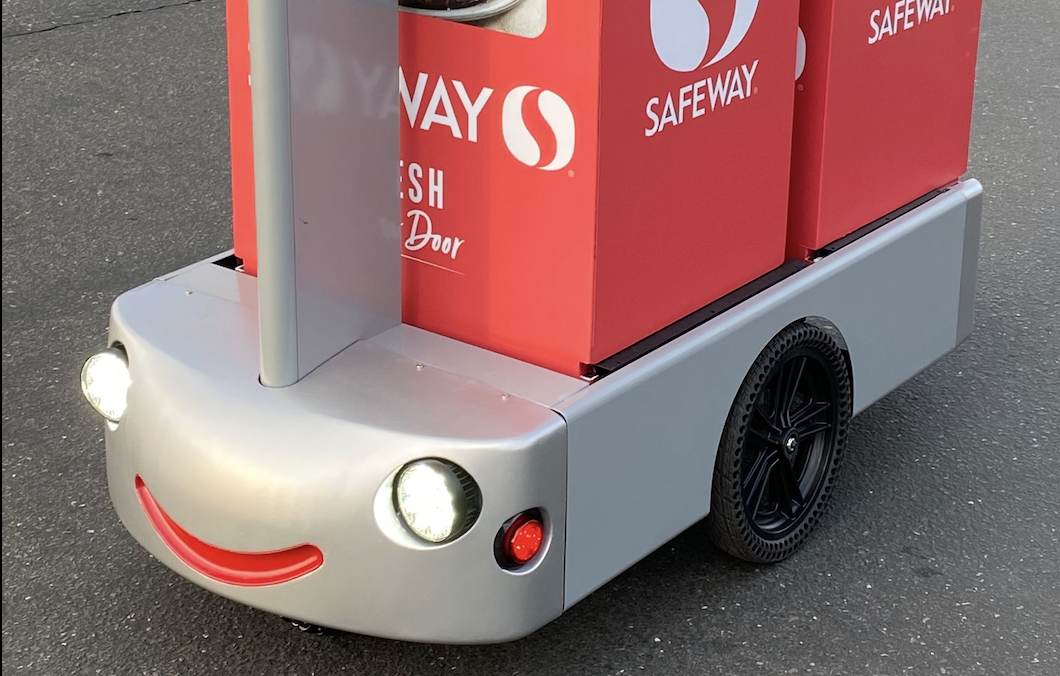
Albertsons Companies, the grocery giant that owns Safeway and Jewel-Osco, has launched a pilot program that will test grocery delivery using remote-controlled delivery robots developed by Silicon Valley startup Tortoise.

The pilot will start at two Safeway locations in Northern California, although Tortoise co-founder and president Dmitry Shevelenko said if successful, he expects the pilot to continue to scale to other stores in the state and possibly throughout the West Coast.

Safeway-branded delivery carts equipped with Tortoise’s sensors and software will be able to deliver goods to customers up to three miles from the store location. Remote-control operators located thousands of miles away will guide the delivery cart to its destination.

The delivery carts, which can hold up to 120 pounds of groceries in four lockable containers, will initially have a human escort. The aim is the remove the extra guide once the pilot is established. Once the delivery cart arrives, the customer receives a text to come outside and pick up their groceries. 

Safeway Tortoise

Image Credits: Tortoise/Albertsons

The pilot is the latest example of large retailers adopting technology in a bid to get goods to customers faster. Amazon, Kroger and Walmart are just a few that are experimenting with delivery robots and using autonomous vehicles to shuttle goods to customers or within its distribution network.

“Our team is obsessed with trying new and disruptive technologies that can bring more convenience for our customers,” Chris Rupp, EVP and chief customer and digital officer said in a statement. “We are willing to quickly test, learn and implement winning innovations that ensure we are offering the easiest and most convenient shopping experience in the entire industry.”

The deal is also a validation of Tortoise’s move into delivery carts, a business pursuit that it kicked off less than a year ago.

“The idea didn’t hit us until April,” Shevelenko said in a recent interview, who added that the first delivery cart was launched in Los Angeles in late October.

Tortoise got its start by equipping electric scooters with cameras, electronics and firmware that allow teleoperators in distant locales to drive electric scooters and bikes to a rider or deliver it back to its proper parking spot. Last spring, as the COVID-19 pandemic raised demand for delivery services, Tortoise adapted its technology to a cart that could shuttle groceries.

“I think about [Amazon] Prime, after that launched everyone expected two-day delivery, and seven days felt like a lifetime.” Now, two days feels like a lifetime as expectations shift to same-day delivery, he added.

Tortoise initially focused on neighborhood stores and specialty brand shops, through a partnership with an online grocery platform. Shevelenko’s strategy is to land contracts with big retailers while continuing to partner with online commerce platforms, which would allow it to reach smaller, independent stores.


Early Stage is the premier “how-to” event for startup entrepreneurs and investors. You’ll hear firsthand how some of the most successful founders and VCs build their businesses, raise money and manage their portfolios. We’ll cover every aspect of company building: Fundraising, recruiting, sales, product-market fit, PR, marketing and brand building. Each session also has audience participation built-in — there’s ample time included for audience questions and discussion.

The technology selloff is getting to be somewhat material

Tech stocks are getting hammered today, with previously high-flying shares of software companies taking even more damage.

For a sector that has enjoyed a year in the sun, recent trading sessions have punctured a period of market adoration. It is too soon to say that the market is repricing tech stocks, but the selloff has reached the point of materiality and is therefore something we need to note.

As we write, the tech-heavy Nasdaq Composite is off another 1.2% today after previous declines. The now-infamous ARK Innovation ETF is off 6.5% and the list of individual declines worth noting in the tech sector is very long indeed.

The change in sentiment is clear in recent results. Here’s the tech-heavy Nasdaq Composite:

  • Nasdaq Composite 52-week high: 14,175.12
  • Nasdaq Composite today: 12,561.13
  • Percent change: -11.4%

And the damage intensifies if we consider just SaaS and cloud stocks. Here’s the Bessemer cloud index:

  • Bessemer cloud index 52-week high: 2,884.23
  • Bessemer cloud index today: 2,185.62
  • Percent change: -24.2%

In more prosaic terms, the Nasdaq is in a technical correction, while SaaS stocks have reached bear-market territory. That’s quite a turnabout from recent all-time highs for both.

Not just software

Lost on the TechCrunch editing floor from late yesterday is a post we wrote noting the sharp declines in the value of insurtech stocks ahead of the impending public debut of Hippo, another neo-insurance company. The SPAC-led Hippo flotation will not touch down in a warm market. Instead, its contemporaries look like this today:

  • Lemonade 52-week high: $188.30
  • Lemonade current price: $84.72
  • Change: -55.0%
  • Root Insurance 52-week high: $29.48
  • Root Insurance current price: $12.38
  • Change: -58.0%
  • MetroMile 52-week high: $20.39
  • MetroMile current price: $10.04
  • Change: -50.8%

The damage is widespread. Hell, recent IPO success-story Snowflake announced yesterday that it grew from revenues of $88 million in its year-ago quarter to $190 million in its most recent. And its stock is off more than 7% today.

We’ll leave it to you whether the changing public valuations are just a blip or a more staid change in the winds. But it does feel different out there.

For startups, this is all somewhat poor news. Valuations for public comps were strong in 2020. To lose that halo in 2021 could crimp late-stage valuations, perhaps even reaching back to Series A and B rounds to limit some upside for growing upstarts. But such an impact will lag the public markets, so don’t expect things to change quite yet.

Still, every private investor has their eye on the exit when it comes to their deals. And if that exit is suddenly shrinking, so too might their interest in paying for quite so great a markup on their next deal.


Early Stage is the premier “how-to” event for startup entrepreneurs and investors. You’ll hear firsthand how some of the most successful founders and VCs build their businesses, raise money and manage their portfolios. We’ll cover every aspect of company building: Fundraising, recruiting, sales, product-market fit, PR, marketing and brand building. Each session also has audience participation built-in — there’s ample time included for audience questions and discussion.

YC-backed Pangea discusses growth, fundraising ahead of demo day

Pangea, a marketplace startup that wants to connect college freelancers and companies in need of digital help, is seeing its growth rate accelerate as it races toward the impending Y Combinator demo day.

It’s traditional around this time that startups in the accelerator reach out to say hello. Provided that they are willing to chat growth metrics, we’re willing to listen.

Pangea, based in Providence, Rhode Island, is one such company. TechCrunch previously covered the company when it announced a $400,000 pre-seed round last April. Now most of the way through the YC accelerator, the company dished regarding its recent growth and the fact that it added more capital to its accounts late last year.

The Pangea team, from their shared house/office. Via the company.

On the growth side of the coin, Pangea CEO Adam Alpert told TechCrunch the company has grown its gross merchandise volume (GMV) sequentially by 35% in each of the last two months. That’s a steep pace of GMV expansion. And the growth is adding up to real numbers, with Pangea facilitating $50,000 in transactions between college freelancers and businesses in the last four weeks.

Alpert said that its year-ago number was around $3,000 or $4,000.

And the company has managed to expand its market take rate to around 25%, tinkering with how it charges for its service. The result is a model that might resonate with anyone familiar with Fiverr, and may help the company more rapidly expand its net revenue.

The company’s recent growth comes after it secured another $350,000 in November 2020 at a higher cap to its previously known pre-seed round. And, of course, it raised $125,000 from Y Combinator, funds that landed in its accounts this January.

Pangea is now active in 600 campuses, Alpert said. And it has found where its service is most in-demand, namely among emerging brands and smaller tech startups. Those firms often need the types of services that college kids are good at — social media, design, etc. — making them a good fit.

The company was somewhat coy on upcoming product news but was clear that it’s looking for investing partners as it works toward Series A scale. Let’s see how Pangea does in a few weeks.


Early Stage is the premier “how-to” event for startup entrepreneurs and investors. You’ll hear firsthand how some of the most successful founders and VCs build their businesses, raise money and manage their portfolios. We’ll cover every aspect of company building: Fundraising, recruiting, sales, product-market fit, PR, marketing and brand building. Each session also has audience participation built-in — there’s ample time included for audience questions and discussion.

Understanding how investors value growth in 2021

We’re not digging into another IPO filing today. You can read all about AppLovin’s filing here, or ThredUp’s document here.

This morning, instead, we’re talking about an old favorite: software valuations. The folks over at Battery Ventures have compiled a lengthy dive into the 2020 software market that’s worth our time — you can read along here; I’ll provide page numbers as we go — because it helps explain some software valuations.


The Exchange explores startups, markets and money. Read it every morning on Extra Crunch, or get The Exchange newsletter every Saturday.


There’s little doubt that there is some froth in the software market, but it may not be where you think it is.

The Battery report has a lot of data points that we’ll also work through in this week’s newsletter, but this morning, let’s narrow ourselves to thinking about rising aggregate software multiples, the breakdown of multiples expansion through the lens of relative growth rates, and cap it off with a nibble on the importance, or lack thereof, of cash flow margins for the valuation of high-growth software companies.

We’ll look at the changing public market perspective, and then ask ourselves if the aggregate image that appears is good or not good for software startups.

I chatted through pieces of the report with its authors, Battery’s Brandon Gleklen and Neeraj Agrawal. So, we’ll lean on their perspective a little as we go to help us move quickly. This is our Friday treat. Or at least mine. Let’s get into it.

Rising multiples

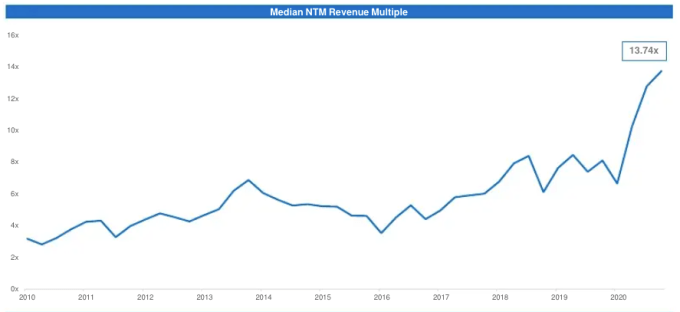
Let’s start with an affirmation. Yes, software valuations have risen to record-high multiples in recent years. Here’s the Battery chart that makes the change clear:

Page 31, Battery report. Image Credits: Battery Ventures

Mary Meeker’s Bond is closing on $2 billion for its second fund, per a new filing

Bond, the growth-stage firm that spun out of the Kleiner Perkins Digital Growth Fund in late 2018, is closing a second fund with $2 billion, suggests a new SEC filing that says the amount has not yet been raised, though investment firms sometimes file their paperwork at the final stages of their fundraising and even long afterward.

Axios was first to flag the paperwork.

Earlier today, we reached out to the firm — which closed its debut fund with $1.25 billion in 2019 — and are awaiting more information. But that Bond would be raising almost twice as much capital for its second vehicle is unsurprising for numerous reasons. For one, thing, the outfit, spearheaded by famed former investment banker Mary Meeker — who left Kleiner with other alums of the firm including Mood Rowghani, Noah Knauf, Juliet de Baubigny, Daegwon Chae, and Paul Vronksky — has been adding to its investing roster.

Most notably, late last year the firm brought aboard Jay Simons to lead its global enterprise practice. Simons knows a thing or two about scaling a business as the former president of Atlassian, the maker of business development and collaboration software that went public in 2015 at a $4.3 billion valuation and now boasts a market cap of nearly $57 billion. (Simons joined the outfit in 2008 as its VP of sales and was promoted to president three years later, spending the next nine years in that role before leaving last summer.) According to LinkedIn, the firm has separately hired a more junior investor, Alex Knight, a Yale graduate and former Stanford business school student who is based in New York.

Bond’s team has also backed the kinds of brands that institutional investors like to see in a portfolio, with growth-stage bets while at Kleiner that include Slack, Uber, Snap and Waze, and current stakes through Bond in some other big and growing businesses around the world. Among these is Byju’s of India, which is among the world’s largest ed tech companies and whose founder wants to take the company public in the next year or two; the London-based online bank Revolut, which was valued at $5.5 billion by private investors as of a year ago and said last month it eventually aims to go public via a traditional U.S. IPO; and Canva, the Australia-based design platform for non-designers that was valued at $6 billion during its last funding round in June of last year.

Of course, a third reason that Bond is raising so much capital ties to the large amount of money still sloshing around in the market and which seems more eager than ever to find its way into late-stage deals, particularly as more companies are being brought into the public market at jaw-dropping valuations.

One of Bond’s portfolio companies, for example, Nextdoor, was last valued by private investors at $2.2 billion back in 2019. According to Bloomberg, the company, which has raised $470 million altogether, began considering options to go public several months ago at a valuation in the range of $4 billion to $5 billion.

Altogether, Bond appears to have used its first fund to invest in roughly 20 companies. Among its newest bets is Locus Robotics, a nearly seven-year-old, Wilmington, Ma.-based company that makes autonomous mobile robots for warehouses and that announced $150 million in Series E funding at a post-money valuation of $1 billion last month co-led by Tiger Global Management and Bond.

According to a December report in The Information, Bond also led the newest round for portfolio company Ironclad, which develops software that helps companies such as Dropbox and MasterCard create and manage business contracts. According to The Information, Bond led a Series D round of at least $100 million for the company at a post-investment valuation of more than $950 million, more than double its valuation from late 2019.

Revolut lets customers switch to Revolut Bank in 10 additional countries

Fintech startup Revolut has its own banking license in the European Union since late 2018. It lets the company offer some additional financial services without partnering with third-party companies. And the company is going to let customers switch to Revolut Bank in 10 additional countries.

The Bank of Lithuania has granted a specialized license — it isn’t a full-fledged license per se, as it focuses on some activities. The company is taking advantage of European passporting rules to operate in other European countries. Right now, Revolut takes advantage of its banking license in two countries — Poland and Lithuania.

In Lithuania for instance, you can apply for a credit card with a credit limit that’s twice the value of your monthly salary (up to €6,000). The company also offers personal loans between €1,000 and €15,000. You can pay back over one to 60 months.

Now, customers in Bulgaria, Croatia, Cyprus, Estonia, Greece, Latvia, Malta, Romania, Slovakia and Slovenia will be able to become Revolut Bank customers. It’s not a transparent process, as you need to get through a few steps to carry your account over.

But once this process is done, your deposits are protected under the deposit guarantee scheme. If Revolut Bank shutters at some point down the road, customers can claim up to €100,000 thanks to the scheme — both euros and foreign currencies are protected.

You can expect new credit products in the 10 new markets. Overall, Revolut has attracted 15 million customers. The company recently announced that it was also applying for a banking license in the U.K., its home country and its biggest market.

SpaceX’s Starship prototype flies to 32,000 feet and sticks the landing in third flight test

SpaceX has launched SN10 — the tenth iteration of its current prototype series of Starship, the heavy-lift reusable spacecraft it’s developing. Starship SN10 took off from Boca Chica, Texas, where SpaceX is developing the vehicle. It flew to a height of roughly 10 km, or 32,000 feet, before performing a maneuver to re-orient itself for a friction-assisted landing descent.

Unlike the last two Starship prototypes to fly this high, however, the roughly six-minute flight did not end in a fireball [UPDATE: Well, not immediately. The rocket did blow up while stationary on the landing pad a few minutes after landing, potentially due to a leak]. Instead, it completed its landing flip maneuver as intended and slowed itself for a soft touchdown, with the rocket remaining vertical and intact afterwards.

This was a fantastic outcome, and a nominal one in all regards according to SpaceX’s livestream. But why the prior explosions to get to this point? That’s partly down to the way in which it has been doing its development of this vehicle. All rocket development includes unexpected events and sub-optimal outcomes, but SpaceX has a couple of things at work that mean is efforts are subject to unusual scrutiny versus your average spaceship manufacturer.

First, it’s doing this out in the open — the Boca Chica facility is basically just a couple small buildings, some concrete pads, some storage tanks and some scaffolding. It’s extremely close to a public roadway (which is closed during testing, while the surrounding area is evacuated), and people can and do just drive up and set up cameras to film what’s going on. That’s not at all how legacy rocket makers have typically done things.

Second, SpaceX founder and CEO Elon Musk has been adamant that SpaceX pursue a development strategy of rapid iteration and prototyping with Starship’s development. That has meant it’s manufacturing and assembling Starship prototypes simultaneously, making small changes as it goes, rather than stepping back after each test and doing a prolonged, multi-month analysis before proceeding with building and flying another version.

A launch attempt earlier in the day was cut short after a brief engine fire, when instrument readings from the rocket showed a slightly high thrust value that violated what Musk termed “conservative.” The fix that SpaceX instituted was actually adjusting the limit higher in order to avoid the abort initiation.

No doubt the company will do an investigation into the cause of the explosion that followed the successful flight and landing maneuver, but the test was still successful in all the ways that matter most for SpaceX at this stage of development. Next up for Starship is likely increasing the height of these test flights. Eventually, the goal is to reach orbit, of course, but SpaceX is likely to try a few launches that remain atmospheric but far exceed this one before it attempts making that trip.

The Aston Martin DBX is a tale of two vehicles

The Aston Martin DBX is the brand’s first SUV — and the stakes for the iconic British luxury car maker couldn’t be higher.

Like Astons before it, the DBX is objectively handsome. Its sculptural form stretches out to unapologetic ample proportions, and stands out in the crowd of SUVs that frequent the private-school pickup lane. It’s an opulent design that scores high on aesthetics, performance and character. It’s also a vehicle that arrives late to the ultra premium SUV segment, and lacks the in-car technology and fuel economy of others of its ilk. Sales of the DBX, which starts at $176,900, began overseas last summer and entered the U.S. market in late 2020. (The version Aston Martin provided to TechCrunch for a test drive had the option-loaded retail price of $205,186 DBX, including delivery fees.)

Call it a tale of two vehicles in a time of dueling principles vying for luxury auto buyer budgets. Demand for SUVs continues to skyrocket, just as the mobility sector inclines sharply toward electrification. Aston Martin set a goal of selling 14,000 vehicles by 2023, a steep hike for a small, boutique brand. However, under new leadership, the company has dialed back those projections to 10,000 as part of its reorganization dubbed “Project Horizon.”

After an underwhelming year due to the pandemic, a new major owner and a new CEO are in place. It’s unclear which narrative will determine the DBX’s fate. The future of the company rests on its success.

Aston Martin said the DBX met sales expectations in 2020, with 1,516 units sold. The company anticipates that the DBX will make up 40% to 60% of global volume in 2021 — its first year of full production.

A tale of two vehicles

How to achieve best-in-class tech in both engineering and in-car experience is a quagmire for low-volume supercar makers who aren’t owned by a larger automaker that can lend that expertise. Aston took steps to solve this problem through an agreement reached with Mercedes-Benz AG to develop engines and electric architecture back in 2013. Tobias Moers, who headed up Mercedes-Benz’s AMG division until last summer, is Aston’s new CEO, a clue on how vital Aston still sees Daimler’s technical performance to its future.

Aston Martin has recently reentered Formula One racing, and true to the brand’s motorsports history, the DBX has sports car-like power, sprinting from 0 to 60 miles per hour in 4.3 seconds, using Mercedes-Benz AMG engines.

On the interior, the DBX scores high as a total sensory experience to drive (and floss in), affording its passengers panache and comfort, all swathed in Bridge of Weir leather. There are nifty options such as a snow pack, complete with a ski boot warmer.

Image Credits: Aston Martin

The other half of this product’s interior story raises more pragmatic questions about the role of in-car tech in the super luxury segment, and gets at the crux of Aston’s dilemma. Aston will always be at least one generation behind the latest Mercedes advancements. For a vehicle with a starting price of $180,000, cars that cost half the price have more advanced in-car features.

User experience

The Aston Martin DBX is equipped with COMAND, an infotainment system that Mercedes introduced in 1998, refreshed in 2014 and updated again in 2016. When it comes to tech, a few years feels like a lifetime. 

The challenge is that it’s not as simple as replacing a head-unit, Nathan Hoyt, a spokesperson for Aston Martin, told TechCrunch.

“The car would need to be revised to work a whole new electrical architecture” he said. “That said, the closer alignment we previously announced between Mercedes and Aston Martin means we will continue using MB technology for the foreseeable future.”

While Aston Martin is saddled with an older system, Mercedes-Benz has since moved on to MBUX, a new more technologically advanced infotainment system that was introduced in 2018 and has already been updated. No word on when MBUX will find its way to Aston Martin products.

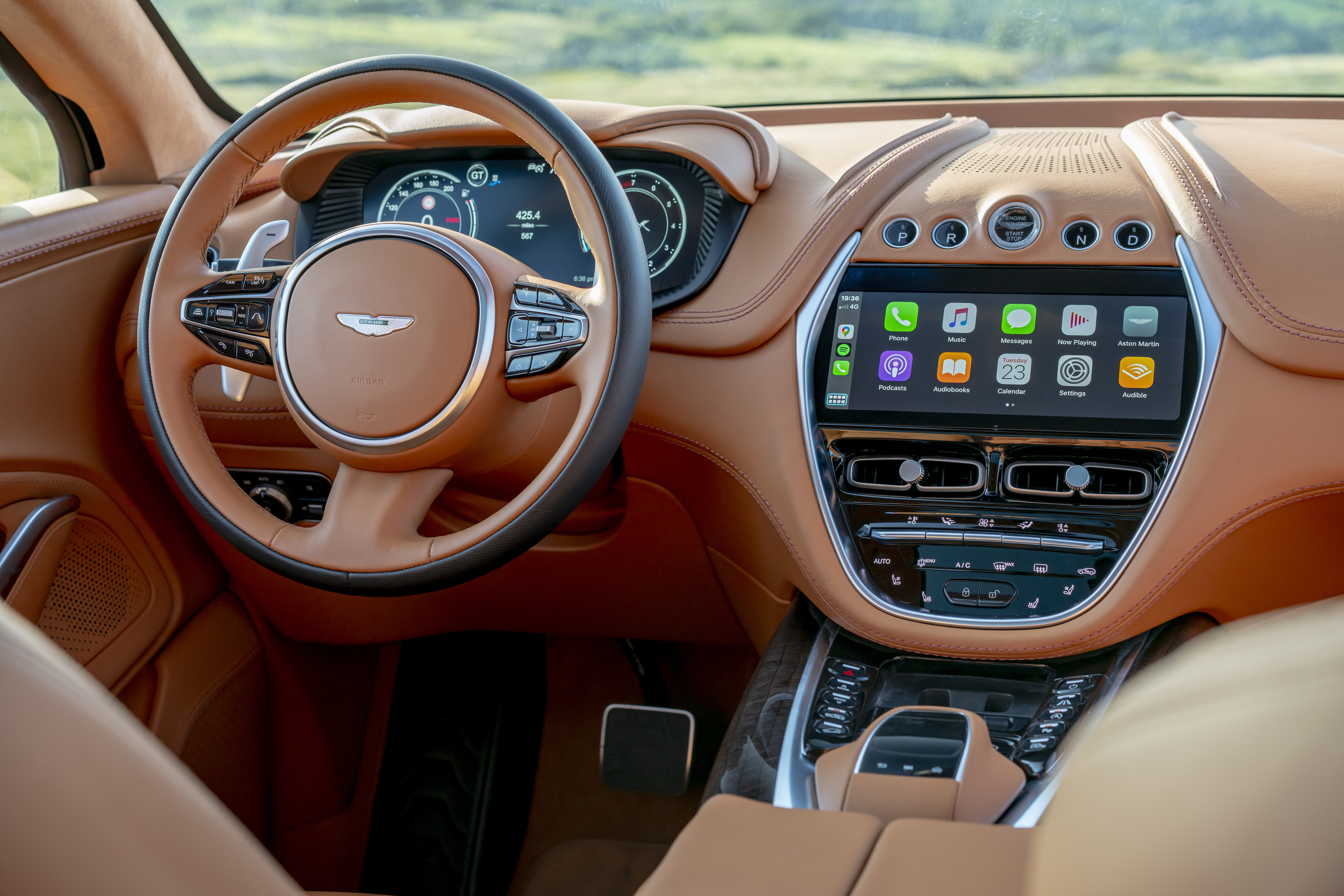
In practical terms, that means a 2021 luxury vehicle that’s missing a touchscreen. What’s in its place is far too much clunky plastic to be called classic analog, which perhaps would make more sense. Think Mac keyboard, circa 2014. Apple CarPlay is standard on the DBX, but it lacks Android Auto.
aston-martin-dbx interior

Image Credits: Aston Martin

Instead of slick knobs, there are plastic buttons that seem out of step with the rest of the vehicle’s swanky naturally sourced woods. Plastic is also present on the air vents and gear selector.

In fairness, the everything-but-the-kitchen sink isn’t the best solution to in-car technology. Many carmakers have far too much frustrating and tactile tech on the dash that isn’t intuitive.

aston-martin-dbx-hyper-red-a1-aml-213-jpg.

Image Credits: Aston Martin

The tech that stood out

Aston’s done what it can to make DBX’s inner working distinct from the traditional Mercedes system. Creative thinking shows up in the 10.2-inch display’s slick graphics made for DBX on the center stack. A DB5, James Bond’s vehicle of choice, is used as an icon to indicate adaptive cruise control activation.

Aston manages to use the tech that it does have to its advantage — and it’s a whole mood.

Ambient lighting offers 64 different colors in two zones and a sound system that feels of the moment. The custom sound system boasts 790 watts over 13 speakers and a sealed subwoofer, and noise compensation tech that drowns out road noise. The combination of that cushy cabin and the boom of those speakers makes it feel as if one is driving around in a high-end theater, back when we all went to the movies, or if you’re an Aston owner, escaped into your personal home theater.

ADAS: form and function

Aston compensates for lack of computational power by making adaptive cruise control, front and rear parking sensors, lane-departure warning, lane-keeping assist and blind-spot monitoring all standard safety features.

Each function is housed in one of the aforementioned plastic buttons. Adaptive cruise control is on the left of the steering wheel, and can be adjusted to monitor distance and speed. The lane-keeping assist button is on the right of the center console.

The controls on the center console require the driver to glance down for a brief moment, causing the eyes to flit off the road. When lane-keeping assist is engaged, a light on the dash and a gentle twitch of the wheel alert the driver. Other switches control driver performance and Aston’s air suspension settings.

Character study

Stateside, Aston might be limited to James Bond, but for the British car culture enthusiasts, the brand is steeped in emotion, gravitas and significance. I attended the Aston centenary in 2010 in England, where I saw an outpouring of love across the U.K. for the brand’s heritage.

Under former CEO Andy Palmer, Aston was in pursuit of its future. A more modern factory in Wales was built to make DBX. But part of Aston’s intrinsic appeal is that some components are still hand built to suit the low-volume connoisseur of a few thousand-of-a-kind vehicle. As cars become more complex computerized systems, hand built becomes more of a liability.

The DBX’s path comes down to what the prospective driver wants and needs this vehicle to be in place of proper high-six figure dream machine such as the Rolls-Royce Cullinan owned by the BMW group, or Bentley Bentayga, Lamborghini Urus and Porsche Cayenne, which fall under the collective VW umbrella. Or Tesla, which is Tesla.

aston-martin-dbx

Image Credits: Aston Martin

As slick technological features become more important, Aston Martin may need to rethink how it solves for lagging behind. That may mean doubling down on what it means to be unapologetic and classic. Or using future powertrain variants to push the 21st century automaker messaging. The latter seems most likely.

A 2020 agreement with Mercedes that builds off of an existing partnership will give Aston Martin access to a wide range of technology, including electric, mild and full hybrid powertrain architectures through 2027.

Aston Martin indicated in its latest earnings call that offering a hybrid SUV will be important for the company. Tobias Moers, Aston Martin’s new CEO and the former head of Mercedes-Benz AMG, said a plug-in hybrid DBX will be offered before 2024. All-electric vehicles are part of the company’s plans as well, and have been targeted for middle of the decade.

The question is whether Aston Martin will give the infotainment system the needed upgrade to match the hybrid and EV tech.

When it comes to high-six figure SUVs, the air is thin at the top.
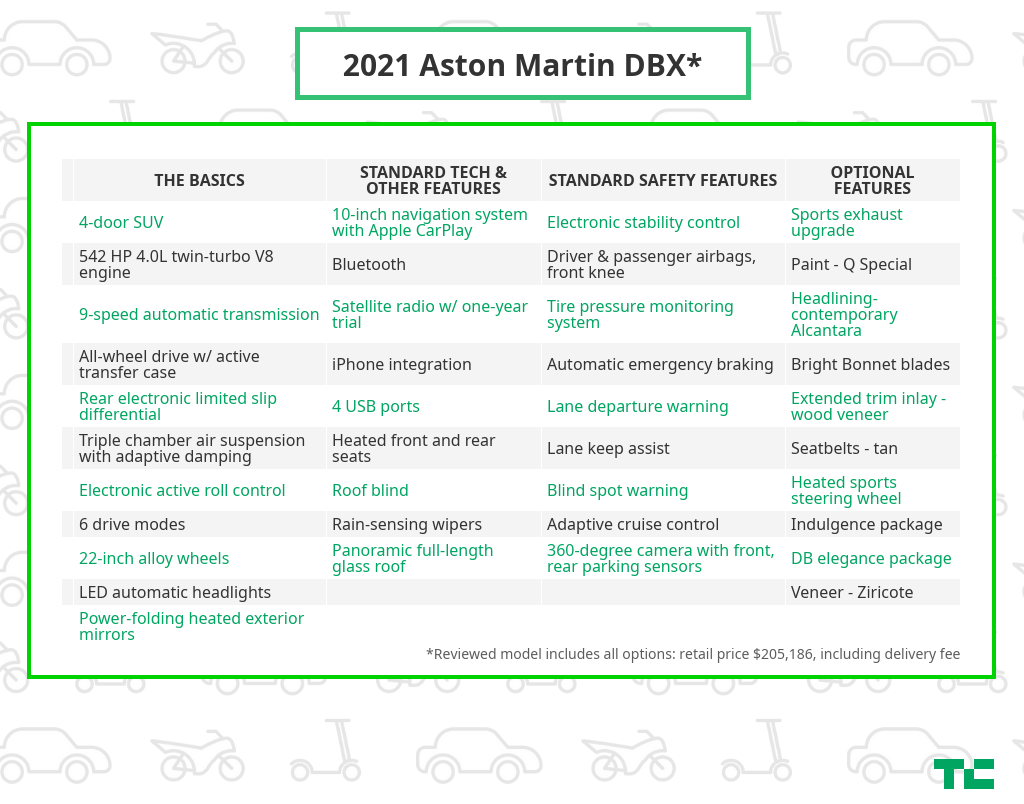
Image Credits: Bryce Durbin


Daily Crunch: Google swears off ad-tracking

Google says it’s focusing on privacy-friendly approaches to ad targeting, Okta acquires Auth0 and a flying taxi startup raises $241 million. This is your Daily Crunch for March 3, 2021.

The big story: Google swears off ad-tracking

While Google had already announced it would be phasing out support for third-party cookies in Chrome, it went further today by declaring that “once third-party cookies are phased out, we will not build alternate identifiers to track individuals as they browse across the web, nor will we use them in our products.”

In fact, Google’s David Temkin argued in a blog post that attempts to build alternative approaches to ad-tracking will not “meet rising consumer expectations for privacy, nor will they stand up to rapidly evolving regulatory restrictions, and therefore aren’t a sustainable long term investment.” Instead, he pointed to Google technologies like its interest-based Federated Learning of Cohorts.

The tech giants

Okta acquires cloud identity startup Auth0 for $6.5B — With Auth0, Okta gets a cloud identity company that helps developers embed identity management into applications.

Netflix launches ‘Fast Laughs,’ a TikTok-like feed of funny videos — This feature (now rolling out on iOS) allows users to watch, react to or share the short clips as well as add the show or movie to a Netflix watchlist.

Facebook’s Oversight Board already ‘a bit frustrated,’ and it hasn’t made a call on Trump ban yet — Board member and former Guardian editor Alan Rusbridger implied that the binary choices the board has at its disposal aren’t as nuanced as he’d like.

Startups, funding and venture capital

‘Flying taxi’ startup Volocopter picks up another $241M, says service is now two years out — Alongside its vertical takeoff and landing aircraft, Volocopter has also been building a business case in which its vessels will be used in a taxi-style fleet in urban areas.

Identiq, a privacy-friendly fraud prevention startup, secures $47M at Series A — Identiq takes a different, more privacy-friendly approach to fraud prevention, without having to share a customer’s data with a third party.

After 200% ARR growth in 2020, CourseKey raises $9M to digitize trade schools — CourseKey’s B2B platform is designed to work with organizations that teach some of our most essential workers.

Advice and analysis from Extra Crunch

Eleven words and phrases to cut from your VC pitch deck — Weeks or even months of working on your pitch deck could come down to the 170 seconds (on average) that investors spend looking at it.

Create a handbook and integrate AI to onboard remote employees — Professionals have adapted to remote working, but the systems they use are still playing catch-up.

First impressions of AppLovin’s IPO filing — AppLovin’s filing tells the story of a rapidly growing company that has managed to scale adjusted profit as it has grown.

(Extra Crunch is our membership program, which helps founders and startup teams get ahead. You can sign up here.)

Everything else

Cables could help soft robots transform into harder structures — The sub-category of soft robotics has transformed the way many think about the field.

Dear Sophie: Can you demystify the H-1B process and E-3 premium processing? — The latest edition of “Dear Sophie,” the advice column that answers immigration-related questions about working at technology companies.

The Daily Crunch is TechCrunch’s roundup of our biggest and most important stories. If you’d like to get this delivered to your inbox every day at around 3pm Pacific, you can subscribe here.

As activist investors loom, what’s next for Box?

Box could be facing troubled times if a Reuters story from last week is accurate. Activist investor Starboard Value took a 7.9% stake in the storage company in September 2019, and a year ago took three board seats as its involvement in the cloud company deepened. It seemed only a matter of time before another shoe dropped.

Activist investor Starboard Value is reportedly after three additional board seats.

That thunk you just heard could be said shoe as Starboard is reportedly after three additional board seats. Those include current CEO Aaron Levie’s and two independent board members, all of whom have their seats coming up for election in June. If the firm were to obtain three additional seats, it would control six of nine votes and could have its way with Box.

What could the future hold for the company given this development (assuming it’s true)? It seems changes are coming for Box.

Below, we’ll explore how Box got to this point. And if an acquisition is in Box’s future, just who might be in the market for a cloud-native content management company built to scale in the enterprise? There would very likely be multiple suitors.

Box’s fickle financial fate

Starboard may have reason to be frustrated by Box’s performance. The cloud company’s stock price and market cap remain stubbornly low. Its share price is mired around $18 a share, not much higher than the price it went public at in 2015 when it was valued at $14 per share. Its market cap today is $3 billion, which is lacking in comparison to fellow cloud stalwarts like Dropbox at $9 billion, Slack at $23 billion or Okta at $34 billion.

Remember back in March 2014 when Box announced it was going public? It then did something highly unusual, delaying the deed 10 months until January 2015. One thing or another kept the company from pulling the trigger and just doing it. Perhaps it was a sign.

Instead, Box raised $150 million more after its S-1 filing received a lackluster response from the market. Looking back, you could argue that the SaaS model was simply less well known in 2014 than it is today. Certainly public investors are more sympathetic to software companies that run deficits in the name of growth than they were back then.

But when Box did file again, finally pricing at $14 per share in 2015, it received a strong welcome. The company had priced above its $11 to $13 per-share IPO range as TechCrunch reported at the time and instantly shot higher. We wrote on its IPO day that the cloud company quickly “surged to over $20 a share and [was then] trading at $23.67.”

A year later, our continuing coverage had flipped with the share price stuck at $10 in January 2016.

When growth won’t come

Cashify raises $15 million for its second-hand smartphone business in India

Tens of millions of people each year purchase a second-hand smartphone in India, the world’s second-largest market. Phone makers and giant online sellers such as Amazon and Flipkart are aware of it, but it’s too much of a hassle for them to inspect, repair and resell used phones. But these firms also know that customers are more likely to buy a smartphone if they are offered the ability to trade-in their existing handsets.

A startup that is helping these firms tackle this challenge said on Thursday it has raised $15 million in a new financing round. New York-based Olympus Capital Asia made the investment through Asia Environmental Partners, a fund dedicated to the environmental sector. The five-year-old startup, which counts Blume Ventures among its early investors, has raised $42 million to date.

Cashify operates an eponymous platform — both online and physical stores and kiosks — for users to sell and buy used smartphones, tablets, smartwatches, laptops, desktops and gaming consoles. But 90% of its business today surrounds the smartphone category, explained Mandeep Manocha, founder and chief executive of Cashify, in an interview with TechCrunch.

“For consumers, our proposition is that we make it easy for you to sell your devices. You come to our site or app, answer questions to objectively evaluate the condition of your device, and we give you an estimate of how much your gadget is worth,” he said. “If you like the price, we pick it up from your doorstep and give you instant cash.”

A few years ago, I wrote about the struggle e-commerce firms face globally in handling returned items. There are many liability challenges — such as having to ensure that the innards in a returned smartphone haven’t been tempered with — as well as overhead costs in reversing an order.

Manocha said that phone makers and e-commerce firms have found better ways to handle returned items in recent years, but they still lose a significant amount of money on them. These challenges have created a big opportunity for startups such as Cashify.

In fact, Cashify says it’s the market leader in its category in India. The startup has partnerships with “nearly every OEM,” including Apple, Samsung, OnePlus, Oppo, Xiaomi, Vivo and HP. “If you walk into an Apple store today, they use our platform.” For consumers in India, if they opted for the trade-in program, Apple.com also uses Cashify’s trading platform, he said.

The startup also works with top e-commerce firms in India — Amazon, Flipkart and Paytm Mall. The firms use Cashify’s trading and exchange software, and also rely on the startup for liquidation of devices. The startup then repairs these gadgets and sells the refurbished units to customers.

“Essentially, whether you come directly to us, or go to popular e-commerce firms or phone OEMs, we are handling the majority of the trading,” he said. Even if a customer trades in the device to OEMs, or e-commerce firms, these companies sell the device to players like Cashify, which serves over 2 million customers in more than 1,500 cities.

The startup plans to deploy part of the fresh capital to expand its presence in the offline market. Manocha said Cashify currently has dozens of offline stores and kiosks at shopping malls across the country and it has already proven immensely effective in brand awareness among customers.

The startup also plans to expand outside of India, hire more talent and invest more in getting the word out about its offerings. Manocha said the team is also working on expanding its expertise to more hardware categories such as cameras.

“The management team at Cashify has an excellent track record in building a strong consumer-facing franchise and building relationships with OEMs, e-commerce companies and electronic product retailers to be present across all touch points for the consumer,” said Pankaj Ghai, managing director of Asia Environmental Partners, in a statement.

Bank of America is bringing VR instruction to its 4,000 banks

As consumer VR begins to have a moment following years of heavy investment from Facebook and other tech giants, corporate America is similarly beginning to find more utility in the technology, as well.

Bank of America announced today that they’ll be working with Bay Area-based VR startup Strivr to bring more of their workplace training into virtual reality. The financial institution has already used the startup’s tech in a pilot effort with about 400 employees, but a wide-scale rollout means scaling the VR learning platform to more of the company’s 45,000 employees and bringing thousands of VR headsets to its bank branches.

Bank of America exec John Jordan has plenty of ideas of where it will be able to implement the technology most effectively, but is open to experimenting early-on, noting that they’ve developed VR lessons for everything from notary services to fraud detection. Jordan also says that they’re working on more ambitious tasks like helping employees practice empathy with customers dealing with sensitive matters like the death of a relative.

Jordan says the scope of the company’s corporate learning program, “The Academy,” is largely unmatched among other major companies in the U.S., except perhaps by the employee instruction programs at Walmart, he notes. Walmart has been Strivr’s largest customer since the startup signed the retail behemoth back in 2017 to bring VR instruction to their 200 “Walmart Academy” instruction centers and all Walmart stores.

Virtual reality is a technology that lends itself to capturing undivided attention, something that is undoubtedly positive for increasing learning retention, which Jordan says was one of the central appeals for adopting the tech. For Bank of America, VR offers a platform change to reexamine some of the pitfalls of conventional corporate learning. At the same time, they acknowledge that the tech isn’t a silver bullet and that there are plenty of best practices for VR that are still unknown.

“We’re just taking it slow to be honest,” Jordan says. “We already feel pretty great about how we’ve made investments, but we view this as a way to get better.”

Enterprise VR startups have seen varying levels of success over the years as they’ve aimed to find paying customers that can tolerate the limitations of the technology while buying in on the broader vision. Strivr has raised more than $51 million, including a $30 million Series B last year, as it has aimed to become a leader in the workplace training space. CEO Derek Belch tells TechCrunch that the company has big plans as it looks toward raising more funding and works to build out its software toolsets to help simplify VR content creation for its partners.