The next entrepreneurial revolution will arise to combat the crisis of our lifetime.
Category: Tech news
hacking,system security,protection against hackers,tech-news,gadgets,gaming
The Political Advertising Black Box Must Be Destroyed
Federal law allowed Both the Trump and Biden campaigns to hide where their ad spending went. Either Congress or the FEC needs to close the loophole.
This Week in Apps: App Store bill passes AZ House, ‘deep nostalgia’ goes viral, Twitter Spaces arrives on Android
Welcome back to This Week in Apps, the weekly TechCrunch series that recaps the latest in mobile OS news, mobile applications and the overall app economy.
The app industry is as hot as ever, with a record 218 billion downloads and $143 billion in global consumer spend in 2020.
Consumers last year also spent 3.5 trillion minutes using apps on Android devices alone. And in the U.S., app usage surged ahead of the time spent watching live TV. Currently, the average American watches 3.7 hours of live TV per day, but now spends four hours per day on their mobile devices.
Apps aren’t just a way to pass idle hours — they’re also a big business. In 2019, mobile-first companies had a combined $544 billion valuation, 6.5x higher than those without a mobile focus. In 2020, investors poured $73 billion in capital into mobile companies — a figure that’s up 27% year-over-year.
This week we’re looking into the app store bill in Arizona, the trend of animating family photos and what’s next for Twitter’s Clubhouse rival, among other things.
This Week in Apps will soon be a newsletter! Sign up here: techcrunch.com/newsletters.
Top Stories
Arizona House passes a bill that would allow developers to avoid the “Apple tax”

Image Credits: Apple
The Arizona House of Representatives this week passed a bill (HB 2005) that could significantly impact Apple and Google’s grip on the App Store market. Unlike a similar measure recently shot down by the North Dakota Senate, this new bill doesn’t force app stores to offer alternative ways for developers to distribute their apps. Instead, it focuses on giving developers the right to use third-party systems that would allow them to circumvent the 15%-20% cut that Apple and Google take from app sales, in-app purchases and subscriptions.
Apple and Google lobbyists were already fighting against this bill before it was even formally introduced by Arizona State Rep. Regina Cobb. Cobb says she was approached by a lobbyist representing Match Group and the Coalition for App Fairness (CAF) — the latter, which has organized some of Apple’s largest competitors — like Epic Games, Match Group, Spotify and Tile — to fight back against Apple’s control of the app ecosystem.
CAF had also backed the North Dakota bill,, and is helping push legislation in other states, including Minnesota, Georgia and Hawaii.
Some legislators may oppose the bill on the grounds that these decisions are more of a federal matter and concerns over how the state would be able to enforce such a policy. The Arizona bill still has to make it through the Senate (and could be vetoed by Governor Doug Ducey) in order to become a law. If it did pass, it would make Arizona an attractive place to set up an app business and could set the groundwork for other states to pass similar legislation.
Animated family photos top the App Store
#MyHeritage re-animated my grandma Anny (here 16 years old in 1936) and now I'm crying tears of joy, hope, thankfulness, longing & regrets
pic.twitter.com/uXtjBz2UZV
— Susanne Wosnitzka
(@Donauschwalbe) February 27, 2021


MyHeritage’s recently launched update that lets users animate their old photos helped to send the app to the top of the App Store this week. The company had last week introduced “Deep Nostalgia” — a facial animation feature powered by technology from Israeli tech company (and TechCrunch Battlefield alum) D-ID. To animate the photos, the tech maps the facial features from the photo to a driver video to create what it calls a “live portrait.”
The app went viral on social media, including TikTok, as people used the photo to animate long-ago relatives and other historical figures.
@thomasflanigan_The app is called MyHeritage ##greenscreenvideo ##myheritage ##McDonaldsCCSing ##ancestors? record before u listen – penny lane
But in a number of more touching videos, people film themselves reacting to seeing their mom or dad “come to life” again through the tech, blinking, smiling and nodding, often set to “Remember When” by Alan Jackson or “Sign of the Times” by Harry Styles as the background track.
Though MyHeritage shot up to become the No. 1 Overall app on the App Store as of Tuesday, a smaller startup, Rosebud, quietly pivoted to address the same use case with its TokkingHeads app. The app, founded by Berkeley PhD Lisha Li, was originally intended for making funny videos and memes with friends, video game avatars or celebs by animating portrait photos with text, speech and puppetry via video — but not so well that it would cross into “deepfake” territory.
But after the release of MyHeritage’s update, TokkingHeads quickly updated to alert users to its own feature set, while also elevating the MyHeritage-like animations it offers in the app. As a result, the app started to gain a following of its own. On February 28, 2021, TokkingHeads saw 1,000 downloads. The next day, it had 8,000 downloads. The following two days, March 2 and 3, it saw 24,000 downloads and 28,000 downloads, respectively.
The app has since reached as high as No. 12 in the App Store’s Entertainment category, as of the time of writing, and No. 94 Overall. (And was climbing daily.)
@mirandasevier#tokkingheads #fyp? Go Rest High On That Mountain – Vince Gill
The YC-backed startup’s ambitions extend beyond animated photos, however. It’s been developing internal tools which it used to generate backgrounds and visuals for use in personalized media. It’s been testing these tools with personalized meditation videos on TikTok, but isn’t yet ready to fully announce a new product. Rosebud is backed by $2.2 million in seed funding led by Khosla Ventures, with participation from Twitch COO Kevin Lin, OpenAI co-founder Ilya Sutskever, former Coinbase CTO Balaji Srinivasan and others.
Weekly News
Platforms: Apple

Image Credits: TechCrunch
Apple clarifies you can’t actually set a “default” music service in iOS 14.5. It explains that the Siri feature that asks you how you want to play the music or other audio (like podcasts or audiobooks) that you’ve requested is only an example of Siri Intelligence, and is not technically making that service a “default.”
Apple’s courtroom battle with Epic Games over the App Store’s alleged anti-competitive behavior is set to start May 3. The judge believes the case is significant enough to hold an in-person trial with witnesses.
The U.K.’s anti-competition authority, CMA (Competition and Markets Authority) is opening its own investigation into Apple’s App Store, following a number of complaints from developers alleging unfair terms.
Apple releases iOS 14.5 beta 3. The new release adds a notification banner to iPhone if you have your Apple Watch set to unlock your paired phone; brings back the Siri feature to choose your preferred audio app for certain requests; updates the Find My screen with plans to support accessories; and makes reference to Apple Card Family features, among other things.
In a bit of App Store history revealed this week, Apple’s Scott Forstall once told Pandora to use jailbroken iPhones to develop their music app ahead of the App Store’s launch.
Apple shuts down Buddybuild, the app development service it acquired in 2018. The team had joined the Xcode group at Apple, but Buddybuild remained online for existing customers. An email has now informed those customers it will cease operations on March 31, 2021.
Apple’s upcoming AirTags gains an anti-stalking feature. In the latest iOS 14.5 beta, a new “Item Safety Features” option was found to be on by default. It would warn you if someone secretly hid an AirTag in your possessions.
Something I hadn’t considered before: new beta includes a Item Safety setting in Find My. This is how Apple is trying to prevent 'stalking' with AirTags. If someone secretly hides a tag in your possessions, your phone will notice and warn you about it. pic.twitter.com/NVJyAZlthw
— Benjamin Mayo (@bzamayo) March 4, 2021
Platforms: Google
Google Play announced it’s reducing the minimum price limit for products in over 20 markets across Latin America, EMEA and APAC. In these markets, developers can now set prices in the range of 10-30 cents U.S. equivalent — or “sub dollar” prices. Google says this will allow developers to reach new potential buyers.

Image Credits: Google
Google debuted Flutter 2, an upgrade that broadens Flutter from a mobile framework to a portable framework. Flutter 2 will allow developers to ship native apps across iOS, Android, Windows, macOS and Linux, as well as web experiences for Chrome, Safari, Firefox and Edge, and cars, TVs and smart TVs. Google says there are now more than 150,000 Flutter apps on the Play Store today, including WeChat, Grab, Yandex Go, Sonos, Betterment and others.
The Google Play Console added a new suite of metrics and comparison benchmarks that will allow developers to evaluate the app’s engagement and monetization against up to 250 different peer sets.
E-commerce
Twitter tests new e-commerce features for tweets. The company was spotted testing a different style of organic tweet which includes product info, pricing and a big “Shop” button. The company confirmed it’s one of many commerce tests in the works.
Amazon’s mobile app got a new icon…again. Customers complained the first iteration, which featured Amazon’s smiling arrow across a brown box with a piece of blue tape at the top, reminded them of Hitler. The updated look gives the tape a smooth edge.
Amazon switches look of app icon after people compare it to Hitler’s mustache https://t.co/yEdHgrzSCN pic.twitter.com/bIenYA7wIf
— philip lewis (@Phil_Lewis_) March 2, 2021
Augmented Reality
The Google Play Service for AR app, which delivers ARCore updates to Android phones, was updated to include support for dual cameras instead of just one, as before. The change was spotted by Android Police, which noted that the support would arrive on Pixel 4 devices first.
Fintech
More evidence of Apple Card Family support spotted in iOS 14.5 beta 3. The new feature will allow family members to share the same Apple Card through iCloud Family Sharing, so each member can access the card in the Wallet app.
Social
Image Credits: TechCrunch
Twitter Spaces beat Clubhouse to Android. Twitter’s social audio service and Clubhouse rival, Twitter Spaces, has been iterating at a rapid pace. The company has been sharing features in public as they’re designed and prototyped, including titles and descriptions, scheduling options, support for co-hosts and moderators, guest lists and more. Twitter also updated the preview card that appears in the timeline and relabeled its “captions” feature to be more accurate, from an accessibility standpoint. This fast pace of development allowed the new product to reach Android users this week, ahead of Clubhouse. However, Android users can only join Spaces for the time being, they can’t host them. Still, the move will help to serve the pent-up demand for social audio among a huge chunk of the mobile market.
LinkedIn says it will stop using IDFA ahead of the iOS App Tracking Transparency launch. The business social network is getting ahead of the change and says it will instead leverage “first-party data” to help advertisers.
Instagram accidentally hid “likes” for a number of users in the U.S., who were unintentionally added to the ongoing test where likes are no longer displayed. The company attributed this to a bug and said it was fixing the issue ASAP.
Right-wing social app Parler had dropped its lawsuit against AWS to get its cloud hosting services reinstated, but its fight isn’t over yet. In a new case, Parler is now going after Amazon with more charges, including defamation, negligence and breach of contract. The suit claims Parler lost “tens of millions” of users and future users” as well as “hundreds of millions” in revenue.
TikTok adds a Business Profile section for marketers and brands. The section offers marketing tips, insights on app usage and advertising events — and likely, in the future, e-commerce tools.
TikTok forms a Safety Advisory Council in Europe, following the death of a girl who fatally attempted the blackout challenge she saw on the app, leading to emergency intervention by Italy’s data protection authority.
Instagram launches “Live Rooms” for live broadcasts with up to four creators. Previously only two people could go live. The launch has a bit of Clubhouse envy to it, as Instagram notes it could be used for things like talk shows, Q&As and interviews, for example. A similar feature has been spotted in TikTok in recent weeks, as well.
Facebook launched BARS, a TikTok-like app for creating and sharing raps. In the app, users react with “fire” emoji while flipping through a full-screen, vertical video feed of people’s raps.
TikTok launches TikTok Q&A. The new feature will allow creators to respond to viewer questions with either text or video replies, including during livestreams. The questions and answers will also be organized in a new Q&A page, linked from the bio. The feature is a direct response to how many creators were already using the app to interact with fans.

Image Credits: TikTok
Photos
Apple introduced a service that will allow iCloud users to transfer their photos and videos to Google Photos. Anti-competitive scrutiny cracks the walled garden, it seems.
MyHeritage tops the App Store after launching a new feature called Deep Nostalgia that animates users’ old family photos.
Messaging & Communications
WhatsApp brought voice and video calls to the desktop companion app. The calls are end-to-end encrypted, and will later expand to include group calls.
WeChat updates its emojis to dial down the violence. It removed the cigar from the smoking soldier emoji and removed the blood from the meat cleaver emoji. It also no longer shows a hammer hitting a head — it’s now a frying pan.
Streaming & Entertainment

Image Credits: Netflix
Netflix launches “Fast Laughs,” a TikTok-like feed of funny videos. The mobile feature is currently iOS-only and lets users flip through a full-screen vertical video feed with short clips from Netflix programming, react, share and add items to a watchlist or immediately start streaming.
Apple pulls Music Memos, a music creation tool, from the App Store. The app was used to analyze rhythm and chords from acoustic guitar and piano recordings. The company advised users to export their content to Voice Memos library instead.
Hulu brings back picture-in-picture mode with the latest iOS update. The feature had been available previously, but was pulled so Hulu could make refinements.
Spotify’s podcast listeners in the U.S. expected to top Apple Podcasts for the first time in 2021, at 28.2 million listeners on Spotify versus 28 million on Apple Podcasts.
Gaming

Image Credits: Genshin Impact (via Sensor Tower)
Genshin Impact from miHoYo has reached $874 million in consumer spend since its September 2020 launch, reports Sensor Tower, making it already the world’s third-highest-earning mobile game.
Hypercasual games are now the largest genre for game downloads, a separate Sensor Tower report says. The genre has expanded from a 17% share of downloads in 2017 to now 31% in 2020. Other genres seeing growth include Arcade and Puzzle, increasing by 33% and 78% respectively.
Books and Reading
Flipboard expands its local coverage to over 1,000 cities and towns. The company last year launched a broader initiative around local news, allowing users to follow their local publications, TV stations, blogs and more.
Google Play Books was updated with new tools for younger readers, including “Read & Listen,” which will let kids listen to a book read out loud, “Tap to Read” to hear words spoken out loud and a kid-friendly dictionary.
Health & Fitness
COVID-19 exposure notification apps have still not seen widespread adoption, USA Today reports. Fewer than half of U.S. states offer the contact-tracing apps, and most people in participating states don’t use them.
Amazon Halo users, the app-paired health and fitness tracker from the retail giant, is being integrated with Alexa. The new feature will let you ask Echo and other Alexa devices for health stats.
Best Buy Health partnered with the Lively app to offer a range of health and safety services aimed at older adults on Apple Watch. Apple Watch users can use the app to get emergency and non-emergency assistance from the Lively agents and receive additional protection from things like Fall Detection.
Period tracking app Clue gets FDA clearance to launch a digital contraceptive. The app’s algorithmic prediction is based on Bayesian modeling and can display the days where there’s a higher risk of pregnancy.
Jamaica’s JamCOVID mobile app and website were taken offline following their third security lapse. The platform was exposing quarantine orders on over than half a million travelers.
Productivity
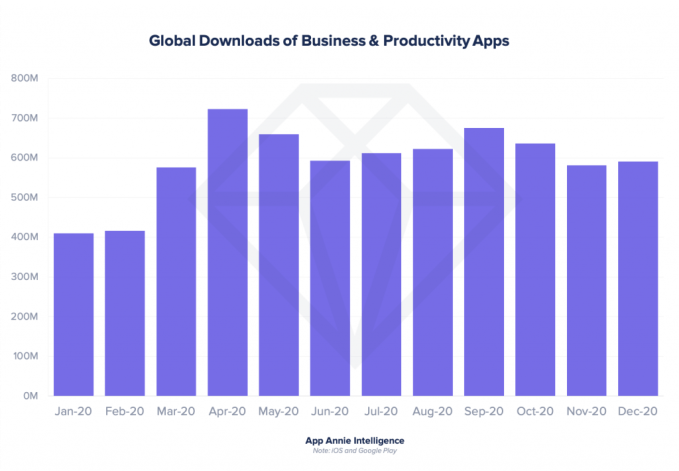
Image Credits: App Annie
Business and productivity apps reached 7.1 billion downloads in 2020, up 35% YoY, reports App Annie. The jump was attributed to the pandemic, with the biggest surge coming in mid-March when shelter-in-place orders kicked in.
Microsoft pulled the Delve mobile apps from the App Store and Google Play, which will be followed by a full shutdown of the service in June. Delve was designed to surface relevant info and insights using the Office Graph. Users were redirected to Outlook Mobile, which has some similar features.
Microsoft launched Group Transcribe, a new kind of mobile transcription app for in-person meetings. The app requires all meeting participants to record from their own phones, which improves accuracy and speaker identification. It also offers real-time translations to help non-native speakers follow along.
Security & Privacy
Thousands of Android and iOS app are leaking data from the cloud, Wired reports. In analysis run on more than 1.3 million Android and iOS apps, researchers found almost 84,000 Android apps and nearly 47,000 iOS apps used public cloud services. Of those, misconfigurations were found in 14% — 11,877 Android apps and 6,608 iOS apps — which were exposing personal information, passwords and medical information.
Hackers released a new jailbreak tool for almost every iPhone by using the same vulnerability Apple said last month was under active attack by hackers. The jailbreak, released by the Unc0ver team, works on iOS 11 to iOS 14.3, and iPhone 5s and later.
Google’s apps with privacy labels have begun receiving updates after lengthy pause. Apps that have started to get updates include Gmail, Slides, Docs, Sheets, Calendar, YouTube, YouTube TV, YouTube Music, Google Tasks and Google Podcasts. Google’s key apps still missing labels include Search, Photos, Assistant, Maps, Pay and Chrome.
Funding and M&A
 Stream raised $38 million for its service that lets developers build chat and activity feeds into apps with a few lines of code. The company now powers communications for 1 billion users, including in apps like TaskRabbit, NBC Sports, Delivery Hero, Gojek and others.
Whatnot raised $20 million in Series A funding for its livestreaming platform for selling collectible toys and cards. The round was led by a16z, and follows a $4 million seed raised at the end of 2020.
Snapcommerce raised $85 million for its platform that uses messaging to personalize the mobile shopping experience. Inovia Capital and Lion Capital co-led the new growth round, bringing the startup’s total raise to date to $100 million.
Food delivery app Instacart raised $265 million at a $39 billion valuation. The round was raised from existing investors, including Andreessen Horowitz, Sequoia Capital, D1 Capital Partners and others and pushes the valuation up from $17.7 billion in October 2020.
 Okta acquired cloud identity startup Auth0 for $6.5 billion. Auth0 offers authentication and security for apps across native mobile, desktop, and web apps. Following the deal, Auth0 will continue to operate as an independent unit inside Okta.
Fintech Square acquired Jay-Z’s streaming service TIDAL for $297 million. Perhaps those yachting trips paid off? Square plans to offer financial tools to artists to help them collect revenue. Despite the deal’s seeming oddness, a good bet is that Square plans to expand into music-based NFTs.
 App marketing company AppLovin filed its S-1 ahead of its IPO. The company was valued at $2 billion in 2018, but posted a net loss of $125.9 million in 2020 on revenue of $1.45 billion, up 46% YoY. The company warned investors that it may be impacted by Apple’s IDFA changes.
Maestro raised $15 million for its interactive commerce, community and engagement tools for livestreams across web and mobile. Maestro can also be embedded into native mobile apps using a web view.
Indie weather app Weather Line acquired. The company didn’t provide any details on its acquisition, including the buyer, but said the app will be removed from the App Store. Existing users will continue to have access until April 1, 2022.
Indian jobs app Apna raised $12.5 million in a round led by Sequoia Capital India and Greenoaks Capital. The app is now used by 80,000 employers and 6 million+ workers such as drivers, delivery personnel, electricians and beauticians.
Istanbul’s Dream Games raised $50 million and launched its first mobile gaming title, Royal Match. The round, led by Index Ventures, is the largest Series A raised by a startup in Turkey.
Downloads
West Tenth

Image Credits: West Tenth
West Tenth’s new app aims to give local home-based business owners a platform to reach potential clients and make sales. The app focuses on women who have opted out of the traditional workforce to stay home, often to raise kids and work more flexible hours. Often targeted by predatory MLMs, West Tenth aims to convince women that many of their everyday skills are, in fact, marketable businesses — like cooking and meal prep, party planning, interior design, photography, home organization, baby sleep training, fitness instructions, homemade crafts and more. The startup also offers online education classes to teach women the basics of marketing and running a home business. (iOS and Android)
Cappuccino
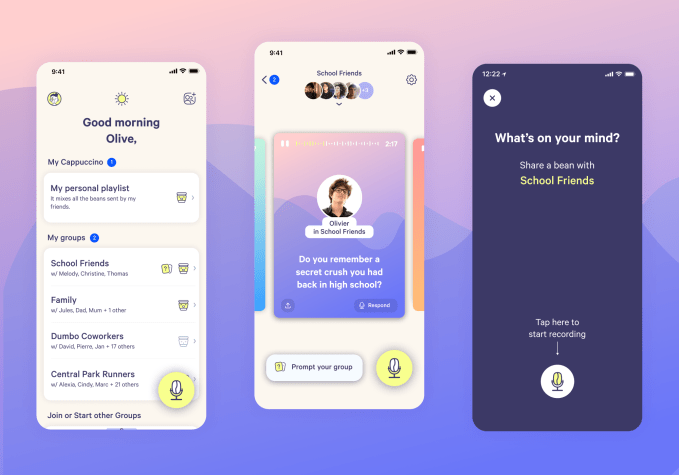
Social audio is growing in popularity thanks to apps like Clubhouse and Twitter’s Spaces. A startup called Cappuccino, reviewed here by TechCrunch, now wants to bring social audio to a more intimate setting: groups of friends. The anti-Clubhouse app lets friends record “podcasts,” which are designed for private consumption. (iOS and Android)
Tweets
If you had any doubts at all about the Wild Wild West that are App Store ratings & reviews, someone is currently buying fake 5-star reviews for my own FlickType app – presumably so that Apple will take my app down.
Apple's fake review detection is failing *so* miserably. pic.twitter.com/kPcCnm7xyM
— Kosta Eleftheriou (@keleftheriou) March 5, 2021
In his interview with CNBC and New York Times journalist Andrew Ross Sorkin, Bill Gates said “I actually use an Android phone. I’ll often play around with iPhones, but the one I carry around happens to be Android. pic.twitter.com/bpX6aTl9nf
— Fossbytes (@fossbytes14) February 28, 2021

VC Lindy Fishburne on the seemingly sudden democratization of science
Deep science investor Lindy Fishburne cofounded the seed- and early-stage venture firm Breakout Ventures several years ago, after cofounding Breakout Labs within the Thiel Foundation back in 2011, and she has amassed a wide array of stakes in the process. Among her firm’s portfolio companies is Cortexyme, a company that aims to treat Alzheimer’s disease; the sustainable materials maker Modern Meadow; and Strateos, a company whose robotic cloud platform is remaking how lab work gets done.
We talked with Fishburne late this week about where — based on what she is seeing — we are in the arc of this pandemic. We also talked about why more of her investments, which once seemed like long shots, suddenly look like solid bets. Parts of our chat, below, have been edited lightly for length and clarity.
TC: We want to be excited about the progress being made in vaccinating Americans. Based on the conversations you’re having, what’s your sense of things?
LF: The acceleration of the vaccines is like nothing we’ve ever seen before in science, and now we really are down to the unsexy part of of the logistics of rolling them out. That’s clearly our biggest challenge. Then the next piece we’re going to have to confront is what happens when the world is vaccinated [at] very unequal levels and how people feel about travel and exposure and equity along those issues.
TC: Science has been the big story of the last year. Are you hearing from investors and potential syndicate partners who weren’t reaching out previously?
LF: Yes. The pandemic has brought the importance of investing in science into sharp relief. For the first time, we’re really seeing a whole set of what you would think of as traditional tech investors who read about the mRNA vaccine that Moderna coded in a weekend and who are starting to believe that we’re able to engineer biology and that it doesn’t feel like a craft process anymore.
TC: You talk about coding a vaccine. Are laboratories becoming less important in that scientists are able to do much more in simulation and, if so, what does that mean for human testing? Are we getting to a point where we don’t have to rely on human testing as much as we did in the past?
LF: That’s where we hope to get on the human testing piece. We’re not there yet. You may have read and heard about organs on a chip and growing organoids, where you can have a very small piece of liver that you’re able to test toxicity on [and] we’re doing more of that. That said, we’re not ready to make that leap from completely doing it in silico to humans with a super-high level of confidence.The human body is such a complex system that we’re not able to model that fully yet.
I do think what you’re pointing toward to some degree is democratization in science and the access for more people to be able with lower skills to be able to work in drug discovery and drug development at a distance. So for example, we have a company that we’ve worked with called Strateos that has a full robotic lab that — instead of having technicians standing there — you have robots and a little train track that moves assays throughout the room so that scientists who were stuck at home this year were able to continue experiments regardless of their geography or safety in the lab or time constraints.
TC: You have another interesting portfolio company, Opus 12, which is transforming industrial carbon dioxide emissions into chemicals. Toward what end?
LF: So obviously, decarbonizing the world is a huge focus. And you’re seeing for the first time corporations like United Airlines making commitments as to what their carbon footprint will be, or going to zero carbon emissions. Opus 12 emerged from two PhDs and an MBA out of Stanford a few years ago and their breakthrough is a catalyst material that allows you to take for example, waste CO2 — the bad stuff — and run it through this catalyst material and produce useful CO. This year, for example, they produced green polycarbonate car parts in partnership with Daimler. The material is exactly the same, which makes it easy to slot into existing products, but it’s actually made by reusing carbon.
The shift in consumer awareness around carbon made materials is an enormous opportunity.
TC: Do companies get some sort of carbon credit for doing that?
LF: Yes, and in the past what we’ve seen is a lot of companies trying to green themselves by basically buying and trading carbon credits, and the shift that we’re going through right now is everyone saying, ‘Okay, to some degree, that was a bit of financial engineering; now we actually need to see these businesses making a change in their direct use of fossil fuels and their direct impact in the amount of carbon.’ [There’s growing awareness that] buying carbon offsets isn’t going to be enough. So you’re now for the first time really seeing commitments to change processes, supply chain and ultimately products.
TC: In recent years, biotech companies have been going public two and three years after being formed. Now, we’re seeing a much wider array of younger companies being transformed into public companies through a growing number of blank-check companies. Any thoughts about whether or not there are parallels here?
LF: On the therapeutic side, you tend to have a very clear playbook around what the potential exit is and who the acquirers are. We know that big pharma is cash rich and pipeline poor, and so [these pharma giants] have to pick up the assets that are working, and you see them do that regularly. And you’ve got comps, and you know what that looks like, so in placing a wide range of bets on early-stage therapeutics, it’s clear that if one wins, you’re covered.
The SPAC world is going to be really interesting because most of these companies are not operating off traditional playbooks, and it’s not clear whether they operate as public companies longer term. Are they really set up for acquisition?
[Another] difference here is these companies are going to have this enormous amount of funding, and yet they’re not going to be able to toil in obscurity, so the traditional metrics that we all want [in] public companies and looking at revenue and profits and those metrics, we’re going to have to look at these SPACs and their growth through a different lens, and I’m just not sure how receptive the public markets will be to that in the next 24 months. I think it’s unclear whether we’ll have a reckoning there or not.
If you’re curious to learn more, including about why new pots of money might be on the horizon for deep tech startups, you can listen in on our full conversation with Fishburne here.
A first look at Coursera’s S-1 filing
After TechCrunch broke the news yesterday that Coursera was planning to file its S-1 today, the edtech company officially dropped the document Friday evening.
Coursera was last valued at $2.4 billion by the private markets, when it most recently raised a Series F round in October 2020 that was worth $130 million.
Coursera’s S-1 filing offers a glimpse into the finances of how an edtech company, accelerated by the pandemic, performed over the past year. It paints a picture of growth, albeit one that came at steep expense.
Revenue
In 2020, Coursera saw $293.5 million in revenue. That’s a roughly 59% increase from the year prior when the company recorded $184.4 million in top line. During that same period, Coursera posted a net loss of nearly $67 million, up 46% from the previous year’s $46.7 million net deficit.
Notably the company had roughly the same noncash, share-based compensation expenses in both years. Even if we allow the company to judge its profitability on an adjusted EBITDA basis, Coursera’s losses still rose from 2019 to 2020, expanding from $26.9 million to $39.8 million.
To understand the difference between net losses and adjusted losses it’s worth unpacking the EBITDA acronym. Standing for “earnings before interest, taxes, depreciation and amortization,” EBITDA strips out some nonoperating costs to give investors a possible better picture of the continuing health of a business, without getting caught up in accounting nuance. Adjusted EBITDA takes the concept one step further, also removing the noncash cost of share-based compensation, and in an even more cheeky move, in this case also deducts “payroll tax expense related to stock-based activities” as well.
For our purposes, even when we grade Coursera’s profitability on a very polite curve it still winds up generating stiff losses. Indeed, the company’s adjusted EBITDA as a percentage of revenue — a way of determining profitability in contrast to revenue — barely improved from a 2019 result of -15% to -14% in 2020.
Snowflake latest enterprise company to feel Wall Street’s wrath after good quarter
Snowflake reported earnings this week, and the results look strong with revenue more than doubling year-over-year.
However, while the company’s fourth quarter revenue rose 117% to $190.5 million, it apparently wasn’t good enough for investors, who have sent the company’s stock tumbling since it reported Wednesday after the bell.
It was similar to the reaction that Salesforce received from Wall Street last week after it announced a positive earnings report. Snowflake’s stock closed down around 4% today, a recovery compared to its midday lows when it was off nearly 12%.
Why the declines? Wall Street’s reaction to earnings can lean more on what a company will do next more than its most recent results. But Snowflake’s guidance for its current quarter appeared strong as well, with a predicted $195 million to $200 million in revenue, numbers in line with analysts’ expectations.
Sounds good, right? Apparently being in line with analyst expectations isn’t good enough for investors for certain companies. You see, it didn’t exceed the stated expectations, so the results must be bad. I am not sure how meeting expectations is as good as a miss, but there you are.
It’s worth noting of course that tech stocks have taken a beating so far in 2021. And as my colleague Alex Wilhelm reported this morning, that trend only got worse this week. Consider that the tech-heavy Nasdaq is down 11.4% from its 52-week high, so perhaps investors are flogging everyone and Snowflake is merely caught up in the punishment.
Snowflake CEO Frank Slootman pointed out in the earnings call this week that Snowflake is well positioned, something proven by the fact that his company has removed the data limitations of on-prem infrastructure. The beauty of the cloud is limitless resources, and that forces the company to help customers manage consumption instead of usage, an evolution that works in Snowflake’s favor.
“The big change in paradigm is that historically in on-premise data centers, people have to manage capacity. And now they don’t manage capacity anymore, but they need to manage consumption. And that’s a new thing for — not for everybody but for most people — and people that are in the public cloud. I have gotten used to the notion of consumption obviously because it applies equally to the infrastructure clouds,” Slootman said in the earnings call.
Snowflake has to manage expectations, something that translated into a dozen customers paying $5 million or more on a trailing 12 month basis, according to the company. That’s a nice chunk of change by any measure. It’s also clear that while there is a clear tilt toward the cloud, the amount of data that has been moved there is still a small percentage of overall enterprise workloads, meaning there is lots of growth opportunity for Snowflake.
What’s more, Snowflake executives pointed out that there is a significant ramp up time for customers as they shift data into the Snowflake data lake, but before they push the consumption button. That means that as long as customers continue to move data onto Snowflake’s platform, they will pay more over time, even if it will take time for new clients to get started.
So why is Snowflake’s quarterly percentage growth not expanding? Well, as a company gets to the size of Snowflake, it gets harder to maintain those gaudy percentage growth numbers as the law of large numbers begins to kick in.
I’m not here to tell Wall Street investors how to do their job, anymore than I would expect them to tell me how to do mine. But when you look at the company’s overall financial picture, the amount of untapped cloud potential and the nature of Snowflake’s approach to billing, it’s hard not to be positive about this company’s outlook, regardless of the reaction of investors in the short term.
Note: This article originally stated the company had a dozen customer paying $5 million or more per month. It’s actually on a trailing 12 month basis and we have updated the article to reflect that.
The owner of Anki’s assets plans to relaunch Cozmo and Vector this year
Good robots don’t die — they just have their assets sold off to the highest bidder. Digital Dream Labs was there to sweep up IP in the wake of Anki’s premature implosion, back in 2019. The Pittsburgh-based edtech company had initially planned to relaunch Vector and Cozmo at some point in 2020, launching a Kickstarter campaign in March of last year.
Today, the company announced plans to deliver on the overdue relaunch, courtesy of a new distributor.
“There is a tremendous demand for these robots,” CEO Jacob Hanchar said in a release. “This partnership will complement the work our teams are already doing to relaunch these products and will ensure that Cozmo and Vector are on shelves for the holidays.”
I don’t doubt that a lot of folks are looking to get their hands on the robots. Cozmo, in particular, was well-received, and sold reasonably well — but ultimately (and in spite of a lot of funding), the company couldn’t avoid the fate that’s befallen many a robotics startup.
It will be fascinating to see how these machines look when they’re reintroduced. Anki invested tremendous resources into bringing them to life, including the hiring of ex-Pixar and DreamWorks staff to make the robots more lifelike. A lot of thought went into giving the robots a distinct personality, whereas, for instance, Vector’s new owners are making the robot open-source. Cozmo, meanwhile, will have programmable functionality through the company’s app.
It could certainly be an interesting play for the STEM market that companies like Sphero are approaching. It has become a fairly crowded space, but at least Anki’s new owners are building on top of a solid foundation, with the fascinating and emotionally complex toy robots their predecessors created.
Update: We removed a reference to a Kickstarter launched by Anki prior to Digital Dream’s acquisition of the company’s IP.
Deep Science: AI adventures in arts and letters
There’s more AI news out there than anyone can possibly keep up with. But you can stay tolerably up to date on the most interesting developments with this column, which collects AI and machine learning advancements from around the world and explains why they might be important to tech, startups or civilization.
To begin on a lighthearted note: The ways researchers find to apply machine learning to the arts are always interesting — though not always practical. A team from the University of Washington wanted to see if a computer vision system could learn to tell what is being played on a piano just from an overhead view of the keys and the player’s hands.
Audeo, the system trained by Eli Shlizerman, Kun Su and Xiulong Liu, watches video of piano playing and first extracts a piano-roll-like simple sequence of key presses. Then it adds expression in the form of length and strength of the presses, and lastly polishes it up for input into a MIDI synthesizer for output. The results are a little loose but definitely recognizable.
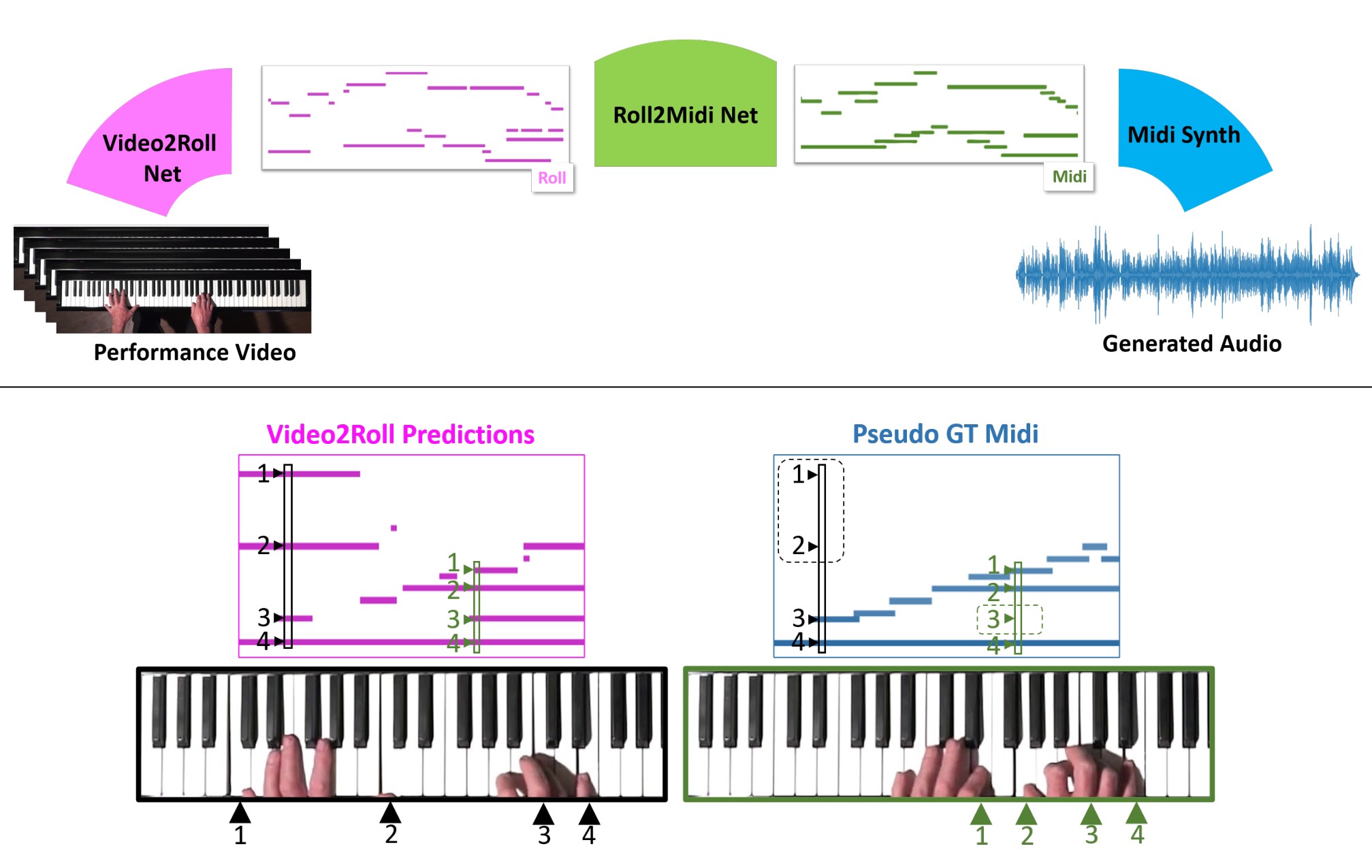
Image Credits: Shlizerman, et. al
“To create music that sounds like it could be played in a musical performance was previously believed to be impossible,” said Shlizerman. “An algorithm needs to figure out the cues, or ‘features,’ in the video frames that are related to generating music, and it needs to ‘imagine’ the sound that’s happening in between the video frames. It requires a system that is both precise and imaginative. The fact that we achieved music that sounded pretty good was a surprise.”
Another from the field of arts and letters is this extremely fascinating research into computational unfolding of ancient letters too delicate to handle. The MIT team was looking at “locked” letters from the 17th century that are so intricately folded and sealed that to remove the letter and flatten it might permanently damage them. Their approach was to X-ray the letters and set a new, advanced algorithm to work deciphering the resulting imagery.

Diagram showing X-ray views of a letter and how it is analyzed to virtually unfold it. Image Credits: MIT
“The algorithm ends up doing an impressive job at separating the layers of paper, despite their extreme thinness and tiny gaps between them, sometimes less than the resolution of the scan,” MIT’s Erik Demaine said. “We weren’t sure it would be possible.” The work may be applicable to many kinds of documents that are difficult for simple X-ray techniques to unravel. It’s a bit of a stretch to categorize this as “machine learning,” but it was too interesting not to include. Read the full paper at Nature Communications.
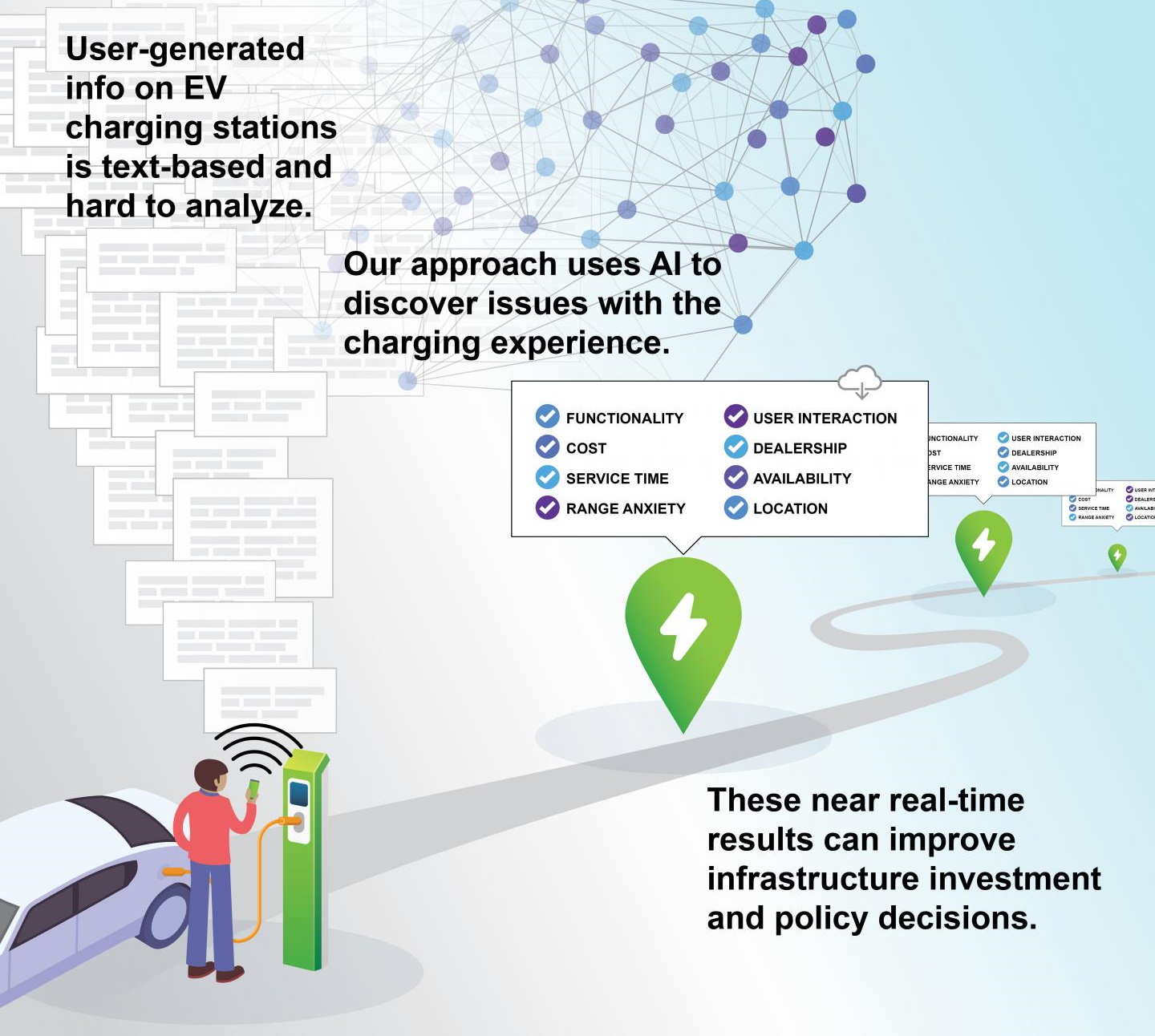
Image Credits: Asensio, et. al
You arrive at a charge point for your electric car and find it to be out of service. You might even leave a bad review online. In fact, thousands of such reviews exist and constitute a potentially very useful map for municipalities looking to expand electric vehicle infrastructure.
Georgia Tech’s Omar Asensio trained a natural language processing model on such reviews and it soon became an expert at parsing them by the thousands and squeezing out insights like where outages were common, comparative cost and other factors.
How the Biden administration is approaching crypto regulations
Leigh Cuen
Contributor
Contributor
Leigh Cuen is a reporter in New York City. Her work has been published by Vice, Business Insider, Newsweek, Teen Vogue, Al Jazeera English, The Jerusalem Post, and many others. Follow her on Instagram at @leighcuen.
More posts by this contributor
It’s hard to imagine a worse scenario than the one left behind by former Treasury Secretary Steven Mnuchin.
The draconian regulatory proposals were Mnuchin’s own personal vendetta, according to Bitcoin veterans like Square Crypto developer Matt Corallo and Coin Center director Jerry Brito, and it’s too soon to say whether incoming Treasury Secretary Janet Yellen will approve the proposed know-your-customer standards or reject them.
Given the chaos created by the Trump administration, bitcoin fans are anxiously optimistic about how regulators will approach the cryptocurrency space during President Joe Biden’s administration.
“Mnuchin at the very end had an alarmist view about the illicit use of cryptocurrency that wasn’t shared by law enforcement and intelligence agencies. It doesn’t seem that Janet Yellen has that same view,” Brito said. “Her view seems to be very standard.”
Namely, Yellen believes there are both positive and negative ways to use cryptocurrency. She’s expressed a desire to strengthen regulations that prevent illicit usage like terror financing. She may set the tone for government bodies like the Office of the Comptroller of the Currency (OCC), the Securities and Exchange Commission (SEC) and the Commodity Futures Trading Commission (CFTC).
“The SEC, OCC and CFTC are choosing people that are very crypto knowledgeable,” Brito added. “That could tell you they are getting deep knowledge to regulate it heavily or, more likely, it’s now seen as an important part of the economy and finance.”
Although it’s still early in the transition, it appears the Biden administration will nominate former Ripple advisor and former U.S. Treasury Department official Michael Barr to head the OCC. In the short term, Trump’s SEC appointee, Commissioner Hester Pierce, will continue her notoriously crypto-friendly approach to the securities market. But the Biden administration is reportedly considering former CFTC chairman Gary Gensler to soon lead the SEC.
“The new SEC Chairman Gary Gensler has been pretty outspoken with his views on Facebook’s project Libra, as well as Ripple. It’s his opinion that those are securities and should be regulated by the SEC,” said attorney Hailey Lennon, a crypto-focused partner at Anderson Kill law firm. “In the next year or two, I hope some of the litigation we are seeing and new leadership in the SEC, will result in greater clarity so that down the road there are less enforcement actions. Clarity will help companies to know what to avoid.”
Meanwhile, Reuters reported the White House is expected to nominate Georgetown University professor Chris Brummer to lead the CFTC. Brummer was previously President Obama’s pick, but never got confirmed by the Senate due to political gridlocks. It’s still unclear who will be nominated in 2021 for key roles related to curbing terror financing, such as the Office of Foreign Assets Control (OFAC) and the Financial Crimes Enforcement Network (FinCEN).
“I think we might start seeing more regulation coming from FinCEN and OFAC. There have been some settlements with crypto companies and OFAC has been adding wallet addresses to the SDN [sanctions] list,” Lennon said. “Even if we see more positive things coming from the OCC, SEC and CFTC, it will be balanced a bit with more regulations related to know-your-customer and anti-money laundering, more general supervision of the source of funds and sanctions screening.”
Sanctions are the hot topic of 2021. Throughout 2020, the Iranian government published statements indicating it intends to use cryptocurrency, including bitcoin but not limited to it, to circumnavigate banking sanctions. Emigres from Iran and other countries have used bitcoin to do exactly this.
So far, the Biden administration hasn’t offered any indication it might lift sanctions. To the contrary, on February 18, the Treasury published a statement that the payment processor BitPay was penalized for allowing users to transact with citizens in sanctions jurisdictions like Iran, Cuba and Ukraine. Regulators’ approach to cryptocurrency, which many Iranian-Americans also use both internationally and domestically, will reflect whether the White House prefers a hawkish or dovish approach to diplomacy in the Middle East.
Perianne Boring, founder of an advocacy group called the Chamber of Digital Commerce, said “the new administration and leadership have signaled a critical perspective” of the broader cryptocurrency space. As such, Boring said she hopes industry leaders will continue to engage with lawmakers to “lay the foundation for America’s leadership role” in global crypto markets.
She said American crypto startups are competing in global arenas, against startups based in nations with more progressive laws as nations strive to foster the “next Silicon Valley.” Other nations are encouraging crypto companies, especially domestic crypto mining industries. Many technologists believe it behooves American leaders to defend dollar dominance by cultivating innovation in this tech sector. After all, many of the leading stablecoins are still denominated in American dollars.
“The Biden-Harris administration and Congress must make clear that addressing digital asset and blockchain policies are a priority,” Boring said. “The Biden-Harris administration should be focused now on growing the economy back to full employment and robust quarterly and annual economic growth.”
Brito said he’s especially curious to see new appointees for OFAC and FinCEN, since they’ll be Yellen’s right and left hand in her approach to sanctions and regulations. He agreed with Lennon and Boring, all of whom believe new legal norms are in the pipeline. However stringent, or pro-business, the coming verdicts may be, at least Biden has yet to rage tweet about hating bitcoin, the way Trump did.
“It’s still that period where everyone is getting their sea legs and trying to understand what their priorities are,” Brito said of the Biden administration. “Once they start either putting forth policy or reacting to the things that happen, that’s when we’ll really know where they stand.”
Tesla has closed its forums to launch a social platform and fans are not happy
Tesla plans to shut down the forums section on its website as it launches a new social platform called the Tesla Engagement Platform, a move that’s raised the ire of a community of its most ardent supporters.
Tesla first announced the new engagement platform with a notice at the top of its forums page that reads: “Starting March 15th, Tesla Forums will become read only. To continue the conversation with the Tesla community visit engage.tesla.com.” The Verge was the first to report the changes.
Rather than create posts and threads, the new site invites owners and fans of the brand to engage by commenting on Tesla’s public-policy-related posts and campaigns that run the gamut, including calls to support the company’s disaster relief efforts in Texas and requests for Nebraskans to ask their state lawmakers to encourage the passing of a bill that would allow the direct sale of Teslas in certain districts.
In the replies of a March 2 Tesla forum post announcing the 13-day countdown until the platform’s demise, one commenter with supposed “inside info” alleged that the forums were closing because Tesla couldn’t afford to hire multiple full-time moderators to keep up with the barrage of spam and trolls that would frequent the threads.
Those trolls are likely to migrate to Twitter now, as the Tesla Engagement Platform will be moderated.
The forums, which will now be available as read-only archives, were a place for Tesla fans, investors and verified owners to ask and answer each other’s questions. However, the unmoderated nature of the forum led to an environment where its most active posters would, at times, attack people for raising concerns. The new microsite, which also helps people apply for membership to local owners’ clubs, promises a direct feedback loop with the company’s policy team and encourages visitors to get involved in Tesla advocacy.
“Engage Tesla is a new platform for both Tesla’s public policy team and Tesla Owner’s Clubs,” reads the first post on the new microsite. “Its goal is to create a digital home base for all of our work, and make it easier for Tesla community members to learn what’s top of mind for us, take meaningful action, and stay in the loop. We hope you’ll join us in getting involved.”
A quick skim through the comments section of the first post reveals a bevy of unhappy users who want the forums to stay, or at least remade into something similar — and moderated — on the new site. There are no shortage of Tesla and other EV-related forums on the internet. This one has been held up as a bastion of toxicity, while being lauded as a place for owners and potential buyers to share honest information on the good and bad parts of the company’s products.
“Please do not get rid of the Forums,” implored one commenter. “This is not a replacement. The forums (with exception of the trolls on it) brought about informed discussion to help fellow owners with issues.”
Indeed, the new platform doesn’t appear to be a replacement. It looks more like a blog that shares industry news, Tesla events and campaigns, an effort to gather the work already being done by its supporters in one place and encourage further advocacy on the company’s behalf. For example, the Tesla Owners club in Silicon Valley had already raised $10,000 to support the Del Valle, Texas community, which surrounds the area in which the company’s new factory is being built.
Not everyone is a critic. While many of the initial comments on the platform’s first post call for a moderated forum, some suggest improvements to the company’s customer service department and others request resources on how to advocate for public charging infrastructure. It’s still early days for the new engagement platform. We’ll see how engaging Tesla’s fans truly find it to be.
California bill would require all self-driving vehicles to be zero emission by 2025
California might be the first state to give self-driving cars a deadline to electrify.
In mid-February, a bill was quietly introduced into the California State Legislature that would require all autonomous vehicles to also be zero emission by 2025. Proposed Bill SB 500, which was introduced by Senator Dave Min and sponsored by the Union of Concerned Scientists (UCS), would directly affect the nascent AV industry in applications like ride-hailing, delivery and trucking.
The amendment is in line with many of California’s goals to reduce emissions. It would add to the state’s vehicle code, which currently provides for programs to promote zero-emission vehicles, such as the Clean Vehicle Rebate Project and the Charge Ahead California Initiative.
Governor Gavin Newsom has said he wants all new vehicle sales to be zero emission by 2035, but that doesn’t apply to commercial fleets. Not unless this bill is passed. The proposed bill is in its infancy stages, so there are plenty of opportunities for it to be quashed. But it surfaces an issue for a burgeoning AV industry and the companies trying to develop and commercialize autonomous driving technology in California. It also has the potential to provide a boost to the companies that only use electric vehicles.
“California has set important standards to aggressively address our climate crisis,” Min told TechCrunch. “My SB 500 aligns with these ambitions and takes a critical first step in requiring autonomous vehicles to be zero emission before they are put to widespread use.”
Proponents of the bill don’t want to see future means of transportation married to the technology of the past, pointing out the potential for AVs to either help or hurt attempts to cut emissions. California has a reputation for leading the rest of the country in EV adoption and other emissions-related policies, so the success or failure of this bill could create ripple effects in states across the nation.
“It definitely seems like we’re going to start seeing AVs in these fleet applications, whether that’s ride-hailing or delivery, and that makes it even more important that these vehicles are electric,” said Elizabeth Irvin, senior transportation analyst at UCS. “The average person drives their car 11,000 to 13,000 miles per year, but a full-time Uber or Lyft driver drives 30,000 or more.”
The strategy
Close to half of California’s greenhouse gas emissions come from transportation. And while there’s nothing quite like a smoggy Los Angeles sunset, supporters say the danger of not placing requirements on the AV industry could lead to a world in which autonomous commercial vehicles are commonplace and powered by fossil fuels.
In a statement defending support of this bill, UCS points to research that shows how AVs could dramatically increase driving, and thus emissions, as people get used to living the luxurious life of a passenger. One study, which examined the potential effects of AVs on the Washington, D.C. metropolitan region transportation system in 2040, found that AVs would cause the total amount of driving to increase by as much as 66% relative to the 2040 baseline year.
Irvin told TechCrunch that UCS has been in talks with various stakeholders — such as Nuro, the SoftBank-backed autonomous delivery startup, and Cruise, General Motor’s self-driving subsidiary — regarding strategies for advancing policy that would require all AVs to be zero-emission in California before mainstream adoption.
“We are supportive of efforts to accelerate the industry’s transition to clean energy, which aligns with Nuro’s goals and values,” said a spokesperson from Nuro. “We are excited for autonomous vehicles to pave the way for the rest of the auto industry, which we believe will lead to a greener and healthier future.”

Image Credits: Nuro
The sentiment is mirrored by Cruise, which unveiled last year a driverless vehicle called Origin that’s designed for sharing and powered by an all-electric platform built by GM, the result of a multi-year partnership with Honda. Cruise is not testing autonomous Origin vehicles in San Francisco yet; the battery platform is still undergoing testing at GM’s proving grounds. Cruise does have aspirations to roll out a fleet of autonomous vehicles — initially using the all-electric Chevrolet Bolt — as part of a ride-hailing, and possibly a delivery, service in San Francisco.
“Because this industry is so new, everyone has a choice to be an EV or not,” Rob Grant, SVP government affairs at Cruise, told TechCrunch. “It’s not like you have to transform an existing fleet. You have a choice to do this in the beginning rather than going down this path and being forced to change it at some later date.”
Hybrids versus electric
Not all AVs use electric vehicles. The Ford Fusion hybrid and Chrysler Pacifica Plug-in Hybrid minivans have been the go-to choices for AV developers, including Argo AI, Aurora, Waymo and Voyage.
Argo AI is a technology platform company that works with major automakers, like Volkswagen and Ford, to develop autonomous driving systems. While Volkswagen’s ID.Buzz will be the company’s first fully electric self-driving car, Ford still prefers to take a more measured approach by modifying the hybrid Ford Fusion.
“We all want to transition to BEVs eventually, but we also need to find the right balance that will help develop a profitable, viable business model,” John Davis, chief engineer at Ford Autonomous Vehicles said. “This means launching with hybrids first.”
Davis outlined various challenges in developing all-electric vehicles as AVs, including depletion of range from on-board tech, decreased use of the vehicle during charge times and degradation of the battery.
“Testing shows that upwards of 50% of BEV range will be used up due to the computing power of an AV system, plus the A/C and entertainment systems that are likely required during a ride-hailing service (for passenger comfort),” Davis said. “We continue to be encouraged as battery chemistry and cost continue to improve to address these issues.”
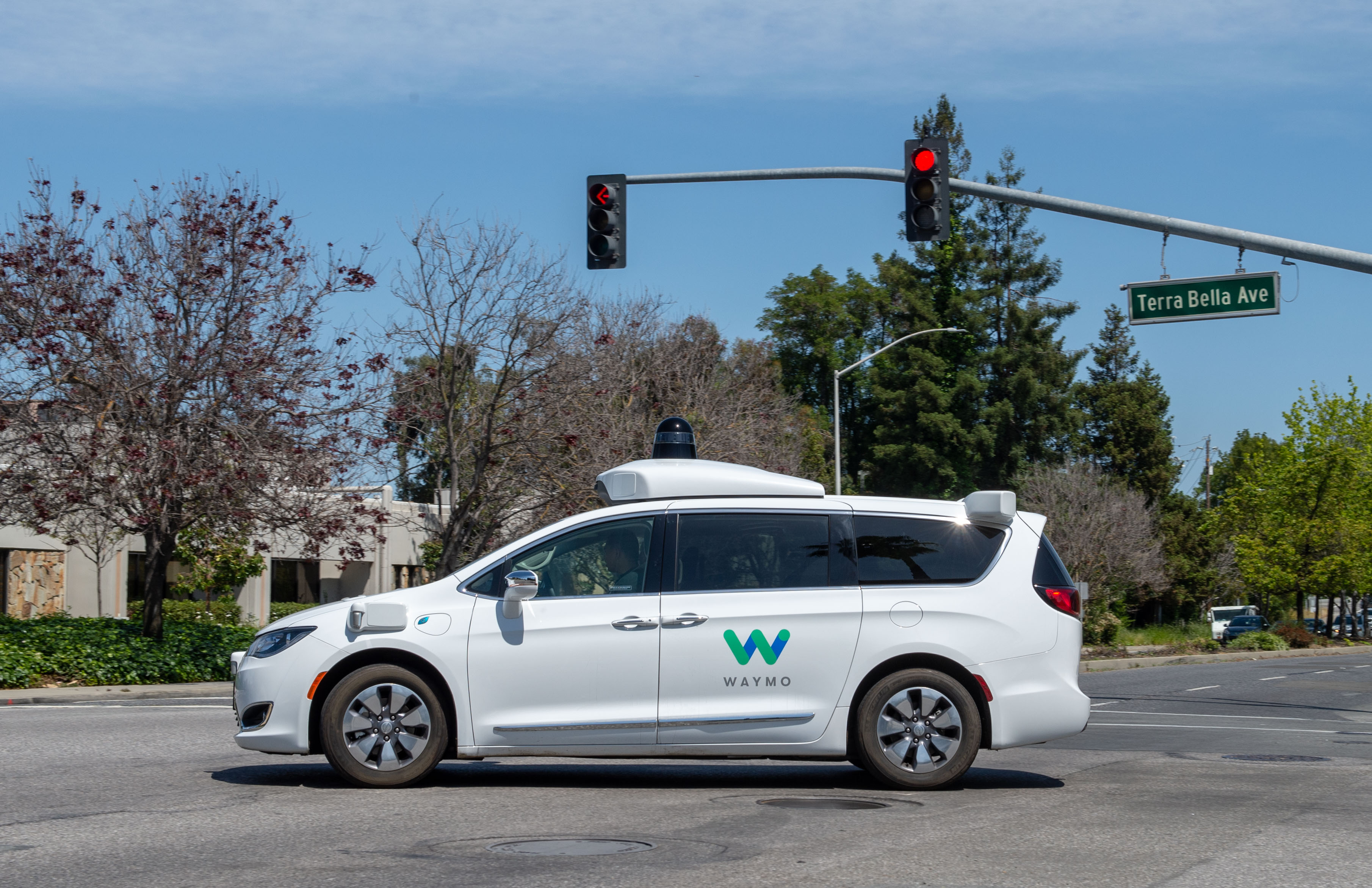
Image credits: Andrej Sokolow/dpa picture alliance via Getty Images
Waymo tested and then launched a robotaxi service in a limited and growing area in the Phoenix suburbs. And while the company has never officially announced it will launch a commercial service in California, its activities over the years all point to that intention. The Mountain View, California-based company regularly tests its vehicles, which includes the electric Jaguar I-Pace, in San Francisco and the surrounding area. The company said it supports Newsom’s recent executive order, but stopped short of endorsing the current language in Min’s bill.
“As the first company to commercially deploy our fully autonomous technology to the public, we strongly support the goals outlined in Governor Newsom’s recent Executive Order N-79-20 which takes a holistic approach to transition California towards a 100% EV future,” a Waymo spokesperson told TechCrunch. “Waymo has business lines and partnerships that span ride-hailing, trucking and local delivery, and we want to ensure that California’s EV policy reflects the myriad issues and industries affected. It’s early in the legislative process, and we look forward to working with Sen. Min in his efforts.”
Industry sources familiar with the bill have noted that the current language, which is fairly brief, is just a placeholder and unlikely to make much headway this session. Those same sources have criticized the sponsors and author for neglecting to specify a plan for charging infrastructure or making distinctions between light and heavy-duty vehicles. Trucks carrying freight are expected to be among the first vehicles with widespread autonomous use. Most self-driving truck development occurs outside of California in regulatory-light states like Arizona and Texas. And while there are some efforts to develop electric and autonomous semi trucks, most testing today involves diesel-powered vehicles. That could prompt companies hoping to deploy in California to lean on the senator’s office to include an exemption for heavy-duty vehicles.
“We’re still looking to fill out details as we move through the legislative process, but UCS’s intention is that this bill stay focused on the electrification requirement,” responded Irvin.
Early Stage is the premier ‘how-to’ event for startup entrepreneurs and investors. You’ll hear first-hand how some of the most successful founders and VCs build their businesses, raise money and manage their portfolios. We’ll cover every aspect of company-building: Fundraising, recruiting, sales, product market fit, PR, marketing and brand building. Each session also has audience participation built-in – there’s ample time included for audience questions and discussion.
How and when to hire your first product manager
In the world of early-stage startups, job titles are often a formality. In reality, each employee may handle a dozen responsibilities outside their job description. The choose-your-own-adventure type of work style is part of the magic of startups and often why generalists thrive here.
However, as a company progresses and the team grows, there comes a time when a founder needs to carve out dedicated roles. Of these positions, product management might be one of the most elusive — and key — roles to fill.
Product management might be one of the most elusive — and key — roles to fill.
We spoke to startup founders and operators to get their thoughts about how and when they hired their first product manager. Some of the things we talked about were:
- Which traits to look for.
- Why it’s important to define the role before you look for your best fit.
- Whether your new hire needs to have a technical background.
- The best questions to ask in an interview.
- How to time your first hire and avoid overhiring.
Don’t hire for the CEO of a product
Let’s start by working backward. Product managers often graduate into a CEO role or leave a company to become a founder. Like founders, talented product managers have innate leadership skills and are able to effectively and clearly communicate. Similarly, both roles require a person who is a visionary when it comes to the product and execution.
David Blake was a product manager before he became a serial edtech founder who created Degreed, Learn In, and most recently, BookClub. He says that experience helped him launch the first prototype of Degreed and attract first clients.
“The must-have skill is the ability to put the team’s best wisdom in check and inform the product decisions with users and potential clients to inform what you are building,” he said. The person “must also be able to take the team’s mission and develop and sell that narrative to users and potential clients. That is how you blaze a new trail, balance risk, while avoiding building a ‘faster horse.”
The overlapping synergies between PMs and founders is part of the reason why the role is so confusing to define and hire for. Ken Norton, former director of product at Figma who recently left to solo advise and coach product managers, says companies can start by defining what PMs are not: The CEO of the product.
“It’s about not handing off the product responsibilities to somebody,” he said. “You want the founder and the CEO to continue to be the evangelist and visionary.” Instead, the role is more about day to day “blocking and tackling.” Norton wrote a piece more than 15 years ago about how to hire a product manager, and it’s still an essential read for anyone interested in the field.
Define the role and set your expectations
Product managers help translate all the jugglers within a startup to each other; connecting the engineer with marketing, design with business development and sales with all the above. The role at its core is hard to define, but at the same time is the necessary plumbing for any startup that wants to be high-growth and ambitious.
While a successful product manager is a strong generalist, they have to have the ability to understand and humanize technical processes. The best candidates, then, have some sort of technical experience as an engineer or otherwise.
UK’s MHRA says it has ‘concerns’ about Babylon Health — and flags legal gap around triage chatbots
The U.K.’s medical device regulator has admitted it has concerns about VC-backed AI chatbot maker Babylon Health. It made the admission in a letter sent to a clinician who’s been raising the alarm about Babylon’s approach toward patient safety and corporate governance since 2017.
The HSJ reported on the MHRA’s letter to Dr. David Watkins yesterday. TechCrunch has reviewed the letter (see below), which is dated December 4, 2020. We’ve also seen additional context about what was discussed in a meeting referenced in the letter, as well as reviewing other correspondence between Watkins and the regulator in which he details a number of wide-ranging concerns.
In an interview he emphasized that the concerns the regulator shares are “far broader” than the (important but) single issue of chatbot safety.
“The issues relate to the corporate governance of the company — how they approach safety concerns. How they approach people who raise safety concerns,” Watkins told TechCrunch. “That’s the concern. And some of the ethics around the mispromoting of medical devices.
“The overall story is they did promote something that was dangerously flawed. They made misleading claims with regards to how [the chatbot] should be used — its intended use — with [Babylon CEO] Ali Parsa promoting it as a ‘diagnostic’ system — which was never the case. The chatbot was never approved for ‘diagnosis.’”
“In my opinion, in 2018 the MHRA should have taken a much firmer stance with Babylon and made it clear to the public that the claims that were being made were false — and that the technology was not approved for use in the way that Babylon were promoting it,” he went on. “That should have happened and it didn’t happen because the regulations at that time were not fit for purpose.”
“In reality there is no regulatory ‘approval’ process for these technologies and the legislation doesn’t require a company to act ethically,” Watkins also told us. “We’re reliant on the health tech sector behaving responsibly.”
The consultant oncologist began raising red flags about Babylon with U.K. healthcare regulators (CQC/MHRA) as early as February 2017 — initially over the “apparent absence of any robust clinical testing or validation,” as he puts it in correspondence to regulators. However with Babylon opting to deny problems and go on the attack against critics his concerns mounted.
An admission by the medical devices regulator that all Watkins’ concerns are “valid” and are “ones that we share” blows Babylon’s deflective PR tactics out of the water.
“Babylon cannot say that they have always adhered to the regulatory requirements — at times they have not adhered to the regulatory requirements. At different points throughout the development of their system,” Watkins also told us, adding: “Babylon never took the safety concerns as seriously as they should have. Hence this issue has dragged on over a more than three-year period.”
During this time the company has been steaming ahead inking wide-ranging “digitization” deals with healthcare providers around the world — including a 10-year deal agreed with the U.K. city of Wolverhampton last year to provide an integrated app that’s intended to have a reach of 300,000 people.
It also has a 10-year agreement with the government of Rwanda to support digitization of its health system, including via digitally enabled triage. Other markets it’s rolled into include the U.S., Canada and Saudi Arabia.
Babylon says it now covers more than 20 million patients and has done 8 million consultations and “AI interactions” globally. But is it operating to the high standards people would expect of a medical device company?
Safety, ethical and governance concerns
In a written summary, dated October 22, of a video call which took place between Watkins and the U.K. medical devices regulator on September 24 last year, he summarizes what was discussed in the following way: “I talked through and expanded on each of the points outlined in the document, specifically; the misleading claims, the dangerous flaws and Babylon’s attempts to deny/suppress the safety issues.”
In his account of this meeting, Watkins goes on to report: “There appeared to be general agreement that Babylon’s corporate behavior and governance fell below the standards expected of a medical device/healthcare provider.”
“I was informed that Babylon Health would not be shown leniency (given their relationship with [U.K. health secretary] Matt Hancock),” he also notes in the summary — a reference to Hancock being a publicly enthusiastic user of Babylon’s “GP at hand” app (for which he was accused in 2018 of breaking the ministerial code).
In a separate document, which Watkins compiled and sent to the regulator last year, he details 14 areas of concern — covering issues including the safety of the Babylon chatbot’s triage; “misleading and conflicting” T&Cs — which he says contradict promotional claims it has made to hype the product; as well as what he describes as a “multitude of ethical and governance concerns” — including its aggressive response to anyone who raises concerns about the safety and efficacy of its technology.
This has included a public attack campaign against Watkins himself, which we reported on last year; as well as what he lists in the document as “legal threats to avoid scrutiny and adverse media coverage.”
Here he notes that Babylon’s response to safety concerns he had raised back in 2018 — which had been reported on by the HSJ — was also to go on the attack, with the company claiming then that “vested interest” were spreading “false allegations” in an attempt to “see us fail.”
“The allegations were not false and it is clear that Babylon chose to mislead the HSJ readership, opting to place patients at risk of harm, in order to protect their own reputation,” writes Watkins in associated commentary to the regulator.
He goes on to point out that, in May 2018, the MHRA had itself independently notified Babylon Health of two incidents related to the safety of its chatbot (one involving missed symptoms of a heart attack, another missed symptoms of DVT) — yet the company still went on to publicly rubbish the HSJ’s report the following month (which was entitled: “Safety regulators investigating concerns about Babylon’s ‘chatbot’”).
Wider governance and operational concerns Watkins raises in the document include Babylon’s use of staff NDAs — which he argues leads to a culture inside the company where staff feel unable to speak out about any safety concerns they may have; and what he calls “inadequate medical device vigilance” (whereby he says the Babylon bot doesn’t routinely request feedback on the patient outcome post triage, arguing that: “The absence of any robust feedback system significant impairs the ability to identify adverse outcomes”).
Re: unvarnished staff opinions, it’s interesting to note that Babylon’s Glassdoor rating at the time of writing is just 2.9 stars — with only a minority of reviewers saying they would recommend the company to a friend and where Parsa’s approval rating as CEO is also only 45% on aggregate. (“The technology is outdated and flawed,” writes one Glassdoor reviewer who is listed as a current Babylon Health employee working as a clinical ops associate in Vancouver, Canada — where privacy regulators have an open investigation into its app. Among the listed cons in the one-star review is the claim that: “The well-being of patients is not seen as a priority. A real joke to healthcare. Best to avoid.”)
Per Watkins’ report of his online meeting with the MHRA, he says the regulator agreed NDAs are “problematic” and impact on the ability of employees to speak up on safety issues.
He also writes that it was acknowledged that Babylon employees may fear speaking up because of legal threats. His minutes further record that: “Comment was made that the MHRA are able to look into concerns that are raised anonymously.”
In the summary of his concerns about Babylon, Watkins also flags an event in 2018 which the company held in London to promote its chatbot — during which he writes that it made a number of “misleading claims,” such as that its AI generates health advice that is “on-par with top-rated practicing clinicians.”
The flashy claims led to a blitz of hyperbolic headlines about the bot’s capabilities — helping Babylon to generate hype at a time when it was likely to have been pitching investors to raise more funding.
The London-based startup was valued at $2 billion+ in 2019 when it raised a massive $550 million Series C round, from investors including Saudi Arabia’s Public Investment Fund and a large (unnamed) U.S.-based health insurance company, as well as insurance giant Munich Re’s ERGO Fund — trumpeting the raise at the time as the largest ever in Europe or U.S. for digital health delivery.
“It should be noted that Babylon Health have never withdrawn or attempted to correct the misleading claims made at the AI Test Event [which generated press coverage it’s still using as a promotional tool on its website in certain jurisdictions],” Watkins writes to the regulator. “Hence, there remains an ongoing risk that the public will put undue faith in Babylon’s unvalidated medical device.”
In his summary he also includes several pieces of anonymous correspondence from a number of people claiming to work (or have worked) at Babylon — which make a number of additional claims. “There is huge pressure from investors to demonstrate a return,” writes one of these. “Anything that slows that down is seen [a]s avoidable.”
“The allegations made against Babylon Health are not false and were raised in good faith in the interests of patient safety,” Watkins goes on to assert in his summary to the regulator. “Babylon’s ‘repeated’ attempts to actively discredit me as an individual raises serious questions regarding their corporate culture and trustworthiness as a healthcare provider.”
In its letter to Watkins (screengrabbed below), the MHRA tells him: “Your concerns are all valid and ones that we share.”
It goes on to thank him for personally and publicly raising issues “at considerable risk to yourself.”
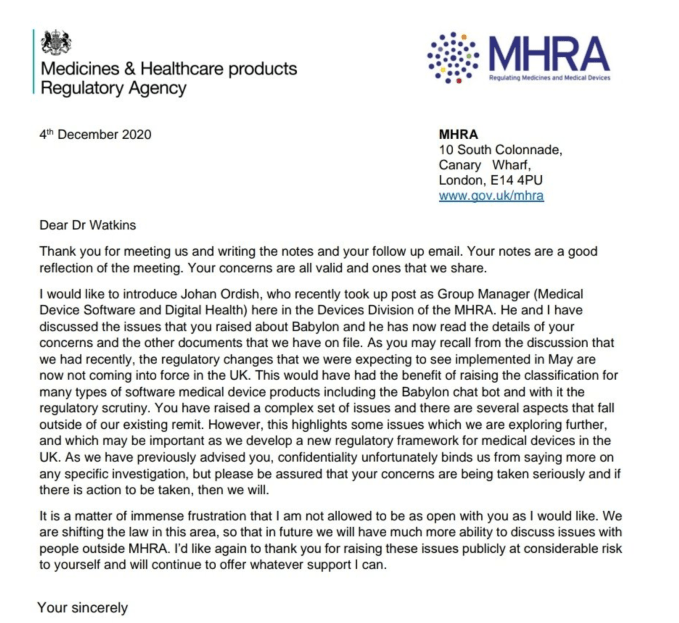
Letter from the MHRA to Dr. David Watkins (Screengrab: TechCrunch).
Babylon has been contacted for a response to the MHRA’s validation of Watkins’ concerns. At the time of writing it had not responded to our request for comment.
The startup told the HSJ that it meets all the local requirements of regulatory bodies for the countries it operates in, adding: “Babylon is committed to upholding the highest of standards when it comes to patient safety.”
In one aforementioned aggressive incident last year, Babylon put out a press release attacking Watkins as a “troll” and seeking to discredit the work he was doing to highlight safety issues with the triage performed by its chatbot.
It also claimed its technology had been “NHS validated” as a “safe service 10 times.”
It’s not clear what validation process Babylon was referring to there — and Watkins also flags and queries that claim in his correspondence with the MHRA, writing: “As far as I am aware, the Babylon chatbot has not been validated — in which case, their press release is misleading.”
The MHRA’s letter, meanwhile, makes it clear that the current regulatory regime in the U.K. for software-based medical device products does not adequately cover software-powered “health tech” devices, such as Babylon’s chatbot.
Per Watkins there is no approval process, currently. Such devices are merely registered with the MHRA — but there’s no legal requirement that the regulator assess them or even receive documentation related to their development. He says they exist independently — with the MHRA holding a register.
“You have raised a complex set of issues and there are several aspects that fall outside of our existing remit,” the regulator concedes in the letter. “This highlights some issues which we are exploring further, and which may be important as we develop a new regulatory framework for medical devices in the U.K.”
An update to pan-EU medical devices regulation — which will bring in new requirements for software-based medical devices and had been originally intended to be implemented in the U.K. in May last year — will no longer take place, given the country has left the bloc.
The U.K. is instead in the process of formulating its own regulatory update for medical device rules. This means there’s still a gap around software-based “health tech” — which isn’t expected to be fully plugged for several years. (Although Watkins notes there have been some tweaks to the regime, such as a partial lifting of confidentiality requirements last year.)
In a speech last year, health secretary Hancock told parliament that with the government aimed to formulate a regulatory system for medical devices that is “nimble enough” to keep up with tech-fueled developments such as health wearables and AI while “maintaining and enhancing patient safety.” It will include giving the MHRA “a new power to disclose to members of the public any safety concerns about a device,” he said then.
In the meanwhile the existing (outdated) regulatory regime appears to be continuing to tie the regulator’s hands — at least vis-a-vis what they can say in public about safety concerns. It has taken Watkins making its letter to him public to do that.
In the letter the MHRA writes that “confidentiality unfortunately binds us from saying more on any specific investigation,” although it also tells him: “Please be assured that your concerns are being taken seriously and if there is action to be taken, then we will.”
“Based on the wording of the letter, I think it was clear that they wanted to provide me with a message that we do hear you, that we understand what you’re saying, we acknowledge the concerns which you’ve raised, but we are limited by what we can do,” Watkins told us.
He also said he believes the regulator has engaged with Babylon over concerns he’s raised these past three years — noting the company has made a number of changes after he had raised specific queries (such as to its T&Cs, which had initially said it’s not a medical device but were subsequently withdrawn and changed to acknowledge it is; or claims it had made that the chatbot is “100% safe” which were withdrawn — after an intervention by the Advertising Standards Authority in that case).
The chatbot itself has also been tweaked to put less emphasis on the diagnosis as an outcome and more emphasis on the triage outcome, per Watkins.
“They’ve taken a piecemeal approach [to addressing safety issues with chatbot triage]. So I would flag an issue [publicly via Twitter] and they would only look at that very specific issue. Patients of that age, undertaking that exact triage assessment — ‘okay, we’ll fix that, we’ll fix that’ — and they would put in place a [specific fix]. But sadly, they never spent time addressing the broader fundamental issues within the system. Hence, safety issues would repeatedly crop up,” he said, citing examples of multiple issues with cardiac triages that he also raised with the regulator.
For crying out loud @babylonhealth!
This dangerously flawed #ChestPain algorithm has been flagged to you on countless occasions.
You really don't care, do you…
Another; 59yr old 20/day smoker with Sudden onset Chest Pain & Nausea suffers #DeathByChatbot pic.twitter.com/ton5VPxP1U
— Dr Murphy (aka David Watkins) (@DrMurphy11) August 16, 2019
“When I spoke to the people who work at Babylon they used to have to do these hard fixes … All they’d have to do is just kind of ‘dumb it down’ a bit. So, for example, for anyone with chest pain it would immediately say go to A&E. They would take away any thought process to it,” he added. (It also of course risks wasting healthcare resources — as he also points out in remarks to the regulators.)
“That’s how they over time got around these issues. But it highlights the challenges and difficulties in developing these tools. It’s not easy. And if you try and do it quickly and don’t give it enough attention then you just end up with something that is useless.”
Watkins also suspects the MHRA has been involved in getting Babylon to remove certain pieces of hyperbolic promotional material related to the 2018 AI event from its website.
In one curious episode, also related to the 2018 event, Babylon’s CEO demoed an AI-powered interface that appeared to show real-time transcription of a patient’s words combined with an “emotion-scanning” AI — which he said scanned facial expressions in real time to generate an assessment of how the person was feeling — with Parsa going on to tell the audience: “That’s what we’ve done. That’s what we’ve built. None of this is for show. All of this will be either in the market or already in the market.”
However neither feature has actually been brought to market by Babylon as yet. Asked about this last month, the startup told TechCrunch: “The emotion detection functionality, seen in old versions of our clinical portal demo, was developed and built by Babylon‘s AI team. Babylon conducts extensive user testing, which is why our technology is continually evolving to meet the needs of our patients and clinicians. After undergoing pre-market user testing with our clinicians, we prioritized other AI-driven features in our clinical portal over the emotion recognition function, with a focus on improving the operational aspects of our service.”
“I certainly found [the MHRA’s letter] very reassuring and I strongly suspect that the MHRA have been engaging with Babylon to address concerns that have been identified over the past three-year period,” Watkins also told us today. “The MHRA don’t appear to have been ignoring the issues but Babylon simply deny any problems and can sit behind the confidentiality clauses.”
In a statement on the current regulatory situation for software-based medical devices in the U.K., the MHRA told us:
The MHRA ensures that manufacturers of medical devices comply with the Medical Devices Regulations 2002 (as amended). Please refer to existing guidance.
The Medicines and Medical Devices Act 2021 provides the foundation for a new improved regulatory framework that is currently being developed. It will consider all aspects of medical device regulation, including the risk classification rules that apply to Software as a Medical Device (SaMD).
The U.K. will continue to recognize CE marked devices until 1 July 2023. After this time, requirements for the UKCA Mark must be met. This will include the revised requirements of the new framework that is currently being developed.
The Medicines and Medical Devices Act 2021 allows the MHRA to undertake its regulatory activities with a greater level of transparency and share information where that is in the interests of patient safety.
The regulator declined to be interviewed or respond to questions about the concerns it says in the letter to Watkins that it shares about Babylon — telling us: “The MHRA investigates all concerns but does not comment on individual cases.”
“Patient safety is paramount and we will always investigate where there are concerns about safety, including discussing those concerns with individuals that report them,” it added.
Watkins raised one more salient point on the issue of patient safety for “cutting edge” tech tools — asking where is the “real-life clinical data”? So far, he says the studies patients have to go on are limited assessments — often made by the chatbot makers themselves.
“One quite telling thing about this sector is the fact that there’s very little real-life data out there,” he said. “These chatbots have been around for a good few years now … And there’s been enough time to get real-life clinical data and yet it hasn’t appeared and you just wonder if, is that because in the real-life setting they are actually not quite as useful as we think they are?”
Dan Siroker’s new startup Scribe automates Zoom note-taking
Optimizely co-founder Dan Siroker said the idea for his new startup Scribe goes back to a couple of personal experiences — and although Scribe’s first product is focused on Zoom, those experiences weren’t Zoom-related at all.
Instead, Siroker recalled starting to go deaf and then having an “epiphany” the first time he put in a hearing aid, as he recovered a sense he thought he’d lost.
“That really was the spark that got me thinking about other opportunities to augment things your body naturally fails at,” he said.
Siroker added that memory was an obvious candidate, particularly since he also has aphantasia — the inability to visualize mental images, which made it “hard to remember certain things.”
It may jog your own memory if I note that Siroker founded Optimizely with Pete Koomen in 2010, then stepped down from the CEO role in 2017, with the testing and personalization startup acquired by Episerver last year. (And now Episerver itself is rebranding as Optimizely.)
Fast-forward to the present day and Siroker is now CEO at Scribe, which is taking signups for its first product. That product integrates into Zoom meetings and transforms them into searchable, shareable transcripts.
Siroker demonstrated it for me during our Zoom call. Scribe appears in the meeting as an additional participant, recording video and audio while creating a real-time transcript. During or after the meeting, users can edit the transcript, watch or listen to the associated moment in the recording and highlight important points.
From a technological perspective, none of this feels like a huge breakthrough, but I was impressed by the seamlessness of the experience — just by adding an additional participant, I had a full recording and searchable transcript of our conversation that I could consult later, including while I was writing this story.
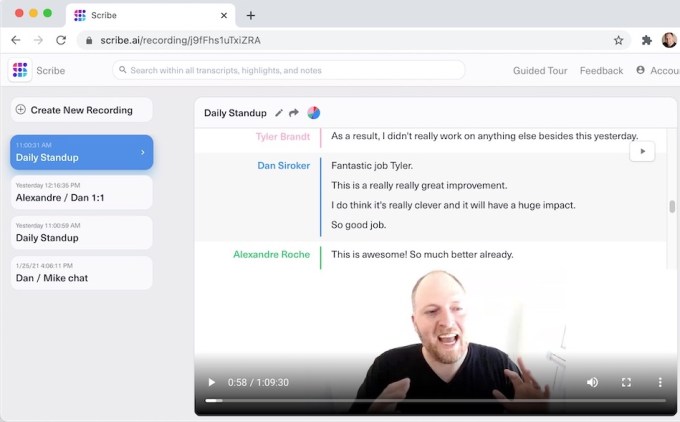
Image Credits: Scribe
Although Scribe is recording the meeting, Siroker said he wants this to be more like a note-taking replacement than a tape recorder.
“Let’s say you and I were meeting and I came to that meeting with a pen and paper and I’m writing down what you’re saying,” he said. “That’s totally socially acceptable — in some ways, it’s flattering … If instead, I brought a tape recorder and plopped in front of you and hit record — you might actually have this experience — with some folks, that feels very different.”
The key, he argued, is that Scribe recordings and transcripts can be edited, and you can also turn individual components on and off at any time.
“This is not a permanent record,” he said. “This is a shared artifact that we all create as we have a meeting that — just like a Google Doc — you can go back and make changes.”
That said, it’s still possible that Scribe could record some embarrassing comments, and the recordings could eventually get meeting participants in trouble. (After all, leaked company meeting recordings have already prompted a number of news stories.) Siroker said he hopes that’s “not common,” but he also argued that it could create an increased sense of transparency and accountability if it happens occasionally.
Scribe has raised around $5 million in funding, across a round led by OpenAI CEO Sam Altman and another led by First Round Capital.
Image Credits: Scribe
Siroker told me he sees Zoom as just the “beachhead” for Scribe’s ambitions. Next up, the company will be adding support for products like Google Meet and Microsoft Teams. Eventually, he hopes to build a new “hive mind” for organizations, where everyone is “smarter and better” because so many of their conversations and knowledge are now searchable.
“Where we go after that really depends on where we think we can have the biggest positive impact on people’s lives,” he said. “It’s harder to make a case for personal conversations you have with a spouse but … I think if you strike the right balance between value and privacy and control, you could really get people to adopt this in a way that actually is a win-win.”
And if Scribe actually achieves its mission of helping us to record and recall information in a wide variety of contexts, could that have an impact on our natural ability to remember things?
“Yes is the answer, and I think that’s okay,” he responded. “Your brain has limited energy … Remembering the things somebody said a few weeks ago is something a computer can do amazingly. Why waste your precious brain cycles doing that?”
Early Stage is the premier ‘how-to’ event for startup entrepreneurs and investors. You’ll hear first-hand how some of the most successful founders and VCs build their businesses, raise money and manage their portfolios. We’ll cover every aspect of company-building: Fundraising, recruiting, sales, product market fit, PR, marketing and brand building. Each session also has audience participation built-in – there’s ample time included for audience questions and discussion.
How Rani Therapeutics’ robotic pill could change subcutaneous injection treatment
A new auto-injecting pill might soon become a replacement for subcutaneous injection treatments.
The idea for this so-called robotic pill came out of a research project around eight years ago from InCube Labs — a life sciences lab operated by Rani Therapeutics Chairman and CEO Mir Imran, who has degrees in electrical and biomedical engineering from Rutgers University. A prominent figure in life sciences innovation, Imran has founded more than 20 medical device companies and helped develop the world’s first implantable cardiac defibrillator.
In working on the technology behind San Jose-based Rani Therapeutics, Imran and his team wanted to find a way to relieve some of the painful side effects of subcutaneous (or under-the-skin) injections, while also improving the treatment’s efficacy. “The technology itself started with a very simple thesis,” said Imran in an interview. “We thought, why can’t we create a pill that contains a biologic drug that you swallow, and once it gets to the intestine, it transforms itself and delivers a pain-free injection?”
Rani Therapeutics’ approach is based on inherent properties of the gastrointestinal tract. An injecting mechanism in their pill is surrounded by a pH-sensitive coating that dissolves as the capsule moves from a patient’s stomach to the small intestine. This helps ensure that the pill starts injecting the medicine in the right place at the right time. Once there, the reactants mix and produce carbon dioxide, which in turn inflates a small balloon that helps create a pressure difference to help inject the drug-loaded needles into the intestinal wall. “So it’s a really well-timed cascade of events that results in the delivery of this needle,” said Imran.
Despite its somewhat mechanical procedure, the pill itself contains no metal or springs, reducing the chance of an inflammatory response in the body. The needles and other components are instead made of injectable-grade polymers, that Imran said has been used in other medical devices as well. Delivering the injections to the upper part of the small intestine also carries little risk of infection, as the prevalence of stomach acid and bile from the liver prevent bacteria from readily growing there.
One of Imran’s priorities for the pill was to eliminate the painful side effects of subcutaneous injections. “It wouldn’t make sense to replace them with another painful injection,” he said. “But biology was on our side, because your intestines don’t have the kind of pain sensors your skin does.” What’s more, administering the injection into the highly vascularized wall of the small intestine actually allows the treatment to work more efficiently than when applied through subcutaneous injection, which typically deposits the treatment into fatty tissue.
Imran and his team have plans to use the pill for a variety of indications, including the growth hormone disorder acromegaly, diabetes and osteoporosis. In January 2020, their acromegaly treatment, Octreotide, demonstrated both safety and sustained bioavailability in primary clinical trials. They hope to pursue future clinical trials for other indications, but chose to prioritize acromegaly initially because of its well-established treatment drug but “very painful injection,” Imran said.
At the end of last year, Rani Therapeutics raised $69 million in new funding to help further develop and test their platform. “This will finance us for the next several years,” said Imran. “Our approach to the business is to make the technology very robust and manufacturable.”
Early Stage is the premier ‘how-to’ event for startup entrepreneurs and investors. You’ll hear first-hand how some of the most successful founders and VCs build their businesses, raise money and manage their portfolios. We’ll cover every aspect of company-building: Fundraising, recruiting, sales, product market fit, PR, marketing and brand building. Each session also has audience participation built-in – there’s ample time included for audience questions and discussion.