Woven Capital kicks off portfolio with investment in autonomous delivery company Nuro

Woven Capital, the investment arm of Toyota’s innovation-focused subsidiary Woven Planet, has announced an investment into Silicon Valley-based autonomous delivery vehicle company Nuro. This kicks off the new $800 million strategic fund, which will invest in growth-stage technology companies that could one day develop into partners or acquisitions to further a mission of building the future of safe mobility, according to George Kellerman, Woven Capital’s head of investments and acquisitions.  

Woven Capital’s contribution was part of Nuro’s $500 million Series C funding round, which was announced last November. Chipotle also invested in the round, which also included funds managed by T. Rowe Price Associates, Inc., with participation from new investors Fidelity Management & Research Company, LLC and Baillie Gifford. The specific amounts invested by each stakeholder were not disclosed. 

Toyota announced the $800 million investment pool in September 2020, and Woven Capital was officially formed in January 2021, with the aim of investing in technologies including autonomous mobility, machine learning, artificial intelligence, automation, connectivity and data and analytics. 

“Nuro was a good jumping off point, because a lot of the work that we’re doing is really focused on developing autonomous passenger vehicles, so this is a way for us to learn and advance through a partner that is laser-focused on local goods delivery,” Kellerman told TechCrunch. “There’s a lot of opportunity to learn from them, and potentially over time, to collaborate and help them expand globally.”

Nuro’s fleet of cargo-only self-driving vehicles has already been approved by California’s Department of Motor Vehicles to test on public roads, delivering goods from partners like Krogers, Domino’s, Walmart and CVS. The coronavirus pandemic accelerated the need for goods delivery, giving Nuro an opportunity to become a leader in this space. Woven Capital saw an opportunity to help accelerate and strengthen that leadership position, while also setting up a strategic knowledge sharing arrangement between the two. 

“[Woven Capital] has assembled a great team with ambitious goals for the future, and we share a common objective of transforming the way people live and move to make life better,” said Nuro co-founder and president Dave Ferguson in a statement. “We’ll use this new capital, and the support of one of the largest automotive companies in the world, to continue growing our team and building a great autonomous delivery product.”

Toyota Woven City concept render.

Toyota Woven City concept render. Image Credits: Toyota

Automation will be a big part of Woven Capital’s portfolio, which exists to support all of parent Woven Planet’s activities, including Woven City, a testing ground for new technologies set in an interconnected smart city prototype. In February, Toyota broke ground at the Higashi-Fuji site in Susono City, Japan, at the base of Mount Fuji. 

“When we think about Woven City, we think about autonomous mobility and automation more broadly,” said Kellerman. “To facilitate that, you’re going to need artificial intelligence, machine learning, data and analytics, connectivity. So we’re going to be building a portfolio that has investments in all those areas.”

A growing trend in the mobility industry is to view mobility not just as the movement of people and goods, but as the movement of information and data. Woven Planet recognizes this and is taking a software-first approach, particularly when it comes to automobiles. This means that instead of the historical auto industry approach of designing the hardware first, and then fitting in the software to operate that vehicle, you start with the software and build hardware around it. 

Building off a software-first architecture provides a lot flexibility for future innovation. If the hardware changes, you don’t have to rewrite the code, you could just add in another application. Kellerman said all the software Woven Planet is developing as a company should be usable in as many applications as possible. 

Having really strong, integrated software is also the logical next step for connected mobility, and it opens up doors for rethinking what a vehicle has the potential to transport. A Nuro vehicle isn’t just a vehicle for whatever groceries it’s delivering, but it’s also a vehicle for all the information it picks up along the way and transmits back to the cloud, such as traffic flows and weather patterns. The value, therefore, is less in the A to B utility, and more in the interchange of information. 

Some of the information collected by Nuro that could be immediately useful to Woven City is that related to street safety. Nuro’s vehicles don’t carry passengers, so the design features focus more on the safety of people outside of the vehicle, the aggregate data of which could be useful in human-centered city planning. 

In the end, Woven Capital’s long-term view is always a potential funnel to future mergers and acquisitions, said Kellerman. 

“Toyota is not historically a very acquisitive company, but within Woven Planet we’re building a corporate development team with an eye to how we can accelerate the vision and mission of Woven Planet through strategic acquisitions, as well,” said Kellerman.
Hub, a productivity platform for technical sales professionals, launches with $1M in funding

Hub, a productivity platform for technical pre-sales, has formally launched with $1 million in seed funding.

CEO Freddy Mangum and CTO Karl Gainey founded Hub in 2020. The pair both had experience in technical sales and recognized the challenges of using spreadsheets to manage their business.

They researched and surveyed sales engineers at big and small companies alike, discovering that many of these professionals were spending a lot of time doing things like “wrangling data to report to management, forcing individual contributors to enter data into a CRM (customer relationship management) system.

“Performing these kinds of mundane tasks was taking time away from them actually selling,” said Mangum. “We also came to the conclusion that technical sales professionals have been the unsung heroes of sales, behind the scenes driving enterprise.”

So they set about creating a better way for presales, solution architects and sales engineers to manage their day-to-day technical sales activities.

Then COVID hit, and obviously, as Mangum puts it, digital selling became much more real.

“That really accentuated the need for specific commercial tooling,” he said.

San Francisco-based Hub was born. The company describes its offering as a SaaS application that “securely interconnects and complements popular CRM systems and productivity applications.”

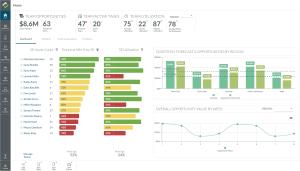
As a personalized productivity platform, Hub is designed to help individual contributors manage the sales process. By gaining greater visibility into every step, the goal is to better analyze and do more accurate forecasting so an organization can better “identify investment areas while taking corrective actions in real time,” Mangum said.

“Our tool can help them automate the mundane tasks and put the focus on high-value tasks to actually win more business,” he added.

Image Credits: Courtesy of Hub

Targeting technical sales professionals is an underserved market, according to Mangum, which presents tremendous opportunity.

Investors in the company include Tom Noonan, general partner of Atlanta-based TechOperators (and former chairman and CEO of Internet Security Systems, which was acquired in 2007 by IBM for $1.3 billion) and SalesLoft CEO and co-founder Kyle Porter.

To Noonan, the pandemic presented the challenge of keeping an enterprise sales force effective while working remotely.

“The biggest concern was not that sales people couldn’t engage with customers. It was how the technical part of the sales cycle was going to be conducted remotely, such as the concepts demonstrations integrations, the modifications, all the things that have to be articulately communicated, and also aligned with the customer’s needs,” he told TechCrunch. “And to me that just made the need for this model of selling that we’re in today.”

Looking ahead, Noonan believes these teams are going to question why they spent so much time on travel and on-site activities. 

“More and more customers have actually gotten accustomed to remote interactions and even more importantly, many of the customers are not working in a place of business now either,” he said. “And that leaves a huge challenge for the solution architects, because they are the glue that bridge between a buyer saying that’s interesting, and an organization concluding that the capabilities of whatever system is being sold to them truly meets their needs both from a technical perspective and integration perspective and a functional perspective.”

Hub, he believes, can help address that challenge.

With a diverse founding team (Mangum is a Bolivian immigrant and Gainey is Black), Hub aims to reflect that diversity in its team. Its developers are based in Argentina, for example. 

“As someone who graduated from ESL when I came to this country it is important that opportunities not be closed off to people just because of language barriers,” Mangum said.

Gillmor Gang: Grifters Paradise

The other day, I attended a celebration of one of the pioneers of collaboration technology, Ray Ozzie. The father of Lotus Notes, Ozzie left Lotus and his startup firm Iris after a hostile takeover by IBM, and eventually joined Microsoft when that company acquired his next startup, Groove. By “attended” I mean a virtual event put on by the Computer History Museum in Silicon Valley. Ray’s peers and partners gathered in a Zoom chat, with a tour of Ray’s early days including amazing hardware like a touchscreen based enterprise chat system called Plato, and these strange things called floppy disks with the earliest source code for DOS and other prehistoric things called operating systems.

At Microsoft, Ray soon became one of several CTOs, and eventually took the role of Chief Software Architect as he helped midwife the company’s move toward the Web and away from its dominant Office suite. Politically, he faced the twin power centers in Redmond: Office and Windows, the latter of which has receded in strategic importance as mobile technologies like iOS and Android took over in the wake of Apple’s iPhone success. But there’s no doubt that Ray’s elevation allowed Bill Gates, who spoke movingly about Ray at the CHM, to pivot to focus with his wife on the philanthropy role at their Foundation. Talk about just in time, as Bill’s voice in the battle against the pandemic has often been a trusted beacon of hope and science in a sea of denial, misinformation, and well, you know the rest.

In his gracious speech, Ray mentioned Gates, Lotus founder Mitch Kapor, and a name less well known to many, Dave Winer. I’m not positive why Dave was called out, but I’m sure it had something to do with Winer’s work championing the development of blogging, RSS, and its attachment extensions that birthed podcasting. In today’s climate of media streaming, newsletters, and live conversation-casting a la Clubhouse, surviving the pandemic means marshaling our tools to work and live more deeply and richly from anywhere. Talk about just in time.

Clubhouse is under attack in the Twitterverse, with some suggesting it’s just another outlet for the noise of social media, or a business idea destined for landfill in the wake of the next shiny object. Clubhouse counterattacked with another overflow megasession from Facebook’s Zuckerberg and the CEOs of Spotify and Shopify. The messaging app Telegram pushed a voice chat 2.0 release with tools for inviting speakers, listeners, raising your hand to speak, and recording built in. The stampede continues, but to what end? Like NFTs, a grifters’ paradise?

Perhaps we’re experiencing a massive multiplayer game where collaborative innovations are being combined and redefined on the fly. One Clubhouse session materialized with one of the big thinkers in mobile, Benedict Evans. After several years as an analyst at Andreessen Horowitz (A16Z) , he’s moved back to London and gone paid newsletter with some of his 150,000 plus subscribers to his weekly free version. Struggling as I am with rising subscription costs, I’ve been making do with waiting for some of his firewalled essays to play off in the free version. But here was a session with Benedict and another former A16Z analyst focused on NFTs and crypto, Morgan Beller.

The talk was at a torrid clip, but meta across both the upside possibilities and the context of earlier innovations that seemed heavy on the gamble but paid off. This was vintage Evans in a casual setting where he gave me a ton of signal, bouncing off an analyst I immediately followed after ten minutes or so, adding her to a notification stream the next time she joined in. At one point, the moderator pinged me to invite me to join in, but thankfully I chose the “maybe later” option so I could go back to desperately trying to keep up with the flow. Maybe later when I actually know something by learning from people who live and breathe this stuff. I can’t even be sure what fungible means so far.

It was not your average big ticket press conference; it was access to people steeped in their interests and willing to be measured against the astuteness of their observations. The social following tools ostensibly produce more effective notifications based on providing interruptions the listener is willing to accept. The size of the crowd is manageable (50 -100) and drafts off the characteristics of not just who is on stage but who’s listening and in what combinations. It’s a mixture (I hope) of follows plus percentage of successful clicks on targeted notifications.

This all feels like a mashup of collaborative platforms, menu items in a new operating system where ideas and tactics are tested transparently in the open. Remember our former president, who famously laundered the unthinkable in public as a way of commanding the conversation. The alphabet soup of NFTs and SPACs is difficult to separate from MLMs and such of previous eras, but eventually we’ll figure out what’s real. A good place to start is in the trenches with practitioners of this new arts yakking it up on the new media channels.

from the Gillmor Gang Newsletter

__________________

The Gillmor Gang — Frank Radice, Michael Markman, Keith Teare, Denis Pombriant, Brent Leary and Steve Gillmor. Recorded live Friday, March 19, 2021.

Produced and directed by Tina Chase Gillmor @tinagillmor

@fradice, @mickeleh, @denispombriant, @kteare, @brentleary, @stevegillmor, @gillmorgang

Subscribe to the new Gillmor Gang Newsletter and join the backchannel here on Telegram.

The Gillmor Gang on Facebook … and here’s our sister show G3 on Facebook.