By using GPS data to monitor slight changes in elevation, the world’s fleet of commercial vessels could aid in forecasting incoming waves.
Category: Tech news
hacking,system security,protection against hackers,tech-news,gadgets,gaming
5 Years After the Oculus Rift, Where Do VR and AR Go Next?
A lot’s happened since Facebook’s first headset brought virtual reality to the masses. Facebook might have been a first mover, but it also wants to be the last one.
Women Street Photographers Captures the Beauty of Normalcy
The photography book, released during Women’s Futures Month and on the heels of a worldwide vaccine rollout, couldn’t come at a better time.
The Foundations of AI Are Riddled With Errors
The labels attached to images used to train machine-vision systems are often wrong. That could mean bad decisions by self-driving cars and medical algorithms.
How to Find a Covid-19 Vaccine Appointment in Your Area
Vaccination rollout has been a challenge across the US. These tips should help you figure out when you’re eligible, where to go, and what to expect.
Amazon partners with Seraphim on AWS accelerator for space startups
Amazon will soon be a big part of the space economy in the form of its Kuiper satellite internet constellation, but here on Earth its ambitions are more commonplace: get an accelerator going. They’ve partnered with space-focused VC outfit Seraphim Capital to create a four-week program with (among other things) a $100,000 AWS credit for a carrot.
Applications are open now for the AWS Space Accelerator, with the only requirement that you’re aiming for the space sector and plan to use AWS at some point. Ten applicants will be accepted; you have until April 21 to apply.
The program sounds fairly straightforward: a “technical, business, and mentorship” deal where you’ll likely learn how to use AWS properly, get some good tips from the AWS Partner Network and other space-focused experts on tech, regulations and security, then rub shoulders with some VCs to talk about that round you’re putting together. (No doubt Seraphim’s team gets first dibs, but there doesn’t appear to be any strict equity agreement.)
“Selected startups may receive up to $100,000 in AWS Activate credit,” the announcement says, which does hedge somewhat, but probably legal made them put that in.
There are a good amount of space-focused programs out there, but not nearly enough to cover demand — there are a lot of space startups! And they often face a special challenge of being highly technical, have customers in the public sector and need rather a lot of cash to get going compared with your average enterprise SaaS.
We’ll understand more about the program once the first cohort is announced, likely not for at least a month or two.
LinkedIn confirms it’s working on a Clubhouse rival, too
Clubhouse’s list of competitors is growing. LinkedIn has now confirmed it’s also testing a social audio experience in its app which would allow creators on its network to connect with their community. Unlike the Clubhouse rivals being built by Facebook and Twitter, LinkedIn believes its audio networking feature will be differentiated because it will be connected with users’ professional identity, not just a social profile. In addition, the company has already built out a platform that serves the creator community, which today has access to tools like Stories, LinkedIn Live video broadcasting, newsletters and more.
And just today, LinkedIn formalized some of its efforts in this area with the launch a new “Creator” mode that lets anyone set their profile as one that can be followed for updates, like Stories and LinkedIn Live videos, for example.
This focus on creators puts LinkedIn on competitive footing in terms of expanding its own Clubhouse rival, compared with other efforts by Facebook, Twitter, Telegram, or Discord — all of which have their own audio-based networking features in various stages development at this time.
Though Twitter’s Clubhouse rival, Twitter Spaces, is already live in beta testing, its full set of creator tools have yet to arrive. In fact, it was only last month that Twitter announced its plans for a larger creator subscription platform via a new “Super Follow” feature, for instance. And it only this year entered the newsletter space via an acquisition. Facebook, meanwhile, has historically offered a number of creator-focused features, but has just recently gotten invested in tools like newsletters.
LinkedIn says its development of an audio-based networking feature came about because its members and creatives have been asking for more ways to communicate on its platform.
“We’re seeing nearly 50% growth in conversations on LinkedIn reflected in stories, video shares, and posts on the platform,” Suzi Owens, a spokesperson for LinkedIn, said when confirming its audio feature’s development. “We’re doing some early tests to create a unique audio experience connected to your professional identity. And, we’re looking at how we can bring audio to other parts of LinkedIn such as events and groups, to give our members even more ways to connect to their community,” she said.
As a result of creators’ interest in this space, the company moved quickly to develop its own Clubhouse-like feature, where there’s a stage showcasing the room’s speakers and a set of listeners below. There are also tools to join and leave the room, react to comments, and request to speak, according to screenshots of the interface first discovered in the LinkedIn Android app by reverse engineer Alessandro Paluzzi.
Note that Paluzzi’s photo shows a user interface populated with his own profile icon, shown in the image he tweeted. That is not part of the LinkedIn mockup. Instead, LinkedIn shared its own conceptual UX mockup of its in-room experiences with TechCrunch, which shows a more fleshed out example of how the feature may look at launch.
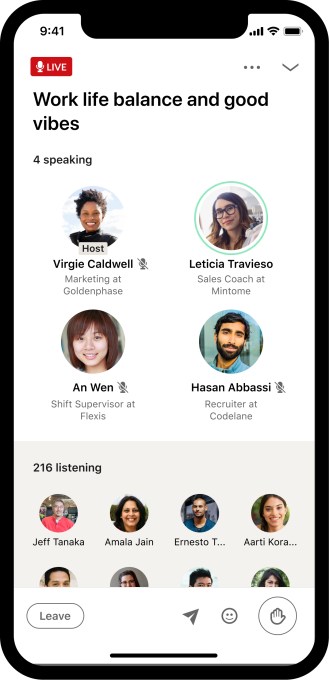
Image Credits: LinkedIn
LinkedIn believes that because the audio experience will be connected with users’ professional identities, they’ll feel comfortable speaking, commenting and otherwise engaging with the content, the company told TechCrunch. It will also be able to leverage its existing investment in moderation tools built for other features — like LinkedIn Live — to help to address any concerns over inappropriate or harmful discussions, like those that have already plagued Clubhouse.
“Our priority is to build a trusted community where people feel safe and can be productive,” Owens noted. “Our members come to LinkedIn to have respectful and constructive conversations with real people and we’re focused on ensuring they have a safe environment to do just that,” she said.
Plus, LinkedIn says that audio networking makes for a natural extension of other areas, like Groups and Events — areas for networking that have continued to grow, and particularly during the pandemic.
In 2020, some 21 million people attended an event on LinkedIn, and overall LinkedIn sessions increased by 30% year-over-year. The company’s 740 million global members also last year built community, had conversations, and shared knowledge, with 4.8 billion connections made.
Like many companies which saw a pandemic boost, LinkedIn believes the pandemic only accelerated the natural progression towards online networking, remote work, and virtual events, which were already in place before lockdowns. For example, LinkedIn says that more than 60% of its members were working remotely by the end of 2020, versus 8% before the pandemic. LinkedIn believes the shift will stick, as more than half the world’s workforce is expected to continue working from home at least some of the time, even after the pandemic comes to an end.
That leaves room for new forms of online networking to grow, as well, including audio experiences.
LinkedIn doesn’t yet have an exact timeframe for its launch of the audio networking feature, but says it will begin beta testing soon.
Daily Crunch: Google starts testing its cookie alternative
Google tries out new ad targeting technology, PayPal adds cryptocurrency support and Substack raises additional funding. This is your Daily Crunch for March 30, 2021.
The big story: Google starts testing its cookie alternative
Google announced today that it has begun rolling out a new technology called Federated Learning of Cohorts (FLoC) in a developer trial. FLoC is meant to serve as an alternative to personally identifiable cookies (which are being phased out by Google and other platforms), with Google analyzing your web browsing behavior and grouping you with other people who have similar interests, for ad-targeting purposes.
The trial is starting out in a number of geographies, including the United States — but not in Europe, where there are concerns about compliance with Europe’s GDPR privacy regulations.
The tech giants
YouTube tests hiding dislike counts on videos — The company says it will run a “small experiment” with different designs that hide dislike counts, but not the “dislike” button itself.
Ballot counting for Amazon’s historic union vote starts today — Amazon’s warehouse in Bessemer, Alabama has become ground zero for one of the most import labor efforts in modern American history.
PayPal’s new feature allows US consumers to check out using cryptocurrency — The feature expands on PayPal’s current investments in the cryptocurrency market.
Startups, funding and venture capital
Celebrity video request site Cameo reaches unicorn status with $100M raise — Cameo has been building a good deal of steam in recent years, but it also got a major boost amidst the pandemic.
Substack confirms $65M raise, promises to ‘rapidly’ expand its financial backing of newly independent writers — Substack did not provide material new growth metrics, instead saying that it has “more than half a million people” paying for writers on its network.
NFT art marketplace SuperRare closes $9M Series A — SuperRare launched its art platform in 2018, since then it has differentiated by maintaining a closed early access platform, closely curating the art that’s sold.
Advice and analysis from Extra Crunch
The Tonal EC-1 — Remember our deep dives into the history, businesses and growth of Patreon, Niantic, Roblox, Kobalt and Unity? We’re bringing the format back with an in-depth, multi-part look at fitness startup Tonal.
Is Substack really worth $650M? — More thoughts on Substack’s finances.
(Extra Crunch is our membership program, which helps founders and startup teams get ahead. You can sign up here.)
Everything else
A trove of imported console games vanish from Chinese online stores — A handful of grey market videogame console vendors on Taobao stopped selling and shipping this week.
Applications for Startup Battlefield at TC Disrupt 2021 are now open — TechCrunch is on the hunt for game-changing and ground-breaking startups from around the globe to feature in Startup Battlefield during TechCrunch Disrupt 2021 this fall.
The Daily Crunch is TechCrunch’s roundup of our biggest and most important stories. If you’d like to get this delivered to your inbox every day at around 3pm Pacific, you can subscribe here.

Apple Maps adds COVID-19 travel guidance for over 300 airports worldwide
Apple has updated its native Maps app with more helpful information designed to assist with travel while mitigating the spread of COVID-19. Apple Maps on iPhone, iPad and Mac will now show COVID-19 health measure information for airports when searched via the app, either through a link to the airport’s own COVID-19 advisory page, or directly on the in-app location card itself.
The new information is made available through a partnership with the Airports Council International and provides details on COVID-19 safety guidelines in effect at over 300 airports worldwide. The type of information provided includes requirements around COVID-19 testing, mask usage, screening procedures and any quarantine measures in effect, and generally hopes to help make the process of traveling while the global pandemic continues easier, and as vaccination programs and other counterefforts are set to prompt a global travel recovery.
Earlier this month, Apple also added COVID-19 vaccination locations within the U.S. to Apple Maps, which can be found when searching either via text, with Siri, or using the “Find nearby” location-based feature. Last year, the company added testing sites in various locations around the world and added COVID-19 information modules to cards for other types of businesses.
Free Extra Crunch membership included with TC Early Stage tickets
TechCrunch Early Stage is coming up this week, and all attendees can get three months of free access to Extra Crunch as a part of a ticket purchase. Extra Crunch is our members-only community focused on founders and startup teams, and it features over 100 exclusive articles per month.
Head here to buy your ticket to TC Early Stage.
Extra Crunch unlocks access to our weekly investor surveys, private market analysis, and in-depth interviews with experts on fundraising, growth, monetization and other core startup topics. Get feedback on your pitch deck through Extra Crunch Live, and stay informed with our members-only Extra Crunch newsletter. Other benefits include an improved TechCrunch.com experience and savings on software services from AWS, Crunchbase and more.
Learn more about Extra Crunch benefits here, and buy your TC Early Stage tickets here.
What is TC Early Stage?
TC Early Stage is a two-day virtual event where early-stage founders can take part in highly interactive group sessions with top investors and ecosystem experts. This includes everything from fundraising and operations to product lifecycle and recruiting.
The event will take place April 1-2, and we’d love to have you join. View the event agenda here, and purchase tickets here.
Once you buy your TC Early Stage pass, you will be emailed a link and unique code to claim the free trial of Extra Crunch.
Already bought your TC Early Stage ticket?
Existing pass holders will be emailed with information on how to claim the free three months of Extra Crunch membership. All new ticket purchases will receive information over email immediately after the purchase is complete.
Already an Extra Crunch member?
We’re happy to extend a free three months of access to existing users. Please contact [email protected], and mention that you are an existing Extra Crunch member who bought a ticket to TC Early Stage.
What if I buy a ticket to both Early Stage 1 and 2?
You get six months of free access.
Amazon acquires Indian retail startup Perpule
Amazon has acquired a startup in India that is helping offline stores go online, the e-commerce group’s latest attempt to make inroads in the world’s second most populous nation where brick and mortar continue to drive more than 95% of sales.
The American e-commerce group said on Tuesday evening that it has acquired Perpule, a four-year-old startup. A regulatory filing showed Amazon Technologies paid $14.7 million to acquire the Indian startup in an all-cash deal. The company is expected to spend an additional $5 million or so to compensate Perpule’s employees.
Perpule, which had raised $6.36 million (per insight platform Tracxn), offers a mobile payments device (point of sale machine) to offline retailers to help them accept digital payments and also establish presence on various mini app stores including those run by Paytm, PhonePe and Google Pay in India.
“Perpule has built an innovative cloud-based POS offering that enables offline stores in India to better manage their inventory, checkout process and overall customer experience,” an Amazon spokesperson said in a statement.
“We are excited to have the Perpule team join us to focus on providing growth opportunities for businesses of all sizes in India while raising the bar of the shopping experience for Indian customers.”
Founded in late 2016, the Indian startup’s first product was focused on helping customers avoid queues at superchains such as Shoppers Stop, Spar Hypermarket and Big Bazaar. But the product, said Abhinav Pathak in a recent interview, wasn’t scaling, which is when Perpule pivoted.
The Bangalore-based startup — which counts Prime Venture Partners, Kalaari Capital and Raghunandan G (founder of neobank Zolve) among its investors — has further expanded in recent years, launching products like StoreSE, which enables a business to support group ordering.
Last year, it also expanded geographically, bringing its offerings to Southeast Asian markets including Indonesia, Malaysia, Thailand, Singapore and Vietnam.
Amazon has aggressively engaged with physical stores in India in recent years, using their vast presence in the nation to expand its delivery network and warehouses and even just relying on their inventory to drive sales.
The company’s push into physical retail comes as Flipkart, and Reliance Jio Platforms (backed by Facebook and Google), which last year raised over $20 billion, also race to capture this market. The acquisition of Perpule comes less than a week after Google backed DotPe, a startup that offers several similar products.
These neighborhood stores offer all kinds of items, are family run and pay low wages and little to no rent. Because they are ubiquitous — there are more than 30 million neighborhood stores in India, according to industry estimates — no retail giant can offer a faster delivery. On top of that, their economics are often better than most of their digital counterparts.
Our Favorite Photography Backpack is $50 Off
At $120, the Moment MTW Backpack is a great bag at a good price—but the discount ends March 31.
Applications for Startup Battlefield at TC Disrupt 2021 are now open
Applications for Startup Battlefield are now open! Founders, this past year has been challenging in ways words can’t encompass. But you are persevering and now is the time to show the world what you have been working on. TechCrunch is on the hunt for game-changing and ground-breaking startups from around the globe to feature in Startup Battlefield during TechCrunch Disrupt 2021 this fall. Startups will be competing for a $100,000 equity-free prize, the eyes of investors from around the world and global media coverage on the most famous stage in tech media.
Eligibility & Application. Startup Battlefield highlights early-stage companies from all geographies, in any industry. Startups should have an MVP. Founders simply need to apply here. Every application is reviewed by a member of the TechCrunch editorial team. TechCrunch takes ZERO fees — the application and participation/training program for selected companies is free. TC does not take equity in any company.
Training. Startups selected to pitch will engage in intensive training over several weeks with the Startup Battlefield team. Founders will perfect their pitches, finesse their business models and hone their presentation skills. Founders will have access to master classes from experts on how to build, market and scale the startups.
Pitch. About 25 startups will be selected to pitch on the main stage at TechCrunch Disrupt 2021. Each founder will present for six minutes, with a live demo, followed by a Q&A with our esteemed panel of judges. Judges like Kristin Green, Aileen Lee, Alfred Lin, Susan Lyne and more. After the first round, the top set of companies will pitch again in the final round in front of a fresh panel of judges. The judges will pick the winner who will receive the Disrupt cup and the $100,000 equity-free prize money.
Disrupt. Startup Battlefield founders are the VIPs of TC Disrupt. Founders get access to private events, complimentary event tickets, exhibition space on the virtual show floor, access to CrunchMatch and a private Startup Battlefield reception with members of the Startup Battlefield alumni community. Battlefield founders will also get access to future TC events and a free subscription to Extra Crunch.
Launch your startup this September. Step into the spotlight. Apply now.
NFT art marketplace SuperRare closes $9 million Series A
The NFT ecosystem is having an explosive moment and the startups that were ready to run with it are getting lots of cash to continue capturing that momentum.
SuperRare, an NFT art platform that has garnered tens of millions in new sales in recent weeks, has just raised millions from investors. The $9 million Series A round was led by Velvet Sea Ventures and 1confirmation. Other investors participating in the round include Collaborative Fund, Shrug Capital, Third Kind, SamsungNext, Ashton Kutcher and Guy Oseary’s Sound Ventures, Mark Cuban, Marc Benioff, Naval Ravikant and Chamath Palihapitiya, among others.
In an announcement of the raise, the team called the crypto art scene a “global phenomenon.”
SuperRare launched its art platform in 2018, since then it has differentiated by maintaining a closed early-access platform that more closely curates the art they sell. Everything on the platform is a single-edition 1/1 sale. The team has said they plan to launch the site widely next year. The company earns a 3% transaction fee on art sales on the platform in addition to a 15% gallery fee for primary sales. One unique facet of the platform is that creators can continue to earn on a piece’s appreciating value following with 10% commissions on secondary sales.
While NFT art sales have taken off in recent weeks, there are still many structural issues facing their mainstream adoption largely due to scalability issues with Ethereum’s mainnet, which SuperRare operates on. Plenty of firms are building layer-two infrastructure that improves speed and cuts down on energy usage and transaction fees. Today, ConsenSys launched a platform called Palm featuring artists Damien Hirst as the platform’s first artist drop.
After a lengthy crypto winter, blockchain startups are coming back with a vengeance amid a surge in startup investing, a surge in enthusiasm around NFTs and a surge in bitcoin prices. Today, NBA Top Shot maker Dapper Labs announced in had raised $305 million in venture funding.
YouTube tests hiding dislike counts on videos
YouTube announced today it will begin testing what could end up being a significant change to its video platform: It’s going to try hiding the dislike count on videos from public view. The company says it will run a “small experiment” where it will try out a few different designs where dislike counts are no longer shown, however none will see the “dislike” button itself removed entirely.
The company announced the tests on Twitter, but then explains further in a community forum post that the goal is not to remove the ability for users to signal they disliked a video — creators will still have access to the video’s like and dislike count from YouTube Studio and dislikes will still help power YouTube’s recommendation algorithms.
Instead, YouTube says that the idea to try hiding dislikes is based on creator feedback.
“We’ve heard from creators that the public dislike counts can impact their well-being and may motivate a targeted campaign of dislikes on a creator’s video,” the announcement reads. “So, we’re testing designs that don’t include the visible like or dislike count in an effort to balance improving the creator experience, while still making sure viewer feedback is accounted for and shared with the creator.”
Of course, there can be a sort of mob mentality that accompanies the use of the Like and Dislike buttons on YouTube. But seeing the dislike count can also help to signal to others when videos are clickbait, spam or misleading, which can be helpful.
Creators, you'll still be able to see the exact number of likes and dislikes in YouTube Studio. For viewers, if you're in the experiment, you can still like or dislike a video to share feedback with creators and help tune the recommendations you see on YouTube.
— YouTube (@YouTube) March 30, 2021
YouTube showed off one potential design being tested that simply shows the same button layout but instead of a number of dislikes, the word “Dislike” appears underneath the thumbs down icon.
There will be no way to opt out of the test if you see the changes appear when you’re logged into YouTube — you’ll only be able to share feedback, the company notes.
To be clear, however, YouTube isn’t yet committed to removing the dislike count for everyone at this time. The feedback from this test will help inform YouTube as to if, when or how it will release designs like this more broadly.
YouTube wouldn’t be the first to experiment with removing metrics from a social app. Instagram has also been testing removing the number of positive engagements (Likes), in order to make the experience feel more authentic and less about chasing clout. And Facebook this year removed the “Like” button from Facebook Pages, in favor of the more accurate “Followers” measurement. However, in the case of removing just the dislike count and not the likes, viewers may misunderstand a video’s true popularity.
The company told TechCrunch the tests will run globally over the next few weeks on Android and iOS while it gathers feedback from a handful of designs.
Updated 3/30/21, 6 pm et to add details about launch.