RPA market surges as investors, vendors capitalize on pandemic-driven tech shift

When UIPath filed its S-1 last week, it was a watershed moment for the robotic process automation (RPA) market. The company, which first appeared on our radar for a $30 million Series A in 2017, has so far raised an astonishing $2 billion while still private. In February, it was valued at $35 billion when it raised $750 million in its latest round.

RPA and process automation came to the fore during the pandemic as companies took steps to digitally transform. When employees couldn’t be in the same office together, it became crucial to cobble together more automated workflows that required fewer people in the loop.

RPA has enabled executives to provide a level of workflow automation that essentially buys them time to update systems to more modern approaches while reducing the large number of mundane manual tasks that are part of every industry’s workflow.

When UIPath raised money in 2017, RPA was not well known in enterprise software circles even though it had already been around for several years. The category was gaining in popularity by that point because it addressed automation in a legacy context. That meant companies with deep legacy technology — practically everyone not born in the cloud — could automate across older platforms without ripping and replacing, an expensive and risky undertaking that most CEOs would rather not take.

RPA has enabled executives to provide a level of workflow automation, a taste of the modern. It essentially buys them time to update systems to more modern approaches while reducing the large number of mundane manual tasks that are part of just about every industry’s workflow.

While some people point to RPA as job-elimination software, it also provides a way to liberate people from some of the most mind-numbing and mundane chores in the organization. The argument goes that this frees up employees for higher level tasks.

As an example, RPA could take advantage of older workflow technologies like OCR (optical character recognition) to read a number from a form, enter the data in a spreadsheet, generate an invoice, send it for printing and mailing, and generate a Slack message to the accounting department that the task has been completed.

We’re going to take a deep dive into RPA and the larger process automation space — explore the market size and dynamics, look at the key players and the biggest investors, and finally, try to chart out where this market might go in the future.

Meet the vendors

UIPath is clearly an RPA star with a significant market share lead of 27.1%, according to IDC. Automation Anywhere is in second place with 19.4%, and Blue Prism is third with 10.3%, based on data from IDC’s July 2020 report, the last time the firm reported on the market.

Two other players with significant market share worth mentioning are WorkFusion with 6.8%, and NTT with 5%.


Uruguayan payments startup dLocal quadruples valuation to $5B with $150M raise

Cross-border payments startup dLocal has raised $150 million at a $5 billion valuation, less than seven months after securing $200 million at a $1.2 billion valuation.

This means that the five-year-old Uruguayan company has effectively quadrupled its valuation in a matter of months.

Alkeon Capital led the latest round, which also included participation from BOND, D1 Capital Partners and Tiger Global. General Atlantic led its previous round, which closed last September and made dLocal Uruguay’s first unicorn and one of Latin American’s highest-valued startups.

DLocal connects global enterprise merchants with “billions” of emerging market consumers in 29 countries across Asia-Pacific, the Middle East, Latin America and Africa. More than 325 global merchants, including e-commerce retailers, SaaS companies, online travel providers and marketplaces use dLocal to accept over 600 local payment methods. They also use its platform to issue payments to their contractors, agents and sellers. Some of dLocal’s customers include Amazon, Booking.com, Dropbox, GoDaddy, MailChimp, Microsoft, Spotify, TripAdvisor, Uber and Zara. 

In conjunction with this latest round, dLocal has named Sumita Pandit to the role of COO. Pandit is former global head of fintech and managing director for JP Morgan, and also worked at Goldman Sachs.

“Sumita is a highly respected and accomplished fintech investment banker, and she’s played a pivotal role advising some of the world’s most successful fintech companies as they’ve scaled to become global leaders,”  said dLocal CEO Sebastián Kanovich in a written statement.

Meanwhile, former COO Jacobo Singer has been promoted to president of dLocal.

The company plans to use its new capital to enhance its technology and continue to expand geographically.

Alkeon General Partner Deepak Ravichandran believes that emerging markets represent some of the fastest growth opportunities in digital payments.

“However, as global merchants look to access these markets, they are often faced with a complex web of local payment methods, cross-border regulations, and other operational roadblocks,” he said in a written statement. “dLocal’s unique platform empowers merchants with a single integrated payment solution, to reach billions of customers, accept payments, send payouts, and settle funds globally.”

Private equity, a SPAC and an IPO walk into a bar

The first quarter of 2021 was a busy season for technology exits. Coming off a hot period in the final quarter of 2020, it was no surprise that tech upstarts pursued liquidity through a variety of mechanisms as the new year began.

There were IPOs, there were direct listings, there were PE deals. Hell, we even saw enough SPACs that we lost track of a few; amid all the noise, you’ll miss the occasional note no matter how well-tuned your ear.


The Exchange explores startups, markets and money. Read it every morning on Extra Crunch, or get The Exchange newsletter every Saturday.


Each path is still open for later-stage startups to pursue exits: The IPO market was welcoming until a few minutes ago and private equity firms are stacked with cash and willing to pay higher multiples than they might in more normal times. And there are sufficient SPACs to take the entire recent Y Combinator class public.

Choosing which option is best from a buffet’s worth of possibilities is an interesting task for startup CEOs and their boards.

DigitalOcean went public via a traditional IPO, raising a slug of capital in the process. The SMB-focused public cloud company likely felt like a somewhat obvious IPO candidate when you read its results. The Exchange spoke with the company’s CEO, Yancey Spruill, about the choice.

Latch, in contrast, decided that a SPAC was its best route out the gate. The Exchange caught up with the company’s CFO, Garth Mitchell, about the transaction and why it made sense for his company.

And, finally, The Exchange spoke with AlertMedia’s founder and CEO, Brian Cruver, about his decision to sell his Texas-based company to a private equity firm.

To prevent this post from reaching an astronomic word count, we’ll give a brief overview of each deal and then summarize the company’s views about why their liquidity choice was the right one.

Three paths to liquidity

Kicking off with DigitalOcean, a few notes: First, the company has been pretty darn public about its growth in the last few years. We knew that it had an annualized run rate of around $200 million in 2018, $250 million in 2019 and around $300 million in the first half of 2020. It later announced that it hit that mark in May of last year.

So when DigitalOcean decided to go public, we weren’t bowled over. The company wound up pricing at $47 per share, the high end of its range. Since then, its stock has struggled somewhat, falling below $37 per share before recovering to $43.80 at the end of trading yesterday.

Enough of all that. Why did the company choose to go public via a traditional IPO? Spruill said his company looked at SPAC deals and direct listings. It selected the IPO route because it fit the company’s goals of generating a broad base of shareholders while creating a branding opportunity.

The cost of an IPO is comparable, he added, to other exit options. Spruill also praised the IPO process itself, noting that its rigorous requirements made DigitalOcean a better company.

Earlier in our chat, I asked Spruill a question that I put to every CEO on IPO day: How are you feeling? It’s a bit of a sop, but it sometimes elicits insights from executives and founders who, after weeks of discussing their companies’ inner workings, are asked a rare personal question.

Spruill said he felt incredible and that nothing could replicate an IPO as the culmination of so much work put into building a company and its team. If you add up the wins and losses over time, with more of the former than the latter, and can cross the finish line with the right metrics and market, you can earn a spot to be “grilled” by the “best investors,” he said.

Those investors put $750 million or so into his company, Spruill added. Funds that it can use to retire debt and free up more cash flow. Not a bad day, I’d say.

Apple expands Apple Arcade with classic App Store games

Apple has announced an expansion for its subscription gaming service Apple Arcade. In addition to exclusive game releases, the company is adding two new categories — Timeless Classics and App Store Greats.

In the “App Store Greats” category, you can find some well-known iPhone games that have been released over the past decade, such as Threes+, Mini Metro+, Monument Valley+, Fruit Ninja Classic+, Cut the Rope Remastered and Badland+.

This is an interesting move, as Apple has focused on exclusive titles so far. Arguably, some Apple Arcade games are sequels of popular App Store games — I’d put Mini Motorways and Rayman Mini in this category, for instance.

But Apple is changing its stance and essentially buying a back catalog of App Store games. Some of them are still available on the App Store, while others have become incompatible with modern iOS versions due to framework and hardware updates. 64-bit processors have rendered many games incompatible for instance.

As always, Apple isn’t just putting free games behind a paywall. These are brand new downloads on the App Store. You get the full game without any ad or in-app purchase.

In addition to old school App Store games, Apple is also adding “Timeless Classics” games. It’s a selection of board games and classic puzzle games that are included in your subscription. Games include Backgammon+, Chess Play & Learn+, Good Sudoku+, Tiny Crossword+, etc.

Those games should definitely help when it comes to reducing churn. Some people just like playing chess over and over again. They might start subscribing to play some chess and pay an Apple Arcade subscription just to keep using the same app.

Overall, Apple is dropping 32 games today, and Apple Arcade has more than 180 games in its catalog. Apple originally launched the service in September 2019. You can download Apple Arcade games for $4.99 per month and there’s no additional in-app purchases. Games are available on the iPhone, the iPad, the Apple TV and macOS. Up to six family members can play with a single Apple Arcade subscription and you can also access Apple Arcade with an Apple One subscription.

Apple has been betting heavily on subscription services, such as Apple Music, Apple TV+, Apple Fitness+ and Apple News+. While some of those services have been very successful, such as Apple Music, the company is still adding more and more content to other services to prove that you should subscribe over the long haul. And today’s Apple Arcade update should definitely help for its game subscription service.

Image Credits: Apple

Clubhouse will create billions in value and capture none of it

Hello and welcome back to Equity, TechCrunch’s venture capital-focused podcast, where we unpack the numbers behind the headlines.

Natasha and Danny and Alex and Grace were all here to chat through the week’s biggest tech happenings. It was a busy week on the IPO front, Danny was buried in getting the Tonal EC-1 out, and Natasha took some time off. But the host trio managed to prep and record a show that was honestly a kick to record, and we think, a pleasure to listen to!

So, for your morning walk, here’s what we have for you:

It was a mix of laughs, ‘aha’ moments and honest conversations about how complex ambition in startups should be. One listener the other day mentioned to us that the pandemic made it harder to carve out time for podcasts, since listening was often reserved for commutes. We get it, and in true scrappy fashion, we’re curious how you’ve adapted to remote work and podcasts. Let us know how you tune into Equity via Twitter and remember that we’re thankful for your ears!

Equity drops every Monday at 7:00 a.m. PST, Wednesday, and Friday at 6:00 AM PST, so subscribe to us on Apple PodcastsOvercastSpotify and all the casts!

Backflip offers an easier way to turn used electronics into cold, hard cash

Mike Barile spent two years and racked up nearly $20,000 in credit card debt to bring his first startup, Backflip, to life.

The former management consultant had spent years toiling in the startup grind, first at Uber, then, after taking a coding academy bootcamp through AppAcademy (where Barile met his co-founder, Adam Foosaner), at Google and at a failed cryptocurrency startup.

Burned by the crypto experience, Barile was casting about for his next thing, and trying to find a way to scrape up some rent money, when he hit on the idea for Backflip. The experience of selling electronics online was still shady and Barile and Foosaner thought there had to be a better way.

That way became Backflip. It offers customers cash on delivery for their used electronics — anything from Androids to Xboxes and Apple devices to Game Boys.

When I first started working on backflip back in March 2019, I met this kid named Chris and he wanted to buy some of my old iPhones. He had been a student at USF and as a side hustle he started buying used devices and would refurbish them and then either sell them himself or sell them to an official reseller,” said Barile. “Chris started making so much money he dropped out of school. That was a ‘holy shit’ moment. He can make a lot of money doing this and he’s doing a really good thing.”

The problem, said Barile, was safety. “He’s got all these devices he’s acquiring paying cash for and he’s driving all around town… Everyone who works in the [refurbish and resell] industry has at least one story about getting robbed at gunpoint.”

Backflip solved that problem by being the intermediary between buyers and sellers and taking a small commission for managing the transaction.

The company raised its first money at the end of 2019, but before that, Foosaner and Barile lived off of credit and used electronics.

So far, Backflip has facilitated the exchange of roughly 3,000 devices. The company handles everything from wiping a device and ensuring its quality to finding a buyer for the electronics. The company pays out roughly $150 per device and has deposited a little over $500,000 with users of the service, according to data provided by the company.

“We did all sorts of stuff to get our first few users,” said Barile. We posted ads on Facebook Marketplace and Craigslist. We started experimenting at the end of the summer with the most bare-bones mobile app kind of thing. At that point it was just Adam and I,” Barile said.

Starting now, Backflip is working with UPS stores to provide in-person drop-off and packaging centers for the used electronics. Over time, Barile sees those services expanding to offer cash on delivery. “The experience will be similar to an Amazon return,” he said. “Except we’ll be paying you.”

Currently about half of the company’s inventory is used handsets and mobile devices, but Barile said that could drop to a third of inventory as word spreads about the hundred-odd pieces of electronics that Backflip is willing to accept.

“Unlike other resale options, Backflip prioritizes the user’s time and convenience,” said Foosaner in a statement. “Forget the back-and-forth of negotiating over price and scheduling a meetup. We’re here to do all the work for the seller and make sure they get paid fairly and quickly. Backflip users can know that they’re getting the most for their devices without having to do anything other than bring them to The UPS Store or box them up at home.”

The connection to the refurbishing community started early for Barile, whose mother had a side business called “Stone Cottage Workshop” where she was flipping refurbished furniture on eBay and at local thrift stores near Barile’s bucolic New Jersey hometown.

“We want to build the Amazon of making things disappear from your apartment,” Barile said. 

Don’t miss the Pitch-Off today at TC Early Stage 2021

Ten global startups, three rounds of pitching, nine expert judges. It’s not the 12 Days of Startups (no robotic partridge in a pear tree here), it’s the TC Early Stage Pitch-Off — otherwise known as day two of TC Early Stage 2021: Operations & Fundraising.

Yesterday on day one, TC Early Stage was all about invaluable how-tos. Today, it moves into a full day of action. TechCrunch vetted hundreds of applications to pitch at Early Stage 2021. Now it’s finally time for the epic battle, as these 10 exceptional startups throw down their best pitch — streamed live to a global audience including investors, press and tech industry leaders.

Each startup gets five minutes to pitch followed by a Q&A with their judges. The action kicks off at 9 a.m. PT with five startups participating in round one — Clocr, Crispify, Pivot Market, hi.health and Fitted.

They’ll have to bring the heat to impress their panel of VC judges: Marlon Nichols (co-founder and managing general partner at MaC Venture Capital), Sarah Smith (partner at Bain Capital Ventures) and Leah Solivan (general partner at Fuel Capital).

Round two begins at 10 a.m. PT and features FLX Solutions, Nalagenetics, The Last Gameboard, Attention Quotient and Soon. They’ll present their pitches to Lucy Deland (partner at Inspired Capital Partners), Eghosa Omoigui (founder and managing general partner at EchoVC Partners) and Neal Sáles-Griffin (managing director at Techstars).

Only three startups will make it into the final round, which starts at 11 a.m. PT. The finalists pitch yet again — facing a new panel of judges and a more extended Q&A. Who’s judging that final round? We tapped Wen Hsieh (partner at Kleiner Perkins), Natalie Sandman (partner at Spark Capital) and Stephanie Zahn (partner at Sequoia Capital).

Then it all comes down to one standout startup. Along with global exposure, the ultimate winner receives a feature article on TechCrunch.com, a free, one-year membership to Extra Crunch and a free Founder Pass to TechCrunch Disrupt 2021 in September.

Don’t forget the value of watching other startups pitch — and hearing the questions the judges ask them. Expert pitch feedback is invaluable, and you might just hear a few tips you can roll into your own presentation.

Ashley Barrington, founder of MarketPearl, experienced a variation on that theme at TC Early Stage 2020.

The Pitch Deck Teardown was incredibly helpful. Hearing the investors give feedback based on their perceptions and what they look for is so valuable. And seeing the other pitch decks and how different founders presented information was both interesting and informative.

Day two of TC Early Stage 2021 will be nonstop pitch action. Grab some popcorn, get comfy on the couch and tune in to the TC Early Stage Pitch-Off — the pitch you improve could be your own.

Updated 4/2/2021: Modified to reflect all pitch-off companies.

Tech in Mexico: A confluence of Latin America, the US and Asia

Kevin Xu
Contributor

Kevin Xu is an early-stage investor and founder of Interconnected, a bilingual newsletter covering tech, business and U.S.-Asia relations.

Mexico has been known as an up-and-coming tech hub and a gateway to the Latin American market. As an investor focused on developer-centered products, open-source startups and infrastructure technology companies with a particular interest in emerging market innovation, I have been wanting to do some firsthand learning there.

So, despite the ongoing pandemic, I took all the necessary precautions and spent roughly seven weeks in Mexico from January to March. I spent most of my time meeting founders to get a handle on what they are building, why they are pursuing those ideas, and how the entire ecosystem is evolving to support their ambitions.

Knowledge transfer is not the only trend flowing in the U.S.-Asia-LatAm nexus. Competition is afoot as well.

The U.S.-Asia-LatAm nexus

One fascinating, though not surprising, observation was how much LatAm entrepreneurs look to Asian tech giants for product inspiration and growth strategies. Companies like Tencent, DiDi and Grab are household names among founders. This makes sense because the market conditions in Mexico and other parts of LatAm resemble China, India and Southeast Asia more than the U.S.

What often happens is entrepreneurs first look to successful startups in the U.S. to emulate and localize. As they find product-market fit, they start to look to Asian tech companies for inspiration while morphing them to suit local needs.

One good example is Rappi, an app that started out as a grocery delivery service. Its future ambition is squarely to become the superapp of LatAm: It is expanding aggressively both geographically and productwise into delivery for restaurant orders, pharmacy and even COVID tests. It’s also introducing new payment, banking and financial-service products. Rappi Pay launched in Mexico just a few weeks ago, while I was still in the country.

Rappi now looks more like Meituan and Grab than any of its U.S. counterparts, and that’s not an accident. SoftBank, whose portfolio contains many of these Asian tech giants, invested heavily in Rappi’s previous two rounds and now has a $5 billion fund dedicated to the LatAm region. The knowledge and experience accumulated from Asian tech in the last 10 years is transferring to like-minded firms like Rappi, right under Silicon Valley’s proverbial nose.

U.S.-Asia-LatAm competition

Knowledge transfer is not the only trend flowing in the U.S.-Asia-LatAm nexus. Competition is afoot as well.

Because of similar market conditions, Asian tech giants are directly expanding into Mexico and other LatAm countries. The one I witnessed up close during my visit was DiDi.

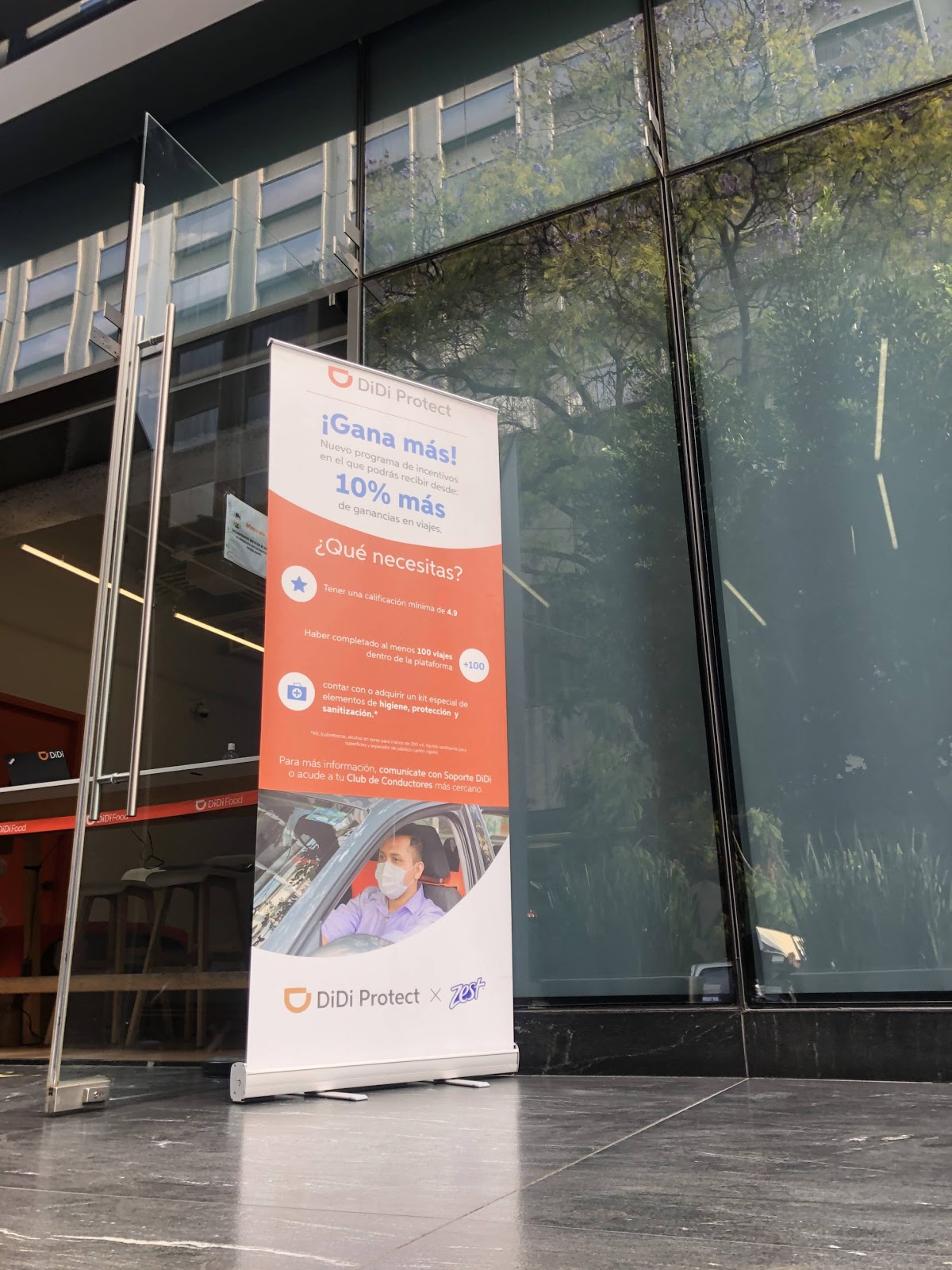
DiDi’s foray into LatAm started in January 2018 with its acquisition of 99, a Brazilian ride-sharing company. In April 2018, DiDi entered Mexico with its bread-and-butter ride-sharing service. It wasn’t until April 2019 that DiDi launched its food delivery service, DiDi Food, in Monterrey and Guadalajara — two of the largest cities in Mexico. Its expansion hasn’t slowed down since, with a 10% extra earnings incentive to lure delivery drivers.

DiDi delivery worker recruitment promotion banner outside venue

Image Credits: Kevin Xu

My Airbnb in Mexico City happened to be two blocks away from the large WeWork building where DiDi’s local office was located. Every day, I saw a long line of people responding to the earning incentives — waiting outside to get hired as DiDi delivery workers.

Meanwhile, the Uber office that’s literally one block away had hardly any foot traffic. As Uber and Rappi fight for more wealthy consumers, DiDi is working to attract lower-income users to grab market share, hoping that one day some of these people will reach the middle class and become profitable customers.

How is edtech spending its extra capital?

Edtech unicorns have boatloads of cash to spend following the capital boost to the sector in 2020. As a result, edtech M&A activity has continued to swell. The idea of a well-capitalized startup buying competitors to complement its core business is nothing new, but exits in this sector are notable because the money used to buy startups can be seen as an effect of the pandemic’s impact on remote education.

In the past week, the consolidation environment is making a clear statement.

The data agrees. Per Crunchbase data, there were 45 edtech exits in 2019 and 24 edtech exits so far in 2021. The same database shows just 35 exits for all of 2020. As we discussed nearly six months ago, the ability to buy (and be bought) has changed.

In the past week, the consolidation environment is making a clear statement: Pandemic-proven startups are scooping up talent — and fast. Kahoot, which is set to list on the Oslo Stock Exchange within months, has bought three businesses within the past 12 months. Quizlet, which became a unicorn nearly one year ago, made its first acquisition ever last week.

To understand more about this activity, I caught up with Quizlet CEO Matthew Glotzbach and Kahoot CEO Eilert Giertsen Hanoa. We talked about trends in the space including lifelong learning, self-directed learning and more.

Q&A is a lucrative business

“To be successful students in the past decade or two, it has required self-direction,” Glotzbach said simply a few minutes into our chat. “Quizlet as a platform is helping to empower that self-directed learner and give them the tools they need to really be successful.”

To further this goal, Quizlet acquired problem-solving tool Slader last week. Unfortunately, the price of the deal was not disclosed (but don’t worry, we’ll have numbers in the next section). What we do know is that it’s the startup’s latest move to solidify its focus as a tech-powered tutoring tool rather than a simple flashcard app.

Currently, Quizlet uses its data around flashcard sets, questions and trained natural language processing tools to understand how students might respond to certain prompts. Artificial intelligence gives the company a little more flexibility to understand the different ways a student could correctly answer the same question.