TikTok adds auto captions to make videos accessible to hard of hearing and deaf

TikTok this morning announced the launch of a new feature designed to make its app accessible to people who are hard of hearing or deaf. The company is today debuting auto captions — a feature that, when enabled, will automatically transcribe the speech from a video so viewers can read what’s being said in the video as an alternative to listening. Initially, auto captions will support American English and Japanese, with additional languages coming in the months ahead, TikTok says.

To use auto captions, the creator will select the option on the editing page after they’ve either uploaded or recorded a video. They can then edit the text that’s generated in order to correct any mistakes before the video is published.
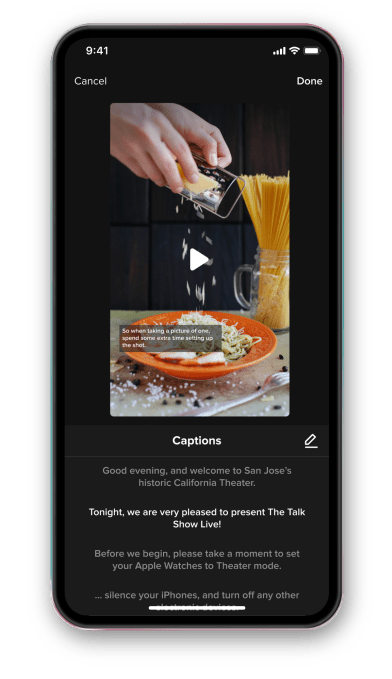
Image Credits: TikTok

Though largely designed for accessibility purposes, auto captions can also help those who want to watch TikTok videos without the sound — for example, when you’re around other people you don’t want to disturb, but lack headphones. They also can be useful for those watching videos where they’re not fluent in the language being spoken, as it’s sometimes easier to understand what’s said when you can also read the words.

Already, many in the TikTok community had embraced captioning by adding text overlays to their videos or using third-party subtitling tools. The text-to-speech trend, where text on screen is read in a Siri-like voice, has remained a popular technique among creators, too.

But the auto captions tool will work differently from existing options because it can be turned on and off by the viewer. That means you wouldn’t have to see the video captions if you don’t want to. To turn the captions off, you’ll first open the share panel, then tap the captions button to disable them.
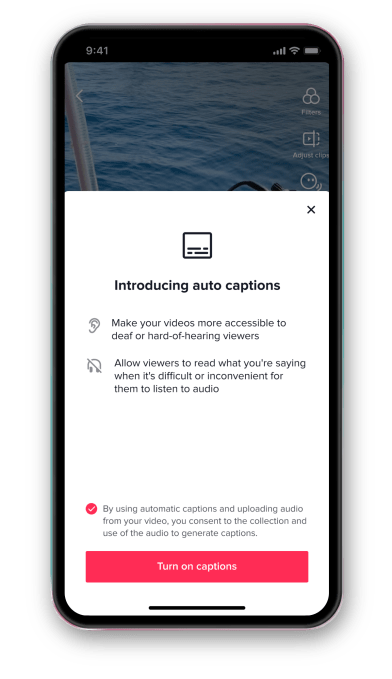
Image Credits: TikTok

With the launch of auto captions, TikTok joins other social apps like YouTube, Facebook and Instagram, which already offer tools that allow creators to easily and automatically add captions to videos.

TikTok says it will be working to spread the word among its creator community about the new addition to encourage users to make their videos accessible to a wider audience.

Auto captions are now one of several accessibility features TikTok has launched, alongside creator warnings when they produce videos that could trigger photosensitive epilepsy and a photosensitivity feature that allows users to skip photosensitive content. The app also offers a text-to-speech feature and a feature to replace animated thumbnails with static images.

TikTok says it’s currently undergoing an accessibility assessment to identify additional areas for improvement, as well, and has worked with the organization The Deaf Collective to increase awareness toward the talent and conversations taking place in deaf communities on its app.


Stanford and Duke join certification program to boost diversity education with investors and the C-suite

A partnership between the University of North Carolina’s Kenan Flagler Entrepreneurship Center, the Opportunity Hub and 100 Black Angels and Allies Fund, set up to improve representation and support of diverse founders in the tech industry, is getting more heavy-hitting partners from Duke and Stanford.

As part of the partnership, faculty affiliated with Stanford and Duke will join educators to staff the DEIS Practicum Certificate and Black Technology Ecosystem Investment Certificate programs, which, respectively, try to address ways in which management can engage in diversity and inclusion in a systemic way beyond simply human resources hires and equity in compensation and ways in which more Black investors can become involved in backing startups.  

“In order to address issues like DEI at a systemic organizational level and to address the pervasive issues causing the wealth gap, we need to work together to help make this kind of education more readily available,” said Entrepreneurship Center Executive Director Vickie Gibbs, in a statement. “Together, we are taking action and making progress toward creating a more equitable society and entrepreneurial community.”

The addition of affiliated faculty from the Stanford Technology Ventures program and Duke University does more than just further validate the program, according to Rodney Sampson, the executive chairman and chief executive of OHUB and co-founder and general partner of 199 Black Allies & Angels fund. For Sampson, who also serves as a visiting professor at the University of North Carolina and Duke, the addition of the two schools will mean more exposure among the two universities’ alumni.

“It also expands the reach of these solutions and insights into the alumni and entrepreneurial communities of these two amazing universities,” said Sampson in a statement. 

The framework that Sampson has developed involves a multipronged approach for employers that includes: a review of the extent to which diversity, equity and inclusion is operationalized in corporate boards and governance; in assessments of hiring, promotion and human resources practices; in procurement and vendor services; in innovation and product development; in resources on going to market to reach diverse audiences; in investments into Black and Latino communities; and in monitoring the impact of the business’ operations on the community.

The framework was recently cited in a report from no less auspicious an organization than the Brookings Institution in a paper authored by Amy Liu and Reniya Dinkins.

“When chief executives demonstrate their own work to dismantle bias and create a culture of true belonging, it provides a level of trust and credibility needed for these firms and leaders to collaborate with others in bringing about broader progress and sustained prosperity in their home regions,” the authors wrote. 

For Stanford University in particular, the opportunity to embrace diversity and education training comes as the university tries to rehabilitate an image tarnished after its rush to embrace policies crafted by the former White House administration that called for universities to limit diversity training

“For too long, diversity, equity and inclusion have been an afterthought in entrepreneurship and innovation. I am grateful to be collaborating with thoughtful, action-oriented colleagues to address systemic racism. Together, we’ll be able to create important new network connections between our organizations and to develop learning insights that can be shared with educators and organizations around the world,” added Tom Byers, Keohane Distinguished Visiting Professor at UNC-Chapel Hill and Duke University and STVP Faculty Director.