RWDSU head says rerun election ‘very likely’ following Amazon union vote loss

However the outcome of today’s vote count turned out, there was one thing we knew for certain: it wasn’t going to mark the end of the battle between Amazon and the Retail, Wholesale and Department Store Union. With voting having broken overwhelmingly in Amazon’s favor, the union was quick to challenge the results.

The RWDSU was quick to offer TechCrunch a statement from President Stuart Appelbaum after no votes broke the 50% threshold, noting, “We demand a comprehensive investigation over Amazon’s behavior in corrupting this election.”

Amazon, unsurprisingly, was quick to take a victory lap. In a blog post credited to “Amazon Staff,” the company writes:

Thank you to employees at our BHM1 fulfillment center in Alabama for participating in the election. There’s been a lot of noise over the past few months, and we’re glad that your collective voices were finally heard. In the end, less than 16% of the employees at BHM1 voted to join the RWDSU union. It’s easy to predict the union will say that Amazon won this election because we intimidated employees, but that’s not true.

While the company was quick to state that the election is “over,” the RWDSU is hopeful, both in terms of future organizing at the Bessemer warehouse and for what the movement will mean for unionizing efforts at Amazon, going forward.

In a press conference held earlier today, Appelbaum suggested that Amazon told workers that they would have to vote against the union if they wanted to keep their jobs.

“We believe a rerun election is going to be very likely,” the union president told media. “I think that if Amazon considers this a victory, they may want to reconsider it. At best, it’s a Pyrrhic victory. Look at what happened during this period. We exposed atrocious working conditions at Amazon for everybody to see.”

Appelbaum’s comments seem to refer, in part, to numerous reports of workers urinating in bottles over concerns about stringent quotas. In the midst of an aggressive social media campaign at the apparent behest of CEO Jeff Bezos, the company initially denied reports, before conceding they may apply to some drivers. Amazon was quick to deflect blame to broader industry issues, however.

“Amazon didn’t win—our employees made the choice to vote against joining a union,” the company added in its post. “Our employees are the heart and soul of Amazon, and we’ve always worked hard to listen to them, take their feedback, make continuous improvements, and invest heavily to offer great pay and benefits in a safe and inclusive workplace. We’re not perfect, but we’re proud of our team and what we offer, and will keep working to get better every day.”

A key part to the RWDSU’s challenge is a ballot box the company reportedly pressured the USPS to install, in defiance of a National Labor Relations Board ruling. Appelbaum said the box “creates the impression of surveillance.”

He added that the union has already been in communication with workers at other Amazon facilities, explaining, “We have already started talking to workers at other facilities, as well, before this election.”

Update: Amazon has offered the following statement about the ballot box, “We said from the beginning that we wanted all employees to vote and proposed many different options to try and make it easy. The RWDSU fought those at every turn and pushed for a mail-only election, which the NLRB’s own data showed would reduce turnout. This mailbox—which only the USPS had access to—was a simple, secure, and completely optional way to make it easy for employees to vote, no more and no less.”

APKPure app contained malicious adware, say researchers

Security researchers say APKPure, a widely popular app for installing older or discontinued Android apps from outside of Google’s app store, contained malicious adware that flooded the victim’s device with unwanted ads.

Kaspersky Lab said that it alerted APKPure on Thursday that its most recent app version, 3.17.18, contained malicious code that siphoned off data from a victim’s device without their knowledge, and pushed ads to the device’s lock screen and in the background to generate fraudulent revenue for the adware operators.

But the researchers said that the malicious code had the capacity to download other malware, potentially putting affected victims at further risk.

The researchers said the APKPure developers likely introduced the malicious code, known as a software development kit or SDK, from an unverified source. APKPure removed the malicious code and pushed out a new version, 3.17.19, and the developers no longer list the malicious version on its site.

APKPure was set up in 2014 to allow Android users access to a vast bank of Android apps and games, including old versions, as well as app versions from other regions that are no longer on Android’s official app store Google Play. It later launched an Android app, which also has to be installed outside Google Play, serving as its own app store to allow users to download older apps directly to their Android devices.

APKPure is ranked as one of the most popular sites on the internet.

But security experts have long warned against installing apps outside of the official app stores as quality and security vary wildly as much of the Android malware requires victims to install malicious apps from outside the app store. Google scans all Android apps that make it into Google Play, but some have slipped through the cracks before.

TechCrunch contacted APKPure for comment but did not hear back.

European tech event mainstays Shift and TOA find new homes, new models, post-COVID

Given the pandemic, huge changes are being wrought in tech events, something which used to be the lifeblood of the industry. Many a startup has pitched to win funding, and many a hackathon has formed teams that went on to greater things. It’s a sad fact that this era is over, at least until the pandemic has fully passed, but this could take some time. Two significant European events have now had to change in order to carry their brands into new realms.

European breakout success story Infobip (which has raised more than $200 million) was born out of Croatia. And so was the seminal developer conference Shift. With Infobip needing that engineering community, and Shift needing a more stable home in uncertain times, it seems only natural that Infobip would put developers front and center of their company strategy with the acquisition of Shift, and appointing its founder and CEO Ivan Burazin to the board as chief developer experience officer. Shift will now form the basis of Infobip’s all-new Developer Experience department.

As Burazin said: “The vision was always to become one of the largest developer conferences in the world, and also to strengthen Croatia’s connection to the world of software developers. So now with the backing of a unicorn and the freedom to keep working on independently, the vision seems to have finally become possible.”

He says Shift won’t disappear, but will now expand globally, first to the U.S. and then to Latin America and southeast Asia, initially in remote events.

Infobip CEO Silvio Kuti? said: “Infobip is on a growth trajectory to expand rapidly into the B2C vertical, or more specifically Business-to-Developer (B2D) space. Having Ivan on board with his experience as the founder of Codeanywhere, a B2D SaaS company, and creator of Shift, the largest developer conference in the region, will be an asset to us going forward.”

Meanwhile, a key startup and founder/investor-oriented conference “Tech Open Air Berlin” is also changing.

Tech Open Air (TOA), was known for its technology and startup festival, which attracted upwards of 20,000 people in Berlin every summer, but it has now pivoted into a new brand: TOA Klub. This will now be a “cohort-based learning and doing platform.” The four-six weeks of online programs will be aimed at helping professionals progress in the tech industry.

TOA Klub will offer Founders Klub (for founders learning to startup); Investors Klub (for newbie investors); Crypto Klub (a “crash course in the crypto field”); and Co-Creators Klub (for founders looking to pivot and grow).

The first confirmed mentors and speakers include Rolf Schrömgens (founder, Trivago), Dominik Richter (founder, HelloFresh) and Jeannette zu Fürstenberg (founding partner, La Famiglia VC).

Nikolas Woischnik, founder of TOA said: “The world will come out of this pandemic having digitally aged by decades, not years. The complexity of our business environment has greatly accelerated. At TOA this gives our long-time mission of “making people, organizations and the planet futureproof” ever more purpose. With the launch of Klub, it is time for us to leverage technology to deliver on our mission in a more impactful and accessible way.”

I for one am glad these greats brands have found new homes, because I know the brands and the founders both carry huge respect in the European startup scene.

Building the right team for a billion-dollar startup

From building out Facebook’s first office in Austin to putting together most of Quora’s team, Bain Capital Ventures managing director Sarah Smith has done a bit of everything when it comes to hiring. At TechCrunch Early Stage, she spoke about how to ensure the critical early hires are the right ones to grow a business. As an investor at Bain Capital Ventures, Smith has a broad view into the problems that companies face as they search for the right candidate to spur organizational success.

In our conversation, Smith touched on a number of issues such as who to hire and when, when to fire, and how to ensure diversity from the earliest days.


What to consider when you first think about hiring

When a company is making its first hires — and then evolving into a bigger organization — the processes and needs may change, but the culture should be consistent from the beginning, according to Smith. From there, an emphasis on good early managers is critical.

I would really encourage you to take some time to think about what kind of company you want to make first before you go out and start interviewing people. So that really is going to be about understanding and defining your culture. And then the second thing I’d be thinking about when you’re scaling from, you know, five people up to, you know, 50 and beyond is that managers really are the key to your success as a company. It’s hard to overstate how important managers, great managers, are to the success of your company.

So we’ll talk a little bit about how to think about that, as there’s a lot of questions around helping people grow into management for the first time. You, as a founder, might be managing people for the first time, so how to think about setting up the company for success.

(Timestamp: 4:15)


How do you build culture in the new remote environment?

Joby Aviation’s JoeBen Bevirt and Reid Hoffman to talk about building a startup, the future of flight and SPACs

Joby Aviation founder JoeBen Bevirt has spent more than a decade developing an all-electric, vertical take-off and landing passenger aircraft — an effort that was largely shrouded in secrecy until January 2020 when the company announced a $590 million Series C round of funding that was led by Toyota Motor Corporation (that round later expanded to $620 million).

The buzzy announcements continued with Joby’s acquisition of Uber Elevate and then culminated in February with its bid to become a publicly traded company through a merger with Reinvent Technology Partners, a special purpose acquisition company from well-known investor and LinkedIn co-founder Reid Hoffman and Zynga founder Mark Pincus.

Joby is just getting started. The company plans to use capital generated via its public listing to fund the launch of passenger service, which is expected to begin in 2024. And Joby still must complete certification of its aircraft and develop manufacturing facilities, but it is already on its way to achieving both. The company is also planning to begin construction on a 450,000-square-foot manufacturing facility, designed in conjunction with Toyota, later this year.

The upshot: Bevirt has a lot to share. That’s why we’re excited to announced that Bevirt and Hoffman will join us on our virtual stage at TC Sessions: Mobility 2021. The virtual event, which features the best and brightest minds in the world of mobility, will be held on June 9. Bevirt and Hoffman will discuss building a startup — and keeping it secret while raising funds — the future of flight and, of course, SPACs.

The pair will join other speakers TechCrunch has announced, a list that so far includes investors Clara Brenner of Urban Innovation Fund, Quin Garcia of Autotech Ventures and Rachel Holt of Construct Capital, as well as Starship Technologies co-founder and CEO/CTO Ahti Heinla. Stay tuned for more announcements in the weeks leading up to the event.

“We approach it (SPACs) as venture capital at scale,” Hoffman told TechCrunch in a February interview. So it’s not a ‘this-year thing,’ it’s a next three years, next five years, next 10 years.”

And yes, Hoffman believes SPACs are here to stay. Although we plan to check in on his stance in June. “I think that it’s valuable to the market and valuable to society to have multiple, different paths by which companies can go public,” Hoffman said.

Early Bird tickets to the show are now available — book today and save $100 before prices go up.

As for Bevirt, the move to go public marks Joby’s readiness to be more open with the rest of the world.

“We think that this is a really exciting moment, where we stand on the threshold of really redefining mobility,” Bevirt said in a previous interview. “And we really want to bring the world along on our exciting journey. Previously, only a very exclusive set of investors has had access to be part of our journey, and it’s really exciting for us to be able to share that more broadly.”

We can’t wait to hear from Bevirt and Hoffman at TC Sessions: Mobility on June 9. Make sure to grab your Early Bird pass before May 6 to save $100 on tickets and join the fun!


Reap all the benefits of exhibiting in Startup Alley at Disrupt 2021

If we’ve said it once, we’ve said it 1,000 times. Startup Alley is ground zero for entrepreneurial opportunity. It’s where hundreds of savvy, exhibiting startups increase their brand recognition, connect with investors, grow their network, expand their customer base and garner invaluable media coverage.

TechCrunch Disrupt 2021 takes place on September 21-23, and we’ve added new features and experiences to help Startup Alley exhibitors make the most of the virtual expo area. Ready to make a minimal investment for maximum opportunity? Buy a Startup Alley Pass for $199.

Play beat the clock: That super early-bird price remains in effect only until May 13 at 11:59 pm (PST). Get moving, and you’ll save $50.

Here’s what’s new in Startup Alley this year, starting with yet another reason to get your exhibitor’s pass ASAP.

Startup Alley+: TechCrunch will select 50 Startup Alley exhibitors to form an elite cohort. These founders receive — at no additional cost — access to a curated pre-Disrupt experience. You’ll compete in a pitch-off at Extra Crunch Live, attend a series of founder masterclasses and receive introductions to top early-stage investors. It’s specifically designed to provide more opportunities for exposure and growth before Disrupt even opens.

The timing matters because Startup Alley+ begins in July at TC Early Stage: Marketing and Fundraising — and the cohort attends for free. If you want a crack at this opportunity, get your exhibitor pass now.

The Startup Alley Crawl: Every tech category gets a dedicated, hour-long crawl. TechCrunch editors will select several startups from each category and interview the founders live from the Disrupt stage. We’ll list the specific times for each in the agenda closer to the event.

From Startup Alley to Startup Battlefield: TechCrunch will award two stand-out startups a Startup Battlefield Wild Card. Those founders will get to compete in the thrilling Startup Battlefield for a chance to win $100,000.

Everyone pitches: Every exhibiting startup is eligible for this opportunity. You’ll have two minutes to throw your best pitch across the plate and receive feedback from pitch-savvy TechCrunch staff. Talk about an opportunity to improve and impress. Your pitch session can have long-term benefits — as told to us by Jessica McLean, the director of Marketing and Communications at Infinite-Compute.

“Disrupt is a great avenue to network with potential investors. It carries a lot of street cred and talking about our CEO’s experience pitching in Startup Alley helps us make those connections and start important conversations.”

TechCrunch Disrupt 2021 takes place on September 21-23. Maximize your opportunities and minimize your investment. Buy your Startup Alley Pass before the super early-bird deadline expires on May 13, at 11:59 pm (PST).

Is your company interested in sponsoring or exhibiting at Disrupt 2021? Contact our sponsorship sales team by filling out this form.

Facebook takes down 16,000 groups trading fake reviews after another poke by UK’s CMA

Facebook has removed 16,000 groups that were trading fake reviews on its platform after another intervention by the UK’s Competition and Markets Authority (CMA), the regulator said today.

The CMA has been leaning on tech giants to prevent their platforms being used as thriving marketplaces for selling fake reviews since it began investigating the issue in 2018 — pressuring both eBay and Facebook to act against fake review sellers back in 2019.

The two companies pledged to do more to tackle the insidious trade last year, after coming under further pressure from the regulator — which found that Facebook-owned Instagram was also a thriving hub of fake review trades.

The latest intervention by the CMA looks considerably more substantial than last year’s action — when Facebook removed a mere 188 groups and disabled 24 user accounts. Although it’s not clear how many accounts the tech giant has banned and/or suspended this time it has removed orders of magnitude more groups. (We’ve asked.)

Update: We understand that the regulator has focused on the removal of groups trading misleading/fake reviews, rather than individual accounts — as banned or suspended users are able to create new profiles, whereas removing the group in which fake reviews are being traded is seen as a more effective way to impact and deter the activity.

Facebook was also contacted with questions but it did not answer what we asked directly, sending us this statement instead:

“We have engaged extensively with the CMA to address this issue. Fraudulent and deceptive activity is not allowed on our platforms, including offering or trading fake reviews. Our safety and security teams are continually working to help prevent these practices.”

Since the CMA has been raising the issue of fake review trading, Facebook has been repeatedly criticised for not doing enough to clean up its platforms, plural.

Today the regulator said the social media giant has made further changes to the systems it uses for “identifying, removing and preventing the trading of fake and/or misleading reviews on its platforms to ensure it is fulfilling its previous commitments”.

It’s not clear why it’s taken Facebook well over a year — and a number of high profile interventions — to dial up action against the trade in fake reviews. But the company suggested that the resources it has available to tackle the problem had been strained as a result of the COVID-19 pandemic and associated impacts, such as home working. (Facebook’s full year revenue increased in 2020 but so too did its expenses.)

According to the CMA changes Facebook has made to its system for combating traders of fake reviews include:

  • suspending or banning users who are repeatedly creating Facebook groups and Instagram profiles that promote, encourage or facilitate fake and misleading reviews
  • introducing new automated processes that will improve the detection and removal of this content
  • making it harder for people to use Facebook’s search tools to find fake and misleading review groups and profiles on Facebook and Instagram
  • putting in place dedicated processes to make sure that these changes continue to work effectively and stop the problems from reappearing

Again it’s not clear why Facebook would not have already been suspending or banning repeat offenders — at least, not if it was actually taking good faith action to genuinely quash the problem, rather than seeing if it could get away with doing the bare minimum.

Commenting in a statement, Andrea Coscelli, chief executive of the CMA, essentially makes that point, saying: “Facebook has a duty to do all it can to stop the trading of such content on its platforms. After we intervened again, the company made significant changes — but it is disappointing it has taken them over a year to fix these issues.”

“We will continue to keep a close eye on Facebook, including its Instagram business. Should we find it is failing to honour its commitments, we will not hesitate to take further action,” Coscelli added.

A quick search on Facebook’s platform for UK groups trading in fake reviews appears to return fewer obviously dubious results than when we’ve checked in on this problem in 2019 and 2020. Although the results that were returned included a number of private groups so it was not immediately possible to verify what content is being solicited from members.

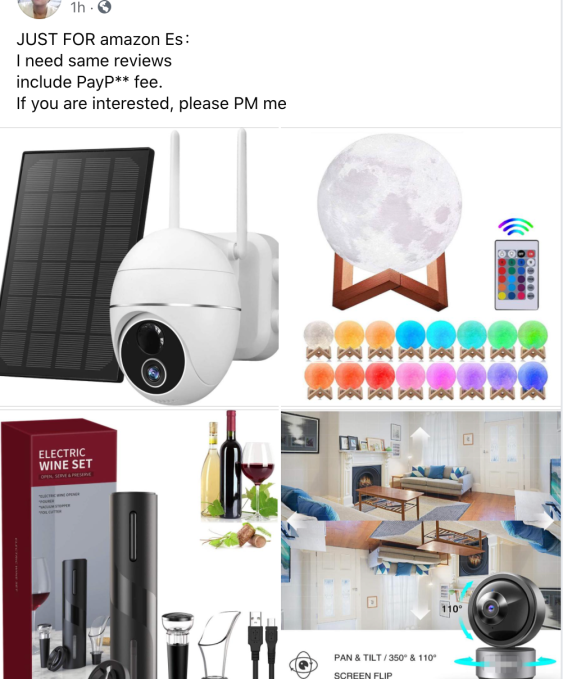
We did also find a number of Facebook groups offering Amazon reviews intended for other European markets, such as France and Spain (and in one public group aimed at Amazon Spain we found someone offering a “fee” via PayPal for a review; see below screengrab) — suggesting Facebook isn’t applying the same level of attention to tackling fake reviews that are being traded by users in markets where it’s faced fewer regulatory pokes than it has in the UK.

Screengrab: TechCrunch

Cleo Capital is targeting $20 million for Fund II

Cleo Capital, a venture capital firm founded in 2018 by Sarah Kunst, is raising up to $20 million for its second fund, according to a source familiar with the matter. A recent SEC filing shows that Cleo Capital has already raised $6.7 million of that goal, bringing total assets under management to around $10 million. Kunst was unable to comment on her fundraising efforts.

That new AUM number is close to what Cleo Capital initially set out to do. When Kunst first launched her firm, she targeted a $10 million close. She ended up closing $3.14 million of that goal, and now, she’s back to double down.

Fund II’s $20 million target, if closed, would allow Cleo Capital, which invests in primarily pre-seed companies, to start leading rounds. The firm has already been writing $1 million checks and targets about a 15-20% ownership in its rounds.

“One of the reasons why we are a pre-seed fund is because in seed, especially late-seed, you have everyone from family offices to TikTok stars and rolling funds competing for hot rounds,” she said. “No one is competing in pre-seed.”

There are firms such as Precursor and Hustle Fund that back pre-seed companies, and cut checks around $100,000 and $25,000 to start, respectively. Kunst sees the ability to write a $1 million pre-seed check as a “huge advantage.” Usually early-stage founders without family money or deep networks have to spend a big chunk of time raising their first round. It’s a lot of time to spend fundraising and not building a company. If a firm can cut a big pre-seed check, she thinks that Cleo is “buying back six months of a company‘s runway,” she said.

Like many firms, Cleo Capital has turned to creative measures to diversify deal flow in the era of Zoom investing and pandemic business. For example, Cleo Capital launched a fellowship program for laid-off workers during COVID-19 to promote entrepreneurship.

Matt Pauker, a repeat founder who has sold companies to Coinbase and HP Enterprise, was one of the advisors of that program. Pauker has joined Cleo Capital as a general partner presumably to line up with the timing of Fund II.

While the firm has no racial or gender investment focus, about 92% of its current investments are companies started by underrepresented founders.

The firm’s portfolio includes Planet FWD, mmhmm, Lunch Club and StyleSeat. As for new opportunities, Kunst says that Cleo Capital is looking at anything that helps the individual turn into a collective. With the growth of the creator economy and solo-entrepreneurs, people need to figure out the future of income, healthcare and benefits, Kunst explained.

“All of these things are hard for people to do as an individual,” she said. The majority of Cleo Capital’s portfolio is based outside of Silicon Valley.

Cleo Capital’s raise comes just over a week after two venture capital firms founded by Black venture capitalists announced new funds, Harlem Capital and MaC Venture Capital.

Amazon defeats warehouse union push, RWDSU challenges results

Efforts to unionize Amazon’s Bessemer, Alabama warehouse were defeated by a wide margin in the second day of vote counting. More than half of the 3,215 votes cast broke in favor of the retailer. The Retail, Wholesale and Department Store Union, which would have served as the workers’ union, had the vote passed, was quick to challenge the results.

RWDSU President Stuart Appelbaum said in a statement offered to TechCrunch:

Amazon has left no stone unturned in its efforts to gaslight its own employees. We won’t let Amazon’s lies, deception and illegal activities go unchallenged, which is why we are formally filing charges against all of the egregious and blatantly illegal actions taken by Amazon during the union vote. Amazon knew full well that unless they did everything they possibly could, even illegal activity, their workers would have continued supporting the union.

That’s why they required all their employees to attend lecture after lecture, filled with mistruths and lies, where workers had to listen to the company demand they oppose the union. That’s why they flooded the internet, the airwaves and social media with ads spreading misinformation. That’s why they brought in dozens of outsiders and union-busters to walk the floor of the warehouse. That’s why they bombarded people with signs throughout the facility and with text messages and calls at home. And that’s why they have been lying about union dues in a right to work state. Amazon’s conduct has been despicable.

This initial defeat represents a large setback in the biggest unionization push in Amazon’s 27-year history. What might have represented a sea change for both the retail giant and blue-collar tech workers has, for now, been fairly soundly defeated.

Amazon has, of course, long insisted that it treats workers fairly, making such union efforts unnecessary. The company cites such standards as a $15 an hour minimum wage, a factor the company initial pushed back on, but ultimately instated after pressure from legislators.

It was a hard-fought battle on both sides. A number of legislators threw their weight behind unionization efforts, in an unlikely alliance that ranged from Bernie Sanders to Marco Rubio. The conservative Florida Senator noted the company’s “uniquely malicious corporate behavior.” President Joe Biden also sided with the workers, calling himself, “the most pro-union president you’ve ever seen.”

The company will no doubt tout the results as vindication. It noted in an early statement, “[O]ur employees are smart and know the truth—starting wages of $15 or more, health care from day one, and a safe and inclusive workplace. We encourage all of our employees to vote.”

In a blog post following the news, the company noted:

It’s easy to predict the union will say that Amazon won this election because we intimidated employees, but that’s not true. Our employees heard far more anti-Amazon messages from the union, policymakers, and media outlets than they heard from us. And Amazon didn’t win—our employees made the choice to vote against joining a union. Our employees are the heart and soul of Amazon, and we’ve always worked hard to listen to them, take their feedback, make continuous improvements, and invest heavily to offer great pay and benefits in a safe and inclusive workplace. We’re not perfect, but we’re proud of our team and what we offer, and will keep working to get better every day.

Among the expected challenges from the union are lingering questions around ballot boxes reportedly installed by the company in violation of labor board terms.”[E]ven though the NLRB definitively denied Amazon’s request for a drop box on the warehouse property, Amazon felt it was above the law and worked with the postal service anyway to install one,” the RWDSU writes. “They did this because it provided a clear ability to intimidate workers.”

The Bessemer warehouse, which employees around 6,000 workers, was opened at the end of March 2020, as the company looked to expand the operation of its essential workers during the impending lockdown. The conversation has surface variously longstanding complaints around the company’s treatment of blue-collar workers, including numerous reports that employees urinate in water bottles in order to meet stringent performance standards.

The company initially denied these claims during a social media offensive, but later clarified its stance in an apology of sorts, appearing to shift the blame to wider industry problems. The company also ran anti-union ads on its subsidiary, Twitch, before the streaming platform pulled them, stating that they “should never have been allowed to run.”

All told, 3,215 ballots were cast, representing more than half of the workers at the Alabama warehouse. In spite of Amazon winning more than half the votes, counting will continue. Challenges are likely to stretch on for weeks.

Daily Crunch: Facebook faces questions over data breach

European regulators have questions about a Facebook data breach, Clubhouse adds payments and a robotics company has SPAC plans. This is your Daily Crunch for April 6, 2021.

The big story: Facebook faces questions over data breach

A data breach involving personal data (such as email addresses and phone numbers) of more than 500 million Facebook accounts came to light over the weekend thanks to a story in Business Insider. Although Facebook said the breach was related to a vulnerability that was “found and fixed” in August 2019, the Irish Data Protection Commission — Facebook’s lead data regulator in the European Union — suggested that it’s seeking the “full facts” in the matter.

“The newly published dataset seems to comprise the original 2018 (pre-GDPR) dataset and combined with additional records, which may be from a later period,” said deputy commissioner Graham Doyle in a statement. “A significant number of the users are EU users. Much of the data appears to been data scraped some time ago from Facebook public profiles.”

In addition, it looks like EU regulators may also look into Facebook’s acquisition of customer service company Kustomer.

The tech giants

Apple launches an app for testing devices that work with ‘Find My’ — Find My Certification Asst. is designed for use by Made for iPhone Licensees who need to test their accessories’ interoperability with Apple’s Find My network.

Google Cloud joins the FinOps Foundation — The FinOps Foundation is a relatively new open-source foundation that aims to bring together companies in the “cloud financial management” space to establish best practices and standards.

Facebook confirms ‘test’ of Venmo-like QR codes for person-to-person payments in US — The feature will allow a user to scan a friend’s code with their smartphone’s camera to send or request money.

Startups, funding and venture capital

Clubhouse launches payments so creators can make money — It’s like a virtual tip jar, or a Clubhouse-branded version of Venmo.

Robotic exoskeleton maker Sarcos announces SPAC plans — The deal could potentially value the robotic exoskeleton maker and blank check company at a combined $1.3 billion.

Hipmunk’s founders launch Flight Penguin to bring back Hipmunk-style flight search — I’ve missed Hipmunk.

Advice and analysis from Extra Crunch

Giving EV batteries a second life for sustainability and profit — Automakers and startups are eying ways to reuse batteries before they’re sent for recycling.

Will Topps’ SPAC-led debut expand the bustling NFT market? — Topps and its products are popular with the same set of folks who are very excited about creating rare digital items on particular blockchains.

LG’s exit from the smartphone market comes as no surprise — Why didn’t it happen sooner?

(Extra Crunch is our membership program, which helps founders and startup teams get ahead. You can sign up here.)

Everything else

GM to build an electric Chevrolet Silverado pickup truck with more than 400 miles of range — GM is positioning the full-sized pickup for both consumer and commercial markets.

Putting Belfast on the TechCrunch map — TechCrunch’s European Cities Survey 2021 — This is the follow-up to the huge survey of investors we’ve done over the last six or more months, largely in capital cities.

The Daily Crunch is TechCrunch’s roundup of our biggest and most important stories. If you’d like to get this delivered to your inbox every day at around 3pm Pacific, you can subscribe here.

Signal tests payments in the UK using MobileCoin

Encrypted chat app Signal is adding payments to the services it provides, a long-expected move and one the company is taking its time on. A U.K.-only beta program will allow users to trade the cryptocurrency MobileCoin quickly, easily, and most importantly, privately.

If you’re in the U.K., or have some way to appear to be, you’ll notice a new Signal Payments feature in the app when you update. All you need to do to use it is link a MobileCoin wallet after you buy some on the cryptocurrency exchange FTX, the only one that lists it right now.

Once you link up, you’ll be able to instantly send MOB to anyone else with a linked wallet, pretty much as easily as you’d send a chat. (No word on when the beta will expand to other countries or currencies.)

Just as Signal doesn’t have any kind of access to the messages you send or calls you make, your payments are totally private. MobileCoin, which Signal has been working with for a couple years now, was built from the ground up for speed and privacy, using a zero-knowledge proof system and other innovations to make it as easy as Venmo but as secure as … well, Signal. You can read more about their approach in this paper (PDF).

MobileCoin just snagged a little over $11 million in funding last month as rumors swirled that this integration was nearing readiness. Further whispers propelled the value of MOB into the stratosphere as well, nice for those holding it but not for people who want to use it to pay someone back for a meal. All of a sudden you’ve given your friend a Benjamin (or perhaps now, in the U.K., a Turing) for no good reason, or that the sandwich has depreciated precipitously since lunchtime.

There’s no reason you have to hold the currency, of course, but swapping it for stable or fiat currencies every time seems a chore. Speaking to Wired, Signal co-founder Moxie Marlinspike envisioned an automatic trade-out system, though he is rarely so free with information like that if it is something under active development.

While there is some risk that getting involved with cryptocurrency, with the field’s mixed reputation, may dilute or pollute the goodwill Signal has developed as a secure and disinterested service provider, the team there seems to think it’s inevitable. After all, if popular payment services are being monitored the same way your email and social media are, perhaps we ought to nip this one in the bud and go end-to-end encrypted as quickly as possible.

Lawmakers press Instagram for details on its plans for kids

A group of Democratic lawmakers wrote to Mark Zuckerberg this week to press the CEO on his plans to curate a version of Instagram for children. In a hearing last month, Zuckerberg confirmed reporting by BuzzFeed that the company was exploring an age-gated version of its app designed for young users.

Senators Ed Markey (D-MA), Richard Blumenthal (D-CT) and Representatives Lori Trahan (D-MA) and Kathy Castor (D-FL) signed the letter, expressing “serious concerns” about the company’s ability to protect the privacy and well-being of young users.

“Facebook has an obligation to ensure that any new platforms or projects targeting children put those users’ welfare first, and we are skeptical that Facebook is prepared to fulfill this obligation,” the lawmakers wrote.

They cited previous failures with products like Messenger Kids, which had a flaw that allowed kids to chat with people beyond their privacy parameters.

“Although software bugs are common, this episode illustrated the privacy threats to children online and evidenced Facebook’s inability to protect the kids the company actively invited onto this platform,” the lawmakers wrote.

“In light of these and other previous privacy and security issues on Facebook’s platforms, we are not confident that Facebook will be able to adequately protect children’s privacy on a version of Instagram for young users.”

The letter set a deadline of April 26 for the company to provide answers to a comprehensive and helpfully specific set of questions about a future kid-targeted product.

In the letter, lawmakers posed a number of questions about how Facebook will handle the private data for young users and if that data would be deleted when an account is terminated. They also asked the company to commit to not targeting kids with ads and not employing push alerts and behavior-shaping features designed to make apps more addictive.

During last month’s big tech hearing in the House, committee members from both political parties grilled Zuckerberg about how Facebook and Instagram adversely affect mental health in young users. Rep. Castor also pressed the chief executive about underage users who circumvent Instagram’s existing age guidelines to use a platform full of posts, videos and ads designed for adults.

“Of course, every parent knows there are kids under the age of 13 on Instagram, and the problem is that you know it,” Zuckerberg said.

Coinbase’s monster Q1 in context

In the first quarter of 2021, American consumer cryptocurrency trading giant Coinbase grew sharply, generating strong profits at the same time.

For Coinbase, the disclosure of its preliminary Q1 2021 results comes a week ahead of its direct listing, an event that will see the company begin to trade publicly. As it is both cash rich and well known, Coinbase is foregoing a traditional IPO in favor of the more exotic method of going public.

In its release, Coinbase disclosed the following metrics, which TechCrunch has compared to metrics from its S-1 filing:

  • Monthly transacting users (MTUs) of 6.1 million, up from 2.8 million at the end of 2020.
  • Platform assets of $223 billion, up from $90.3 billion at the end of 2020.
  • Trading volume of $335 billion, up from $193.1 billion at the end of 2020.
  • Revenue of $1.8 billion, up from $585.1 million in Q4 2020.
  • Net income of “approximately $730 million to $800 million,” up from $178.8 million in Q4 2020.
  • Adjusted EBITDA of “approximately $1.1 billion,” up from $287.7 million in Q4 2020.

The growth of Coinbase from Q4 2020 to Q1 2021 is so extreme that the company’s year-over-year comparisons are farcical. For example, in Q1 2020 Coinbase’s revenues were $190.6 million, or just under 11% of its Q1 2021 top line. The company’s adjusted profits alone in Q1 2021 were more than five times its year-ago revenues.

The new numbers may help solidify some valuation marks that the company has been discussed as approaching, like the $100 billion threshold, or even boost them.

The company did present some warnings in its public release, noting that cryptocurrency price “cycles can be highly volatile, and as a result, [Coinbase] measure[s] [its] performance over price cycles in lieu of quarterly results.” The company also stated that future declines in crypto trading activity will not slow its investment:

MTUs, Trading Volume, and therefore transaction revenue currently fluctuate, potentially materially, with Bitcoin price and crypto asset volatility. This revenue unpredictability, in turn, impacts our profitability on a quarter-to-quarter basis. In terms of expenses, we intend to prioritize investment, including in periods where we may see a decrease in Bitcoin price. This is because we believe that scale is central to achieving our mission and it is still early in the development of this industry. [Emphasis: TechCrunch]

Or more simply, it is willing to sacrifice future profitability if its revenues decline, as it is building for the future instead of hewing to more near-term investor expectations. At least Coinbase is being clear in its messaging to investors: Don’t buy Coinbase stock expecting the company to tune its results to quarterly expectations.

Looking ahead, Coinbase did provide some guidance for its full-year results. For 2021, the company provided three scenarios. The first “assumes an increase in crypto market capitalization and moderate-to-high crypto asset price volatility,” leading to 7 million MTUs. The second “assumes flat crypto market capitalization and low-to-moderate crypto asset price volatility” and 5.5 million MTUs. The third “assumes a significant decrease in crypto market capitalization, similar to the decrease observed in 2018, and low levels of crypto asset price volatility thereafter” and 4 million MTUs for the year.

But don’t think that Coinbase is anticipation stagnant growth, simply because its best scenario anticipates mere growth from 6.1 million MTUs to 7 million MTUs. The company wrote in its release under the headline “institutional revenue” that it expects “meaningful growth in 2021 driven by transaction and custody revenue given the increased institutional interest in the crypto asset class.”

Coinbase’s quarter was bonkers good. But so was the performance of cryptocurrencies themselves. A bet on the company’s shares, then, could easily be seen as a bet on the value of bitcoin and its ilk. April 14 is going to be a fun day to watch.

Rapid raises $12M for its manufacturing robotics

Bay Area-based Rapid Robotics today announced a $12 million Series A. The new round, led by NEA, brings the company’s total funding up to $17.5 million. It joins a recently closed seed round, announced way back in November of last year. Existing investors Greycroft, Bee Partners and 468 Capital also took part in the round.

We noted at that stage that COVID-19 had a sizable impact on robotics investment. At the very least, the pandemic has served to accelerate interest in automation, as many “non-essential” workers have been unable to travel to their jobs. At present, manufacturing jobs often lack the ability to perform remotely.

Rapid notes that the company’s tech has been involved with the production of some 50 million parts over the past year, over a wide variety of different manufacturing verticals. And, like his predecessor, President Biden has already begun talking up strategies to return manufacturing jobs to the U.S. Of course, ambitious as it might be, any plan is going to have to be a balancing act between human jobs and automation.

The company notes the longstanding issue with human operators in these roles. “If we don’t solve this problem, U.S. manufacturers will never be able to compete in a global market,” CEO Jordan Kretchmer said in a release. “It’s really that simple.”

Rapid’s main value add here is ease of use. The company creates systems designed to get up and running quickly.
