Facebook brings software subscriptions to the Oculus Quest

Subscription pricing is landing on Facebook’s Oculus Store, giving VR developers another way to monetize content on Facebook’s Oculus Quest headset.

Developers will be allowed to add premium subscriptions to paid or free apps, with Facebook assumedly dragging in their standard percentage fee at the same time. Oculus and the developers on its platform have been riding the success of the company’s recent Quest 2 headset, which Facebook hasn’t detailed sales numbers on but has noted that the months-old $299 headset has already outsold every other Oculus headset sold to date.

Subscription pricing is an unsurprising development but signals that some developers believe they have a loyal enough group of subscribers to bring in sizable bits of recurring revenue. Facebook shipped the first Oculus Rift just over five years ago, and it’s been a zig-zagging path to finding early consumer success during that time. A big challenge for them has been building a dynamic developer ecosystem that offer something engaging to users while ensuring that VR devs can operate sustainably.

At launch, there are already a few developers debuting subscriptions for a number of different app types, spanning exercise, meditation, social, productivity and DJing. In addition to subscriptions, the new monetization path also allows developers to let users try out paid apps on a free trial basis.

The central question is how many Quest users there are that utilize their devices enough to justify a number of monthly subscriptions, but for developers looking to monetize their hardcore users, this is another utility that they likely felt was missing from the Oculus Store.

Billion-dollar B2B: cloud-first enterprise tech behemoths have massive potential

Dharmesh Thakker
Contributor

Dharmesh Thakker is a general partner at Battery Ventures and a former managing director at Intel Capital.

More than half a decade ago, my Battery Ventures partner Neeraj Agrawal penned a widely read post offering advice for enterprise-software companies hoping to reach $100 million in annual recurring revenue.

His playbook, dubbed “T2D3” — for “triple, triple, double, double, double,” referring to the stages at which a software company’s revenue should multiply — helped many high-growth startups index their growth. It also highlighted the broader explosion in industry value creation stemming from the transition of on-premise software to the cloud.

Fast forward to today, and many of T2D3’s insights are still relevant. But now it’s time to update T2D3 to account for some of the tectonic changes shaping a broader universe of B2B tech — and pushing companies to grow at rates we’ve never seen before.

One of the biggest factors driving billion-dollar B2Bs is a simple but important shift in how organizations buy enterprise technology today.

I call this new paradigm “billion-dollar B2B.” It refers to the forces shaping a new class of cloud-first, enterprise-tech behemoths with the potential to reach $1 billion in ARR — and achieve market capitalizations in excess of $50 billion or even $100 billion.

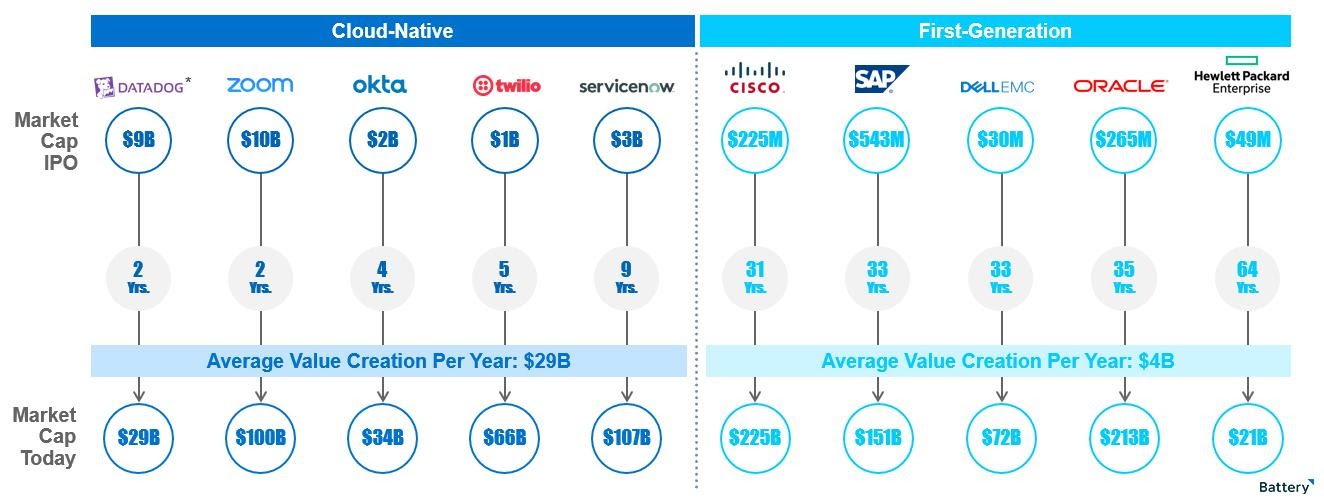
In the past several years, we’ve seen a pioneering group of B2B standouts — Twilio, Shopify, Atlassian, Okta, Coupa*, MongoDB and Zscaler, for example — approach or exceed the $1 billion revenue mark and see their market capitalizations surge 10 times or more from their IPOs to the present day (as of March 31), according to CapIQ data.

More recently, iconic companies like data giant Snowflake and video-conferencing mainstay Zoom came out of the IPO gate at even higher valuations. Zoom, with 2020 revenue of just under $883 million, is now worth close to $100 billion, per CapIQ data.

Graphic showing market cap at IPO and market cap today of various companies.

Image Credits: Battery Ventures via FactSet. Note that market data is current as of April 3, 2021.

In the wings are other B2B super-unicorns like Databricks* and UiPath, which have each raised private financing rounds at valuations of more than $20 billion, per public reports, which is unprecedented in the software industry.

Can the tech trade show return in 2021?

The past year has been a devastating one for the conference industry. It’s certainly an issue we’ve grappled with here at TechCrunch, as we’ve worked to move our programming to a virtual setting. Clearly each individual case calls for an individual solution, dependent on geography, attendance and a variety of other factors.

IFA has proven itself bullish on the in-person element. The Berlin tech show was one of a small handful of these sorts of events to go on with the show in Europe. The organization held an in-person event in September, albeit at a dramatically scaled-back rate.

“To be a little poetic, usually in the late summer, there’s a special air in Berlin and you go out in the morning, you feel this air,” director Jens Heithecker told me of last year’s event, which scaled back to around 170 exhibitors from 2,300.

Perhaps unsurprisingly, the organization is planning to come back big this year, in spite of prolonged concerns around COVID-19 and its variants. A press release announcing the show’s fall return is downright celebratory.

“With the world on course to emerge from the pandemic, IFA Berlin is set to take place as a full-scale, real-life event from 3 – 7 September 2021,” the company writes. “Huge interest from brands, manufacturers and retailers across all industry sectors to exhibit, network and co-innovate on location in Berlin.”

The organization highlights some health and safety measures that are being carried over from last year’s event. But while it’s not quite ready to talk scale yet, the organization is highlighting a number of new tracks for the conference.

“As always, keeping our visitors and exhibitors safe is our top priority,” it said in a statement. “Of course, with all our precautions to ensure everybody’s good health, we don’t expect IFA Berlin 2021 to set new records. However, the trend is clear: IFA Berlin is set for a full-scale comeback, to lead our industry once more.”

Over in Spain, the GSMA is still working on its messaging as a number of large companies have already announced they intend to only attend the show “virtually.”

Organizers offered TechCrunch the following statement:

We appreciate that it will not be possible for everyone to attend MWC Barcelona 2021, but we are pleased that?exhibitors?including Verizon*,?Orange and Kasperksy are excited to join us in Barcelona. To ensure everyone can?enjoy?the unique MWC experience, we have developed an industry-leading virtual event platform. The in-person and virtual options are provided so that all friends of MWC Barcelona can attend and participate in a way that works for them. We respect the decisions that have been made by some exhibitors and are working with them to move their participation to the virtual platform.

[*Disclosure: Verizon owns TechCrunch]

Google, IBM, Nokia, Sony, Oracle and Ericsson have already announced they won’t be attending the show in person. Other large names are seemingly undecided. The whole thing is reminiscent of the lead-up to last year’s event, which was ultimately canceled.

The necessity of these large events was called into question prior to the pandemic, but the shift to virtual events has truly brought the topic into sharp relief. It’s true that there’s still value in an in-person event for hardware, specifically, but many have learned to adapt to a virtual setting. Even though if the last CES taught us anything, it’s that there are still a whole lot of kinks to work out with the system, especially as it pertains to prioritizing content all effectively being channeled through the same funnel.

People’s willingness to attend these events is based on a broad range of factors. At the very base level, there’s a question of personal comfortability (I can’t be the only one who has a visceral reaction every time they see crowded photos from past events). For many, it will be a bit of a shock to the system to suddenly attend a large indoor conference. There are factors like vaccinations and a particular region’s handling of the pandemic (all of which can wildly swing in the course of several months).

Just today, Germany’s Health Minister sounded the red alert, asking states to tighten restrictions. “We know from last autumn what happens when we don’t act quickly,” Jens Spahn warned the media.

There are a slew of other factors, including a potential attendee’s location and their workplace’s willingness to approve travel. Many companies have restricted business travel to all but the most essential trips. Depending on what you do for a living, your definition of “essential” may vary. But given how much can potentially change in that time, the soundest strategy for many is planning to tackle things remotely.

Earlier this week, the GSMA sent out its own email to previous attendees titled, “Why do you believe MWC Barcelona 2021 will take place?” The note seems to be a direct response to stories about exhibitors opting for a virtual presence.

“Depending on when you are reading this, we will be about 12 weeks away from the doors opening for MWC21 in Barcelona,” CEO John Hoffman wrote. “To say that the last year has been disruptive is an understatement and my thoughts are with anyone who has been impacted by COVID-19. I am not only hopeful about the future, but I am also excited about convening our ecosystem at MWC21. We recognise that not everyone will be able to attend in person and that is fine as we will augment our physical event with our MWC virtual program bringing you content from the show.”

Canceling a flagship show one year could have been utterly devastating. For many of these organizers — and the local governments who rely on tourism money — two years might seem unthinkable. MWC’s virtual strategy in year one of the pandemic was, understandably, undercooked.

More than a year into this, however, the GSMA and organizations like it hopefully have more robust strategies in place. The fact of the matter is that going virtual isn’t a one- or two-off. For many companies and people profoundly impacted by the pandemic, this is what the future looks like.

Do you fit the mold for the next generation of values-driven VCs?

Jonathan Greechan
Contributor

Jonathan Greechan is co-founder of the world’s largest pre-seed accelerator, Founder Institute.

More individuals than ever are donning the investor cap. Almost a fifth of U.S. equity trading in 2020 was driven by mom-and-pop investors — up from around 15% in the previous year. With such impressive returns to be made, many are deciding to set up a full-fledged investment business.

With the fundraising world becoming more democratic and accessible, we should help people find the right path to setting up a venture capital firm and also make sure the right people are entering the VC sphere. Startups are changing, and any new investment manager will have to adapt to the shifting landscape. VCs today have to provide more than money to get the best portfolio, and they must have a strong focus on impact to get the best institutional investors into their funds.

Startup investors can be the financial backbone for mass disruption. That’s why, at Founder Institute, we believe in the need for more VCs with strong values: Because they will prop up the companies that will build a brighter future for humanity. We’re not the only ones — our first “accelerator for ethical VCs” was oversubscribed.

VCs today have to provide more than money to get the best portfolio, and they must have a strong focus on impact to get the best institutional investors into their funds.

So if you want to lead your own VC fund in 2021, here are the main questions aspiring investors need to ask themselves.

Are you doing this for the right reasons?

Investing in startups is not just about making money. In selecting the startups that will become future industry leaders, VCs have a lot more power than most to do good (or harm). If you’re only interested in money, you likely won’t go too far. Identifying the greatest businesses means seeing beyond their capital into the longevity of their vision, their real-life impact on society, and how much consumers will love or hate them.

After all: Most startup founders pour their blood, sweat and tears into building a business not just to make money, but also to make an impact on the world and build products that align with their mission. Any new venture capitalist looking to attract the best founders needs to think about the vision and mission of their fund in the same terms.

Although VC firms have been slow on the uptake when it comes to environmental, social and governance (ESG) goals, there are signs that times are changing. Some firms are forming a community around implementing ESG, not only because of the external impact but because it furthers their business goals. To help accelerate this trend, we asked our VC Lab participants to take The Mensarius Oath (Latin for “banker” or “financier”), a professional code of conduct for finance professionals to create an ethical, prosperous and healthy world.

What value do you bring to the table?

The number of VCs are growing and the industry is increasingly becoming concentrated. This means that simply offering large sums of money won’t get you traction with the best startups. Founders are looking for value over volume — they usually want mission alignment, connections, value-added services and industry expertise more than a blank check.

Remember that the best founders get to choose their VCs from a menu of options, not the other way around. To convince them that you’re the right match, you’ll need a proven track record in the same industry (or transferable experience from another industry) and referrals from credible people. You’ll also need a strong value proposition or niche that sets you apart from other funds. For example, Untapped Capital invests in “unexpected” and “undernetworked” founders, while R42 Group invests in AI and longevity-focused businesses.

If you don’t think you’ve got the profile to offer value to founders just yet, it’s worth taking some time to lay out exactly who you are. That is: what you hope to achieve as a fund manager, the vision you have for your portfolio companies and how you alone can help them get there.

What’s your secret sauce?

As a new VC fund without historical data points, limited partners (LPs) will naturally be cautious to invest in your fund. So, you have to build a brand that tells your story and proves your reputation.

Go back to the basics and pinpoint exactly what your strengths are. If you’re having trouble finding inspiration, use statements like, “I can get the best deal because I have X,” or, “I help grow my portfolio companies by X” to get the ball rolling. Be wary of saying that the amount of money you have is your strength — at this stage, your bank balance isn’t your competitive edge. Focus instead on what makes you unique, credible and relevant. Having a high number of strategic contacts, extensive industry experience or a backsheet of successful exits could be your secret ingredients. For extra guidance, check out this resource my team put together to help fund managers consolidate their niche in an “investment thesis.”

Once you have a list, choose your top three strengths and write a followup sentence detailing how each of them can be enriched by your network and expertise. Ideally, share these with a test group (friends, family or fellow entrepreneurs) and ask them which is the most compelling. If there’s a general consensus toward one point, you know to make that a large chunk of your VC fund’s thesis.

Do you have a solid network?

Who you know is just as important as what you know, and the most prominent VCs tend to be in the middle of a flow of information and people. Your network tells founders that you’re respected and reassures them that they will probably be brought into the fold to connect with future mentors, customers, investors or hires.

If you’re a thought leader, the alumni of a well-known company like Uber or PayPal, or if you’ve started a community around an emerging vertical, you’re more likely to form a positive deal flow. But this status and these relationships have to be established before you launch your fund — if you try to network from zero, you’ll be spinning too many plates and won’t have the social proof to back yourself up.

Don’t just rely on your gut to tell you whether your network is satisfactory. Map out your personal ecosystem, sorting people based on familiarity (close contacts or acquaintances) and defining characteristics (consumers, finance, ex-CEOs, etc.). That “map” can be as basic as an Excel sheet with a column for each category, or you could use more attractive visual tools like Canva — great for sharing with your future team and encouraging them to fill any network gaps.

What size fund do you want to launch?

A VC fund runs like any other business — you have to develop a vision, recruit a team, form an entity, raise money, deliver value and report to stakeholders. To kick things off, you need to consider what size fund you want, and then secure significant commitments from LPs — at least 10% of your total fund. LPs can be corporations, entrepreneurs, government agencies and other funds.

Also keep in mind that most LPs will want you to personally invest at least 1% of the total fund size so that you have “skin in the game.”

For that reason especially, it’s best to start small, somewhere between $5 million and $20 million, and use this “training fund” to demonstrate returns and create a launchpad for bigger raises to follow.

Can you help founders from launch to exit?

Your partnership with companies will be for the long haul, so you can’t rely just on offering value when you wire the money. Founders need consistent support across the full startup lifecycle, meaning you need to be conscious not to overpromise and fail to deliver. Think of the startups you’d most like to work with: How could you help them now? How could you help them in the future? And how could you help them exit?

You can take a skills-centric approach, where you reserve different resources and connections based on marketing, hiring, fundraising and culture-creation that can be applied as the startup grows. Alternatively, you might want to make sprint-like plans, where you check in with founders on a repeating basis and iterate the support you offer based on their progress. Whatever way you chose to structure your support, ensure that you’re realistic about what you can bring to the table, your availability, preferred involvement and how you’ll document it.

The future of VC will be driven by venture capitalists with strong values who have built funds with the new needs of founders in mind. VC may once have been exclusive and mysterious, but 2021 could be the year VC becomes a more open and fair space for businesses and investors alike.

Consumer groups and child development experts petition Facebook to drop ‘Instagram for kids’ plan

A coalition of 35 consumer advocacy groups along with 64 experts in child development have co-signed a letter to Facebook asking the company to reconsider its plans to launch a version of Instagram for children under the age of 13, which Facebook has confirmed to be in development. In the letter, the groups and experts argue that social media is linked with several risk factors for younger children and adolescents, related to both their physical health and overall well-being.

The letter was written by the Campaign for a Commercial-Free Childhood, an advocacy group that often leads campaigns against big tech and its targeting of children.

The group stresses how influential social media is on young people’s development, and the dangers such an app could bring:

“A growing body of research demonstrates that excessive use of digital devices and social media is harmful to adolescents. Instagram, in particular, exploits young people’s fear of missing out and desire for peer approval to encourage children and teens to constantly check their devices and share photos with their followers,” it states. “The platform’s relentless focus on appearance, self-presentation, and branding presents challenges to adolescents’ privacy and wellbeing. Younger children are even less developmentally equipped to deal with these challenges, as they are learning to navigate social interactions, friendships, and their inner sense of strengths and challenges during this crucial window of development,” the letter reads.

Citing public health research and other studies, the letter notes that excessive screen time and social media use can contribute to a variety of risks for kids including obesity, lower psychological well-being, decreased quality of sleep, increased risk of depression and suicide ideation, and other issues. Adolescent girls report feeling pressured to post sexualized selfies for attention from their peers, the letter said, and 59% of U.S. teens have reported being bullied in social media, as well.

Another concern the groups have is the use of the Instagram algorithm which could suggest what kids would see and click on next, noting that children are “highly persuadable.”

They also point out that Facebook knows there are already children under 13 who have lied about their age using the Instagram platform, and these users will be unlikely to migrate to what they’ll view as a more “babyish” version of the app than the one they’re already using. That means Facebook is really targeting an even younger age group who don’t yet have an Instagram account with this “kids version.”

Despite the concerns being raised, Instagram’s plans to compete for younger users will not likely be impacted by the outcry. Already, Instagram’s top competitor in social media today — TikTok — has developed an experience for kids under 13. In fact, it was forced to age-gate its app as a result of its settlement with the U.S. Federal Trade Commission, which had investigated Musical.ly (the app that became TikTok) for violations of the U.S. children’s privacy law COPPA.

Facebook, too, could be in a similar situation where it has to age-gate Instagram in order to properly direct its existing underage users to a COPPA-compliant experience. At the very least, Facebook has grounds to argue that it shouldn’t have to boot the under-13 crowd off its app, since TikTok did not. And the FTC’s fines, even when historic, barely make a dent in tech giants’ revenues.

The advocacy groups’ letter follows a push from Democratic lawmakers, who also this month penned a letter addressed to Facebook CEO Mark Zuckerberg to express concerns over Facebook’s ability to protect kids’ privacy and their well-being. Their letter had specifically cited Messenger Kids, which was once found to have a design flaw that let kids chat with unauthorized users. The lawmakers gave Facebook until April 26 to respond to their questions.

Zuckerberg confirmed Facebook’s plans for an Instagram for kids at a Congressional hearing back in March, saying that the company was “early in our thinking” about how the app would work, but noted it would involve some sort of parental oversight and involvement. That’s similar to what Facebook offers today via Messenger Kids and TikTok does via its Family Pairing parental controls.

The market, in other words, is shifting towards acknowledging that kids are already on social media — with or without parents’ permission. As a result, companies are building features and age gates to accommodate that reality. The downside to this plan, of course, is once you legitimize the creation of social apps for the under-13 demographic, companies are given the legal right to hook kids even younger on what are, arguably, risky experiences from a public health standpoint.

The Campaign for a Commercial-Free Childhood also today launched a petition which others can sign to push Facebook to cancel its plans for an Instagram for kids.

Instagram Letter by TechCrunch on Scribd

Facebook, reached for comment, offered the following statement:

We’ve just started exploring a version of Instagram for younger teens. We agree that any experience we develop must prioritize their safety and privacy, and we will consult with experts in child development, child safety and mental health, and privacy advocates to inform it. In addition, we will not show ads in any Instagram experience we develop for people under the age of 13. The reality is that kids are online. They want to connect with their family and friends, have fun, and learn, and we want to help them do that in a way that is safe and age-appropriate. We also want to find practical solutions to the ongoing industry problem of kids lying about their age to access apps. We’re working on new age verification methods to keep under-13s off Instagram and we’re exploring an Instagram experience for kids that is age-appropriate and managed by parents.

Coinbase’s direct listing alters the landscape for fintech and crypto startups

Coinbase’s direct listing was a massive finance, startup and cryptocurrency event that impacted a host of public and private investors, early employees, and crypto-enthusiasts. Regardless of where one sits in the broader tech and venture world, Coinbase storming north of a $100 billion valuation during its first day of trading was the biggest startup happening of the year.

The transaction’s effects will be felt for some time in the public market, but also among the startups and capital that comprise the private market.

In the buildup to Coinbase’s flotation — and we’d argue especially after it released its blockbuster Q1 2021 results — there was a general expectation that the unicorn’s direct listing would provide a halo effect for other startups in the space. Anthemis’ Ruth Foxe Blader told The Exchange, for example, that “the Coinbase listing shows this great inflection point for crypto,” with another “wave” of startup work in the space coming up.

The widely held perspective raised two questions: Will the success of Coinbase’s direct listing bolster private investment in crypto-focused startups, and will that success help other areas of financially focused startup work garner more investor attention?


The Exchange explores startups, markets and money.

Read it every morning on Extra Crunch or get The Exchange newsletter every Saturday.


Presuming that Coinbase’s listing will positively impact its niche and others around it is not a stretch. But to make sure we weren’t misreading sentiment, and to get deeper into the why of the concept, The Exchange reached out to venture capitalists who invest in the broader fintech world to get their take. We even roped in an analyst or two to round out our panel.

The answer is not a simple yes. There are several ways to approach investing in the cryptocurrency space — from buying coins themselves, to investing in mainstream-ish institutions like legal exchanges, to the more exotic, like supporting efforts on the forefront of the decentralized blockchain world. And while it is somewhat clear that most folks expect more capital to be available for crypto projects, it’s not clear where it may end up inside the market.

We’ll wrap by considering what impact Coinbase’s direct listing will have, if any, on non-crypto fintech venture capital investing.

After yesterday’s examination of how blazingly hot the venture capital market looked in the first quarter, we’re again trying to gauge the private market’s temperature. Let’s talk to some folks on the ground and hear what they are seeing.

Are crypto startups less risky now?

Coinbase’s direct listing floated a company that is worth more than all but two major blockchains, namely Ethereum and Bitcoin. Several other chains have aggregate coin values in the 11-figure range, but a 12-digit worth is still rare among crypto assets.

The scale of Coinbase’s valuation post-listing matters, according to Chainalysis Chief Economist Phillip Gradwell. Gradwell told The Exchange that “Coinbase’s $100 billion valuation today demonstrates that venture investors can make great returns from putting money into crypto companies, not just cryptocurrencies. That proof point is good for the entire ecosystem.”

More simply, it is now eminently reasonable to invest in the companies working in the crypto space instead of merely putting capital to work hard-buying coins themselves. The other way to consider the comment is to realize that Coinbase’s share price appreciation is steep enough since its 2012 founding to rival the returns of some coins over the same time frame.

Cleo Capital‘s Sarah Kunst expanded on the point, telling The Exchange in an email that “it’s now credible to say you’re a crypto startup and plan to IPO [versus] having acquisition or ICO be the only proven exit paths in the U.S.”

Japanese VC Samurai Incubate closes $18.6M fund for African startups

Samurai Incubate, a Tokyo-based venture capital firm, announced today it has closed its “Samurai Africa 2nd General Partnership” fund, totalling 2.026 billion yen (~$18.6 million).

According to the firm, the fund was oversubscribed as it targeted 2 billion (~$18.4 million) and a total of 54 investors joined as LPs. One notable LP is the Toyota Tsusho Corporation, which has a diverse network across the continent. The firm founded Mobility 54, a corporate venture capital (CVC) looking to invest $45 million into African mobility, logistics, and fintech startups

Kentaro Sakakibara founded Samurai Incubate, and in 2018, the firm began investing in Africa by establishing a subsidiary called Leapfrog Ventures. From August 2018, Samurai Incubate invested $2.5 million in 20 African startups via the newly established firm. Then in June 2019, renamed itself Samurai Incubate Africa

“Throughout our journey, we have focused on refining and optimizing our operating approach to maximize our value proposition to founders. However, we might not always have been perfect. We believe that the value we bring should go beyond capital and access to Japanese investors and corporations,” the firm said in a statement.

A sector-agnostic fund, Samurai Incubate Africa has already invested in 26 companies. The six from this second fund include Eden Life, a tech-enabled home service startup; online loan marketplace Evolve Credit; energy startup Shyft Power Solutions; microfinance services for car lenders FMG; freight forwarding company Oneport; and online grocery platform Pricepally.

Most of Samurai’s companies are from three African countries — Kenya, Nigeria, and South Africa. However, that will change going forward. According to Rena Yoneyama, the managing partner at the firm, Samurai Incubate Africa is joining Egypt to the list of countries it will target.

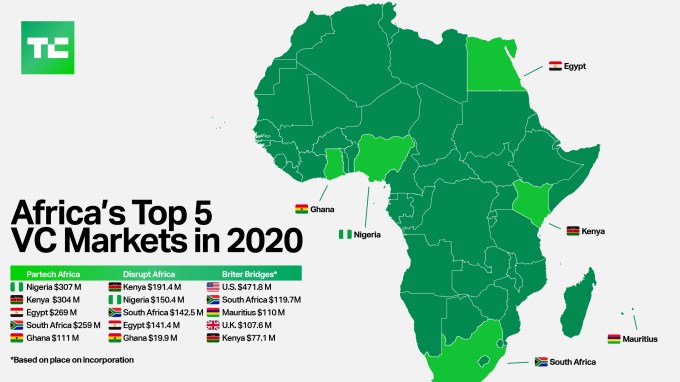
africa vc market

Image Credits: Bryce Durbin/TechCrunch

Since 2018, Egypt has been witnessing outstanding ecosystem growth and is producing talent, startups and indigenous investors at a breathtaking pace. For Samurai Incubate Africa, it’s only fair to tap into this growth because Egypt’s inclusion ensures the firm has startups in the Big Four — the continent’s top startup ecosystems.

“Egyptian startup ecosystem and its economy is rapidly expanding and we got to know that there are many talented founders and great investors in the country as well,” Yoneyama said to TechCrunch. “We already decided to make one investment into an Egyptian startup, and we know we’ll never regret it.”

When Samurai first announced this fund back in January 2020, its ticket size was between $50,000 to $500,000. For pre-seed to seed rounds, startups got $200,000 or less. And for pre-Series A and Series A rounds, not more than $500,000. But upon completing the fund, Samurai Incubate is extending the maximum amount of investment to $800,000.

“We would like to support our portfolio companies’ pre-series A and series A raises as an existing investor. To do so, we thought it would be better to increase the ticket size considering the recent round size and valuation of companies,” Yoneyama said of the ticket size increase.

Although sector-agnostic, the firm is particular about companies in fintech, insurtech, logistics, healthtech, consumer and commerce, energy, agritech, mobility and entertainment.

The Japanese VC plans to invest in 30 to 40 new companies at the pre-seed and seed stage as well as follow-up pre-Series A and Series A investments in 7 to 10 existing portfolio companies. Samurai Incubate is part of the growing list of Japanese VC firms like Kepple Africa and Uncovered Fund targeting African startups.

Hadrian is building the factories of the future for rocket ships and advanced manufacturing

If the eight person team behind the new startup Hadrian has their way, they’ll have transformed the manufacturing industry within the next decade.

At least, that’s the goal for the new San Francisco-based startup, founded only last year, which has set its sights on building out a new model for advanced manufacturing to enable the satellite, space ship, and advanced energy technology companies to build the future they envision better and faster.

We view our job as to provide the world’s most efficient space and defense component factory,” said Hadrian founder, Chris Power.

Initially, the company is building factories to make the parts that go on rocket ships, according to Power, but the business has implications for any company that needs bespoke components to make their equipment.

“Let me tell you how bad it is at the moment and what’s going to happen over the next 20 years. Right now everyone in space and defense, [including] SpaceX and Lockheed Martin, outsources their parts and manufacturing to small factories across the country. They’re super expensive, they’re unreliable and they’re completely invisible to the customers,” said Power. “This causes big problems with space and defense manufacturers in the design phase, because the lead time is so long and the iteration time is super long. Imagine running software and being able to iterate on your product once every 20 days? If you can imagine a Gantt chart of how to build a rocket, about 60% of that is buffer time… A lot of the delays in launches and stuff like that happen because parts got delivered three months ago. It’d be like running a McDonalds and realizing that your fries and burger providers could not tell you when the food would arrive.”

It’s hard to overstate the strategic importance of the parts suppliers to the operations of aerospace, defense, and advanced machining companies. As no less an authority on manufacturing than Elon Musk noted in a tweet, “The factory is the product.” It’s also hard to overstate the geopolitical importance of re-establishing the U.S. as a center of manufacturing excellence, according to Hadrian’s investors Lux Capital, Founders Fund, and Construct Capital. Which is one reason why they’re investing $9.5 million into the very early stage business.

“America made massive strategic mistakes in the early 90s which have left our national manufacturing ecosystem completely dilapidated,” said Founders Fund principal Delian Asparouhov. “The only way to get out of this disaster is to re-invent the most basic input into our aerospace and defense supply chains, machining metal parts quickly and with high tolerance. Right now, America’s most innovative company, SpaceX, relies on a network of near-retired machinists to produce space-worthy metal parts, and no one in technology is. focused on solving this.”


The factory is the product

— Elon Musk (@elonmusk) January 11, 2021

Power got to understand the problem at his previous company, Ento, which sold workforce management software to blue collar customers. It was there he realized the issue of. the aging workforce and the need for manufacturers to upgrade almost every aspect of their own technology stack. “I realized that the right way to bring technology to the industrial space is not to sell software to these companies, it’s to build an industrial business from scratch with software.”

Initially, Hadrian is focusing all of its efforts on the space industry, where the component manufacturing problem is especially acute, but the manufacturing capabilities the company is building out have broad relevance across any industry that requires highly engineered components.

“The demand for manufacturing from both the large SpaceX and Blue Origin all the way to this growing long tail of companies from Anduril to Relativity to Varda,” said Lux Capital co-founder Josh Wolfe. “Most of these guys are using mom and pop machine shops… [and] those shops are horribly inefficient. They’re not consistent, and they’re not reliable. Between the software automation, the hardware, you can cut down on inefficiency every step of the process… I like to think of value creation as waste reduction… so mundane things like quoting, scheduling, bidding, and planning all the way to the programming of the manufacturing… every one of those things takes hours to tens of hours to days and weeks, so if you can do that in minutes, it’s just a no-brainer. [Hadrian] will be the cutting edge choice for all of the new and explicitly dedicated and focused aerospace and defense companies.”

Power envisions a network of manufacturing facilities that can initially cover roughly 65% of all space and defense components, and will eventually take that number up to 95% of components. Already several of the biggest launch vehicle and satellite manufacturers are in talks with the company to produce hundreds of units for them, Power said. Some of those companies just happen to be in the Construct, Lux, and Founders Fund portfolio.

And the company’s founder sees this as a new way to revitalize American manufacturing jobs as well. “Manufacturing jobs in space and defense can easily be as high paying as a software engineering job at Google,” he said. In an ideal world, Hadrian would like to offer an onramp to high paying manufacturing careers in the 21st century in the same way that automakers provided good union jobs in the twentieth.

“We haven’t built any of this. If you look at the sheer number of people that we need to train and hire on our new technology and new systems, that people problem and that training problem is part of growing our business.”

A render of Axiom’s future commercial space station design.

Tamika Butler, Remix’s Tiffany Chu and Revel’s Frank Reig to discuss how to balance equitability and profitability at TC Sessions Mobility

The race among mobility startups to become profitable by controlling market share has produced a string of bad results for cities and the people living in the them.

City officials and agencies learned from those early deployments of ride-hailing and shared scooter services and have since pushed back with new rules and tighter control over which companies can operate. This correction has prompted established companies to change how they do business and fueled a new crop of startups, all promising a different approach.

But can mobility be accessible, equitable and profitable? And how?

TC Sessions: Mobility 2021, a virtual event scheduled for June 9, aims to dig into those questions. Luckily, we have three guests who are at the center of cities, equity and shared mobility: community organizer, transportation consultant and lawyer Tamika L. Butler, Remix co-founder and CEO Tiffany Chu and Revel co-founder and CEO Frank Reig.

Butler, a lawyer and founder and principal of her own consulting company, is well known for work in diversity and inclusion, equity, the built environment, community organizing and leading nonprofits. She was most recently the director of planning in California and the director of equity and inclusion at Toole Design. She previously served as the executive director of the Los Angeles Neighborhood Land Trust and was the executive director of the Los Angeles County Bicycle Coalition. Butler also sits on the board of Lacuna Technologies.

Chu is the CEO and co-founder of Remix, a startup that developed mapping software used by cities for transportation planning and street design. Remix was recently acquired by Via for $100 million and will continue to operate as a subsidiary of the company. Remix, which was backed by Sequoia Capital, Energy Impact Partners, Y Combinator, and Elemental Excelerator has been recognized as both a 2020 World Economic Forum Tech Pioneer and BloombergNEF Pioneer for its work in empowering cities to make transportation decisions with sustainability and equity at the forefront. Chu currently serves as Commissioner of the San Francisco Department of the Environment, and sits on the city’s Congestion Pricing Policy Advisory Committee. Previously, Tiffany was a Fellow at Code for America, the first UX hire at Zipcar and is an alum of Y Combinator. Tiffany has a background in architecture and urban planning from MIT.

Early Bird tickets to the show are now available — book today and save $100 before prices go up.

Reig is the co-founder and CEO of Revel, a transportation company that got its start launching a shared electric moped service in Brooklyn. The company, which launched in 2018, has since expanded its moped service to Queens, Manhattan, the Bronx, Washington, D.C., Miami, Oakland, Berkeley, and San Francisco. The company has since expanded its focus beyond moped and has started to build fast-charging EV Superhubs across New York City and launched an eBike subscription service in four NYC boroughs. Prior to Revel, Reig held senior roles in the energy and corporate sustainability sectors.

The trio will join other speakers TechCrunch has announced, a list that so far includes Joby Aviation founder and CEO JonBen Bevirt, investor and Linked founder Reid Hoffman, whose special purpose acquisition company just merged with Joby, as well as investors Clara Brenner of Urban Innovation Fund, Quin Garcia of Autotech Ventures and Rachel Holt of Construct Capital and Starship Technologies co-founder and CEO/CTO Ahti Heinla. Stay tuned for more announcements in the weeks leading up to the event.

Vietnamese electric motorbike startup Dat Bike raises $2.6M led by Jungle Ventures

Son Nguyen, founder and chief executive officer of Dat Bike on one of the startup's motorbikes

Son Nguyen, founder and chief executive officer of Dat Bike

Dat Bike, a Vietnamese startup with ambitions to become the top electric motorbike company in Southeast Asia, has raised $2.6 million in pre-Series A funding led by Jungle Ventures. Made in Vietnam with mostly domestic parts, Dat Bike’s selling point is its ability to compete with gas motorbikes in terms of pricing and performance. Its new funding is the first time Jungle Ventures has invested in the mobility sector and included participation from Wavemaker Partners, Hustle Fund and iSeed Ventures.

Founder and chief executive officer Son Nguyen began learning how to build bikes from scrap parts while working as a software engineer in Silicon Valley. In 2018, he moved back to Vietnam and launched Dat Bike. More than 80% of households in Indonesia, Malaysia, Thailand and Vietnam own two-wheeled vehicles, but the majority are fueled by gas. Nguyen told TechCrunch that many people want to switch to electric motorbikes, but a major obstacle is performance.

Nguyen said that Dat Bike offers three times the performance (5 kW versus 1.5 kW) and 2 times the range (100 km versus 50 km) of most electric motorbikes in the market, at the same price point. The company’s flagship motorbike, called Weaver, was created to compete against gas motorbikes. It seats two people, which Nguyen noted is an important selling point in Southeast Asian countries, and has a 5000W motor that accelerates from 0 to 50 km per hour in three seconds. The Weaver can be fully charged at a standard electric outlet in about three hours, and reach up to 100 km on one charge (the motorbike’s next iteration will go up to 200 km on one charge).

Dat Bike’s opened its first physical store in Ho Chi Minh City last December. Nguyen said the company “has shipped a few hundred motorbikes so far and still have a backlog of orders.” He added that it saw a 35% month-over-month growth in new orders after the Ho Chi Minh City store opened.

At 39.9 million dong, or about $1,700 USD, Weaver’s pricing is also comparable to the median price of gas motorbikes. Dat Bike partners with banks and financial institutions to offer consumers twelve-month payment plans with no interest.

“These guys are competing with each other to put the emerging middle class of Vietnam on the digital financial market for the first time ever and as a result, we get a very favorable rate,” he said.

While Vietnam’s government hasn’t implemented subsidies for electric motorbikes yet, the Ministry of Transportation has proposed new regulations mandating electric infrastructure at parking lots and bike stations, which Nguyen said will increase the adoption of electric vehicles. Other Vietnamese companies making electric two-wheeled vehicles include VinFast and PEGA.

One of Dat Bike’s advantages is that its bikes are developed in house, with locally-sourced parts. Nguyen said the benefits of manufacturing in Vietnam, instead of sourcing from China and other countries, include streamlined logistics and a more efficient supply chain, since most of Dat Bike’s suppliers are also domestic.

“There are also huge tax advantages for being local, as import tax for bikes is 45% and for bike parts ranging from 15% to 30%,” said Nguyen. “Trade within Southeast Asia is tariff-free though, which means that we have a competitive advantage to expand to the region, compare to foreign imported bikes.”

Dat Bike plans to expand by building its supply chain in Southeast Asia over the next two to three years, with the help of investors like Jungle Ventures.

In a statement, Jungle Ventures founding partner Amit Anand said, “The $25 billion two-wheeler industry in Southeast Asia in particular is ripe for reaping benefits of new developments in electric vehicles and automation. We believe that Dat Bike will lead this charge and create a new benchmark not just in the region but potentially globally for what the next generation of two-wheeler electric vehicles will look and perform like.”

Binance Labs leads $1.6M seed round in DeFi startup MOUND, the developer of Pancake Bunny

Decentralized finance startup MOUND, known for its yield farming aggregator Pancake Bunny, has raised $1.6 million in seed funding led by Binance Labs. Other participants included IDEO CoLab, SparkLabs Korea and Handshake co-founder Andrew Lee.

Built on Binance Smart Chain, a blockchain for developing high-performance DeFi apps, MOUND says Pancake Bunny now has more than 30,000 daily average users, and has accumulated more than $2.1 billion in total value locked (TVL) since its launch in December 2020.

The new funding will be used to expand Pancake Bunny and develop new products. MOUND recently launched Smart Vaults and plans to unveil Cross-Chain Collateralization in about a month, bringing the startup closer to its goal of covering a wide range of DeFi use cases, including farming, lending and swapping.

Smart Vaults are for farming single asset yields on leveraged lending products. It also automatically checks if the cost of leveraging may be more than anticipated returns and can actively lend assets for MOUND’s cross-chain farming.

Cross-Chain Collateralization is cross-chain yield farming that lets users keep original assets on their native blockchain instead of relying on a bridge token. The user’s original assets serve as collateral when the Bunny protocol borrows assets on the Binance Smart Chain for yield farming. This allows users to keep assets on native blockchains while giving them liquidity to generate returns on the Binance Smart Chain.

In a statement, Wei Zhou, Binance chief financial officer, and head of Binance Labs and M&A’s, said “Pancake Bunny’s growth and MOUND’s commitment to execution are impressive. Team MOUND’s expertise in live product design and service was a key factor in our decision to invest. We look forward to expanding the horizons of Defi together with MOUND.”

Battery Resourcers raises $20M to commercialize its recycling-plus-manufacturing operations

Equipment at Battery Resourcers’ new cathode sintering and analysis facility in Novi, Michigan. (Photo: Battery Resourcers)

As a greater share of the transportation market becomes electrified, companies have started to grapple with how to dispose of the thousands of tons of used electric vehicle batteries that are expected to come off the roads by the end of the decade.

Battery Resourcers proposes a seemingly simple solution: recycle them. But the company doesn’t stop there. It’s engineered a “closed loop” process to turn that recycled material into nickel-manganese-cobalt cathodes to sell back to battery manufacturers. It is also developing a process to recover and purify graphite, a material used in anodes, to battery-grade.

Battery Resourcers’ business model has attracted another round of investor attention, this time with a $20 million Series B equity round led by Orbia Ventures, with injections from At One Ventures, TDK Ventures, TRUMPF Venture, Doral Energy-Tech Ventures and InMotion Ventures. Battery Resourcers CEO Mike O’Kronley declined to disclose the company’s new valuation.

The cathode and anode, along with the electrolyzer, are major components of battery architecture, and O’Kronley told TechCrunch it is this recycling-plus-manufacturing process that distinguishes the company from other recyclers.

“When we say that we’re on the verge of revolutionizing this industry, what we are doing is we are making the cathode active material — we’re not just recovering the metals that are in the battery, which a lot of other recyclers are doing,” he said. “We’re recovering those materials, and formulating brand new cathode active material, and also recovering and purifying the graphite active material. So those two active materials will be sold to a battery manufacturer and go right back into the new battery.”

“Other recycling companies, they’re focused on recovering just the metals that are in [batteries]: there’s copper, there’s aluminum, there’s nickel, there’s cobalt. They’re focused on recovering those metals and selling them back as commodities into whatever industry needs those metals,” he added. “And they may or may not go back into a battery.”

The company says its approach could reduce the battery industry’s reliance on mined metals — a reliance that’s only anticipated to grow in the coming decades. A study published last December found that demand for cobalt could increase by a factor of 17 and nickel by a factor of 28, depending on the size of EV uptake and advances in battery chemistries.

Thus far, the company’s been operating a demonstration-scale facility in Worcester, Massachusetts, and has expanded into a facility in Novi, Michigan, where it does analytical testing and material characterization. Between the two sites, the company can make around 15 tons of cathode materials a year. This latest funding round will help facilitate the development of a commercial-scale facility, which Battery Resourcers said in a statement will boost its capacity to process 10,000 tons of batteries per year, or batteries from around 20,000 EVs.

Another major piece of its proprietary recycling process is the ability to take in both old and new EV batteries, process them and formulate the newest kind of cathodes used in today’s batteries. “So they can take in 10-year-old batteries from a Chevy Volt and reformulate the metals to make the high-Ni cathode active materials in use today,” a company spokesman explained to TechCrunch.

Battery Resourcers is already receiving inquiries from automakers and consumer electronics companies, O’Kronley said, though he did not provide additional details. But InMotion Ventures, the venture capital arm of Jaguar Land Rover, said in a statement its participation in the round as a “significant investment.”

“[Battery Resourcers’] proprietary end-to-end recycling process supports Jaguar Land Rover’s journey to become a net zero carbon business by 2039,” InMotion managing director Sebastian Peck said.

Battery Resourcers was founded in 2015 after being spun out from Massachusetts’ Worcester Polytechnic Institute. The company has previously received support from the National Science Foundation and the U.S. Advanced Battery Consortium, a collaboration between General Motors, Ford Motor Company and Fiat Chrysler Automobiles.

Daily Crunch: Microsoft acquires Nuance for $19.7B

Microsoft makes a big healthcare tech acquisition, Twitter is building a presence in Africa and Apple may be cooking up some new smart home products. This is your Daily Crunch for April 12, 2021.

The big story: Microsoft acquires Nuance for $19.7B

Microsoft announced this morning that it’s acquiring speech-to-text company Nuance Communications for $19.7 billion. It seems like the real focus here is on healthcare — Microsoft announced a Cloud for Healthcare last year, while Nuance’s industry products include Dragon Ambient eXperience, Dragon Medical One and PowerScribe One for radiology reporting.

“Today’s acquisition announcement represents the latest step in Microsoft’s industry-specific cloud strategy,” the company said in a blog post.

Analysts told us that this could help Microsoft fill in crucial gaps when it comes to both speech recognition and health data.

The tech giants

Apple and Google will both attend Senate hearing on app store competition — After it looked like Apple might no-show, the company has committed to sending a representative to a Senate antitrust hearing on app store competition later this month.

Twitter to set up its first African presence in Ghana — In a statement, Twitter said it is now actively building a team in Ghana “to be more immersed in the rich and vibrant communities that drive the conversations taking place every day across the continent.”

Apple said to be developing Apple TV/HomePod combo and iPad-like smart speaker display — Apple is reportedly working on a couple of new options for a renewed entry into the smart home, according to Bloomberg.

Startups, funding and venture capital

Austin’s newest unicorn: The Zebra raises $150M after doubling revenue in 2020 — The Zebra started out as a site for people looking for auto insurance via its real-time quote comparison tool, and has added homeowners insurance as well.

Hardware is still hard in the Motor City — Astrohaus co-founder Adam Leeb describes the ups and downs of launching a hardware startup in Detroit.

EcoCart raises $3M for a Honey-like browser extension to offset shoppers’ carbon emissions — Brands pay the company a commission to drive traffic to their websites under a standard affiliate marketing model and EcoCart uses a portion of the proceeds to offset a shopper’s carbon emissions.

Advice and analysis from Extra Crunch

How to choose and deploy industry-specific AI models — Organizations that seek the most accurate results from their AI projects will simply have to turn to industry-specific models.

UiPath’s first IPO pricing could be a warning to late-stage investors — The company’s first IPO price range failed to value the company where its final private backers expected it to.

Ride-hailing’s profitability promise is in its final countdown — The Exchange is back!

(Extra Crunch is our membership program, which helps founders and startup teams get ahead. You can sign up here.)

Everything else

Biden’s cybersecurity dream team takes shape — President Biden has named two former National Security Agency veterans to senior government cybersecurity positions, including the first national cyber director.

Tech and auto execs tackle global chip shortage at White House summit — A collection of tech and auto industry executives met with the White House to discuss solutions for the worldwide chip shortage today.

How one founder identified a huge healthcare gap and acquired the skills necessary to address it — We’ve already been telling you about TechCrunch’s new podcast Found, but now we’ve got the very first episode for your listening pleasure.

The Daily Crunch is TechCrunch’s roundup of our biggest and most important stories. If you’d like to get this delivered to your inbox every day at around 3pm Pacific, you can subscribe here.

Another milestone for in-space servicing as Northrop Grumman gives aging satellite new life

Northrop Grumman hit a new milestone in extending the life of active spacecraft as a purpose-built spacecraft, MEV-2, docked with Intelsat’s IS-10-02 satellite to give it another five years of life. It’s a strong demonstration of the possibilities in a growing field of orbital servicing operations.

MEV-2 launched in August and matched the orbit of Intelsat’s 18-year-old satellite, which would have soon been due for decommissioning, having exceeded its original mission by some five years. But it’s precisely this type of situation that the new “on-orbit service, assembly and manufacturing,” or OSAM, industry intends to target, allowing such satellites to live longer — likely saving their operators millions.

In today’s operation, the MEV-2 spacecraft slowly approached IS-10-02 and docked with it, essentially adding itself as a spare engine with a full tank. It will stay attached this way for five years, after which it will move on to its next mission — another end-of-life satellite, probably. “You can think of MEV-2 as a jetpack for the 10-02 satellite,” said a Northrop Grumman representative.

The docking process is really more of a clamping-on than a docking, since while there’s a mechanical fit between the MEV-2’s probe and the IS-10-02’s engine cone, it’s not like they’re making a seal and exchanging fluids or power. The representative explained:

The MEV-2 docking system consists of a probe that we insert into the liquid apogee engine on the aft end of a satellite. Nearly 80% of satellites in orbit have this featuring, allowing the MEV service a variety of customers. The liquid apogee engine acts as a “cone to capture” to help guide the probe which once it passes through the throat of the engine, expands to capture the client satellite. The probe is then retracted pulling three stanchions, or feet, up against the launch adaptor ring, securely clamping the two vehicles together.

Last year the MEV-1 mission performed a similar operation, docking with Intelsat’s IS-901 and changing its orbit.

But in that case, the satellite was inactive and not in the correct orbit to return to service. MEV-1 therefore had a bit more latitude in how it approached the first part of the mission.

In the case of MEV-2, the IS-10-02 satellite was in active use in its accustomed orbit, meaning the servicing spacecraft had to coordinate an approach that ran no risk of disrupting the target craft’s operations. Being able to service working satellites, of course, is a major step up from only working with dead ones.

And naturally the goal is to have spacecraft that could dock and refuel another satellite without hanging onto it for a few years, or service a malfunctioning part so that a craft that’s 99% functional can stay in orbit rather than be allowed to burn up. Startups like Orbit Fab aim to build and standardize the parts and ports needed to make this a reality, and Northrop Grumman is planning a robotic servicing mission for its next trick, expected to launch in 2024.


From pickup basketball to market domination: My wild ride with Coupang

Ben Sun
Contributor

Ben Sun is co-founder and general partner at Primary Venture Partners, a seed-stage VC firm based in NYC.

A month ago, Coupang arrived on Wall Street with a bang. The South Korean e-commerce giant — buoyed by $12 billion in 2020 revenue — raised $4.55 billion in its IPO and hit a valuation as high as $109 billion. It is the biggest U.S. IPO of the year so far, and the largest from an Asian company since Alibaba’s.

But long before founder Bom Kim rang the bell, I knew him as a fellow founder on the hunt for a good idea. We stayed in touch as he formed his vision for what would become Coupang, and I built it alongside him as an investor and board member.

As a board member, I’ve observed a brief quiet period following the IPO. But now I want to share how exactly our paths intersected, largely because Bom exemplifies what founders should aspire to and should seek: big risks, dogged determination and obsessive responsiveness to the market.

Bom fearlessly turned down an acquisition offer from then-market-leader Groupon, ferociously learned what he didn’t know, made a daring pivot even after becoming a billion-dollar company, and iteratively built a vision for end-to-end market dominance.

Why I like talking to founders early

In 2008, I met Bom while playing a weekend game of pickup basketball at Stuyvesant High School. We realized we had a mutual acquaintance through my recently sold startup, Community Connect Inc. He told me about the magazine he had sold and his search for a next move. So we agreed to meet up for lunch and go over some of his ideas.

To be honest, I don’t remember any of those early ideas, probably because they weren’t very good. But I really liked Bom. Even as I was crapping on his ideas, I could tell he was sharp from how he processed my feedback. It was obvious he was super smart and definitely worth keeping in touch with, which we continued to do even after he relocated to go to HBS.

I soon began investing in and incubating businesses, starting mostly with my own capital. When I got a call from an executive recruiter working for a company in Chicago called Groupon — who told me they were at a $50 million run rate in only a few months — I became fascinated with their model and started talking to some of the investors, former employees and merchants.

Inspired, and as a new parent, I decided to launch a similar daily-deal business for families: Instead of skydiving and go-kart racing, we offered deals on kids’ music classes and birthday party venues. While I was working on this idea, John Ason, an angel investor in Diapers.com, said I should meet with the founder and CEO Marc Lore. By the end of the meeting, Marc and I etched a partnership to launch DoodleDeals.com co-branded with Diapers.com. The first deal did over $70,000 — great start.

I’ve observed a brief quiet period following the IPO. But now I want to share how exactly our paths intersected, largely because Bom exemplifies what founders should aspire to and should seek: big risks, dogged determination, and obsessive responsiveness to the market.

All that time, I kept in touch with Bom. In February 2010, we were catching up over lunch at the Union Square Ippudo, and he asked if I had heard of Buywithme, a Boston-based Groupon clone. He hadn’t yet heard about Groupon, so I explained the business model and shared the numbers. He thought something similar might transfer well to South Korea, where he was born and where his parents still lived.

This kind of conversation is exactly why I love working with founders early, even before the idea forms: You learn a lot about them as they explore, wrestle with uncertainty and eventually build conviction on a business they plan to spend the next decade-plus building. Ultimately, success comes down to founders’ belief in themselves; when you develop the same belief in them as an investor, it is pretty magical. I was starting to really believe in Bom.

The idea gets real — and moves fast

I'm not Korean — I am ethnically Chinese — so Bom put together slides on the Korean market and why it was perfect for the daily-deal model. In short: a very dense population that’s incredibly online.

I’m not Korean — I am ethnically Chinese — so Bom put together slides on the Korean market and why it was perfect for the daily-deal model. In short: a very dense population that’s incredibly online. Image Credits: Ben Sun

I told Bom he should drop out of business school and do this. He said, “You don’t think I can wait until I graduate?” I responded, “No way! It will be over by then!”

First-mover advantage is real in a business like this, and it didn’t take Bom long to see that. He raised a small $1.3 million seed round. I invested, joined the board. Because of my knowledge of the deals market and my entrepreneurial experience, Bom asked me to get hands-on in Korea — not at all typical for an investor or even a board member, but I think of myself as a builder and not just a backer, and this is how I wanted to operate as an investor.

Once he realized time was of the essence, Bom was heads down. For context, he was engaged to his longtime girlfriend, Nancy, who also went to Harvard undergrad and was a successful lawyer. Imagine telling your fiancée, “Honey, I am dropping out of business school, moving to Korea to start a company. I will be back for the wedding. Not sure if I will ever be coming back to the U.S.”

I emailed Bom, saying: “Bom — honestly as a friend. Enjoy your wedding. It is a real blessing that your fiancée is being so supportive of you doing this. Launching a site a few weeks before the wedding is going to be way too distracting and she won’t feel like your heart is in it. Launching a few weeks later is not going to make or break this business. Trust me.”

Bom didn’t listen. He launched Coupang in August 2010, two weeks before the wedding. He flew back to Boston, got married and — running on basically no sleep — sneaked out for a 20-minute nap in the middle of his reception. Right after the wedding, he flew back to Seoul. Nancy has to be one of the most supportive and understanding partners I have ever seen. They are still married and now have two kids.

Jumping on new distribution, turning down an acquisition offer