The Luxor finding has been called “the second most important archaeological discovery” since King Tut’s tomb.
Category: Tech news
hacking,system security,protection against hackers,tech-news,gadgets,gaming
Tips to Make Recovering From Surgery or Illness Easier
Embracing the tools that let us live and work in a pandemic made a recent recovery much easier. Here’s what I learned.
The Best Mouse (and Mousepads) for Every Kind of Gamer
Whether you’re into esports or casual fragging, these are the greatest gaming mice we’ve tested.
The FDA’s Decision to Pause J&J Could Help Defeat Covid-19
A slower vaccine rollout isn’t ideal, but it’s more important that Americans know they can trust officials to address health concerns when they arise.
All the tech crammed into the 2022 Mercedes-Benz EQS
Mercedes-Benz lifted the final veil Thursday on its flagship EQS sedan after weeks of teasers, announcements and even a pre-production drive in which TechCrunch participated. The company peeled off the camouflage of the EQS — the electric counterpart to the Mercedes S Class — and revealed an ultra-luxury and tech-centric sedan.
The exterior is getting much of the attention today; but it’s all of the tech that got ours, from the microsleep warning system and 56-inch hyperscreen to the monster HEPA air filter and the software that intuitively learns the driver’s wants and needs. There is even a new fragrance called No.6 MOOD Linen and is described as “carried by the green note of a fig and linen.”
“There is not one thing because this car is 100 things,” Ola Källenius, the chairman of the board of management of Daimler AG and head of Mercedes-Benz, told TechCrunch in an interview the morning of the EQS launch. “And it’s those 100 little things that make the difference and that makes a Mercedes a Mercedes.”
Mercedes is betting that the tech, coupled with performance and design, will attract buyers. This is a high-stakes game for Mercedes. The German automaker is banking on a successful rollout of the EQS in North America that will erase any memory of its troubled — and now nixed — launch of the EQC crossover in the United States.
Quick nuts and bolts
Before diving into the all the techy bells and whistles, here are the basics. The EQS is the first all-electric luxury sedan under the automaker’s new EQ brand. The first models being introduced to the U.S. market will be the EQS 450+ with 329 hp and the EQS 580 4MATIC with 516 hp. Mercedes didn’t share the price of these models. It did provide a bevy of other details on its performance, design and range.
The EQS that will be available in the U.S. has a length that is a skosh over 17 feet, precisely 205.4 inches long, which is the Goldilocks equivalent to the Mercedes S Class variants.
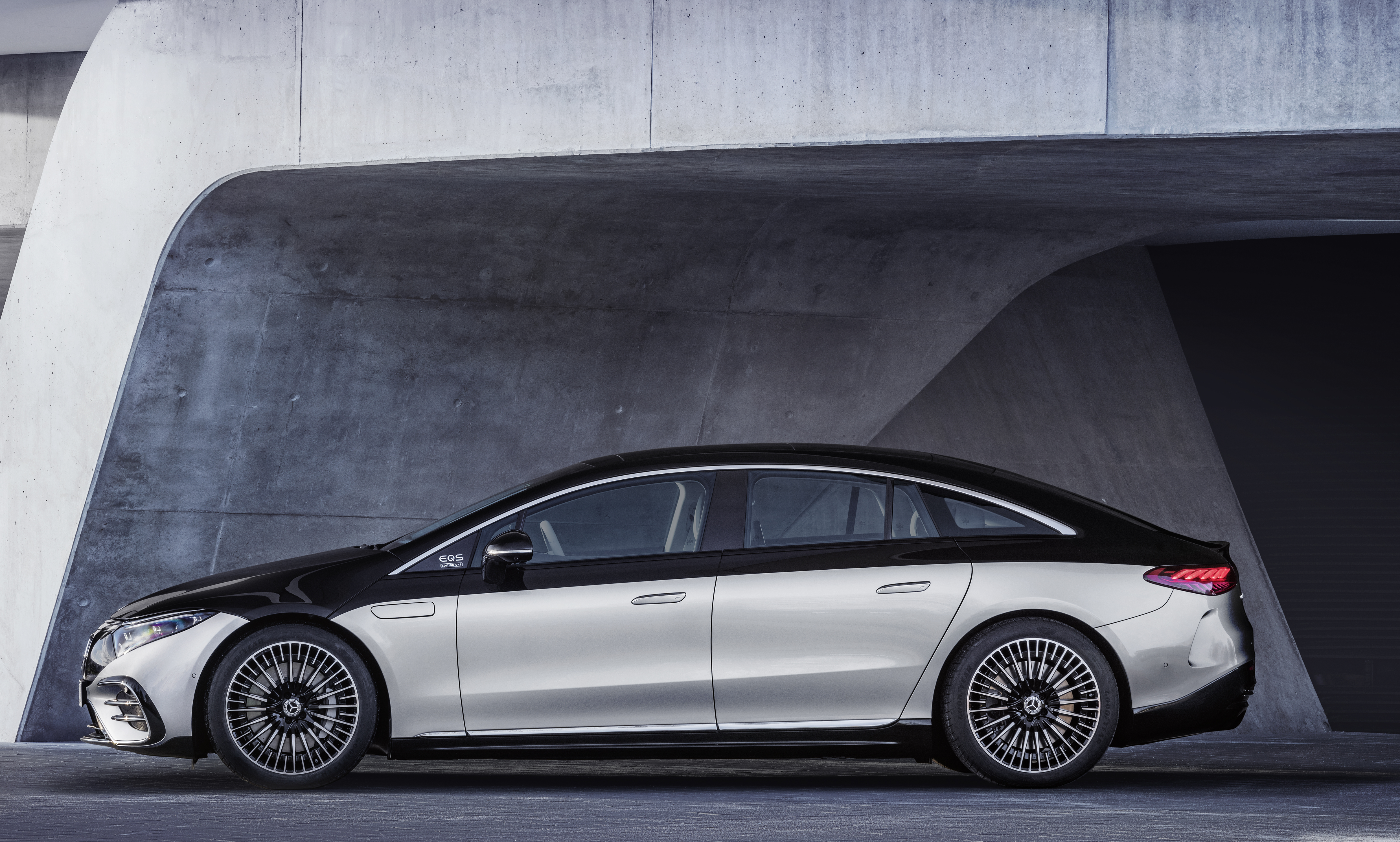
Mercedes EQS 580 4MATIC
The vehicle has a co-efficient drag of 0.202, which sneaks below Tesla’s Model S and the upcoming Lucid Motors Air, making its the most aerodynamic production car in the world. All EQS models have an electric powertrain at the rear axle. The EQS 580 4MATIC also has an electric powertrain at the front axle, giving it that all-wheel drive capability. The EQS generates between 329 hp and 516 hp, depending on the variant. Mercedes said a performance version is being planned that will have up to 630 hp. Both the EQS 450+ and the EQS 580 4MATIC have a top speed of 130 miles per hour. The EQS 450+ will have a 0 to 60 mph acceleration time of 5.5 seconds, while its more powerful sibling will be able to achieve that speed in 4.1 seconds.
The EQS will have two possible batteries to choose from, although Mercedes has only released details of one. The heftiest configuration of the EQS has a battery with 107.8 kWh of usable energy content that can travel up 478 miles on a single charge under the European WLTP estimates. The EPA estimates, which tend to be stricter, will likely fall below that figure.
The vehicle can be charged with up to 200 kW at fast charging stations with direct current, according to Mercedes. At home or at public charging stations, the EQS can be charged with AC using the on-board charger.
Now on to some of the technological highlights within the vehicle.
ADAS
There are loads of driver assistance features in the EQS, which are supported by a variety of sensors such as ultrasound, camera, radar and lidar that are integrated into the vehicle. Adaptive cruise, the ability to adjust the acceleration behavior, lane detection and automatic lane changes as well as steering assist helps the driver follow the driving lane at speeds up to 130 mph are some of the ADAS features. The system also recognizes signposted speed limits, overhead frameworks and signs at construction zones, and includes warnings about running a stop sign or a red light.
Another new feature is the microsleep warning function, which becomes active once the vehicle reaches speeds over 12 mph. This feature works by analyzing the driver’s eyelid movements through a camera on the driver’s display, which is only available with MBUX Hyperscreen.
There are several active assist features that will intervene if needed. An active blind spot assist can give a visual warning of potential lateral collisions in a speed range from around 6 mph to 124 mph. However, if the driver ignores the warnings and still initiates a lane change, the system can take corrective action by one-sided braking intervention at the last moment if the speed exceeds 19 mph, Mercedes said. The feature remains active even while parked and will warn against exiting if a vehicle or cyclist is passing nearby.
There is also an active emergency stop assist feature that will brake the vehicle to a standstill in its own lane if the sensors and software recognizes that the driver is no longer responding to the traffic situation for a longer period. The brakes are not suddenly applied. If the driver is unresponsive, it begins with an acoustic warning and a visual warning appears in the instrument cluster. Those warnings continue as the vehicle starts to slowly decelerate. Hazard lights are activated and the driver’s seatbelt is briefly tensioned as a haptic warning. The final step is what Mercedes describes as a “short, strong brake jolt” as an additional warning followed by the car decelerating to a standstill, with an optional single lane change if necessary.
Mercedes is also offering the option of DRIVE PILOT, which is an SAE Level 3 conditional automated driving system feature. This would allow hands-free driving. Regulations in Europe prevent that level of automation to be deployed in production vehicles on public roads. However, Källenius told media in Germany on Thursday that the company is on “on the verge of trying to certify the first volume production car Level 3 system in Germany in the second half of this year,” Automotive News Europe reported.
The car that learns
Many of the technological gee-whiz doodads in the EQS tie back to an underlying AI that is designed to learn the driver’s behavior. That is achieved through software and a dizzying number of sensors. Mercedes said that depending on the equipment, the EQS will have up to 350 sensors that are used to record distances, speeds and accelerations, lighting conditions, precipitation and temperatures, the occupancy of seats as well as the driver’s blink of an eye or the passengers’ speech.
The sensors capture information, which is then processed by electronic control units (computers) and software algorithms then take over to make decisions. TechCrunch automotive reviewer Tamara Warren noticed the vehicle’s ability to learn her preference during a half day with the EQS.
Mercedes ran through a number of examples of how these sensors and software might work together, including an optional driving sound that is interactive and reacts to different parameters, such as position of the accelerator pedal, speed or recuperation.
The intuitive learning is mostly apparent through interactions with the MBUX infotainment system, which will proactively show the right functions for the user at the right time. Sensors pick up on change in the surroundings and user behavior and will react accordingly. Mercedes learned from data collected from the first-generation MBUX, which debuted in the 2019 Mercedes A Class, and found most of the use cases fall in the Navigation, Radio/Media and Telephone categories.
That user data informed how the second-generation MBUZ, and specifically the one in the EQS, is laid out. For instance, the navigation app is always in the center of the visual display unit.
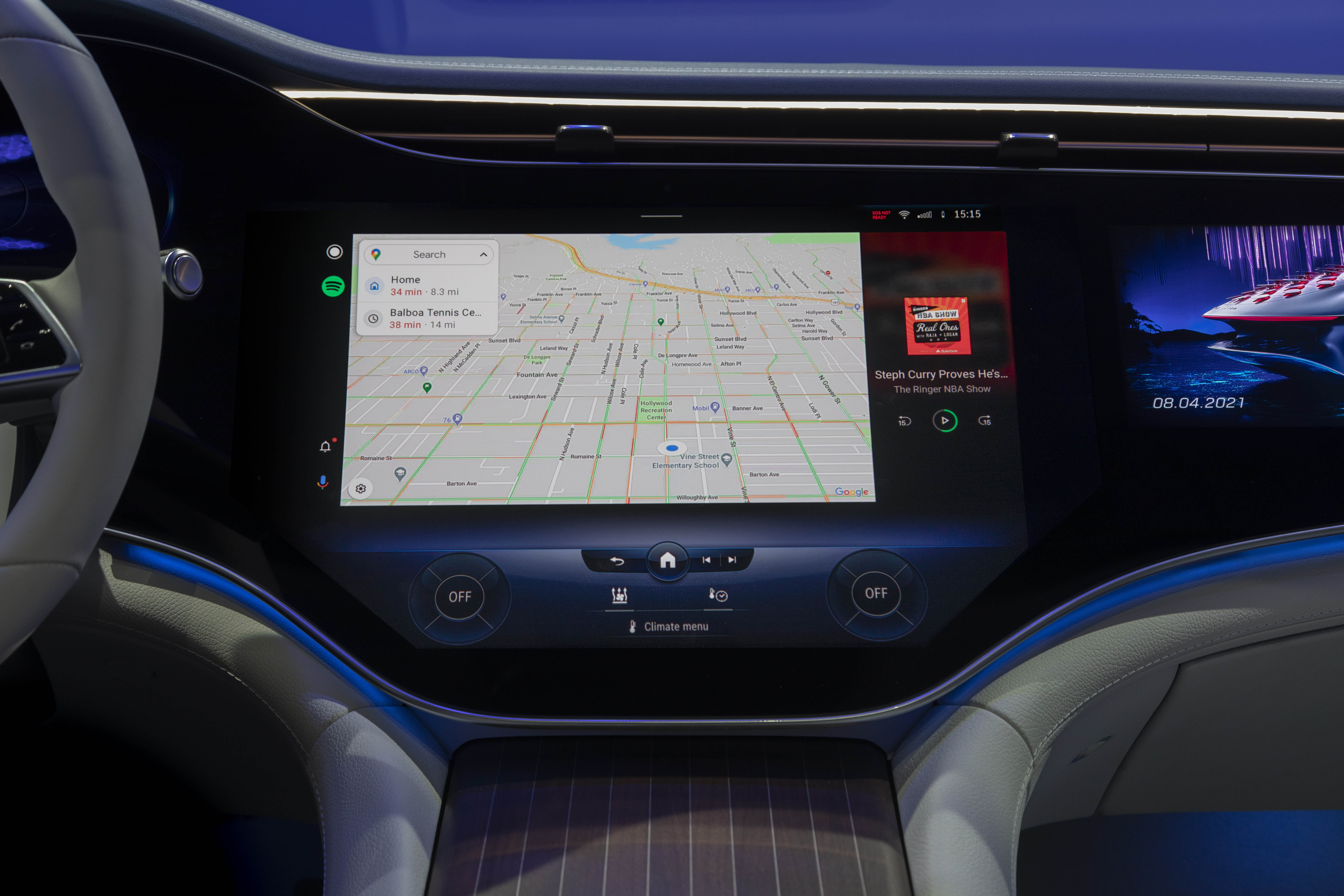
Image Credits: Mercedes-Benz
The MBUX uses natural language processing and so drivers can always use their voice to launch a radio station or control the climate. But Mercedes is really pushing the EQS’ intuitive learning capabilities. This means that as a driver uses the vehicle, items that might be typically buried in the menu will appear up front, or offered up depending on the time or even location of the vehicle.
“The car gets to know you as a person and your preferences and what you do,” said Källenius. “It’s almost like it serves up the option that you want to do next, before you even think about it you get.”
“You get a pizza delivered before you even get hungry,” Källenius said, jokingly. “That’s phenomenal in terms of intuition.”
According to Mercedes there are more than 20 other functions such as birthday reminders that are automatically offered with the help of artificial intelligence when they are relevant to the customer. These suggestion modules, which are displayed on the zero-layer interface, are called “Magic Modules.” Here is how it might work: if the driver always calls a particular friend or relative on the way home on certain evenings, the vehicle will deliver a suggestion regarding this particular call on this day of the week and at this time. A business card will appear with their contact information and — if this is stored — their photo, Mercedes said. All the suggestions from MBUX are coupled with the logged-in profile of the user. This means that if someone else drives the EQS on that same evening, with their own profile logged-in, this recommendation is not displayed.
If a driver always listens to a specific radio program on their commute home, this suggestion will be displayed, or if they regularly use the hot-stone massage, the system will automatically suggest the comfort function in colder temperatures.
This also applies to the vehicle’s driving functions. For example, the MBUX will remember if the driver has a steep driveway or passes over the same set of speed bumps entering their neighborhood. If the vehicle approaches that GPS position, the MBUX will suggest raising the chassis to offer more ground clearance.
Health and wellness
Remember those sensors? There’s a way for drivers to take it a step further and link their smartwatch — Mercedes-Benz vivoactive 3, the Mercedes-Benz Venu or another compatible Garmin — to the vehicle’s so-called energizing coach. This coach responds to the user’s behavior and will offer up one of several programs such as “freshness,” “warmth,” “vitality” or “joy” depending on the individual. Via the Mercedes me app, the smartwatch sends vital data of the wearer to the coach, including pulse rate, stress level and sleep quality. The pulse rate recorded by the integrated Garmin wearable is shown in the central display.
What does this all mean in practice? Depending on the user’s wants and the AI system’s understanding of what he or she wants, the lighting, climate, sound and seating might change. This is, of course, all integrated with the voice assistant “Hey Mercedes” so drivers can simply make a statement to trigger the program they want.
If the driver says “I am stressed,” the Joy program will be launched. If the driver says “I’m tired,” they are then prompted to take a break the Vitality program.
Mercedes S Class owners might already be familiar with these options, although the automaker notes that EQS builds on the system. There are now three new energizing nature programs called forest glade, sounds of the sea and summer rain, as well as training and tips options. Each program launches different and immersive sounds, created in consultation with the acoustic ecologist Gordon Hempton. For instance, “forest glade” will deliver a combination of birdsong, rustling leaves and a gentle breeze. The program is rounded off by warm music soundscapes and subtle fragrance.
Sounds of the sea will produce soft music soundscapes, wave sounds and seagull sounds. Blasts of air from the air conditioning system completes the effect. Meanwhile “summer rain” offers up sounds of raindrops on leafy canopies, distant thunder, pattering rain and ambient music soundscapes.
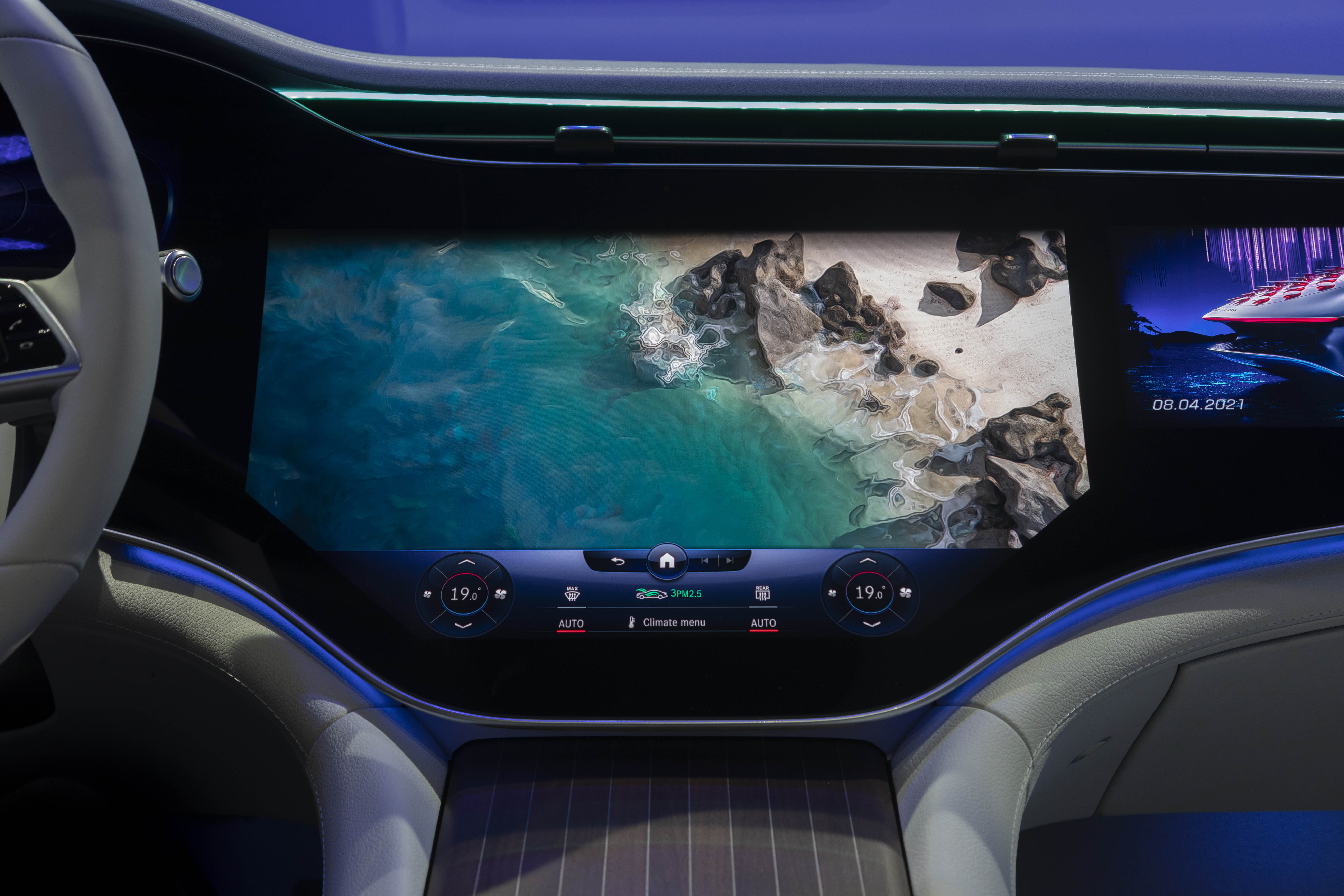
Image Credits: Mercedes-Benz
For those long drives that require a break, Mercedes added a power nap feature. Once power nap is selected (and no, never when driving), the program runs through three phases: falling asleep, sleeping and waking up. The driver’s seat moves into a rest position, the side windows and panorama roof sunshade are closed and the air ionization is activated. Soothing sounds and the depiction of a starry sky on the central display support falling asleep, according to Mercedes. Once it is time to wake up, a soundscape is activated, a fragrance is deployed and a brief active massage and seat ventilation begins. The seat raises and the sunshade in the roof liner opens.
Voice
As mentioned, the “Hey Mercedes” voice assistant uses natural language processing and can handle an array of requests. Mercedes said the assistant can now do more, and certain actions such as accepting a phone call can be made without the activation keyword “Hey Mercedes.” The assistant can now explain vehicle functions.
The assistant can also recognize vehicle occupants by their voices. There is in fact individual microphones placed at each seating area within the vehicle. Once they have been learned, the assistant can access personal data and functions for that specific user.
The voice assistant in the EQS can also be operated from the rear, according to Mercedes.
These personal profiles are stored in the cloud as part of “Mercedes me.” That means the profiles can also be used in other Mercedes-Benz vehicles with the new MBUX generation. Security is built in and includes a PIN and then combines face and voice recognition to authenticate. This allows access to individual settings or verification of digital payment processes from the vehicle, the automaker said.
Screens and entertainment
Finally, yes the screens. All of the screens. The 56-inch hyperscreen gets the most attention, but there are screens throughout the EQS. What is important about them is how they communicate with each other.
The hyperscreen is actually three screens that sit under a common bonded glass cover and visually merge into one display. The driver display is 12.3 inches, the central display is 17.7 inches and front passenger display is 12.3 inches. The MBUX Hyperscreen is a touchscreen and also throws in haptic feedback and force feedback.
“Sometimes when I think about the first design and what we’ve actually done here, it’s like, ‘Are we mad to try to create a one meter 41 centimeters curved bonded glass, one piece in the car,” said Källenius. “The physical piece in its own right — it’s a piece of technological art.”
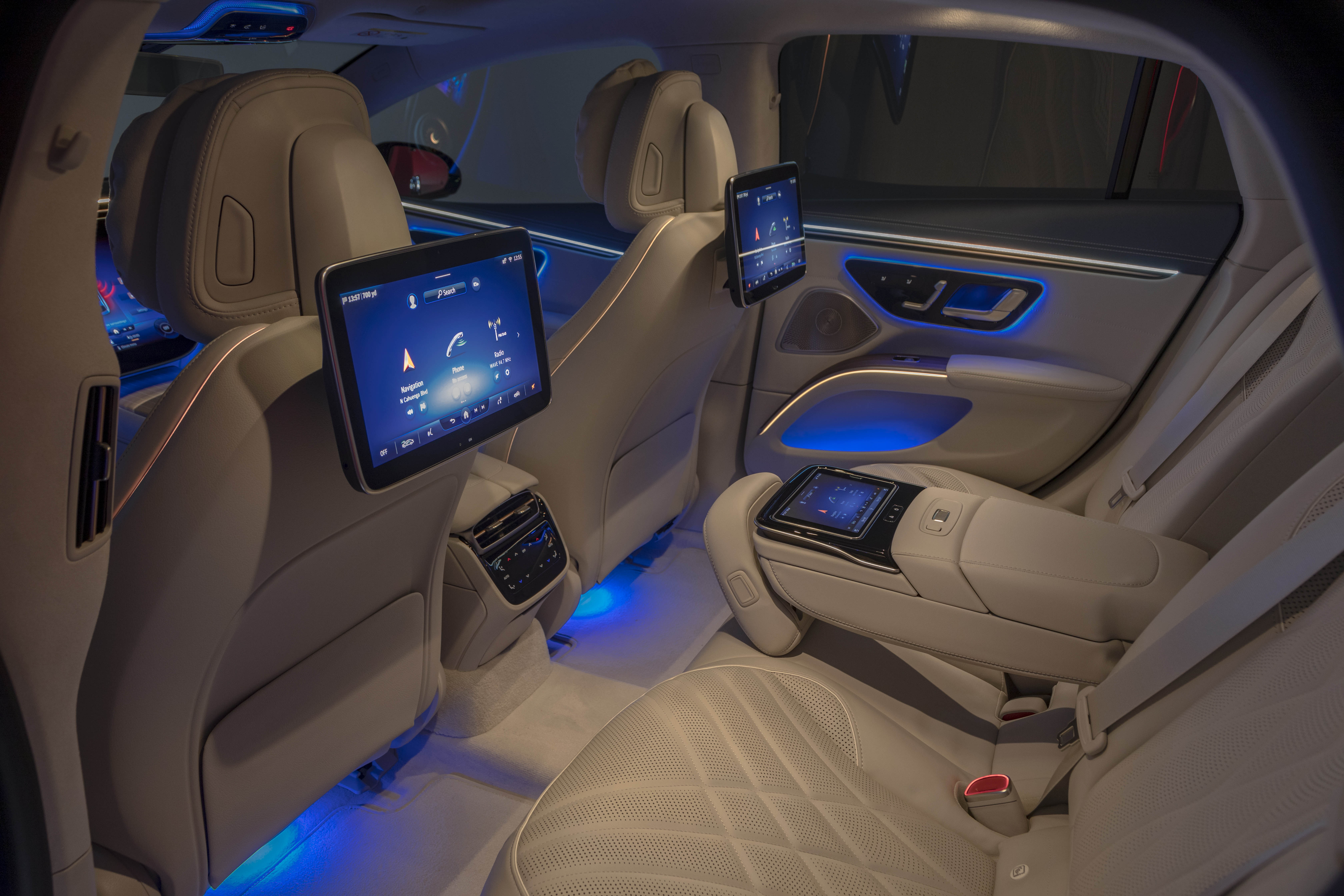
Image Credits: Mercedes-Benz
A lot of attention was paid to the backseat because the EQS, like its S Class counterpart, is often used to chauffeur the owner. Mercedes won’t call this a rear-seat entertainment system and instead refers to it as a multi-seat entertainment system because everything is connected.
Källenius explained that if a driver wants the two rear passengers to watch a different movie, a simple drag and swipe motion on the main screen will throw that new programming back to the rear. The passengers can also throw movies from left to right.
Sen. Wyden proposes limits on exportation of American’s personal data
Senator Ron Wyden (D-OR) has proposed a draft bill that would limit the types of information that could be bought and sold by tech companies abroad, and the countries it could be legally sold in. The legislation is imaginative and not highly specific, but it indicates growing concern at the federal level over the international data trade.
“Shady data brokers shouldn’t get rich selling Americans’ private data to foreign countries that could use it to threaten our national security,” said Sen. Wyden in a statement accompanying the bill. They probably shouldn’t get rich selling Americans’ private data at all, but national security is a good way to grease the wheels.
The Protecting Americans’ Data From Foreign Surveillance Act would be a first step toward categorizing and protecting consumer data as a commodity that’s traded on the global market. Right now there are few if any controls over what data specific to a person — buying habits, movements, political party — can be sold abroad.
This means that, for instance, an American data broker could sell the preferred brands and home addresses of millions of Americans to, say, a Chinese bank doing investment research. Some of this trade is perfectly innocuous, even desirable in order to promote global commerce, but at what point does it become dangerous or exploitative?
There isn’t any official definition of what should and shouldn’t be sold to whom, the way we limit sales of certain intellectual property or weapons. The proposed law would first direct the secretary of Commerce to identify the data we should be protecting and to whom it should be protected against.
The general shape of protected data would be that which “if exported by third parties, could harm U.S. national security.” The countries that would be barred from receiving it would be those with inadequate data protection and export controls, recent intelligence operations against the U.S. or laws that allow the government to compel such information to be handed over to them. Obviously this is aimed at the likes of China and Russia, though ironically the U.S. fits the bill pretty well itself.
There would be exceptions for journalism and First Amendment-protected speech, and for encrypted data — for example storing encrypted messages on servers in one of the targeted countries. The law would also create penalties for executives “who knew or should have known” that their company was illegally exporting data, and creates pathways for people harmed or detained in a foreign country owing to illegally exported data. That might be if, say, another country used an American facial recognition service to spot, stop and arrest someone before they left.
If this all sounds a little woolly, it is — but that’s more or less on purpose. It is not for Congress to invent such definitions as are necessary for a law like this one; that duty falls to expert agencies, which must conduct studies and produce reports that Congress can refer to. This law represents the first handful of steps along those lines: getting the general shape of things straight and giving fair warning that certain classes of undesirable data commerce will soon be illegal — with an emphasis on executive responsibility, something that should make tech companies take notice.
The legislation would need to be sensitive to existing arrangements by which companies spread out data storage and processing for various economic and legal reasons. Free movement of data is to a certain extent necessary for globe-spanning businesses that must interact with one another constantly, and to hobble those established processes with red tape or fees might be disastrous to certain locales or businesses. Presumably this would all come up during the studies, but it serves to demonstrate that this is a very complex, not to say delicate, digital ecosystem the law would attempt to modify.
We’re in the early stages of this type of regulation, and this bill is just getting started in the legislative process, so expect a few months at the very least before we hear anything more on this one.
Twitter bans James O’Keefe of Project Veritas over fake account policy
Twitter has banned right-wing provocateur James O’Keefe, creator of political gotcha video producer Project Veritas, for violating its “platform manipulation and spam policy,” suggesting he was operating multiple accounts in an unsanctioned way. O’Keefe has already announced that he will sue the company for defamation.
The ban, or “permanent suspension” as Twitter calls it, occurred Thursday afternoon. A Twitter representative said the action followed the violation of rules prohibiting “operating fake accounts” and attempting to “artificially amplify or disrupt conversations through the use of multiple accounts,” as noted here.
This suggests O’Keefe was banned for operating multiple accounts, outside the laissez-faire policy that lets people have a professional and a personal account, and that sort of thing.
Ssharp-eyed users noticed that O’Keefe’s last tweet unironically accused reporter Jesse Hicks of impersonation, including an image showing a partly redacted phone number supposedly belonging to Hicks. This too may have run afoul of Twitter’s rules about posting personal information, but Twitter declined to comment on this when I asked. (Update: The image was in fact redacted, I thought it was done by the person who took the screenshot but the first digits were removed in the original tweet.)
Supporters of O’Keefe say that the company removed his account as retribution for his most recent “exposé” involving surreptitious recordings of a CNN employee admitting the news organization has a political bias. (The person he was talking to had, impersonating a nurse, matched with him on Tinder.)
For his part O’Keefe said he would be suing Twitter for defamation over the allegation that he operated fake accounts. Chief Legal Officer Jered T. Ede told TechCrunch that “James O’Keefe has only one account. He does not have fake accounts. Twitter’s statement is simply false.”
Daily Crunch: Google Earth gets an update
Google Earth gives users a new look at a changing planet, Facebook tests new business discovery features and Autodesk acquires Upchain. This is your Daily Crunch for April 15, 2021.
The big story: Google Earth gets an update
Google is describing this as Google Earth’s biggest update since 2017, though there’s really just one major addition: A time-lapse mode bringing together satellite photos from the past 37 years, in 3D.
Beyond just being a novel new feature, this mode can reveal how climate change has reshaped our planet. In fact, Google Earth now offers guided tours focused on forest change, urban growth, warming temperatures and more.
The tech giants
Facebook to test new business discovery features in US News Feed — Users will be able to tap on topics they’re interested in underneath posts and ads in their News Feed, allowing them to explore related content from businesses.
Autodesk acquires Upchain — Upchain is a Toronto-based startup that offers a cloud-based product life cycle management service.
Consumer groups and child development experts petition Facebook to drop ‘Instagram for kids’ plan — The letter was written by the Campaign for a Commercial-Free Childhood, an advocacy group that often leads campaigns against big tech and its targeting of children.
Startups, funding and venture capital
Polestar raises $500M from outside investors as EV market grows — This is the first external round for Volvo Car Group’s standalone electric performance brand.
Goldman Sachs leads $23M in funding for Brazilian e-commerce startup Olist — Olist connects small businesses to larger product marketplaces, helping entrepreneurs sell their products to a larger customer base.
Substack announces a $1M initiative to fund local journalists — The newsletter startup will fund independent writers creating local news publications.
Advice and analysis from Extra Crunch
Coinbase’s direct listing alters the landscape for fintech and crypto startups — In Alex Wilhelm’s view, Coinbase reaching a valuation north of $100 billion during its first day of trading was the biggest startup event of the year.
Billion-dollar B2B: cloud-first enterprise tech behemoths have massive potential — Dharmesh Thakker of Battery Ventures writes that a new class of cloud-first, enterprise-tech behemoths have the potential to reach $1 billion in ARR.
How startups can ensure CCPA and GDPR compliance in 2021 — It’s important to enact best data management practices before a legal situation arises.
(Extra Crunch is our membership program, which helps founders and startup teams get ahead. You can sign up here.)
Everything else
Detroit’s native son, billionaire Dan Gilbert, makes the case for his town — The Quicken Loans founder has poured at least $2.5 billion into rehabilitating buildings in the heart of the city.
Can the tech trade show return in 2021? — IFA promises “full-scale, real-life event” for Berlin in September, while MWC reels from the loss of marquee names.
Garry Kasparov launches a community-first chess platform — Kasparovchess will be a platform in which legendary chess players have free reign to share tips and tricks with players from various levels.
The Daily Crunch is TechCrunch’s roundup of our biggest and most important stories. If you’d like to get this delivered to your inbox every day at around 3pm Pacific, you can subscribe here.

Should Dell have pursued a more aggressive debt-reduction move with VMware?
When Dell announced it was spinning out VMware yesterday, the move itself wasn’t surprising; there had been public speculation for some time. But Dell could have gone a number of ways in this deal, despite its choice to spin VMware out as a separate company with a constituent dividend instead of an outright sale.
The dividend route, which involves a payment to shareholders between $11.5 billion and $12 billion, has the advantage of being tax-free (or at least that’s what Dell hopes as it petitions the IRS). For Dell, which owns 81% of VMware, the dividend translates to somewhere between $9.3 billion and $9.7 billion in cash, which the company plans to use to pay down a portion of the huge debt it still holds from its $58 billion EMC purchase in 2016.
Dell hopes to have its cake and eat it too with this deal: It generates a large slug of cash to use for personal debt relief while securing a five-year commercial deal that should keep the two companies closely aligned.
VMware was the crown jewel in that transaction, giving Dell an inroad to the cloud it had lacked prior to the deal. For context, VMware popularized the notion of the virtual machine, a concept that led to the development of cloud computing as we know it today. It has since expanded much more broadly beyond that, giving Dell a solid foothold in cloud native computing.
Dell hopes to have its cake and eat it too with this deal: It generates a large slug of cash to use for personal debt relief while securing a five-year commercial deal that should keep the two companies closely aligned. Dell CEO Michael Dell will remain chairman of the VMware board, which should help smooth the post-spinout relationship.
But could Dell have extracted more cash out of the deal?
Doing what’s best for everyone
Patrick Moorhead, principal analyst at Moor Insights and Strategies, says that beyond the cash transaction, the deal provides a way for the companies to continue working closely together with the least amount of disruption.
“In the end, this move is more about maximizing the Dell and VMware stock price [in a way that] doesn’t impact customers, ISVs or the channel. Wall Street wasn’t valuing the two companies together nearly as [strongly] as I believe it will as separate entities,” Moorhead said.
E-commerce investor Upper90 raises $55M for equity investments
It might be strange to hear this from a firm that just raised a $55 million equity fund, but the team at Upper90 would like to remind you that equity isn’t the only funding that’s available.
Upper90 is led by CEO Billy Libby (former head of quantitative education sales at Goldman Sachs) and Chairman Jason Finger (co-founder of Seamless), and it was the first investor in both Thrasio and Clearbanc. The firm offers debt and equity funding, and it just closed a $195 million fund in December — but the fund announced today is Upper90’s first to be devoted purely to equity financing.
Finger said he and Libby have taken this combined approach because there are often predictable parts of an online business, where (for example) “if I’m doing some marketing, I know that $1 on Facebook will generate $8 of revenue.” In those cases, “equity is the most expensive way you can finance growth,” and he said it “really fundamentally bothered me that the founders and early investors who took a lot of the risks, dedicating their life on a 24/7 basis” would often end up owning a small percentage of the company.
That doesn’t mean debt is the only solution, but in Finger’s words, founders should stop seeing big equity rounds as “a badge of honor.” Instead, they can work with Upper90 to find the “optimal capital structure” combining both elements.
“Life isn’t binary,” he added. “Part of the reason we launched an equity fund in the [e-commerce] rollup sector is that equity is an important piece for you to get the highest quality lender — they’re going to want to know that there’s equity protection underneath their credit facility.”
He also suggested that making an equity investment turns Upper90 into a “long-term partner” for the companies it backs, freeing the team from being “purely focused on the returns related to our credit.”
As alluded to earlier, Libby and Finger see the e-commerce aggregation market as one that’s particularly well suited to their approach. (Thrasio is perhaps the best-known startup rolling up Amazon sellers, while Clearbanc offers its own revenue-based financing to e-commerce and SaaS companies.)
“I always say: What’s new is old,” Libby told me. “If we had this conversation 15 years ago, we’d be talking about rolling up gyms and dry cleaners and smoothie shops [ … ] The infrastructure that Amazon has developed allows people to be entrepreneurs in a week, so I think that we’re still extremely early in this trend. There are going to be so many more people starting their own store on Amazon.”
And eventually, he suggested Upper90 could take a similar approach in other industries: “A content creator who starts a YouTube channel is not that different than the Amazon store owner. Five years from now, we could be talk about, what’s the value of a subscriber on YouTube, what’s the value of an influencer’s following on Instagram, how can we bring some of that revenue forward?”
You can now pay for BART using an iPhone or Apple Watch
Good news, Bay Area! Apple Pay now works with Clipper cards.
That means you can now use an iPhone or Apple Watch to pay for BART. Or Muni. Or Caltrain. Or the ferry! Or (almost) any other transit-related thing you’d otherwise use the plastic Clipper card for.
Clipper has a page outlining the Apple Pay setup process right here.
A few quick but important things to note:
- Adding an existing Clipper card to an Apple Wallet apparently transfers the funds off that card. At that point, says Clipper, “your plastic card has been deactivated” — so it sounds like it won’t work as a physical backup card.
- Some people will want to hang on to the plastic cards, regardless: Clipper notes that Bay Area bike share users and anyone using an RTC Discount Card will need to keep the plastic card, even after it’s deactivated for transit use.
- Clipper has previously confirmed that support is coming for Google Pay (Android) “this spring,” but today’s rollout seems to support Apple Pay only.
As noted back in February when this was first confirmed as on the way, Clipper works with Apple’s “Express Transit” feature. That’s just a fancy way to say that you can tap to pay with the digital Clipper card without first needing to punch in your phone’s PIN or using FaceID. On certain newer iPhones, it also lets you keep using the Clipper card for a few hours after your battery has died; a wonderful thing in a pinch, but probably not something you want to rely on regularly.
MEPs call for European AI rules to ban biometric surveillance in public
A cross-party group of 40 MEPs in the European parliament has called on the Commission to strengthen an incoming legislative proposal on artificial intelligence to include an outright ban on the use of facial recognition and other forms of biometric surveillance in public places.
They have also urged EU lawmakers to outlaw automated recognition of people’s sensitive characteristics (such as gender, sexuality, race/ethnicity, health status and disability) — warning that such AI-fuelled practices pose too great a rights risk and can fuel discrimination.
The Commission is expected to presented its proposal for a framework to regulate ‘high risk’ applications of AI next week — but a copy of the draft leaked this week (via Politico). And, as we reported earlier, this leaked draft does not include a ban on the use of facial recognition or similar biometric remote identification technologies in public places, despite acknowledging the strength of public concern over the issue.
“Biometric mass surveillance technology in publicly accessible spaces is widely being criticised for wrongfully reporting large numbers of innocent citizens, systematically discriminating against under-represented groups and having a chilling effect on a free and diverse society. This is why a ban is needed,” the MEPs write now in a letter to the Commission which they’ve also made public.
They go on to warn over the risks of discrimination through automated inference of people’s sensitive characteristics — such as in applications like predictive policing or the indiscriminate monitoring and tracking of populations via their biometric characteristics.
“This can lead to harms including violating rights to privacy and data protection; suppressing free speech; making it harder to expose corruption; and have a chilling effect on everyone’s autonomy, dignity and self-expression – which in particular can seriously harm LGBTQI+ communities, people of colour, and other discriminated-against groups,” the MEPs write, calling on the Commission to amend the AI proposal to outlaw the practice in order to protect EU citizens’ rights and the rights of communities who faced a heightened risk of discrimination (and therefore heightened risk from discriminatory tools supercharged with AI).
“The AI proposal offers a welcome opportunity to prohibit the automated recognition of gender, sexuality, race/ethnicity, disability and any other sensitive and protected characteristics,” they add.
The leaked draft of the Commission’s proposal does tackle indiscriminate mass surveillance — proposing to prohibit this practice, as well as outlawing general purpose social credit scoring systems.
However the MEPs want lawmakers to go further — warning over weaknesses in the wording of the leaked draft and suggesting changes to ensure that the proposed ban covers “all untargeted and indiscriminate mass surveillance, no matter how many people are exposed to the system”.
They also express alarm at the proposal having an exemption on the prohibition on mass surveillance for public authorities (or commercial entities working for them) — warning that this risks deviating from existing EU legislation and from interpretations by the bloc’s top court in this area.
“We strongly protest the proposed second paragraph of this Article 4 which would exempt public authorities and even private actors acting on their behalf ‘in order to safeguard public security’,” they write. “Public security is precisely what mass surveillance is being justified with, it is where it is practically relevant, and it is where the courts have consistently annulled legislation on indiscriminate bulk processing of personal data (e.g. the Data Retention Directive). This carve-out needs to be deleted.”
“This second paragraph could even be interpreted to deviate from other secondary legislation which the Court of Justice has so far interpreted to ban mass surveillance,” they continue. “The proposed AI regulation needs to make it very clear that its requirements apply in addition to those resulting from the data protection acquis and do not replace it. There is no such clarity in the leaked draft.”
The Commission has been contacted for comment on the MEPs’ calls but is unlikely to do so ahead of the official reveal of the draft AI regulation — which is expected around the middle of next week.
It remains to be seen whether the AI proposal will undergo any significant amendments between now and then. But MEPs have fired a swift warning shot that fundamental rights must and will be a key feature of the co-legislative debate — and that lawmakers’ claims of a framework to ensure ‘trustworthy’ AI won’t look credible if the rules don’t tackle unethical technologies head on.
How startups can ensure CCPA and GDPR compliance in 2021
Beth Winters
Contributor
Contributor
Beth Winters, JD/MBA, is the solutions marketing manager of Aparavi, a data intelligence and automation software and services company that helps companies find and unlock the value of data.
Data is the most valuable asset for any business in 2021. If your business is online and collecting customer personal information, your business is dealing in data, which means data privacy compliance regulations will apply to everyone — no matter the company’s size.
Small startups might not think the world’s strictest data privacy laws — the California Consumer Privacy Act (CCPA) and Europe’s General Data Protection Regulation (GDPR) — apply to them, but it’s important to enact best data management practices before a legal situation arises.
Data compliance is not only critical to a company’s daily functions; if done wrong or not done at all, it can be quite costly for companies of all sizes.
For example, failing to comply with the GDPR can result in legal fines of €20 million or 4% of annual revenue. Under the CCPA, fines can also escalate quickly, to the tune of $2,500 to $7,500 per person whose data is exposed during a data breach.
If the data of 1,000 customers is compromised in a cybersecurity incident, that would add up to $7.5 million. The company can also be sued in class action claims or suffer reputational damage, resulting in lost business costs.
It is also important to recognize some benefits of good data management. If a company takes a proactive approach to data privacy, it may mitigate the impact of a data breach, which the government can take into consideration when assessing legal fines. In addition, companies can benefit from business insights, reduced storage costs and increased employee productivity, which can all make a big impact on the company’s bottom line.
Challenges of data compliance for startups
Data compliance is not only critical to a company’s daily functions; if done wrong or not done at all, it can be quite costly for companies of all sizes. For example, Vodafone Spain was recently fined $9.72 million under GDPR data protection failures, and enforcement trackers show schools, associations, municipalities, homeowners associations and more are also receiving fines.
GDPR regulators have issued $332.4 million in fines since the law was enacted almost two years ago and are being more aggressive with enforcement. While California’s attorney general started CCPA enforcement on July 1, 2020, the newly passed California Privacy Rights Act (CPRA) only recently created a state agency to more effectively enforce compliance for any company storing information of residents in California, a major hub of U.S. startups.
That is why in this age, data privacy compliance is key to a successful business. Unfortunately, many startups are at a disadvantage for many reasons, including:
- Fewer resources and smaller teams — This means there are no designated data privacy officers, privacy attorneys or legal counsel dedicated to data privacy issues.
- Lack of planning — This might be characterized by being unable to handle data privacy information requests (DSARs, or “data subject access requests”) to help fulfill the customer’s data rights or not having an overall program in place to deal with major data breaches, forcing a reactive instead of a proactive response, which can be time-consuming, slow and expensive.
Rivian to initially launch in-house insurance program in 40 states
Electric truck startup Rivian released Thursday details of its in-house Rivian Insurance program, which it says will be integrated into its digital ordering process.
The insurance will initially be available in 40 states. Keeping in line with the company’s marketing as an “adventure vehicle” company, customers will also have the option to cover their home and recreational equipment, such as boats, dirt bikes and campers. Rivian’s plans to start an insurance program first leaked more than a year ago after a job posting was spotted.
What makes the insurance offering stand out, however, is its integration with the Rivian vehicle platform and Driver+ safety suite, which the company said in a blog post will help deliver “tailored, data-driven coverage.” Customers who choose Rivian Insurance will get Driver+ rate reductions, with more details to come. Drivers can additionally opt in to a separate program that offers savings for using Rivian’s Active Driver Assistance software.
It’s a clever move for the company, which plans to bring its first electric pickup to market later this year. Like Tesla, Rivian intends to have Rivian Collision Centers and Service Centers performing the work — and by keeping everything in-house, the company is likely thinking customers will be attracted to a seamless insurance program. Rivian Insurance is another instance of the newer entrant following in the veteran’s lead, but with one big advantage: Tesla Insurance is only available to owners in California.
Join ECL on Wednesday to pitch your startup to Fifth Wall’s Brendan Wallace and Hippo’s Assaf Wand
Have you ever dreamed about the opportunity to find yourself in, say, an elevator with an investor who is open to hearing your pitch? Well, then the next episode of Extra Crunch Live is for you.
If you’ve hung out with us on an ECL before, you know we start with a bit of top news, chat with our speakers about how to successfully fundraise, and then finish with the Pitch Deck Teardown, where we take a look at decks submitted by you, the audience members, and give live feedback.
On Wednesday, with the help of Fifth Wall’s Brendan Wallace and Hippo’s Assaf Wand, we’re going to shake things up a bit.
Folks who attend the live event will be able to virtually ‘raise their hand’, come on screen, and give a 60-second pitch of their startup. No demoes. No videos. No visual aids of any kind. It’s the ultimate elevator pitch, and it’ll be done before a live audience.
Wallace and Wand (that’s catchy, eh?) will give their feedback and ask questions at the end of every pitch.
The only way you can participate in the ECL Pitch-off is to show up. Luckily, the events are free to anyone. However, accessing any of this content on demand is reserved strictly for Extra Crunch members.
We’re super excited to introduce the pitch-off as a feature of ECL and hope you are too! See you on Wednesday!