This is how it begins. You see a mighty dragon in your mind, its
frightening head, shiny scales, marvelous wings, a long tail with a row
of spikes… It’s so real you can almost touch it!
You grab a pencil, or
a graphics tablet pen, you feel the creative energy coming through your
fingers, and… nothing looks right. It just doesn’t. And you would
understand it if you were generally bad at drawing, but no, you can draw
realistic things as long as you use a reference, right? Your lines are
clean, you can control a pencil, you get the proportions right—but only
when there’s something you can look at in reality.
Drawing from imagination seems to be a higher skill than simply re-creating reality. After all, this is a real
creation—you’re bringing to life something no one’s ever seen before! All
these amazing creatures and fantastic stories in your mind are only waiting for
you to set them free. You want to observe them as they’re being born on
a sheet of paper, to see them come true, for everyone to admire them as you
do. Why is it so hard? How to get a proper connection between the image in your mind and the lines created by your hand?
How Do You Draw?
This is the question you need to answer first. Drawing isn’t as simple as you think—it’s made of many different aspects
(that’s how different styles can be created even though there’s only
one reality). Therefore, the method you use for drawing from a reference
may be (and probably is) completely different than the method you use for
drawing from imagination. If so, no wonder why one of them is easy for
you, and the other one seems impossible, even though they’re both
called “drawing”.
The same effect can be reached using different methods. For example, you can get a realistic picture of a horse by:
- taking a photo of a real horse
- sculpting a realistic horse and taking a photo of it in appropriate lighting
- using blobs of pigments to create a painting of a horse
- using points of light to create a digital painting of a horse
All
these methods, if used properly, will give you the same realistic
picture of a horse. It’s the same with your drawings—even though a
reference-based drawing and an imagination-based drawing are both drawn
with the same lines, the same hand, and the same mind, they are created
in a different way. In other words, there are two different processes
going on in your mind when re-creating and creating.
Drawing From a Reference: Copying
Take a reference, try to draw, and observe how you do it. How does it work? What are you actually
doing, except “drawing”? Observe the processes in your mind, analyze
them. What questions do you seem to ask yourself about the reference, and how do you answer them?
The most popular way of using a reference
is to copy the lines. In order to do it properly one needs to master
copying of proportions—seeing the distance and re-creating it in a
different scale. It’s relatively easy to practice and it gives fast
results, along with an impression you are good at drawing.
However, it
makes you only good at copying lines and proportions.
If you have a good memory, you can even memorize the lines and draw the
same object without a reference later, but it still has nothing to do
with skills you need for drawing from imagination. Not to mention how
many lines there are to remember and how easy it is to forget them!


a precise set of lines is very prone to misrepresentation—with time it
literally falls to pieces in your memory and you need to fill the gaps
with your guesses
Drawing From Imagination: Seeing
Now try to draw something from imagination. What questions appear here? What do you do to answer them?
A
typical process of drawing from imagination looks like this: you see
the image of something in your mind, you can feel it, and you proceed to
draw it. The idea in your head is kind of elusive—you don’t see it as
clearly as a real picture, but there’s a very strong feeling that if you
only take a pencil, it will automatically fill the gaps in your vision.
But then it doesn’t, and you feel hopeless.

That’s
why drawing from imagination can’t be created the same way as drawing
from a reference. You can’t copy the lines and proportions of something you
can’t see yet—it’s only after you’ve drawn it that you can see whether
it is what you wanted or not. But… why? Why do you have such a strong
feeling you can see it in your mind, when you actually don’t?
Images of Imagination
Imagination is a feature of your mind that lets you mix elements of reality to create new versions of it. Creativity
represents your skill in this matter. The more creative you are, the
more original structures you can create out of the same old things.

We
are all creative to some extent, but some of us are better than others
in this regard. What’s interesting is that most children are very creative,
because they can’t fathom the concept of the absurd. They just create ideas without judging them and eliminating the craziest ones. As we get
older, we learn more and our creativity often suffers for it, because
we are so afraid of failing and making ourselves look ridiculous.
A bonus hint: if
you want to train your creativity, find a partner and ask each other hard questions that you’re not allowed to answer with “I don’t know.”
The crazier the questions and answers, the better!
Being creative is enough to create things in imagination, but not enough to bring them out. You need to know
the elements of reality you’ve used to create this new vision in order
to picture them.
It doesn’t matter that you want to draw a dragon, and
dragons don’t exist—because what does
exist is a concept of the dragon (e.g. in Western culture: a big,
scaled reptile with wings), live creatures, claws, the jaws of carnivorous
animals, the construction of legs required for effective locomotion, the
construction of wings required for their function, and so on. This is a
huge amount of information you may think you possess—but do you?
Memory
We
can tell there are two kinds of memories: passive and active. Passive
memory is kind of read-only—you use it to recognize something. For
example, object 1 is saved in passive memory with features A, B, and C, so when you see an object with features A, B, and C, it’s labeled as object 1.
It doesn’t take much effort to store something in passive memory and it stays there for a long time, but at the same time you don’t have direct access to it—you need to see the object it’s linked to to use it. Without the object, the information simply doesn’t exist for you.
Passive
memory gathers all the information around you, without being asked for
it. It’s very detailed, but not directly accessible. You can only get the
information from the outside, and then it’s a matter of a simple
equation (Do any of the objects stored in the memory have features A,
B, and C?).
Active memory is something more. It contains a copy of
information you’ve once received and consciously decided to keep. When
you make an effort to memorize something, you actually sculpt a
copy of it. However, that sculpture melts with
time, so you need to come back to it sometimes and fix it, making it
harder every time. This is the mechanism of remembering and repetition.
Passive Memory
Let’s
take a closer look at the processes of remembering. Passive memory is
fully subconscious—you look at an object (1) and then its features are
saved in your memory (2). You are not even aware of this! In this way
you “remember” the haircuts and faces of all your friends without
thinking about it.

Passive
memory makes you feel a sense of familiarity when seeing an object
that’s already been saved—it’s because your subconsciousness checks if
it’s already in the database, in case it should be saved. That’s why a
child is fascinated with everything it sees (its passive memory is
almost empty), and an adult doesn’t even notice these things. When we
see something we’ve never seen before, it draws our attention, so that
it can be saved properly in passive memory. Then it’s not interesting
anymore.

Passive memory, though “lazy”, is very useful and fast. It makes you
recognize all the things around you without using the conscious mind. You
just look at something, your eyes bring the information to the brain,
and suddenly you know what you’re looking at—without being aware there
was a short moment you didn’t. You have no idea you had any question,
because it’s already answered!
Can you dig to information stored in a passive memory without using this
whole comparison-mechanism? Yes, but only subconsciously. Think about
your dreams—in some of them, especially the lucid ones, you can see an incredible amount of details, and they’re mostly true. All the dream
world is based on your passive memories, though they may be mixed.
That’s also why you can recall something after a time of not thinking about it—your subconscious tries to answer the question even if you consciously decided to give up.
Active Memory
Active memory is more complicated than that. It requires your conscious effort to remember something. It works every time you try to memorize a name or a number; when you decide to remember something.

That
effort is worth it—active memory lets you re-create something from your
mind using the same “recipe” you created when remembering it.

Active memory, as the name implies, requires your consciousness, thus
it’s slower. You are aware of both the question and the answer (or lack
thereof). You need to make an effort to bring the information back from
your mind.
Let’s say your friend has a new haircut. Your passive memory
says something’s not right (something doesn’t fit the template). Now you
need to recall what your friend looked like before, using your active
memory. If you’ve never asked this question before, chances are you
don’t have a copy of this information saved in your head—only a template
made by your subconscious, inaccessible for your conscious mind. So,
passive memory tells you you know it, but at the same time you can’t tell what you know.
I Don’t Know What I Know
Now, both passive and active memory are actually the same. It’s the processes of remembering and recalling that differentiate them.
Let’s
imagine that memories can be stored in a container of a live membrane. It
doesn’t have any openings, so if you want to place a memory inside, you
need to pierce through it. If you do it unconsciously, it comes in very
easily. However, you can’t consciously bring the memory back through the
“unconscious” opening. The only thing that can use this channel is a
short piece of information: “yes” or “no”, as an answer to the question “is
information X stored inside?” This is our passive memory.


If
you want to save some information consciously, it’ll take more time and effort. Every piece of it must pierce its own opening, but if you manage
to do it, you’ll also be able to bring them back. This is our active
memory.


The
problem is that every opening heals with time, making it harder to bring any
information back. Because “yes” or “no” are so small, they can make it
through for a very long time after the act of remembering. Conscious
openings heal at the same rate, but they become too small for their
information very fast, making it impossible to bring them back. The only
way to make the openings unhealed is to retrieve the memories just
before the opening gets too small. The more often you do it, the slower
the opening heals!

more time has passed since the moment of remembering, the smaller bit
of stored information is able to make it through the channel, until you
get nothing but the feeling it is there
Of
course, this is only one of many ways to simplify the processes going on
in our mind. Human memory has not yet been fully understood, and it’s
surely much more complicated than what I’m explaining. Still, the
metaphor of passive and active memory is all we need to understand and
solve the problems with drawing from imagination.
Imagination = Mix of Memories
Now
we know why sometimes, when we are so sure we know what something looks
like, we can’t draw it at all. But there’s more to it.
It’s not
very likely the creature you have in mind has a visual form. Our
memories are very complex—for example, when I say “keys”, you can
automatically see the shape of a key, but also feel the taste/smell of
iron, hear the sound of keys bound together, feel the cold of metal in
your hand, or the weight of a bunch of keys, depending on which of your
senses is the most sensitive.
Once again take a good look at the
creature in your mind. Do you really see it? Or maybe do you feel the
massive weight of its body, the warmth of its breath, the sound of the tail
sliding on the pebbles?
Maybe you can feel that weird feeling we don’t
usually call a sense, the feeling of motion, when the claws are open and
ready to tear, or even the vibration in its throat when it’s growling?
All this information makes you sure that the image of the creature is
complete, while the visual information—the one you need to draw
something—is actually very poor. How does it work? When you can feel the
claws, you don’t need to see them, because they’re part of the image
anyway. However, you can’t draw a feeling!
How to check if the image you seem to see is complete and ready to be brought to reality?
Test Your Imagination
There’s
an easy way. Treat all the elements of the image as if they were part
of active memory, and then you’ll learn if they really are. How? Simply
ask yourself about them and answer with words, not with a sketch. The
more detailed the information, the more chance you will get it right
when drawing.
There’s a trap waiting for you. Most likely you’ll easily answer these questions:
- How many legs does it have?
- How big are its eyes?
- How long is its tail?
- How long are its legs?
- What is its color?
- What is its pattern?
- Is it small or big?
- Is it male or female?
- Is it muscular or skinny?
- What kind of feet does it have: claws, hooves, paws?
The
problem is all these answers are still questions! What does “muscular” mean? What do “big” and “small” mean? What is the difference
between “claws” and “paws”, between “male” and “female”? More, what are
“legs”, “tail”, “eyes”…? All these definitions are stored in your
passive memory, so you get this deceptive feeling of knowing them, but
it doesn’t mean you will be able to access them actively when drawing!

That’s
why there’s such a strong temptation to draw the creature instead of
answering the questions with words. You think: “I can’t describe it, but
if you only let me sketch it…” Your passive memory needs something
to compare, so it tells you to provide it, and then it will be able to
answer your question: “Do you want to know what X is? Show me something
and I’ll tell you if it is X”. So you start drawing the claws
optimistically, and you get the answer: “Nope, these aren’t claws”. Now
it’s obvious why it makes you feel so bad!
You can use another trick to test your knowledge. If you think you know what a proper wing looks like, you should also be able to describe a wing that’s doesn’t look proper.
Chances are you don’t really know anything about wings, and all you
have is that elusive feeling of this structure in your mind.
Sculpt Your Memories
Now
we know what kind of process lies at the base of our problems. How to
overcome it? What can we do to easily draw from imagination? Well, the
answer is simple: we need to replace passive memory with active memory.
I’ll give you a little advice that will help you reach this goal.
Focus on One Medium
First,
don’t make the learning process more complicated than it needs to be. Focus
on one tool, one technique. If you struggle with drawing from
imagination, don’t combine it with your other problems like shading or
blending. It’s better to fight one enemy instead of a whole army!
Use a
simple pencil, not even a graphic tablet—because even a tablet may be a
source of other problems. Also, if you’re actually good at shading,
coloring and other things like this, you may be tempted to use these
skills to hide the one that’s not so developed. It will not help you
develop it either!

This is linked to another piece of advice:
Find Your Unskills
“I
can’t draw” is the most dangerous thing an aspiring artist can say.
Drawing has many aspects, and I’m sure you are able to master at least a
few of them, like holding a pencil or pressing it to the paper. If
you’re good
at copying (I don’t mean tracing), you can feel very optimistic about
your drawing skills. Problems with drawing from imagination are
perfectly normal in this situation!
You probably feel frustrated about
it because you treat two types of drawing as the same thing, so you
can’t comprehend why one of them is easy for you, and one comes out
terribly wrong. At the very moment you divide these two skills—drawing
as a manual skill and understanding the object as a mental skill—you can
relax and focus on learning the other one without this annoying feeling
that there’s something wrong with you.
Go on, draw something
from imagination. Did something appear on the paper? Great, you’ve drawn
it! Now, take a look at it. What is wrong with it? I mean, what exactly.
“It looks like a mess” is not the answer. “The legs look wrong” is much
better. You can’t learn how to “un-mess” a drawing as a whole, but you
can learn what the “right” legs look like. Now, it’s much easier to solve the problem “I can’t draw a leg from imagination” than “I can’t
draw from imagination at all”.

There are probably a lot of “unskills” you’ll need to work on, but don’t let it
discourage you. Make a list and take them step by step, working
individually on each one.
Observe, Ask, Answer
I’ll
repeat it once again to be absolutely clear: if you can draw from a
reference, but not from imagination, it’s not drawing you have problems
with. When you want to write down your phone number, but you forget it,
it’s not that you “can’t write it”, because you can—you just don’t have
it placed well in your active memory.
So it’s not: “I can’t draw a
horse from imagination”, it’s: “I don’t remember what a horse looks like.” To draw something from imagination, you only need to memorize it, as you would with anything else you’d like to remember.
However,
live creatures are much more complex than a word or a number. To draw
them properly, you can’t memorize a picture—they look different in every
perspective, and they’re not only about look; they also have a special
way of moving and behavior that influences the final picture.
It all
needs to be learned, and apparently you can’t use your copy-lines
technique to do it. Theoretically, an animal you want to memorize could
be converted to a form of lines and memorized this way, but it would be
unbelievably hard. There’s another method:
Step 1
Learn how to draw simple blocks, like balls, cubes, cylinders, and so on. This will require a basic understanding of perspective, and this is something you simply mustn’t skip. Don’t worry, you don’t need to learn about vanishing points and converging lines—just understand where perspective comes from and what it does to the observable world.
At this level you should be able to draw any blocks you want from imagination,
giving them the intended look. It may seem boring, but remember—you can’t
be good at drawing fantastic creatures, if you can’t draw a simple
cylinder. Take as much time as needed to get it right—otherwise it would
be like trying to draw a picture made of thousand lines without knowing
how to draw only one! Above all, don’t lie to yourself. Not even the
best tutorial will help you if you do.


Step 2
Learn
how to build more complicated figures using the simple blocks you’ve
mastered before. These structures don’t need to resemble anything real, so
just have fun with them. This is the time to make sure you feel
completely comfortable using them, and that you can build any structure
from imagination.
Again, if you can’t imagine and draw
block-based structures, how could you possibly imagine and draw
extremely complicated live beings? Don’t fool yourself, it will take you
nowhere! I know you’re eager to go further to the next steps, but
believe me—this is what has stopped you for such a long time. Stay here, be patient, and don’t get frustrated if it takes longer than you
expected—after all, it’s 80% of what you need to draw from imagination.
If you manage to learn it, you will not say “I can’t draw” anymore!

it requires a significant effort, come back to the previous step.
Continue when you’re ready to build anything you imagine in a form of
blocks easily
Step 3
Now, time to
observe. Focus on one topic at a time. If you want to draw horses from
imagination, go see a live horse, find a realistic model of it, or just
use a big set of photos with different perspectives of the same horse.
Observe it carefully and imagine you’re stuffing its whole body with all
the simple forms you’ve practiced before. Answer every question you
could ask about it. Learn the horse, pay attention to every
detail, understand what makes it a horse. Measure with your eyes,
understand the proportions, and imagine what the horse would look like if
they changed.

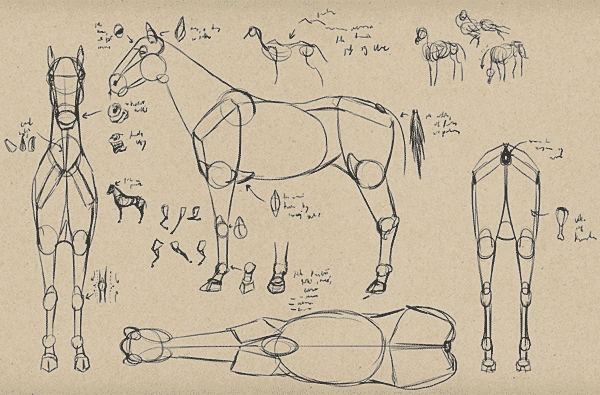
Step 4
Make a kind of a reference sheet, with every side of the body shown as a
structure of simplified forms. Note all the observations and
measurements, every little detail you think is important. What’s
crucial, don’t simply draw a horse using the one you’re looking at as a
reference. Your job is to describe it in detail, including all the
information you need to re-create every perspective you wish, not to
learn a single one you can observe at the moment.
Describe the
look, the movement, the behavior, and sketch a few characteristic poses. If
you ever think, “It’s obvious, I’ll remember it,” note it anyway—it
may be obvious now, but later you may struggle to remember it. This
reference sheet is a letter to your future self, sitting at a desk and
trying to draw a horse without looking at it. Do yourself a favor and answer all the questions your future self may have.

What’s
important, our brain doesn’t like simple answers, like “red”, “long”,
“sharp”. It’s much better when they’re compound, linked to something we
already know. Instead of asking (and answering) “what teeth does the
horse have?” ask “what does the horse eat?”. Try to write your answers
in this form: “they have [feature X], because [function Y].” Our memory
is a web of linked information, and it works best when used this
way!
Step 5
On the next day after sketching the
reference sheet, redraw it, cleaning it up. Make sure everything is
obvious, even for someone who doesn’t have your fresh memory of
observing a horse. Draw a horse using the reference sheet and check if
everything you need is there. If not, find the information somewhere
else and update the sheet.
Get yourself a portfolio or a
briefcase, or whatever you like storing papers in, and put the reference
sheet in there. Congratulations, you’ve just finished the first phase!
Step 6
Give
yourself two or three days of a break, but no more. Try drawing a horse
using the information from the reference sheet, but without
actually opening it. It may be very hard, but you’ll see you already
remember some of it. When you’re done, get the reference sheet and fix
the mistakes, paying special attention to them and noting in your mind why
you made them. Once again check if there is any question left unanswered, and update the reference sheet if necessary.

Step 7
Repeat
the previous step from time to time. Start with short intervals, and then
give yourself longer breaks. Every time you will make fewer mistakes, and
one day you won’t need the reference sheet anymore, because your active
memory of a horse will be fully sculpted! Do the same with every
object/animal you want to master. As your portfolio gets filled, so will
your active memory!
Notice that it would be very hard and
time-consuming to create a
perfect, complete reference sheet—for example, you’d need to learn the
bones, tendons, muscles, and veins of the horse to draw it realistically
from imagination. Fortunately, as long as you don’t go
for hyper-realism (which nobody expects from drawings from imagination),
there’s no need for it. On the contrary, the simplifications you make
while analyzing the
subject will create your own style!
Practice (Or You Lose It)
Now,
your brain hates wasting space and energy for information you don’t
need, and apparently you don’t need something you don’t use. You can be
great at drawing a horse from imagination now, but stop using your
active memory of it for a while, maybe a month, maybe a year, and it’s
gone. Fortunately, if you followed the learning process properly, you should
be able to easily refresh it with the reference sheet. Still, keep in
mind that you can’t learn “how to draw from imagination” once and for
all—constant practice is essential!
Conclusion
There’s a surprising conclusion arising from this article—you always
draw from a reference, be it a reference in the form of a photo or a
memory.
Now you see that the romantic vision of a talented artist drawing
amazing creatures from imagination is untrue—that artist must have had
their share of drawing from a reference before reaching the level you’re
observing them at now.
So it’s not that you can’t draw something from
imagination—you just don’t have a reference for it saved in your mind.
And this is actually good news for you—no matter how talented (or not)
you are, you can learn your way to free, creative drawing. It takes
time, it takes effort, but the prize is worth it!

{excerpt}
Read More